Why Is There Water Around the Base of My Toilet?
If water appears only after flushing, check the wax ring or closet bolts first; if it appears without flushing, inspect condensation, the supply line, tank, or bowl cracks. Leaving the source alone can rot subflooring, stain ceilings below, and send you after the wrong repair. Start with the obvious path, then work outward until you find the leak point.
Locating the leak source based on timing and signs
Water at the base usually means moisture is coming from a specific leak point, then pooling where the toilet meets the floor. A base leak often shows up after flushing or rocking, while steady moisture is more commonly linked to condensation or a slow drip from the tank, supply line, or tank-to-bowl joints.
Begin by asking when the water shows up. Timing tells you the most. If the floor is dry overnight but gets wet after a flush, the wax ring, flange, or overflow splash are common places to check first. If the floor stays damp all day, look higher first.
When a base leak is most likely
A leak at the base is most likely when water appears right after flushing, when the toilet rocks, or when the floor is wet on one side of the bowl. The wax ring seals the toilet horn to the closet flange, and it can fail if the toilet shifts, the flange height is off, or the seal is compressed unevenly.
The closet flange secures the toilet to the floor and should sit level with, or slightly above, the finished floor. If it is cracked, loose, or corroded, the wax ring may not compress evenly. Loose toilet bolts can add movement and let wastewater seep out at the base.
When it is probably not the wax ring
If water forms with no flush at all, the wax ring is less likely. A supply line drip, a tank-to-bowl leak, or condensation can all run down the porcelain and collect around the bottom. A toilet in a humid bathroom can also sweat enough to leave a puddle that looks like a seal failure.
Suppose a toilet is dry in the morning, then the floor is wet after a ten-second flush. That pattern points toward a base seal or overflow issue. Suppose the bowl area is damp before anyone flushes, and the tank feels cold with visible droplets. That pattern points upward, not to the wax ring.
Toilet leak source checklist
| Symptom pattern | Most likely source | First test to perform |
|---|---|---|
| Leaks only after flushing | Wax ring, closet flange, loose toilet bolts, or overflow splash from a blockage | Dry the base, flush once, then watch whether water appears at the rear edge or sides |
| Water appears after tank refills | Tank-to-bowl gasket and bolts, supply line, or shutoff valve | Dry the outside of the tank and connections, then wait for the refill cycle and check for fresh drips |
| Water is present constantly | Condensation, a slow supply-line leak, or a tank crack | Turn off the shutoff valve and see whether the dampness stops over the next hour |
| Toilet rocks when sat on | Loose bolts, damaged flange, or compressed wax ring | Check for movement at the bowl and confirm whether the floor flange or bolt caps shift |
Is it the tank, supply line, or wax ring?
Yes, and those sources behave differently. A tank-to-bowl leak often starts higher and drips down the outside of the toilet. A supply line or shutoff valve leak often runs behind or under the bowl. A wax ring leak usually shows up only after flushing, especially if the toilet moves.
Tank-to-bowl gasket and bolts
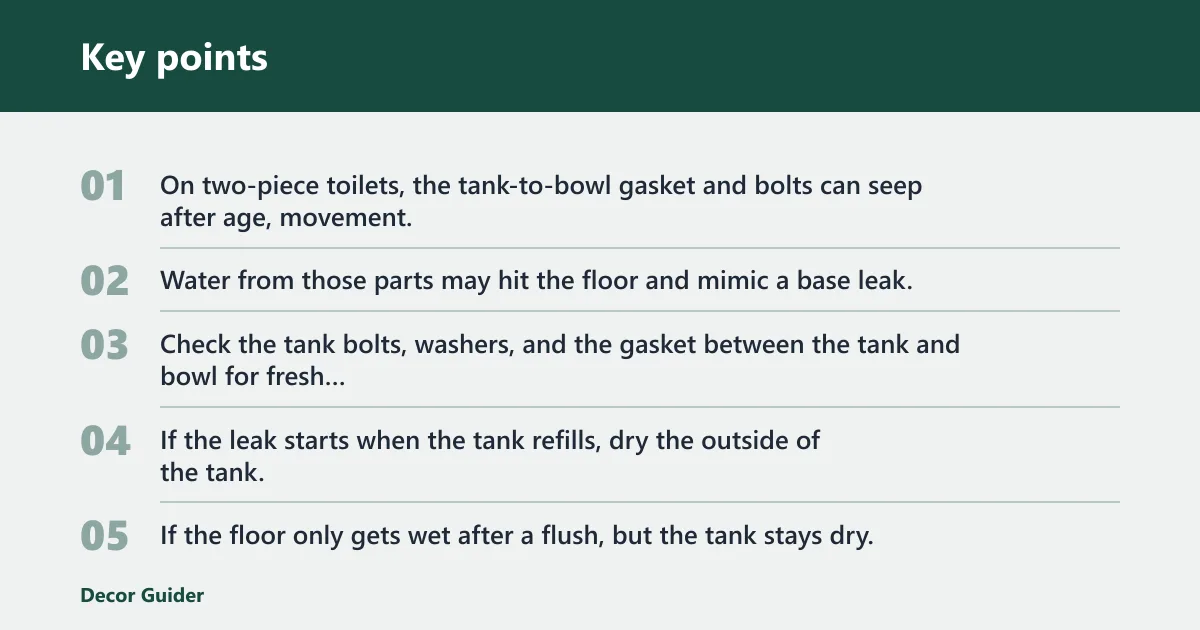
On two-piece toilets, the tank-to-bowl gasket and bolts can seep after age, movement, or repeated tightening. Water from those parts may hit the floor and mimic a base leak. Check the tank bolts, washers, and the gasket between the tank and bowl for fresh moisture after a refill cycle.
If the leak starts when the tank refills, dry the outside of the tank, then watch the lower rear corners and bolt heads. Fresh drops there point upward. If the floor only gets wet after a flush, but the tank stays dry, the issue is more likely at the base.
Supply line and shutoff valve
The supply line and shutoff valve connect water to the tank and can leak in a way that hides behind the bowl. A braided stainless line is common, and a slow drip can follow the porcelain down to the floor without making the tank area look obviously wet. The shutoff valve should stop flow during diagnosis.
Close the shutoff valve and dry the visible fittings. If the floor stays dry after the next refill attempt is prevented, the supply side is the likely source. If water still appears after flushing with the tank isolated, the leak is downstream at the bowl or floor connection.
Wax ring and closet flange
The wax ring is the most common seal at the base, but it fails for specific reasons. It can be crushed unevenly if the toilet shifts. It can also fail when the flange sits too low, when bolts are loose, or when the flange is damaged enough that the seal cannot compress evenly.
Replacing a wax ring generally means removing the toilet. That is not a surface repair. It also means checking the flange height and bolt condition before reinstalling. A new ring will not solve a cracked flange or a toilet that rocks every time someone sits down.
How to tell overflow splash from a true base leak
If water appears right after a flush and the bowl seems slow to drain, a blockage may be pushing water up and out. Use a plunger or toilet auger first so you can rule out overflow splash before you assume the wax ring failed. An auger reaches deeper clogs than a plunger.
A true base leak often leaves moisture at the rear of the toilet or around the bolt caps. Overflow splash tends to be more random and may appear after a noisy, sluggish flush. If the toilet backs up, clear the clog first, then retest the base after several normal flushes.
What should you check first?
Start with the easiest tests that separate floor-level leaks from higher plumbing leaks. Dry the area, stop the water supply if needed, and watch for fresh moisture during one flush cycle and one refill cycle. That order keeps you from replacing the wrong part and shows whether the leak begins above or below the bowl.
Dry the floor and trace fresh moisture
- Dry the floor, base, and nearby sidewall or baseboard.
- Check the rear of the toilet, the supply line, and the tank bolts with a dry tissue.
- Flush once and watch where the first wet spot appears.
- Wipe the area again, then wait for the tank to refill and check for new drips.
That simple sequence separates a refill leak from a flush leak. It also shows whether water is moving under the bowl from a higher point. If the floor gets wet before anyone flushes, look upward and around the tank first.
Check for rocking, loose bolts, or flange movement
Press gently on the toilet from side to side. A toilet should not rock. If it moves, the closet bolts may be loose, the flange may be compromised, or the floor underneath may be uneven. Loose bolts should be snug, not overtightened, because overtightening can crack the bowl or distort the wax seal.
The toilet bolts are usually hidden under caps at the base. If one side feels looser than the other, that uneven pressure can let waste seep past the seal. Tighten only enough to stop movement, then retest. If movement remains, the floor mount likely needs repair rather than more force.
Use a plunger or auger if flushing starts the leak
If the leak appears only when the toilet flushes slowly or gurgles, treat the drain path as suspect before the seal. A plunger may clear a near-clog. A toilet auger is better for deeper blockages. If the bowl clears and the base stays dry afterward, the leak was likely splash or overflow related.
A common first-timer mistake is replacing a wax ring before clearing a clog. That can leave the real problem in place and create a second leak risk during reinstall. Clear the drain first, then retest with several normal flushes.
Do you need to remove the toilet?
If the leak points to the wax ring, yes, the toilet usually has to come off. That is also the point to inspect the closet flange, floor condition, and bolt hardware. If the leak is coming from the tank, supply line, or shutoff valve, removing the toilet is usually the wrong first move.
When a wax ring replacement is the next step
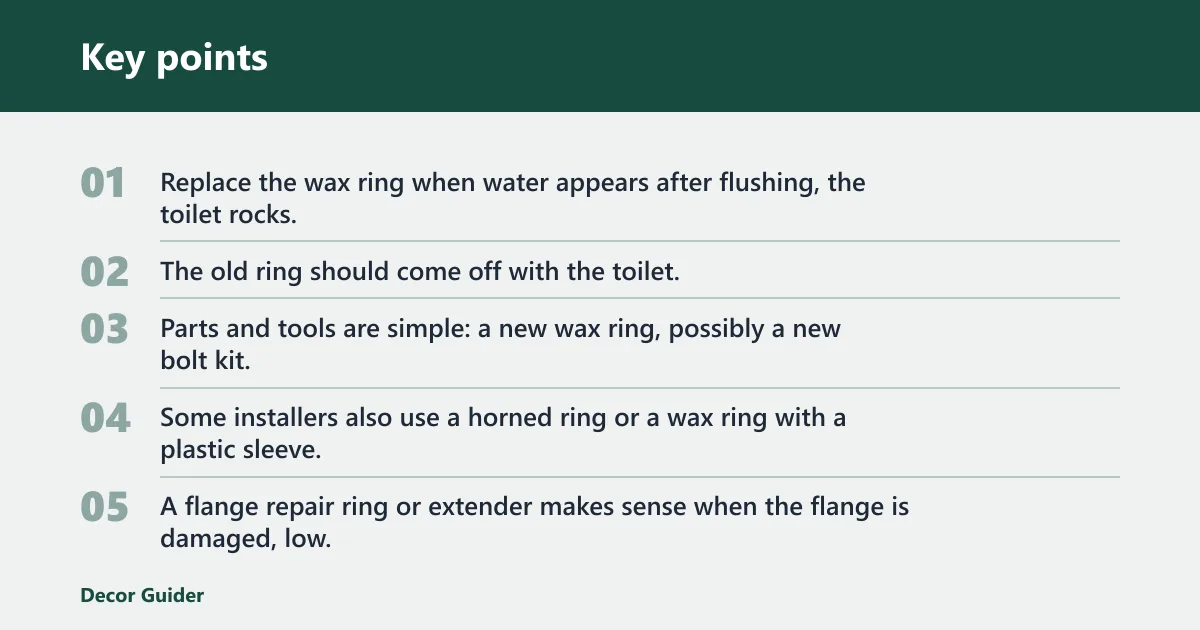
Replace the wax ring when water appears after flushing, the toilet rocks, or the flange sits low enough that the seal cannot compress properly. The old ring should come off with the toilet, and the flange should be checked for cracks, corrosion, or loose mounting before a new ring goes on.
Parts and tools are simple: a new wax ring, possibly a new bolt kit, a putty knife or scraper, a wrench, towels, a bucket, and a utility knife for old caulk. Some installers also use a horned ring or a wax ring with a plastic sleeve, depending on the toilet and flange setup.
When a flange repair ring or extender makes sense
A flange repair ring or extender makes sense when the flange is damaged, low, or no longer gives the wax ring proper support. The flange should sit level with, or slightly above, the finished floor. If it is below floor level, a standard wax ring may compress poorly and leak again.
If the flange is cracked but still in place, a repair ring may help restore bolt hold and seal support. If the flange is loose, corroded, or badly broken, replacement is often better. The right fix depends on whether the mounting surface is stable enough to hold the toilet square.
Why overtightening bolts can make the problem worse
Overtightening the toilet bolts can crack the china, distort the base, or squeeze the wax ring unevenly. Snug is the goal. The bowl should sit still without flexing, and both sides should share load evenly. If one side tightens much faster than the other, stop and reassess the flange and floor.
Caulk is not a cure for a bad seal. A caulk bead around the toilet base is often added after repair, but some installs leave a small gap at the back so future leaks are easier to spot. Use bathroom-grade, mildew-resistant caulk, and do not seal over an active leak.
When is it a red flag?
Stop and inspect further if the bowl is cracked, the flange is damaged, or the leak returns after a wax-ring replacement. Those are signs that the source is structural or that the first repair did not address the real problem. Soft flooring and stained subflooring also point to a leak that has been happening for a while.
Cracked bowl or visible porcelain damage
A cracked bowl can leak intermittently and may not show a clean pattern. Water can escape only when the toilet is in use or when pressure changes during flushing. If porcelain is cracked near the base, the toilet may need replacement rather than seal work.
Damaged, loose, or corroded flange
A damaged, loose, or corroded flange prevents proper wax-ring compression. If the flange moves when the toilet rocks, or if bolts will not hold firmly, the seal will keep failing. This is the point where a repair ring, flange extender, or full flange replacement becomes more than optional.
Recurring leaks after wax-ring replacement
If the same leak returns after a wax-ring replacement, stop assuming the ring is the problem. Recheck the flange height, bolt tightness, and toilet stability. A recurring leak often means the floor is uneven, the flange is still too low, or the toilet is not seating flat.
Soft flooring or stained subfloor
Tile, vinyl, or laminate can trap water, and the damage may spread under baseboards before you notice it. Soft flooring near the toilet, discoloration, or a spongy feel underfoot suggests longer-term leakage. At that point, the subfloor may need inspection because the water may have traveled farther than the visible puddle.
Frequently asked questions
Why is there water around the base of my toilet?
Water around the base most often comes from a wax-ring leak, a loose toilet, a supply-line drip, a tank-to-bowl leak, or condensation. The timing matters most. If it happens only after flushing, start at the floor seal and flange. If it happens without flushing, check the tank, fittings, and humidity.
Why is there water at the base of my toilet?
If water is at the base, the source may be moving down from above or rising from the floor seal. A wet floor after a flush points to the wax ring, flange, or rocking bowl. Constant dampness points more toward a slow drip, sweating tank, or shutoff connection.
Why is there water leaking around the bottom of my toilet?
Water leaking around the bottom can come from a failed wax ring, but it is not the only cause. A loose supply line, a tank-to-bowl gasket leak, or condensation can run along the porcelain and pool at the floor. Check the highest visible wet point first, then work downward.
Why is there water coming from the base of my toilet?
Water that seems to come from the base often begins somewhere else and follows the toilet exterior down to the floor. If it appears after flushing, the floor seal and flange are top suspects. If it appears after the tank refills, look at the tank bolts, gasket, supply line, and shutoff valve.
Why is there no water at the bottom of my toilet?
No water at the bottom does not mean there is no problem. A leak may be tiny, intermittent, or hidden under flooring. If the toilet rocks, the floor feels soft, or you see staining at the baseboard, the leak may be present even when the visible puddle is gone.
Why would there be water around the base of my toilet?
Water around the base usually means the toilet seal is failing, a connection above the bowl is dripping, or condensation is collecting on the tank and running down. The key question is when it appears. That timing tells you whether to inspect the floor seal, the tank, or the supply side first.
Products related to this article
Sponsored / affiliate links. As an Amazon Associate I earn from qualifying purchases. I may earn additional commission from eligible campaigns.