How Tall Should a Canopy Bed Be?
A canopy bed usually works best when the frame top still leaves breathing room under the ceiling and around any light fixture above it. A practical rule is: recommended frame height = ceiling height − fixture drop − desired top clearance of 4–6 inches − any extra drape or finial allowance. That keeps the bed from feeling cramped and helps the curtains hang cleanly.
This guide is part of our Bed and Bathroom Fixes: Bed Frames, Mattresses, Toilets, Tubs and Vanities series.
Canopy bed height basics

Canopy bed height is mostly a clearance problem, not a style problem. The right frame height depends on the room’s ceiling, any fan or pendant above the bed, and how much fabric you want to hang. For many rooms, a lower-profile canopy or posts-only look is easier to fit than a fully dressed frame.
What height range do canopy beds usually fall into?
Canopy beds are commonly sold in the broad range of about 76 to 96 inches tall, with many queen models landing around 80 to 88 inches. That range helps explain why two beds with the same mattress size can feel very different in a room: the frame design and top structure matter as much as the footprint.
How does bed size affect canopy height?
Bed width changes how tall the frame reads visually. A queen canopy often feels easier to place than a king because it occupies less wall space and leaves more margin at the sides. King and California king frames tend to look more substantial, so the same height can feel more dominant in the room.
Common heights by bed size
- Twin: often at the lower end of the standard canopy range, especially in lighter metal frames.
- Full: usually fits well in the middle of the range, with a smaller footprint than queen or king.
- Queen: commonly listed at 80 to 88 inches tall.
- King: often needs the most room because width and post mass make the bed read taller and larger.
- California king: similar height logic to king, but the longer mattress shape can change how the frame sits in the room.
What styles feel taller or shorter?
A full canopy with an overhead bridge usually needs the most vertical room. A posts-only bed, half canopy, or minimalist metal frame can feel lighter because it removes some of the overhead bulk. If you want a lower-profile look, the minimalist metal canopy approach often works better visually than a heavy, fully draped frame.
How much ceiling clearance do you need?
Plan on leaving 4–6 inches above the highest point of the canopy so the bed does not crowd the ceiling line or rub against it. After that, subtract any light fixture drop and any extra room you want for finials or drape. If the room has a fan or pendant, those components reduce the usable height quickly.
What is the recommended clearance above the canopy?
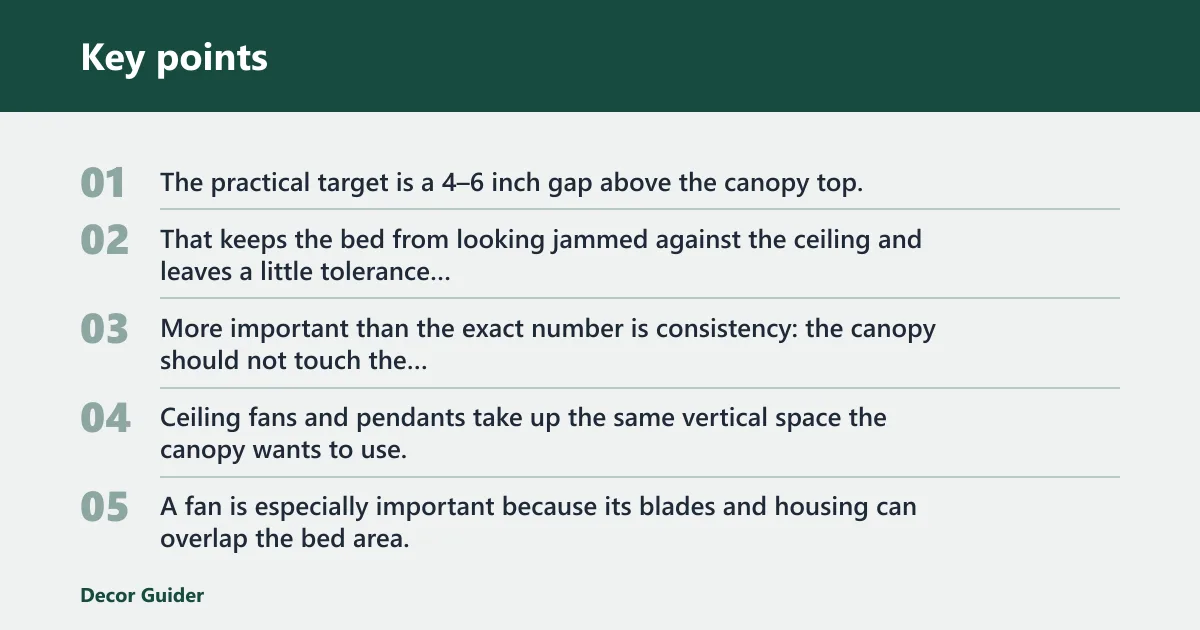
The practical target is a 4–6 inch gap above the canopy top. That keeps the bed from looking jammed against the ceiling and leaves a little tolerance for installation. More important than the exact number is consistency: the canopy should not touch the ceiling, and it should not compete with nearby fixtures.
What changes when there is a ceiling fan or pendant?
Ceiling fans and pendants take up the same vertical space the canopy wants to use. A fan is especially important because its blades and housing can overlap the bed area, while a pendant can interfere with the centerline of the frame. In those rooms, the fixture drop must be measured before you choose the bed height.
What ceiling height is easiest for a canopy bed?
Higher ceilings make the fit easier because they leave more room for clearance, drape, and lighting. Eight-foot ceilings can still work, but they usually favor slimmer frames and restrained fabric. Taller ceilings give you more freedom for a full canopy look without making the bed feel compressed.
What an 8-foot ceiling can handle
An 8-foot ceiling equals 96 inches, so the usable height shrinks once you subtract fixture drop, top clearance, and any drape allowance. For that reason, 8-foot ceilings tend to suit lower canopy profiles best. If you want a softer look, keep the frame lighter and the fabric less generous.
How tall should a canopy bed be for your room?
The right height depends on both ceiling clearance and how the bed sits in the room. A canopy can fit numerically and still feel oversized if the room is narrow or the frame is bulky. In general, queen and king canopy beds need enough floor space around them to avoid crowding circulation and furniture placement.
What room size works for queen and king canopy beds?
Room size guidance is only a starting point, but it matters. A queen canopy is often easiest in a room with comfortable clearance on all sides, while a king needs more open wall space and wider walking paths. If the room is compact, a lower-profile canopy style usually reads better than a tall, fully dressed frame.
How much space should be left around the bed?
- Leave about 24 to 30 inches for walking space on the sides whenever possible.
- Keep about 30 inches or more at the foot of the bed if the room allows daily movement there.
- Account for nightstands, lamps, and doors that swing nearby.
- If the room is narrow, choose a slimmer frame and lighter drape.
Do canopy beds make a room look smaller?
They can, especially when the frame is tall, dark, or heavily draped. Open lines, slimmer posts, and lighter fabric reduce that effect. If you want the room to stay visually open, a restrained canopy or posts-only setup usually works better than a dense curtain treatment.
Canopy bed fit checker
Use this quick check to compare ceiling height, fixture drop, and frame style before you buy. The point is to decide whether you can fit a full canopy, should scale back to frame-only styling, or should switch to posts-only. When in doubt, measure the bed zone at the lowest obstruction, not just the center of the room.
| Ceiling height | Fixture type / drop | Suggested frame approach | Full canopy | Frame-only | Posts-only |
|---|---|---|---|---|---|
| 8 ft / 96 inches | Flush mount or very shallow fixture | Lower-profile frame, slim posts | Possible with tight clearance and light drape | Usually the safest middle ground | Best if the room feels visually tight |
| 8 ft / 96 inches | Fan or pendant with notable drop | Shorter frame, minimal top detail | Often impractical if the fixture overlaps the bed zone | Better than a full canopy in many rooms | Often the most realistic option |
| 8.5 ft / 102 inches | Flush mount or shallow drop | Standard-height canopy with restrained drape | Often workable | Very workable | Still an option if you want a lighter look |
| 8.5 ft / 102 inches | Fan or pendant with moderate drop | Measure fixture first, then choose frame height | Possible only if the fixture stays clear of the canopy zone | Usually safer | Good fallback if the fixture hangs low |
| 9 ft / 108 inches | Flush mount or shallow drop | Standard to taller canopy profile | Often the easiest fit for a full look | Easy fit | Also workable, especially for minimalist styling |
| 9 ft / 108 inches | Fan or pendant with moderate drop | Choose a frame after subtracting fixture clearance | Often possible if the fixture is high enough | Usually very workable | Best if you want to avoid visual crowding |
| Sloped ceiling | Any fixture | Keep the canopy well below the low point | Usually difficult unless the high side is generous | May work on the taller side of the room | Usually the safest choice |
For a sloped ceiling, the low point matters more than the average ceiling height. If the bed sits under the slope, the canopy should stay comfortably below the lowest obstruction and away from any fan path. In a flat room with a flush mount, you usually have more freedom than in a room with a hanging fixture.
What changes the height you should choose?
Frame style changes the fit as much as the ceiling does. Full canopies need the most overhead room, while half canopies, minimalist frames, and posts-only designs reduce the visual load. If you are balancing a tall ceiling against a busy room, a simpler canopy structure is usually easier to live with.
Which canopy styles need the most clearance?
Full canopies need the most clearance because they add a top structure over the bed. Fabric, finials, and decorative crossbars can all increase the visual height. Posts-only styling needs the least overhead room, which is why it often works best in lower-ceiling or fixture-heavy rooms.
What stability details should you check?
- Bolted corner joints: better for resisting side-to-side movement.
- Diagonal bracing: helps limit sway in taller frames.
- Dry-fitted joints: need close fit and good hardware to stay rigid.
- Post thickness: thicker posts usually feel steadier at wider bed sizes.
How does a lower-profile style help?
A lower-profile canopy can solve both visual and clearance problems at once. It leaves more air above the bed, reduces the chance of clashing with a fan or pendant, and can make the room feel less crowded. If you want a simpler look, a minimalist metal canopy is often easier to scale to the room.
How long should canopy bed curtains be?
Curtain length should be set from the finished frame height, not guessed from the mattress alone. The goal is to let the fabric hang cleanly without bunching, dragging awkwardly, or blocking the walking path. Lighter fabric can often be cut shorter; heavier fabric usually needs more length and more support to fall neatly.
What is the right way to measure curtain length?
Measure from the point where the curtain will hang on the canopy down to the point where you want the fabric to stop. Then add enough allowance for the style you want: a neat float, a light break, or a floor touch. That sequence is more reliable than shopping by bed size alone.
How much should fabric weight change the decision?
Heavier fabric usually needs more drop and a sturdier support point because it hangs with more visual mass. Sheer panels can work well in tighter rooms because they read lighter and less crowded. Opaque or lined panels create a fuller look, but they make clearance limitations much more obvious.
What happens if the curtains are too long?
If the curtains are too long, they can collect on the floor, shorten the perceived height of the bed, and make the room feel busier. That may be intentional in a dramatic design, but in a compact room it often works against the canopy’s proportions. A cleaner length usually looks more refined.
How to measure before you buy
Measure the room in the same order you would build the canopy fit: ceiling height, fixture drop, frame height, then fabric length. That keeps you from buying a frame that looks right in a product photo but fails once the mattress height, fan, or pendant is included. It also makes it easier to compare listings fairly.
- Measure the ceiling height at the lowest point in the room.
- Measure the drop of any fan, pendant, or low-mounted fixture over the bed zone.
- Subtract 4–6 inches of clearance above the canopy top.
- Check whether the remaining height matches the listed frame height.
- Confirm that the bed size leaves enough side and foot clearance.
- Plan the curtain length after the frame height is set.
A smart follow-up is to compare the chosen frame height with the finished bed height, especially if you are using a thicker mattress. If you need a refresher on how mattress thickness changes the final look, see mattress height before ordering curtains or committing to a taller frame.
Frequently asked questions
How tall should a canopy bed be?
A canopy bed should be tall enough to clear the ceiling by 4–6 inches after you account for any fixture drop and any extra top detail. Many models fall around 76 to 96 inches tall, but the right height depends on the room, the light above the bed, and whether you want curtains or a simpler frame.
How tall should your ceilings be for a canopy bed?
Ceilings around 8 feet can work for simpler canopy setups, especially with flush lighting and minimal drape. Taller ceilings make a full canopy easier to fit and give you more room for curtain depth. The key is to subtract fixture drop first, then choose the frame height.
What is the ideal canopy bed height for an 8-foot ceiling?
For an 8-foot ceiling, lower-profile frames are usually the safest choice. A queen or king frame near the lower end of the canopy range is more likely to fit comfortably, especially if the room has a flush mount rather than a fan or pendant over the bed.
How much clearance should be above a canopy bed?
Leave 4–6 inches above the highest point of the canopy. That keeps the frame from crowding the ceiling and helps the proportions look intentional. If a fan or pendant is present, include that in the clearance calculation and reduce the usable height accordingly.
How do you measure canopy bed height correctly?
Measure from the floor to the highest point of the frame, then compare that number with the ceiling height after subtracting fixture clearance. If you want the bed to feel more finished, include mattress thickness and curtain drop as part of the final check so the whole composition works together.
Products related to this article
Sponsored / affiliate links. As an Amazon Associate I earn from qualifying purchases. I may earn additional commission from eligible campaigns.