How Tall Should a Headboard Be?
A headboard should usually rise about 24 to 36 inches above the top of the mattress, or roughly 48 to 64 inches from the floor for many beds, with taller builds needing a bit more if the frame sits low. Headboards that sit too low can vanish behind pillows, while oversized ones can crowd the room and clash with ceiling height. This guide shows how to measure for queen, king, and California king beds, plus how mattress thickness, frame height, and mounting type change the final number.
Headboard height basics
Headboard height has two different measurements. The first is the overall height from the floor to the top of the headboard. The second is the visible height above the mattress, which is the number that controls what you actually see once the bed is made.
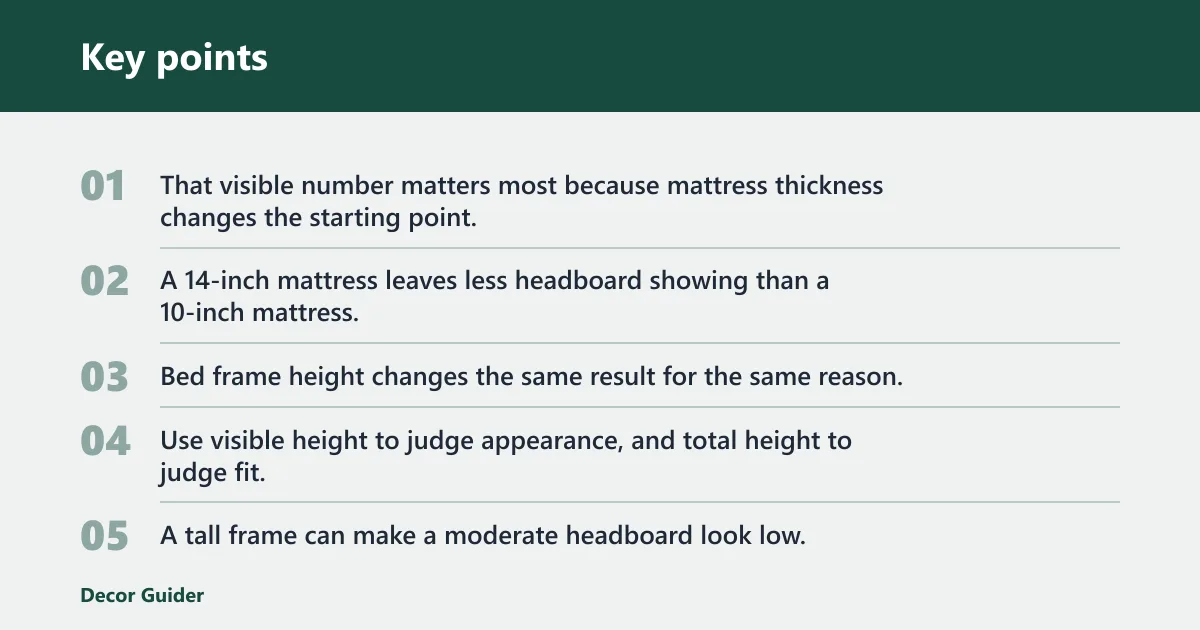
That visible number matters most because mattress thickness changes the starting point. A 14-inch mattress leaves less headboard showing than a 10-inch mattress, even when the headboard itself is identical. Bed frame height changes the same result for the same reason.
Visible height vs total height
Use visible height to judge appearance, and total height to judge fit. A tall frame can make a moderate headboard look low. A low platform bed can make the same headboard read much taller because more of it sits above the mattress line.
Why mattress thickness changes the result
Measure from the top of the mattress, not from the bed frame. The top of the mattress is the point that determines whether a headboard looks balanced or buried behind pillows. Thicker mattresses reduce visible headboard height by the exact amount they rise above a thinner one.
What bed frame height changes
Platform beds usually sit lower, so they leave more headboard visible. Box spring setups usually sit higher, so they hide more of the headboard behind the mattress and foundation. That difference is why the same headboard can look mid-rise on one bed and short on another.
How tall should a headboard be?

A practical target is 24 to 36 inches of visible height above the mattress. That range works for many bedrooms because it gives enough presence without crowding the wall. Choose the lower end for tall mattresses and small rooms, and the higher end when the bed sits low or the wall has generous height.
A quick measurement formula
Start with your mattress thickness, then add the bed frame or foundation height to get the mattress top height from the floor. Add 24 to 36 inches for the visible headboard target. If the room has a low ceiling or a short wall section, stay near the lower end of that range.
- Measure from the floor to the top of the mattress.
- Decide how much headboard you want visible above the mattress.
- Add that visible target to the mattress-top measurement.
- Check whether the total height leaves enough wall space above the bed.
- Confirm the mounting type can support that height.
Low platform beds
Low platform beds usually need a taller total headboard to reach the same visible height. Because the mattress sits closer to the floor, a 56-inch headboard may read much taller than it would on a box spring setup. This is helpful in rooms with standard ceilings, as long as the wall space is still available.
Box spring setups
Box spring setups start higher, so the visible headboard height shrinks unless the headboard itself is taller. If the mattress top is already high off the floor, a mid-rise profile may look too low. In those cases, a taller headboard often gives a better visual balance.
How tall should a queen headboard be?
A queen headboard should usually follow the same about 24 to 36 inch visible-height target, but the width of a queen bed can change how that height reads. On a queen, a mid-rise profile often looks balanced in an average bedroom, while a taller profile works better when the mattress is thick or the wall is expansive.
Queen bed width and proportion
A queen bed is wide enough to carry a substantial headboard, but not so wide that height can be ignored. If the headboard is too short, it can look lost against the mattress and pillows. If it is too tall, it can overpower the bed and leave little open wall above it.
When a mid-rise profile works
Choose a mid-rise queen headboard when the mattress top already sits fairly high, the room has average ceiling height, or you want a cleaner wall line. A mid-rise profile often lands near the lower half of the 24 to 36 inch visible range.
When to choose a taller profile
Choose a taller queen headboard when the mattress is thick, the bed sits low, or the wall feels visually empty. Say your queen bed uses a thick mattress on a platform frame. A headboard that only shows a few inches above the pillows can look undersized, so a taller model gives the bed more presence.
How tall should a king headboard be?
A king headboard usually benefits from more height than a queen because the wider bed needs stronger visual balance. The same visible range still applies, but a king often looks best when the headboard rises toward the upper end of that range, especially in rooms with taller walls or a large wall span behind the bed.
King width and visual balance
King beds need enough height to match their width. A short headboard can look compressed across a king frame, especially if the mattress is thick. Wider beds often read better with a more substantial profile, since the eye expects more vertical presence to match the horizontal scale.
California king differences
A California king is narrower and longer than a standard king, so height choice depends more on wall height and mattress thickness than on width alone. Because the bed does not span as much width, a very tall headboard can feel more dominant than it does on a standard king.
When width needs more height
When a king bed sits in a large room with a wide blank wall, the headboard often needs extra height to avoid looking flat. Picture a king bed with a 14-inch mattress and a low platform frame. If the headboard only rises 18 inches above the mattress, it can look too short for the wall.
How high should a headboard be above the mattress?
The top of the mattress is the key reference point. A good headboard usually sits 24 to 36 inches above that line, which keeps it visible behind pillows and gives enough structure to the bed. If the visible height is much lower, the headboard can seem like an afterthought.
Reading the top-of-mattress measurement
Measure from the floor to the mattress top, then subtract that from the full headboard height. That difference is the visible headboard height. This is the most useful number because two headboards with the same total height can look very different once mattress thickness changes.
Ceiling height and wall space
Ceiling height limits how tall the headboard can look without crowding the room. Higher ceilings can handle a taller profile, while lower ceilings usually work better with a moderate profile. Also check the wall space above the bed; a headboard that nearly reaches the crown molding can feel too tall even if the bed itself fits.
Signs the headboard is too low or too tall
If the headboard disappears behind pillows, looks clipped by the mattress, or leaves a large empty space above the bed but little visible furniture, it is probably too low. If it reaches uncomfortably close to the ceiling or makes the bed feel compressed, it is probably too tall.
Headboard height decision table
Use this table as a text-only guide before you buy. The range is the visible headboard height above the mattress, not the total floor-to-top measurement.
| Mattress thickness | Bed frame type | Ceiling height | Recommended visible headboard range | Too-low or too-tall warning |
|---|---|---|---|---|
| 8 to 10 inches | Platform bed | 8 feet | 28 to 36 inches | Too low if under 24 inches; too tall if above 40 inches visible |
| 8 to 10 inches | Box spring setup | 8 feet | 24 to 32 inches | Too low if under 20 inches; too tall if above 36 inches visible |
| 11 to 13 inches | Platform bed | 9 feet | 24 to 34 inches | Too low if under 22 inches; too tall if above 38 inches visible |
| 11 to 13 inches | Box spring setup | 8 feet | 24 to 30 inches | Too low if under 20 inches; too tall if above 34 inches visible |
| 14 to 16 inches | Platform bed | 8 feet | 24 to 32 inches | Too low if under 22 inches; too tall if above 36 inches visible |
| 14 to 16 inches | Box spring setup | 8 feet | 20 to 28 inches | Too low if under 18 inches; too tall if above 32 inches visible |
| 14 to 16 inches | Platform bed | 9 feet | 28 to 36 inches | Too low if under 24 inches; too tall if above 40 inches visible |
Mounting type and material choices
Mounting type changes how precisely you can place the headboard, and material changes how it feels and how it reads in the room. Bed-frame-mounted and wall-mounted are the main installation types. Upholstered, wood, and faux leather are the main material options.
Bed-frame-mounted vs wall-mounted
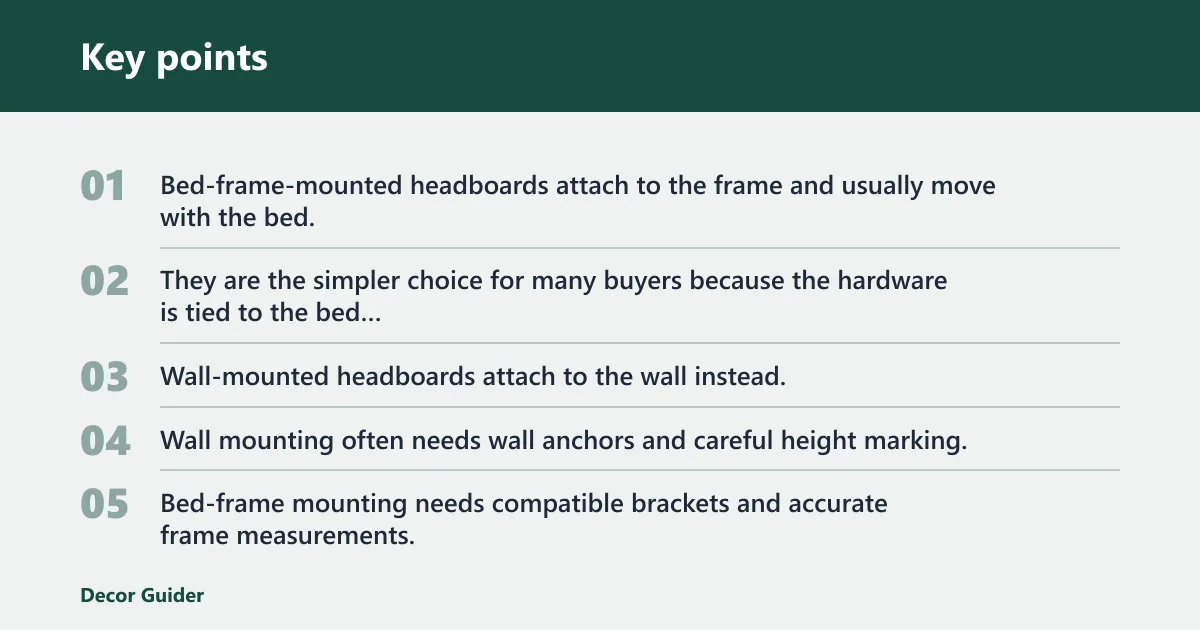
Bed-frame-mounted headboards attach to the frame and usually move with the bed. They are the simpler choice for many buyers because the hardware is tied to the bed itself. Wall-mounted headboards attach to the wall instead, which can make it easier to place a tall headboard exactly where you want it.
Wall mounting often needs wall anchors and careful height marking. Bed-frame mounting needs compatible brackets and accurate frame measurements. Renters may prefer frame-mounted or removable wall setups, while homeowners may have more freedom to use anchors and permanent placement.
Installation hardware and adjustability
Check whether the package includes frame brackets, wall anchors, or both. If you may change mattress thickness later, choose an adjustable-height headboard with a stated minimum and maximum range. That helps prevent the headboard from looking too short after a mattress upgrade.
Two examples show how that flexibility can matter. LUCID headboard height adjusts from 34 to 46 inches, and it supports both bed-frame and wall mounting. Amazon Basics headboard uses faux-linen upholstery, includes tufted squares, and adjusts from 45.5 to 53 inches high.
Upholstered, wood, and faux leather
Upholstered headboards usually feel softer against the back and are common for reading in bed. Wood headboards often read more visually solid and are easy to wipe down. Faux leather sits between the two for cleaning and comfort, though it can show texture and seams more clearly.
For buyers who want a finished look with soft contact, an upholstered model is often the easiest fit. For a cleaner surface and firmer visual lines, wood is simpler. For easy maintenance with a smooth face, faux leather can work well.
What to check before buying a headboard
Before buying, compare the mattress thickness, frame height, wall space, and mounting hardware. A headboard that looks correct in a product photo can read very differently once it sits behind a thick mattress or on a low platform base. Measure first, then match the headboard to those numbers.
- Measure the mattress top height from the floor.
- Check whether your bed uses a platform, slats, or a box spring.
- Measure the wall space from the mattress top to the ceiling.
- Confirm the headboard’s adjustable range if it has one.
- Verify width compatibility for queen, king, or California king.
- Check the mounting hardware before ordering.
Headboard width matters too. For a queen, king, or California king bed, the headboard should match the bed width closely enough that the frame does not look exposed at the sides. A king headboard often needs the most visual weight, while a California king can tolerate a slightly lighter look because it is narrower.
How to choose the right headboard height
Use three checks: visible height above the mattress, frame type, and room proportions. If the mattress is thick, start with a taller visible range. If the bed is a low platform, allow more total headboard height. If the room has a lower ceiling, avoid a headboard that crowds the wall or reaches too close to the top of the room.
A common first-timer mistake is buying a headboard that looks correct online but sits too low once a 14-inch mattress is added. Another is picking a tall model for a room with an 8-foot ceiling and very little wall space above the bed. Both errors are avoidable with a tape measure and the table above.
Frequently asked questions
How tall should a headboard be above the mattress?
A headboard should usually stand 24 to 36 inches above the top of the mattress. That visible range keeps it readable behind pillows and gives the bed enough structure without overpowering the wall. Use the lower end for thick mattresses or low ceilings, and the higher end for low beds and larger rooms.
How high should my headboard be above the bed?
Above the bed, not the floor, the visible headboard should usually measure 24 to 36 inches. That is the simplest way to judge fit. Measure from the top of the mattress, then make sure the headboard clears pillows and still leaves enough wall space above it.
Products related to this article
Sponsored / affiliate links. As an Amazon Associate I earn from qualifying purchases. I may earn additional commission from eligible campaigns.