How to Tighten a Loose Toilet Seat with Hidden Bolts
To tighten a loose toilet seat with hidden bolts, remove the hinge caps, identify whether the hardware uses a concealed nut, a top-fix expansion anchor, or a quick-release latch, then tighten in small increments. Replace the seat hardware if the fastener spins, cracks, or still wobbles. Forcing the wrong part can chip the bowl, damage the hinge, and make the looseness return.
What you’ll need

- Flathead screwdriver for gently popping hinge caps and, on some seats, turning bolt heads
- Adjustable wrench for holding or turning nuts when the hardware allows access
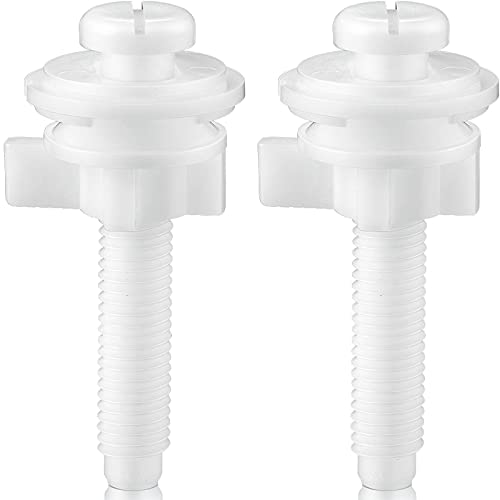
- Replacement bolt kit or toilet seat replacement kit for stripped, corroded, or frozen hardware
- Plastic washer or bushing to reduce movement at the bolt interface
- Penetrating oil for corroded or seized fasteners
- Paper towel or rag for cleaning grit before reassembly
How do you access the hidden bolts?
Start at the hinge caps, not under the bowl. Many concealed toilet seat bolts sit inside plastic housings or caps and are reached from the top, but not every hidden-bolt seat allows wrench access underneath. Quick-release models may use a latch or button instead of a standard bolt, so confirm the mechanism before turning anything. Bob Vila’s toilet seat repair guidance and iFixit’s loose-seat guide both emphasize checking the hinge design first.
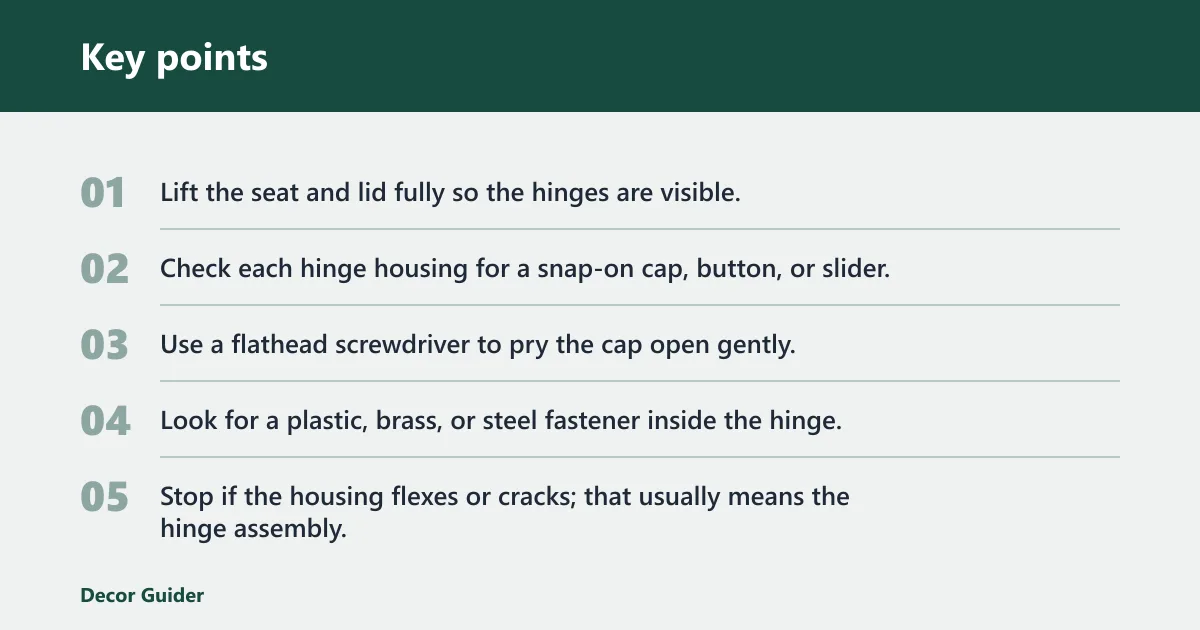
- Lift the seat and lid fully so the hinges are visible.
- Check each hinge housing for a snap-on cap, button, or slider.
- Use a flathead screwdriver to pry the cap open gently, or pop it open by hand if it releases easily.
- Look for a plastic, brass, or steel fastener inside the hinge.
- Stop if the housing flexes or cracks; that usually means the hinge assembly, not just the bolt, is worn.
How do you tell a quick-release hinge from a hidden-bolt hinge?
A quick-release seat usually has a visible release button, slider, or lift-off point at the hinge base, while a hidden-bolt seat keeps the fastener under a cap. If the seat separates without turning a nut or screw, treat it as a release mechanism, not a standard concealed bolt assembly.
What is the difference between a top-fix anchor and a concealed nut design?
A top-fix expansion anchor tightens from above by expanding a sleeve into the bowl hole, while a concealed nut design depends on an underside nut or insert that may not be reachable on all toilets. If the bowl opening blocks wrench access, the seat may be top-fix only and should be adjusted from the hinge side.
How do you tighten a loose toilet seat without access underneath?
Tighten from the top in about 1/4-turn steps and test the seat after each turn. That works for many hidden-fix seats because the fastener threads into a concealed insert or expansion anchor inside the hinge. If the seat still rocks after one or two adjustments, the issue is usually a loose fit, worn threads, or a damaged hinge housing.
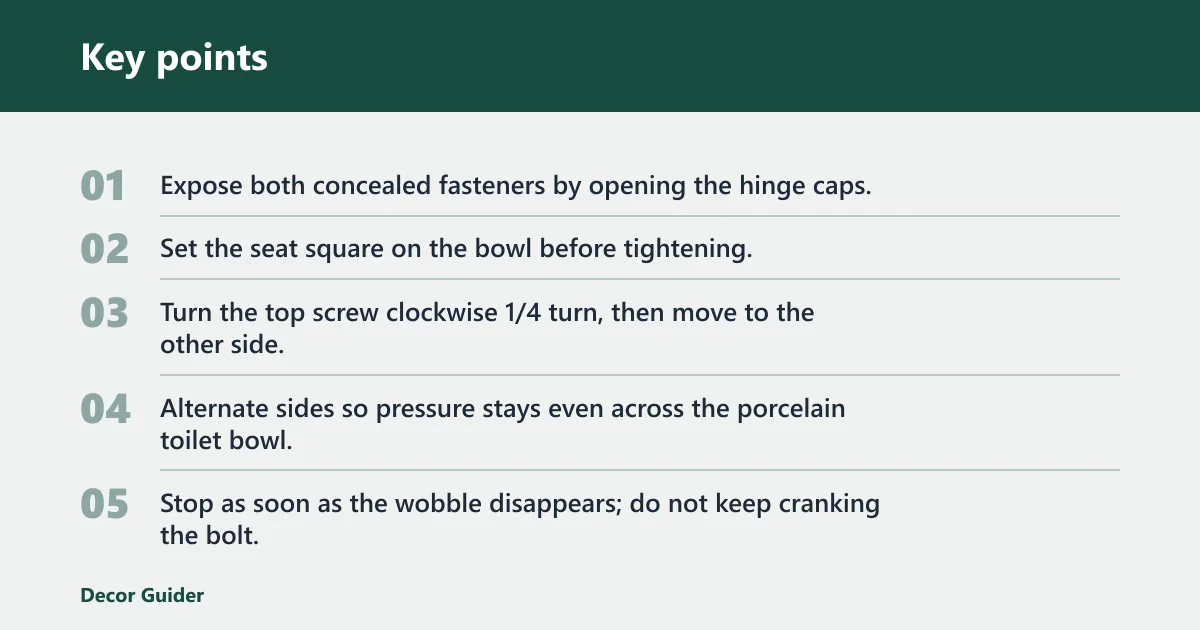
- Expose both concealed fasteners by opening the hinge caps.
- Set the seat square on the bowl before tightening.
- Turn the top screw clockwise 1/4 turn, then move to the other side.
- Alternate sides so pressure stays even across the porcelain toilet bowl.
- Stop as soon as the wobble disappears; do not keep cranking the bolt.
What should you do if one side tightens and the other does not?
Stop and inspect that hinge before going farther. A mismatch usually means one side has a worn insert, a cracked cap, or a fastener that has lost grip. Tightening only the good side can distort the seat and make the loosened hinge fail faster.
Why should you tighten in small increments?
Small turns protect both the seat hardware and the bowl mounting points. Incremental tightening lets you stop as soon as the wobble is gone, which lowers the chance of overtightening, uneven pressure, or a cracked porcelain toilet bowl.
What if the fastener spins?
That usually means the insert is stripped, the anchor is no longer expanding correctly, or the threads are worn out. If the screw turns without drawing the seat down, do not force it harder. A washer or bushing can help only when the hardware still has enough grip to hold.
- Back the screw out enough to inspect the threads and insert.
- Add a plastic washer or bushing if the fit is loose but intact.
- Retighten by hand first, then use the correct tool only until the wobble stops.
- Replace the fastener if it keeps spinning or the insert has stripped free.
How do you tell a stripped insert from a loose fit?
A loose fit still gives some resistance and may tighten briefly before shifting again, while a stripped insert turns freely with no downward pull. If the fastener never catches, replacing the bolt or anchor is more effective than repeated tightening.
What if the fastener is corroded?
Corrosion can freeze concealed hardware so tightly that normal tightening fails. Use penetrating oil sparingly and keep it off plastic hinge parts when possible, because some plastics can swell or weaken. If the bolt will not move cleanly after treatment, stop before you twist the insert or crack the hinge cap.
- Apply penetrating oil at the fastener head and let it sit briefly.
- Use the flathead screwdriver or adjustable wrench that fits the hardware exactly.
- Turn slowly instead of forcing the bolt through resistance.
- Replace the bolt kit if the hardware remains seized or the head strips.
When is corrosion beyond a simple adjustment?
If the head rounds off, the fastener binds after oiling, or the hinge cap starts deforming, the corrosion is past the point of safe adjustment. At that stage, replacement is usually less risky than applying more force to a seized concealed assembly.
How do you fix loose toilet seat bolts that keep spinning?
Spinning usually means the concealed nut, insert, or threads are no longer gripping. A washer or bushing can help when the hardware is only slightly loose, but repeated spinning points to a worn fastener set. At that stage, replacement is the better fix than more tightening.
- Remove the cap and inspect the hinge housing for cracks.
- Try holding the nut or insert with an adjustable wrench if the design allows it.
- Add a plastic bushing or washer to take up slack if the hole is oversized.
- Swap in a replacement bolt kit if the screw still spins freely.
Say the left hinge rocks every time the seat drops and the screw turns without pulling down. That is a stripped-interface problem, not a toilet-base problem. The base stays solid, but the concealed seat hardware has lost its grip.
Suppose the right hinge quiets down after one 1/4 turn and the left side keeps moving. Stop tightening the left fastener. That mismatch usually means one side is worn, seized, or cracked inside the cap.
Loose seat fix table
| Symptom | Likely problem | Exact tool | Next action | What to check first |
|---|---|---|---|---|
| Wobble at hinge cap | Cap hides a loose concealed bolt | Flathead screwdriver | Pry the cap open gently, then tighten 1/4 turn at a time | Whether the cap is snap-on or a release latch |
| Spinning screw | Stripped threads or worn insert | Adjustable wrench | Hold the nut or insert if possible; if it still spins, add a washer or replace the bolt kit | Whether the fastener has any downward pull at all |
| Stripped insert | Fastener no longer grips the seat hardware | Replacement bolt kit | Stop tightening and install new nuts and bolts | Whether the insert turns freely without catching |
| Corroded fastener | Rust or seizure in the concealed hardware | Penetrating oil | Apply oil, wait briefly, then try controlled turning; replace if it will not move cleanly | Whether the hinge parts are plastic and should be kept clear of oil |
| Quick-release seat | Seat detaches from a base with a button or slider | Flathead screwdriver or release button | Use the release method for that model; do not treat it like a standard concealed hinge | Whether the hinge base has a latch instead of a bolt |
How do you tighten a toilet seat lid?
The lid usually shares the same hinges as the seat, so you tighten the hinge hardware, not the lid panel itself. If the lid sags or shifts, focus on the concealed bolts inside the caps. A lid that still moves after proper tightening often points to a cracked hinge housing or worn pivot.
- Lift the lid and seat to expose both hinges.
- Open the hinge caps and inspect the concealed fasteners.
- Turn each side evenly until the lid and seat stop shifting.
- Replace the hinge assembly if the pivot or housing is cracked.
What if the lid still moves after tightening?
If the lid still shifts after the concealed hardware is snug, the pivot or housing is probably worn rather than simply loose. At that point, further tightening may only stress the hinge. Replacement hardware is usually the safer way to restore a stable fit.
When should you replace toilet seat hardware instead of tightening it?
Replace the hardware when tightening no longer changes anything. That includes spun threads, cracked caps, corroded bolts that will not turn, and inserts that have pulled loose from the seat. A toilet seat replacement kit is often the cleanest fix, especially when the seat needs new bolts, nuts, or bushings together.
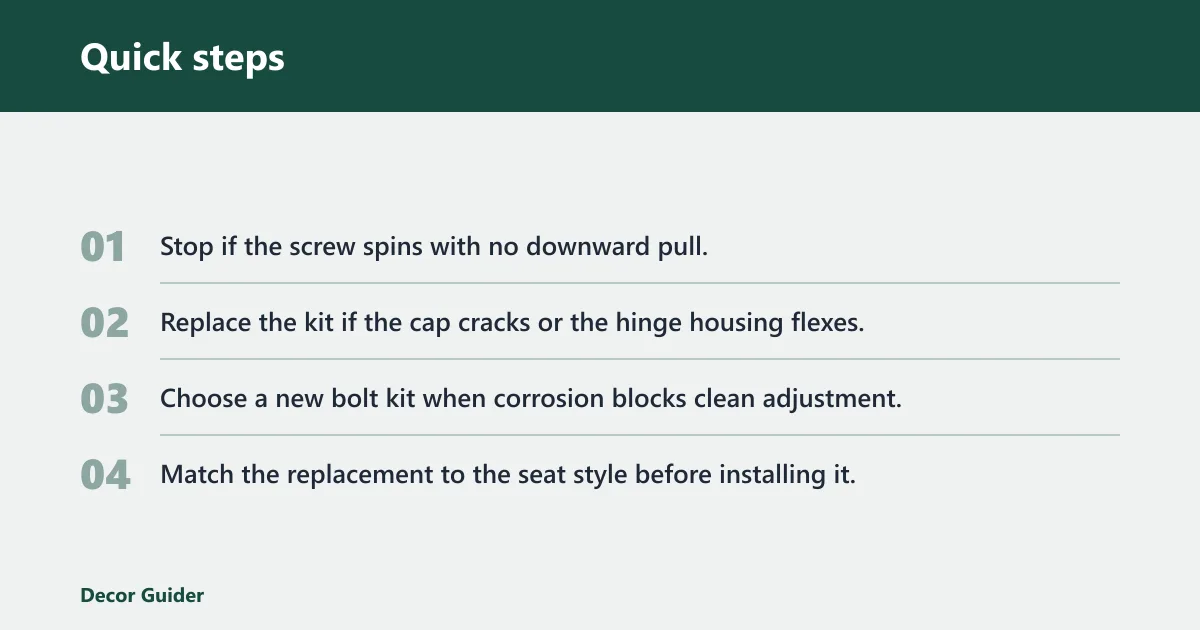
- Stop if the screw spins with no downward pull.
- Replace the kit if the cap cracks or the hinge housing flexes.
- Choose a new bolt kit when corrosion blocks clean adjustment.
- Match the replacement to the seat style before installing it.
Hidden-hardware seats usually loosen again when the fit is already poor. Bob Vila describes replacing worn seat hardware when tightening no longer holds, and iFixit notes that enlarged mounting holes can make the problem recur. A bushing can help here, but only if the fastener still has sound threads.
When is a repair no longer worth trying?
If the seat needs constant retightening, the hinge cap is damaged, or the fastener will not hold after one careful adjustment, replacement is usually the better threshold. Repair works best when the hardware still has usable threads and the hinge body has not cracked.
Common mistakes
- Overtightening can damage the bolt and crack the porcelain toilet bowl. Tighten only until the wobble stops.
- Using the wrong tool on plastic caps can snap the cover before you reach the fastener.
- Ignoring damaged hinge housings wastes time, because the seat will keep shifting even if the screw feels snug.
- Treating quick-release hardware like standard concealed hinges can break the latch or base.
- Mixing up seat and base problems can lead you to chase the wrong repair; a loose base is a toilet support issue, not a seat issue.
A loose toilet seat can be fixed in a few minutes when the hardware is sound. If the concealed fastener is spinning, seized, or cracked, stop tightening and move to replacement before the bowl or hinge housing takes damage.
What should you never do while tightening hidden toilet seat hardware?
Do not force a fastener that has stopped biting, do not use aggressive torque on plastic hinge parts, and do not keep tightening one side after the seat has already seated. Those mistakes usually turn a simple adjustment into broken hardware or a cracked bowl.
Frequently asked questions
How do you tighten toilet seat bolts with hidden fixings?
Pop open the hinge caps, confirm that the seat uses top-access concealed bolts, then tighten each fastener 1/4 turn at a time. Use an adjustable wrench only if the design lets you hold the nut. Stop as soon as the wobble disappears, then test the seat again.
How do you tighten a toilet seat properly without cracking the porcelain?
Alternate sides and tighten by 1/4 turn, then stop when the seat no longer moves. Do not crank one side hard before the other. Even pressure matters because the porcelain toilet bowl can crack if the load is uneven or the bolt is overtightened.
What should you do if the hidden toilet seat bolts are corroded?
Apply penetrating oil first, then wait briefly before turning the fastener with the correct tool. If the bolt still resists or the head starts to strip, stop. A replacement bolt kit or toilet seat replacement kit is the safer next step than forcing a seized fastener.
Products related to this article
Sponsored / affiliate links. As an Amazon Associate I earn from qualifying purchases. I may earn additional commission from eligible campaigns.