How to Hang a Heavy Bathroom Mirror
For a heavy bathroom mirror, anchor into studs whenever possible. If no stud lines up, use anchors rated above the mirror’s total weight, and use the right drill bit for the wall surface. Bad hardware can crack tile, pull out of drywall, and drop the mirror. This guide shows how to pick the right hanging method and hardware by mirror weight and wall type.
Choose the mounting method first
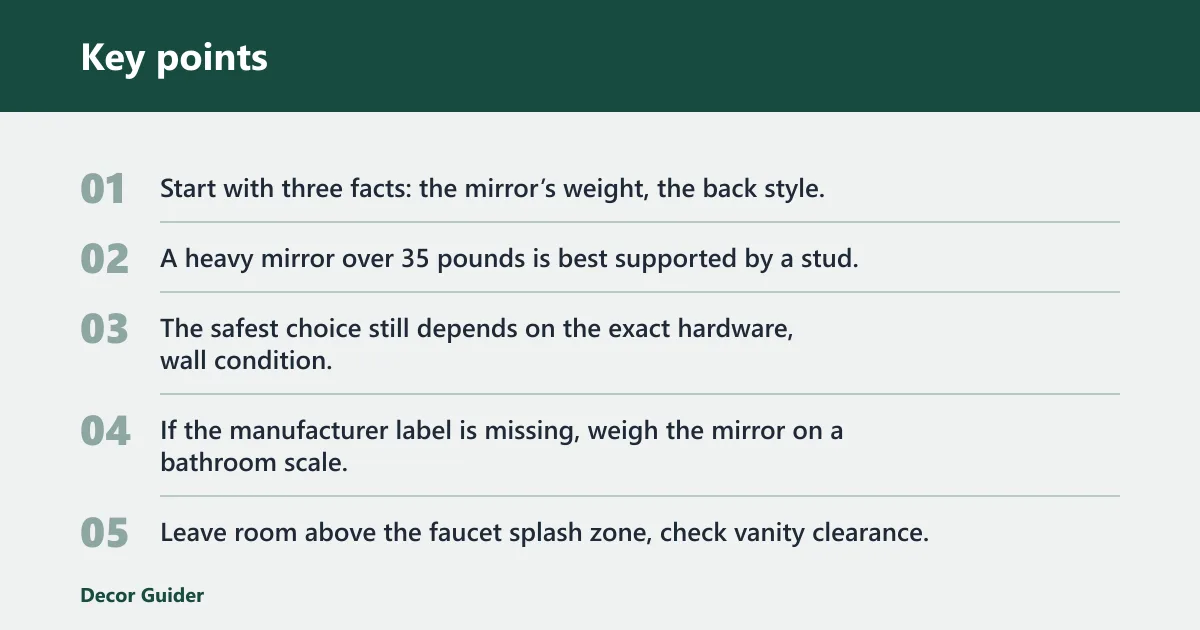


Start with three facts: the mirror’s weight, the back style, and the wall you are drilling into. A heavy mirror over 35 pounds is best supported by a stud, but that is not a blanket rule for every wall or hanger. The safest choice still depends on the exact hardware, wall condition, and how the mirror is built. If the manufacturer label is missing, weigh the mirror on a bathroom scale, or weigh yourself holding the mirror and subtract your own weight. (Wikihow)
Bathroom layout matters too. Leave room above the faucet splash zone, check vanity clearance, and make sure the lower edge will not crowd the sink backsplash or countertop. Heavy mirrors may need a helper; mirrors over 10 pounds are easier to handle with help.
Say your 32-inch framed mirror weighs 28 pounds and the studs line up with the hanger points. A stud-based install is usually the cleanest path. Suppose the same mirror lands over tile with no stud behind one side; then the hardware choice changes, and tile-safe drilling becomes part of the job.
Which wall type are you drilling into?
Drywall, plaster, and masonry are the main wall types to sort out first. That choice changes the bit, the fastener, and the risk of cracking or pullout. If tile covers drywall, treat the surface as tile first and the structure behind it as a second step.
Drywall and plaster
Drywall and plaster often need a stud or a rated anchor. For 1/2-inch drywall, use a wood screw into a stud when possible. For plaster walls, use a screw long enough to get solid stud bite.
Tile over drywall
Tile over drywall is more fragile than plain drywall. Drill the tile face with the correct tile or diamond bit for the tile type and anchor diameter, then continue into the substrate behind it as the anchor instructions require. Do not treat the tiled surface like bare drywall, and do not start with a fast spinner that can skid across glazed tile.
Brick, concrete, and other masonry
Masonry needs a masonry drill bit and a masonry-rated fastener or anchor. Match the bit to the anchor diameter, then follow the anchor maker’s depth instructions for brick or concrete. If the wall is crumbly, uneven, or patched, stop and reassess before loading the hole.
Mirror hardware decision table
Use this table as a planning guide, not a universal capacity chart. Exact ratings vary by model, wall condition, and mirror design. When the mirror is near the top of a range or the wall is questionable, move up to a stronger method or choose a different mounting point.
| Mirror weight band | Wall type | Back style | Safest hardware choice | Tools you need | Helper mandatory? |
|---|---|---|---|---|---|
| Up to 10 pounds | Drywall with stud alignment | Framed mirror with wire or rings | Picture hooks or screw-in hanger into studs; use hardware sized for the backing | Stud finder, level, tape measure, drill, wood screws | No, but help is still useful for layout |
| Up to 10 pounds | Drywall without studs | Framed mirror with wire or rings | Rated drywall anchors such as winged anchors or molly bolts, matched to the hanger style | Stud finder, drill, anchor setting tool if needed, level | Usually no |
| 10 to 35 pounds | Drywall or plaster with no stud at the hanger point | Framed mirror with wire or D-rings | Winged anchors or molly bolts; use two anchors when the hanger spacing allows it | Stud finder, drill, level, tape measure, screwdriver | Yes if the mirror is large or awkward to balance |
| 10 to 35 pounds | Drywall or plaster with a stud available | Frameless mirror with top and bottom clips | Top and bottom clips anchored into studs where possible; use rated anchors only where the clip pattern allows it | Stud finder, drill, level, tape measure, masonry bit only if tile is present | Often yes for layout and lifting |
| Over 35 pounds | Drywall, plaster, or masonry | Framed or frameless | Stud-based mounting whenever possible; otherwise use a fastening system the manufacturer rates for the exact load | Stud finder, drill, level, proper bit for the wall, wood screws or masonry anchors | Yes |
| 40 pounds and up | Any wall type | Framed mirror with hook points only | Do not rely on picture hooks alone; choose a stronger system matched to the backing and wall | As above, plus the hardware kit for the exact hanger pattern | Yes |
Can you hang it on studs?
Yes, and that is the first place to look. Studs are wooden structural members behind drywall or plaster, and they give the most dependable support for a heavy mirror when the hanger points line up. A stud finder helps locate them, but before drilling, check for hidden electrical wires or plumbing with an appropriate detector.
Once you find a stud, confirm the hanger spacing and use wood screws sized for the wall thickness. If the mirror hardware does not line up with a stud, switch to a rated anchor plan instead of forcing the issue.
A common first-timer mistake is drilling for the mirror, then discovering that the second hanger lands in open space. At that point, do not fill the hole and guess. Recheck the layout, then either move the mounting points or choose hardware meant for hollow-wall support.
What to use when no stud lines up
If no stud lines up, use an anchor rated above the mirror’s weight and matched to the wall type. For larger mirrors on drywall or plaster, winged anchors are a common choice. Molly bolts and strap toggles are also used for hollow walls when the load is within the anchor’s listing and the mirror hardware matches the fastener style.
Self-drilling drywall anchors are generally not the default choice for heavy mirrors. Use them only if the manufacturer’s listing explicitly supports the load and the mirror’s hanger pattern fits that anchor style. For heavy mirrors, anchor choice matters as much as weight; mirror load must not exceed the hardware rating.
Removable installs favor anchors that can be backed out cleanly, while permanent-feeling installs often use molly bolts or toggles with a firmer set. If you expect to reposition the mirror often, choose hardware that tolerates removal better and accept that every extra hole raises wall repair risk.
How do framed and frameless mirrors differ?
Framed mirrors usually hang from rings, wire, or D-rings already mounted to the back. Frameless mirrors usually need bottom clips first, then top clips, with precise spacing and support points.
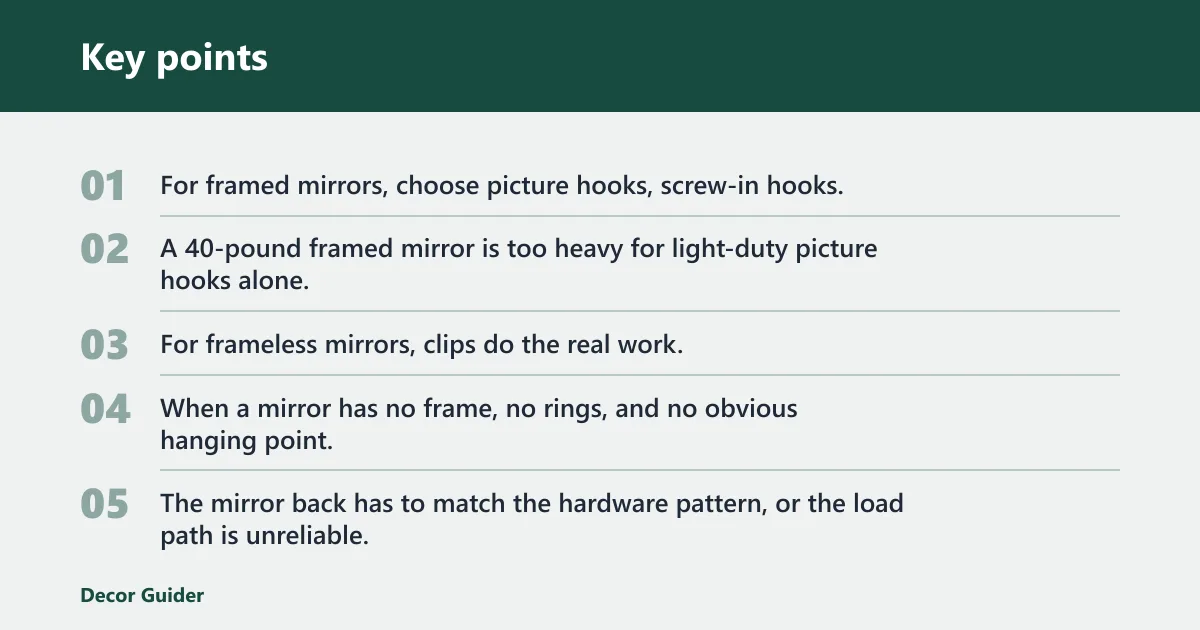
For framed mirrors, choose picture hooks, screw-in hooks, or anchors that match the backing style and spread the load correctly. A 40-pound framed mirror is too heavy for light-duty picture hooks alone. For frameless mirrors, clips do the real work, so the layout must be level before any drilling starts.
When a mirror has no frame, no rings, and no obvious hanging point, check whether the product uses clips, a hidden rail, or a special mounting kit. Do not improvise with random fasteners. The mirror back has to match the hardware pattern, or the load path is unreliable.
Picture hooks, wire, and D-rings. Picture hooks suit lighter framed mirrors with wire or centered hanger points. D-rings are better when the frame has two fixed hang points because they let you control spacing and keep the mirror flatter to the wall. Wire can work, but the wire must be rated for the mirror and tight enough that the frame does not tip.
Top and bottom clips for frameless mirrors
Frameless mirrors typically need clips or brackets that hold both the bottom edge and the top edge. The bottom clips carry the resting load, and the top clips prevent lift and wobble. Because the placement is exact, measure twice and mark with a level before drilling any tile or drywall.
When adhesive is part of the mounting system
Some mirror systems use adhesive with clips, but adhesive alone is not a default answer for a heavy bathroom mirror. Use mirror-safe adhesive such as neutral-cure silicone or mirror mastic only when the mirror product and the mounting system both call for it. Avoid general-purpose construction adhesive and any solvent-based product that can damage mirror backing. Clips still provide the mechanical support, while adhesive may reduce movement or help keep the glass flat.
Install without cracking tile or misaligning the mirror
Mark the hanger points first, then verify level, vanity clearance, and faucet splash zone before drilling. If the mirror spans tile, lay out the full mount before making the first hole so the top and bottom points stay aligned. A level and tape measure do more to prevent crooked installs than any last-minute adjustment.
For tile, drill slowly through the glaze with the right tile or diamond bit, then continue into the wall structure only after the bit has started cleanly. Use the bit size called for by the anchor, not a close guess. For brick or concrete, follow the anchor instructions for depth and fit rather than using one fixed rule for every masonry wall.
- Measure the mirror and mark the centerline above the vanity.
- Find studs with a stud finder and confirm the hanger spacing.
- Choose studs, anchors, or clips based on the wall and backing style.
- Check for tile, then select the correct masonry drill bit if needed.
- Drill carefully, set the fasteners, and hang the mirror with a helper if the mirror is large or heavy.
- Add bumpers if needed, then check level and clearance again.
Suppose the bathroom wall is tile over drywall and the mirror has no frame. That is a higher-risk install because the clips must land in the right spots, the tile must be drilled cleanly, and the mirror cannot drift while the fasteners are being set. Stop if the tile chips badly or the wall sounds hollow where a support point should be.
Heavy bathroom mirror checklist
This checklist covers the jobs that fail most often. If any of these problems show up, pause and change the plan rather than forcing the hardware.
- Hollow drywall: The anchor spins, mushrooms, or will not tighten. Recheck for a missed stud and switch to a rated hollow-wall anchor if the mirror load still fits the listing.
- Tile over drywall: The bit skates, the glaze chips, or the hole is oversized. Stop, mark a new point only if the design allows it, and use the correct tile or diamond bit for the anchor diameter.
- Masonry: The hole crumbles, dust keeps collapsing back in, or the fastener will not seat. Reassess the base material and use the anchor type the wall can actually hold.
Frequently asked questions
What to use to hang a heavy mirror
The right answer depends on the wall and the back of the mirror. Studs with wood screws are the strongest path when they line up. Otherwise, use drywall anchors, picture hooks, clips, or D-rings that match the hardware pattern and the mirror’s actual weight.
Products related to this article
Sponsored / affiliate links. As an Amazon Associate I earn from qualifying purchases. I may earn additional commission from eligible campaigns.