How to Mount a Towel Bar Without Studs
Mount a towel bar without studs by matching the fastener to the wall and the load: use toggle bolts or other hollow-wall anchors in drywall and plaster, and masonry screws or anchors in tile, brick, or concrete. For a bar expected to hold regular wet towels, skip thin plastic plugs. Wrong anchors can pull out, leave crooked hardware, and damage finished walls. Actual hold depends on wall thickness, wall condition, and installation quality, so treat any rating as a best-case benchmark rather than a guarantee.
What you need before drilling
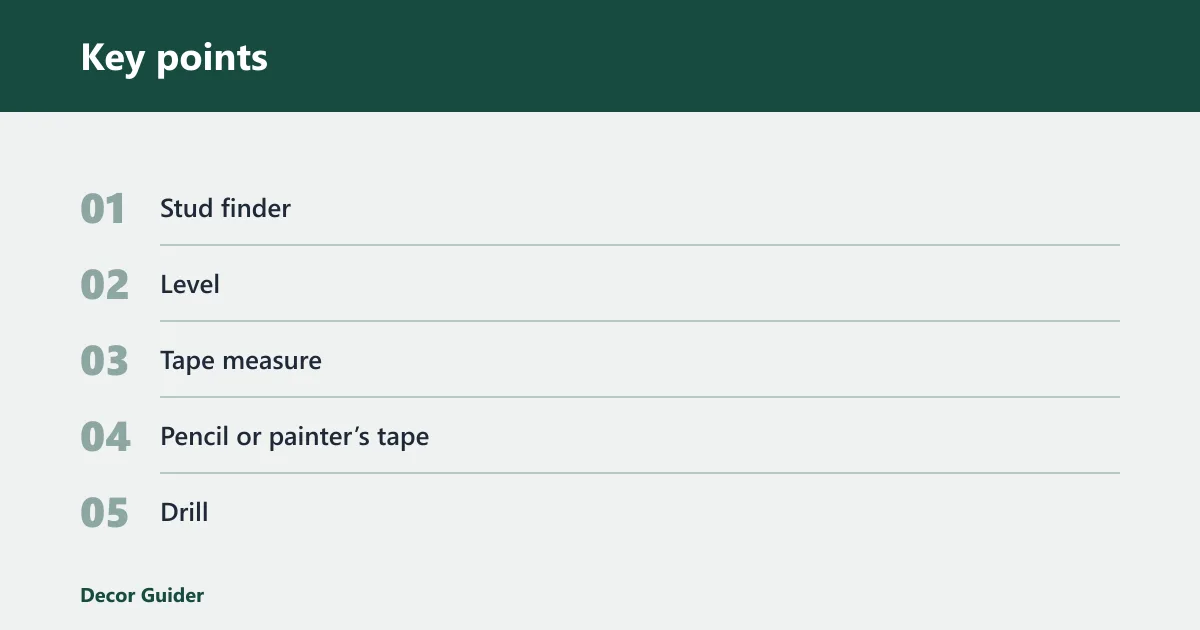


- Stud finder
- Level
- Tape measure
- Pencil or painter’s tape
- Drill
- Pilot bit for studs
- Tile bit for tile surfaces
- Masonry bit for brick or concrete
- Toggle bolts or other hollow-wall anchors sized to the wall and screw
- Wall screws sized for the bracket holes and anchor
- Screwdriver or driver bit that fits the screw head
Measure the bar before you pick fasteners
A standard two-bracket towel bar needs enough wall space for both mounts. A 24-inch bar often cannot line up with both studs in typical framing, so one bracket may need an anchor. Measure the bracket spacing first, then check whether one end can catch a stud and the other can use a hollow-wall fastener.
For hollow drywall, choose a toggle bolt or comparable hollow-wall anchor when the bar will hold regular wet towels. Thin plastic drywall plugs can handle only light duty and are not a good match for repeated damp load. The screw size and the wall thickness must match the anchor, and manufacturer instructions should always control the final choice.
Best anchor choice for a towel bar without studs
| Wall type | Bar length | Expected load | Recommended fastener | Drill bit type | Red-flag failure signs |
|---|---|---|---|---|---|
| Drywall | Up to 24 inches | Light use only | Small toggle bolt or hollow-wall anchor matched to wall thickness and screw size | Bit sized to the anchor hole | Anchor spins, screw feels loose, bracket tilts after tightening |
| Drywall | 24 inches or longer | Regular wet towels | Toggle bolt; avoid thin plastic plugs | Bit sized to the toggle opening | One side sags, anchor pulls forward, bar wobbles under towel weight |
| Tile | Any common bar length | Light to moderate | Tile-safe anchor or screw system made for tile-backed wall assemblies | Tile bit; steady pressure to avoid chipping glaze | Glaze chips, tile cracks, hole flares out, bracket never sits flat |
| Brick | Any common bar length | Moderate | Masonry anchor or screw made for brick | Masonry bit | Dusty oversized hole, anchor spins, fastener will not bite |
| Concrete | Any common bar length | Moderate to heavier | Masonry anchor or concrete screw | Masonry bit | Hole wanders, fastener backs out, bracket shifts after tightening |
| Plaster | Up to 24 inches | Light to moderate | Toggle bolt or comparable hollow-wall anchor | Bit sized to the anchor hole | Crumbly edges, cracked finish, anchor loosens after first use |
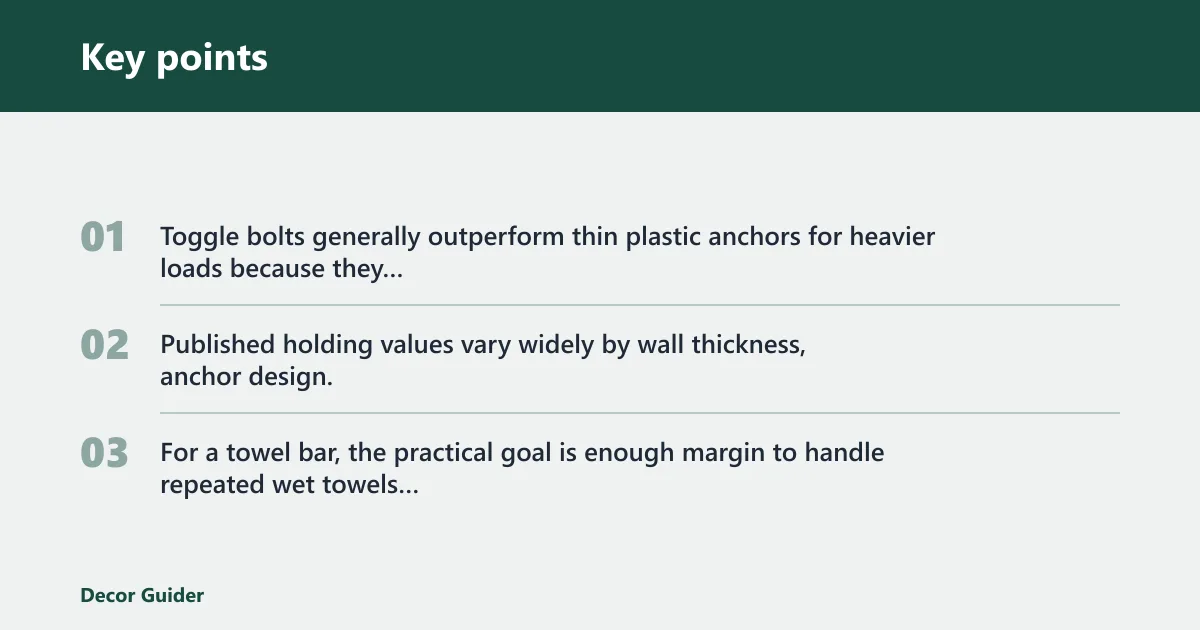
Toggle bolts generally outperform thin plastic anchors for heavier loads because they spread force behind the wall instead of relying on a small plug in soft gypsum. Published holding values vary widely by wall thickness, anchor design, and installation quality, so use manufacturer load data as a guide rather than a promise. For a towel bar, the practical goal is enough margin to handle repeated wet towels without wobble.
Can you hang a towel bar without a stud?
Yes, if the wall and fastener match the load. When one bracket hits a stud, use the stud on that side and a toggle or other hollow-wall anchor on the other side. When both brackets miss studs, a towel bar can still work in drywall or plaster with the right anchors, but a decorative bar on thin plastic plugs is a poor choice for wet towels.
When one bracket lands on a stud
That is the best case for a two-bracket towel bar. A stud is the strongest fastening point available, and one bracket can use it while the other uses an anchor. A 24-inch bar often misses one of the two 16-inch-on-center studs, so mixed fastening is common rather than a mistake.
When both brackets miss studs
Use hollow-wall anchors sized for the wall thickness and screw. In drywall or plaster, choose a toggle bolt for any bar expected to hold regular wet towels. Skip thin plastic plugs if the bar will see daily use; they can loosen over time and pull out under repeated wet load.
How to choose the mounting height
Standard bath towel bar center height is 48 inches from the floor. For hand towels, many guides place the bar around 36 to 40 inches high when reach or accessibility matters. Pick the height before marking holes so the brackets align cleanly and the towels clear nearby trim, vanities, and outlets.
If you are coordinating with nearby fixtures, it can help to check related wall-planning topics such as wall anchor guide and wall repair after drilling before you start. The best height is the one that fits both the room layout and the towel’s swing path.
Check reach before you drill
Stand where the towel will be used and confirm that the bar is easy to reach without brushing the sink or toilet. If the wall is narrow, a lower placement can improve access, but the bar still needs enough clearance to hang and dry the towel without hitting fixtures.
Start by confirming the wall type, then level the brackets before drilling. Mark both mounting points together so the bar stays straight. If one bracket lands on a stud, fasten that side first and set the other side with the correct anchor. Drill to the anchor size, not by guesswork.
- Locate studs and confirm whether the wall is drywall, tile, brick, concrete, or plaster.
- Hold the brackets in place and level them as a pair before making any holes.
- Mark the holes with a pencil or tape, then recheck the spacing against the bar.
- Drill the correct hole: pilot bit for a stud, tile bit for tile, masonry bit for brick or concrete, or the bit size required by the anchor.
- Install the anchor or toggle without forcing it. A toggle does not sit like a plastic plug; it opens behind the wall surface.
- Fasten the brackets until snug, then hang the bar and test it with a towel.
- Add load in small steps, about one towel at a time, and recheck for movement after each addition.
Suppose a 24-inch bar goes on drywall with one bracket in a stud and the other in a toggle. If the first towel makes the free side sag, the anchor choice is too light or the bracket hole is oversized. Swap to a stronger hollow-wall anchor before using the bar daily.
Why the fastener choice matters
Wet towel load creates real pull on the wall. That load is harder on hardware than decorative wall decor, and it can loosen flimsy anchors over time. For towel bars in hollow drywall, a toggle bolt or comparable hollow-wall anchor is generally the minimum practical choice when the bar will carry regular wet towels.
Plastic plugs fail sooner
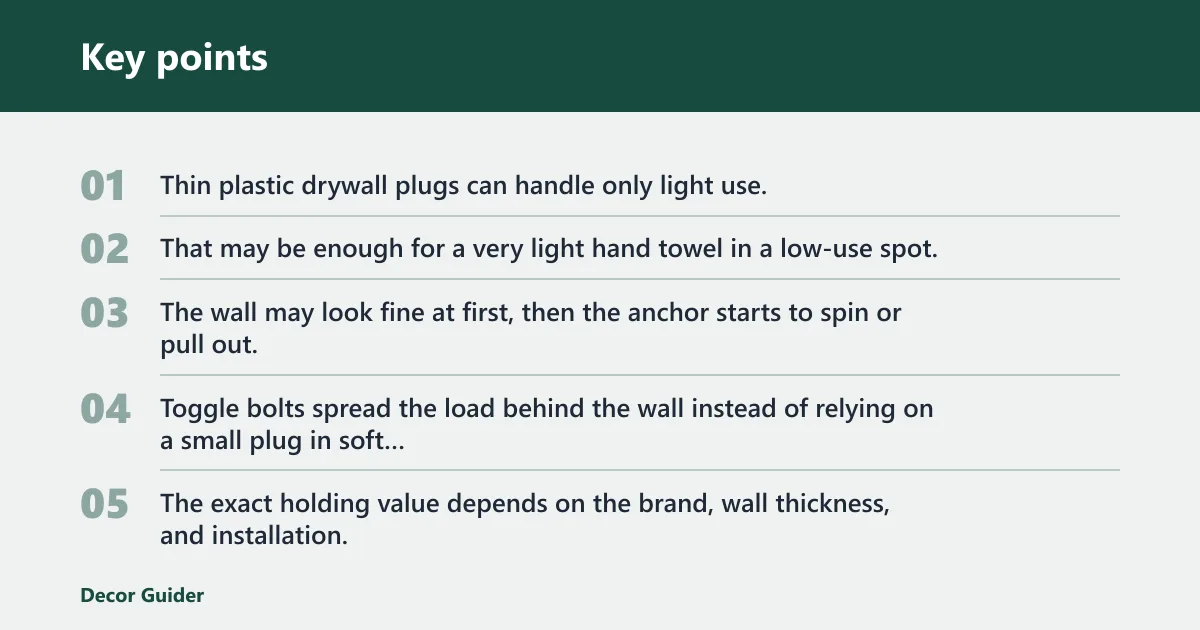
Thin plastic drywall plugs can handle only light use. That may be enough for a very light hand towel in a low-use spot, but it is a weak fit for a bathroom bar that sees repeated damp load. The wall may look fine at first, then the anchor starts to spin or pull out.
Toggle bolts suit hollow drywall better
Toggle bolts spread the load behind the wall instead of relying on a small plug in soft gypsum. The exact holding value depends on the brand, wall thickness, and installation, so use the product’s stated limits and choose a comfortable safety margin. For towel bars, that margin matters because wet fabric adds pull every time it hangs.
Common mistakes that cause sagging or pull-out
The biggest failures come from the wrong drill bit, the wrong anchor, and poor alignment. Tile needs a tile-safe bit and steady pressure to avoid chipping glaze. Brick and concrete need masonry bits. Drywall needs an anchor that matches wall thickness and screw size, not a random plug from a mixed kit.
What to avoid first
Do not overtighten screws. Snug is enough; extra force can strip the anchor or crack tile. Do not skip the level check, because a crooked bracket often tempts people to torque the screw harder. Do not keep using a bar with visible cracking, spinning anchors, or a side that drops after loading.
If that did not work, try this next
- Remove the screw and test whether the anchor spins in place.
- If it spins, replace it with a toggle bolt or a stronger wall-specific anchor.
- If the hole is oversized, move the bracket slightly and patch the old hole.
- If tile has cracked, stop and relocate to sound tile or another wall section.
- If one side still sags, shift load to a stud on that side if the layout allows it.
Picture a bar installed on plaster with one loose side and one solid side. The solid side can hide the problem for a day or two, but the loose bracket will keep working against the wall. Fix the weak side first; otherwise the good side eventually takes the full load.
Prevention
Before hanging towels, test the bar with a dry towel first, then a damp one. If the bracket moves at either stage, stop and upgrade the anchor before everyday use.
Frequently asked questions
Does a towel rack need a stud?
No, but a stud is the best fastening point when one is available. A 24-inch bar often cannot catch both studs, so one bracket may need a stud and the other an anchor. For regular wet towels, use a hollow-wall anchor that matches the wall and screw size.
How do you hang a towel bar without a stud?
Use a toggle bolt or other hollow-wall anchor in drywall or plaster, then fasten the bracket with the correct screw size. In tile, brick, or concrete, use a wall-specific anchor and the right bit. Level the brackets first so the bar does not bind during installation.
How do you hang a towel bar without screws?
For a permanent wall mount, you generally do not. If you cannot make holes, use a freestanding towel stand or another non-mounted holder instead. Adhesive-only mounting is usually too limited for a normal towel bar that will carry wet towels.
Can you hang a towel rack without studs?
Yes, with the right anchor for the wall type. Drywall and plaster call for a hollow-wall anchor such as a toggle bolt. Tile, brick, and concrete typically need their own wall-specific fasteners. The load matters more than the generic anchor name. (Wikipedia)
How do you install a grab bar without studs?
Grab bars are different from towel bars because they are safety-critical. Do not treat them as a parallel DIY install unless the product is specifically rated for the wall assembly and the load, and follow the manufacturer’s instructions exactly. For bathroom safety, use a rated grab-bar system, confirm the mounting substrate, and rely on code and manufacturer guidance rather than general-purpose anchors alone.
How do you mount a paper towel holder without screws?
Use a no-drill holder only if the load is light and the surface allows it, such as a countertop or cabinet edge designed for clamp or adhesive mounting. A wall-mounted paper towel holder, like a towel bar, is safer with mechanical fasteners than with generic adhesive alone.
Products related to this article
Sponsored / affiliate links. As an Amazon Associate I earn from qualifying purchases. I may earn additional commission from eligible campaigns.