What Is A Low Profile Box Spring? Essential Guide
A low profile box spring is a short foundation designed to sit under your mattress, providing necessary support while significantly lowering the overall height of your bed. It’s perfect when you want a modern look or have high ceilings, helping to prevent your bed from feeling too tall.

QEROMY
QEROMY 3 Inch Low Profile Box Spring…
- 【STABLE & DURABLE】Inside the queen size box spring is a metal frame made of reinforced steel that can support up to 2000LB, a stab…
- 【3 INCH QUEEN BOX SPRING ONLY】Low profile design is perfect for shorter mattresses or for those who prefer their bed to be low to…
- 【EASY ASSEMBLY】The newly designed construction is easy to assemble by following the simple instructions. All box spring queen part…
As an Amazon Associate I earn from qualifying purchases.
Have you ever bought a new mattress only to find your finished bed looks like a giant tower? Maybe you struggle to comfortably climb into bed, or perhaps the whole setup dominates your bedroom. It’s a common frustration! Traditional box springs add significant height, but swapping them out can feel overwhelming if you aren’t sure what your options are. Don’t worry; making your bed the right height is easier than you think. This guide will break down exactly what a low profile box spring is, why you might need one, and everything else required to make a smart decision for your bedroom setup.
What Exactly Is a Low Profile Box Spring? (The Simple Definition)
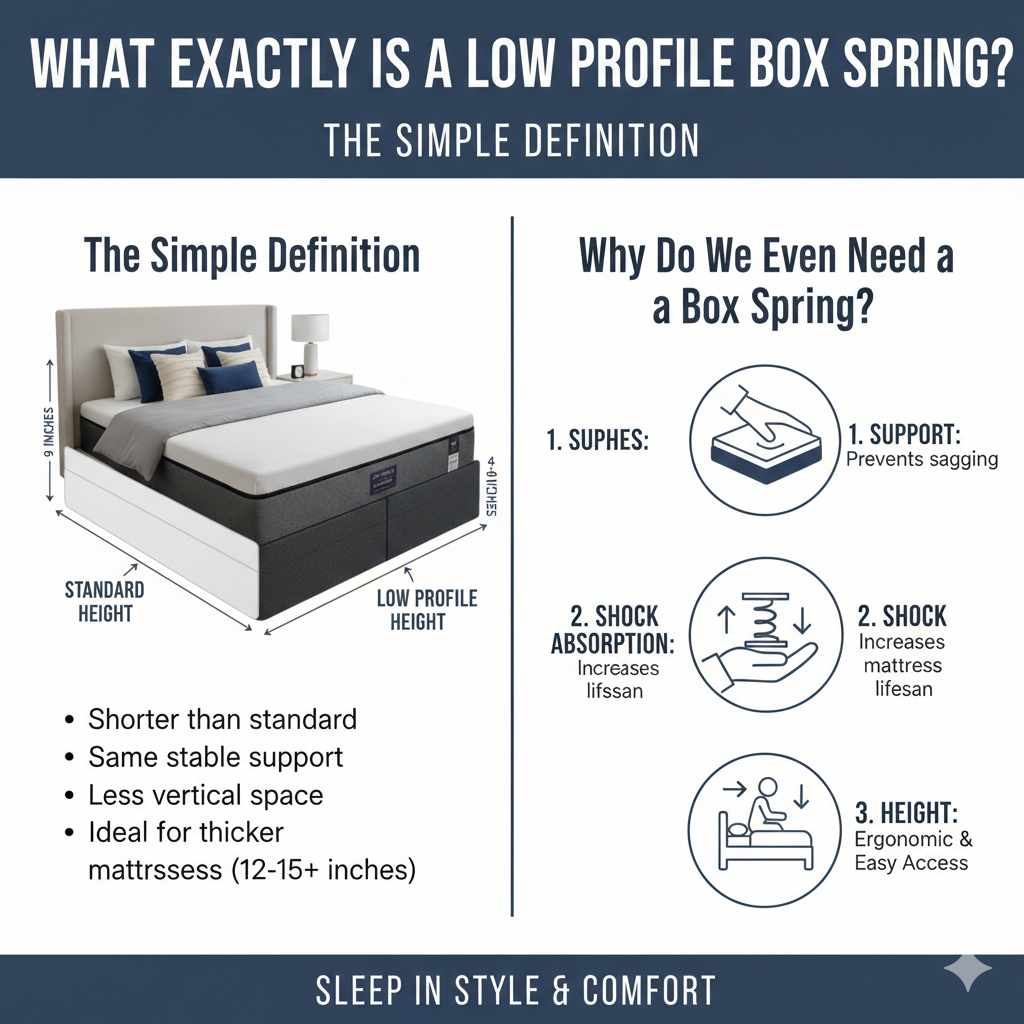
Simply put, a low profile box spring is a bed foundation that is shorter than the standard version. It performs the exact same job—providing stable, even support for your mattress—but it does it while taking up less vertical space.
Think of it this way: most standard box springs are about 9 inches tall. A low profile box spring usually measures between 4 and 6 inches tall. That might not sound like much, but when you combine that with modern, thicker mattresses (which can be 12 to 15 inches high), shaving off 3 to 5 inches makes a huge difference in the final bed height.
Why Do We Even Need a Box Spring?
Before diving deeper into the “low profile” aspect, let’s quickly cover why the foundation itself is important. You can’t just toss a mattress on the floor forever! A box spring (or a modern equivalent like a slatted foundation) serves three main jobs:
- Support: It creates a solid, flat surface that prevents the mattress from sagging in the middle or between slats.
- Shock Absorption: It absorbs the pressure and movement when you get in and out of bed, helping the mattress last longer by reducing constant stress.
- Height: It raises the mattress to a comfortable, ergonomic level for getting in and out of bed easily.
Standard vs Low Profile Box Springs: Measuring the Difference
The core difference is entirely about height. Understanding the standard measurements helps you truly appreciate how much shorter the low profile option is.
The industry standard for a traditional box spring is quite tall. This height was established decades ago when mattresses were thinner. Today, mattresses (especially memory foam or hybrid models) are much thicker, leading to very tall beds when paired with a standard 9-inch foundation.
Here is a quick comparison chart to visualize the change:
| Foundation Type | Typical Height Range | Total Bed Height Impact (with 12” Mattress) |
|---|---|---|
| Standard Box Spring | 8 to 9 inches | Approximately 20 to 21 inches |
| Low Profile Box Spring | 4 to 6 inches | Approximately 16 to 18 inches |
| Platform Base (Slats Only) | 2 to 4 inches (frame dependent) | Varies widely |
As you can see, switching styles can reduce your overall bed height by several inches—a major win for shorter individuals or people aiming for a less bulky aesthetic.
When Is a Low Profile Box Spring the Right Choice for You?
Choosing the right foundation isn’t just about looks; it genuinely affects how you use your bedroom space and how you sleep. Here are the top reasons drivers and DIYers looking for an upgrade should consider the shorter option.
1. Achieving a Modern, Sleek Aesthetic
Interior design trends lean heavily toward lower furniture profiles right now. Low profile box springs fit beautifully with modern, minimalist, or Scandinavian-style bedroom sets.
They prevent the mattress from looking “stacked” on top of a high base.
They allow other design elements, like headboards or wall art, to stand out more effectively.
The overall look feels cleaner and less imposing in the room.
2. Ergonomics and Accessibility
This is perhaps the most practical reason. If you or your partner are on the shorter side, climbing into a 21-inch tall bed can feel like scrambling into a small truck!
A lower bed height makes entry and exit much safer and easier. This is especially important for older adults or anyone recovering from an injury, as fewer steps mean less risk of a fall. You want getting into bed to feel relaxing, not like a small workout. To check basic comfort levels, some ergonomic standards relate to comfortable seating height, which is typically between 17 and 20 inches for an ideal bedroom setup.
3. Rooms with Lower Ceilings
In older homes, apartments, or even small bedrooms, high ceilings aren’t always a given. A towering bed can make a room with an 8-foot ceiling feel cramped and cave-like. Lowering the foundation instantly gives the whole room a more open, airy feel without needing to knock down any walls!
4. Compatibility with Existing Bed Frames
Many popular modern bed frames—especially platform beds or sleigh beds—are designed with specific rail heights that look awkward or don’t function properly with a traditional 9-inch box spring. Often, these frames are built expecting a lower foundation, usually in the 4-to-6-inch range, to bring the mattress surface to a visually pleasing height within the frame’s backing or side rails.
Do I Still Need a Box Spring if My Mattress Recommends It?
This is where things get tricky. The trend in mattresses has shifted significantly. Modern innerspring, hybrid, and memory foam mattresses usually do notrequire a traditional box spring anymore. They often need a solid surface or closely spaced slats.
However, some manufacturers still specify a foundation to maintain the warranty. If your mattress warranty requires a box spring, you must use one.
Here’s how to match the foundation to the mattress type:
- Memory Foam/All-Foam Mattresses: These hatetraditional box springs made of large, open grids. They need firm, non-flexible support. A low profile foundation can work if it is a true “bunkie board” style or has very tight slats (gaps no more than 2-3 inches apart, as recommended by many manufacturers).
- Hybrid Mattresses: These often benefit from a traditional sprung foundation, but a low profile version works perfectly if the interior structure is robust (coils supporting wood/metal).
- Innerspring Mattresses: These are the most flexible but still need consistent support to prevent premature wear. A low profile box spring is often an easy substitute for a standard one, provided the height doesn’t interfere with your frame.
Crucial Reminder: Always check the warranty paperwork that came with your mattress. If it says “Foundation Required,” you must provide one. If it doesn’t specify, or says “Use with platform base only,” you have more flexibility, but the structure still needs to be firm.
The Build and Construction of a Low Profile Foundation
What makes a low profile box spring short? It’s all in the internal structure. Traditional box springs rely on a deep wooden frame and large internal coils or wire grids. Low profile versions simplify this significantly.
Key Differences in Internal Structure
- Standard Structure: A deeper wooden perimeter frame, often containing internal metal support coils or a large wire grid designed to flex under pressure.
- Low Profile Structure: This usually involves a much shallower wooden frame with a solid piece of plywood or tightly packed, short wooden slats across the interior. Some are essentially upholstered-frame platforms designed specifically to be very thin.
Because they lack the deep, springy internal components of a standard unit, they offer firm, consistent support, which is often exactly what modern mattresses crave. They transfer weight more directly to the bed frame or legs supporting them.
Materials You Might Find
When looking at construction, you’ll generally encounter these core materials in a successful low profile foundation:
- Wood Frame: Sturdy lumber (such as pine or fir) forms the outer box.
- Plywood or Particle Board: This solid decking sits inside to offer a completely flat surface, especially critical for foam mattresses.
- Upholstery: The exterior is wrapped in durable fabric, matching the look of the mattress or frame.
- Support Legs: Depending on where it sits (inside a frame or on its own), it will have short, strong legs or mounting hardware.
Step-by-Step: How to Choose the Right Low Profile Box Spring
Picking the perfect foundation requires checking a few things off your list before you click “Add to Cart.” Follow these steps to avoid headaches later.
Step 1: Confirm Mattress Requirements (The Non-Negotiable Step)
Before anything else, determine what your mattress absolutely requires. If your warranty demands a 9-inch box spring, a low profile 5-inch one voids that contract. If the mattress only needs support, read the fine print on recommended spacing for slats or the need for solid decking. For most modern mattresses, a low profile foundation with a solid, flat top surface is usually acceptable.
Step 2: Measure Your Current Setup
If you are replacing an old box spring but keeping the frame, you must measure twice!
- Mattress Height: Measure your current mattress thickness (e.g., 13 inches).
- Desired Final Height: Decide how high you want the final surface to be (e.g., 18 inches is a comfortable target for most adults).
- Calculate Needed Foundation Height: Subtract your mattress height from your desired final height (18” desired – 13” mattress = 5” foundation needed). A 5-inch low profile box spring should fit perfectly.
- Frame Compatibility: Check the inside dimensions of your current bed frame. Does it use side rails that fit snugly around a standard 9-inch foundation? If so, a 9-inch foundation might sit too high, making the mattress look awkward above the rail line. A low profile unit will sit flush or slightly below the rail, which looks much better.
Step 3: Determine If You Need Legs or a Frame
Low profile box springs come in two main forms, and knowing which you need is crucial for assembly and stability:
Foundation Only (For Inside a Frame): These sit directly inside your existing decorative headboard/footboard frame. They usually do not have their own legs and rely entirely on the frame structure for support.
Foundation with Integrated Legs (For Naked Setup): If you are ditching the bulky frame for a simpler look, the low profile unit needs its own sturdy legs attached securely. Make sure these legs are strong enough to distribute weight safely. For durable support, consider consulting guidance on load-bearing structures, acknowledging that properly engineered furniture legs are tested for safety, similar to basic automotive jack stands in terms of uniform weight distribution principles. Sources like architectural standards agencies often publish guidelines on residential load distribution.
Step 4: Assess Durability and Materials
Don’t just buy the shortest one you find. Check reviews regarding squeaking or sagging after a year of use. A well-made low profile foundation uses high-quality wood bracing or sturdy metal supports, even if they are shallower. A cheap, thin piece of particle board will fail fast under stress.
Low Profile vs Other Foundation Alternatives
The low profile box spring is just one tool in the modern sleeper’s toolbox. You might hear about platform beds or Bunkie boards, so let’s compare them briefly so you choose the best support system for your needs.
The Platform Bed (Slatted Foundation)
A platform bed is a bed frame that uses slats (wooden or metal strips) spaced closely together to act as the foundation, entirely eliminating the need for a box spring.
Pros: Often the lowest profile option available, extremely minimalist look, highly supportive for foam mattresses.
Cons: Slat spacing is critical; if slats are too far apart (over 3 inches), they can cause mattress damage or sagging. Many platform beds require you to purchase the frame and the support system separately.
The Bunkie Board
A Bunkie board is a very thin, often 2-inch thick, piece of sturdy material (usually wood or foam core covered in fabric) designed to be placed on topof existing slats or inside a traditional box spring platform to firm up the surface.
Pros: Inexpensive, adds minimal height, excellent for using with a foam mattress that needs more rigidity than the existing slats provide.
Cons: Not a standalone foundation; it absolutely requires a supportive base underneath it. It doesn’t offer the same shock absorption as a true sprung box spring.
Comparison Table: Foundation Styles
| Foundation Type | Typical Height | Best For | Aesthetics |
|---|---|---|---|
| Low Profile Box Spring | 5 inches | Users keeping a traditional frame but wanting lower height; hybrid mattresses. | Modern, clean look. |
| Standard Box Spring | 9 inches | Thicker innerspring mattresses requiring maximum rebound and height. | Traditional, taller bed profiles. |
| Platform Slats | 2–4 inches (Frame dependent) | Foam, latex, or newer hybrid mattresses; minimalist style. | Extremely low and modern. |
Maintenance Tips to Keep Your Low Profile Sprung Lasting Long
Even though a low profile box spring is simpler than its older counterparts, you still need to treat it right to ensure years of reliable support. Think of it like maintaining your car’s chassis—it does the heavy lifting, so keep it solid!
1. Tighten Fasteners Regularly
If your low profile unit has removable legs or if it connects to a metal frame using bolts, you need to check those connections periodically. Vibration from daily use can loosen hardware over time, which leads to wobbling and annoying squeaks. A quick check with a wrench every six months can save you from unexpected noise on a quiet night.
2. Rotate Your Mattress
While the box spring itself doesn’t “wear spots” the same way a mattress does, rotating your mattress 180 degrees every 3 to 6 months ensures the weight is distributed evenly across the foundation beneath it. This prevents premature wear patterns on both the upper and lower sleeping surfaces.
3. Check for Moisture Exposure
Just as you wouldn’t leave engine parts out in the rain, keep your foundation dry. Wood frames and particle board interiors can warp or mold rapidly if exposed to humidity or spilled liquids that aren’t cleaned up immediately. If you live in a very humid climate, ensure your foundation has adequate airflow underneath—this is another reason platform systems are popular, as they allow air to circulate freely under the mattress.
4. Don’t Overload It
These foundations are engineered for the weight of the mattress plus the weight of one or two adults sleeping on it. Avoid placing extremely heavy items—like stacks of books, overly heavy decorative furniture, or even taking a running jump onto the edge—as this exceeds the load rating and can snap internal bracing, especially in the shallower models.

FAQ Section: Quick Answers for Beginners
Q1: Can I use a low profile box spring with any mattress?
No. While they work great with most modern hybrids and innersprings, memory foam or latex mattresses often require a solid or very tightly slatted base (gaps under 3 inches). Always confirm your mattress manufacturer’s specific foundation guidelines.
Q2: Will a low profile box spring squeak more than a standard one?
Not necessarily. Squeaking usually comes from loose hardware, rubbing wood against metal, or failing internal coils. If the low profile unit is well-built with solid decking, it should be quieter than a worn-out, traditional spring unit.
Q3: How much shorter is a low profile box spring?
A standard box spring is around 9 inches tall, while a low profile version is typically between 4 and 6 inches tall. This difference significantly reduces the overall bed height.
Q4: Do I need to buy a low profile box spring that matches my current bed frame?
If your current frame is designed to cradle a standard 9-inch foundation, you should measure carefully. If the frame rails are high, a 9-inch spring might push your mattress too high. If you want a specific look where the mattress is nearly flush with the side rails, the low profile version is usually the better aesthetic match for modern frames.
Q5: Is using a low profile foundation bad for the mattress warranty?
It is only bad if your warranty explicitly states that a foundation of a specific height or type (like a traditional sprung foundation) is mandatory. If your warranty simply says “use a supportive foundation,” a quality 5-inch low profile unit is generally acceptable.
Q6: Can I just use a flat piece of plywood instead of a low profile box spring?
You can*, but it’s not recommended unless your mattress explicitly supports it (like dense foam). Plywood doesn’t offer shock absorption, meaning all the pressure from getting in and out of bed concentrates directly onto the mattress materials, significantly shortening its lifespan.
Conclusion: Driving Towards a Better Night’s Sleep
By now, it’s clear that a low profile box spring isn’t just a “shorter version” of a traditional foundation — it’s a smart adjustment for modern bedrooms and modern mattresses.
As mattresses have grown thicker and bedroom styles have shifted toward cleaner, lower silhouettes, the old 9-inch box spring simply doesn’t make sense for everyone anymore. That extra height can turn a comfortable bed into an awkward climb and make a small bedroom feel even tighter.
A low profile box spring solves that problem without sacrificing support.
Related pick: Check today's price on Amazon
Products related to this article
Sponsored / affiliate links. As an Amazon Associate I earn from qualifying purchases. I may earn additional commission from eligible campaigns.