How Much Does a Japanese Soaking Tub Weigh?
A Japanese soaking tub is commonly reported to weigh about 80 to 300 pounds empty and about 1,000 to 3,000 pounds when filled, so upstairs installs often call for a structural check. Skip that, and you can overload joists, damage finishes, or face a costly retrofit. This guide breaks down weight by material and size, plus the floor-load and delivery factors to verify before you buy.
What is a Japanese soaking tub?
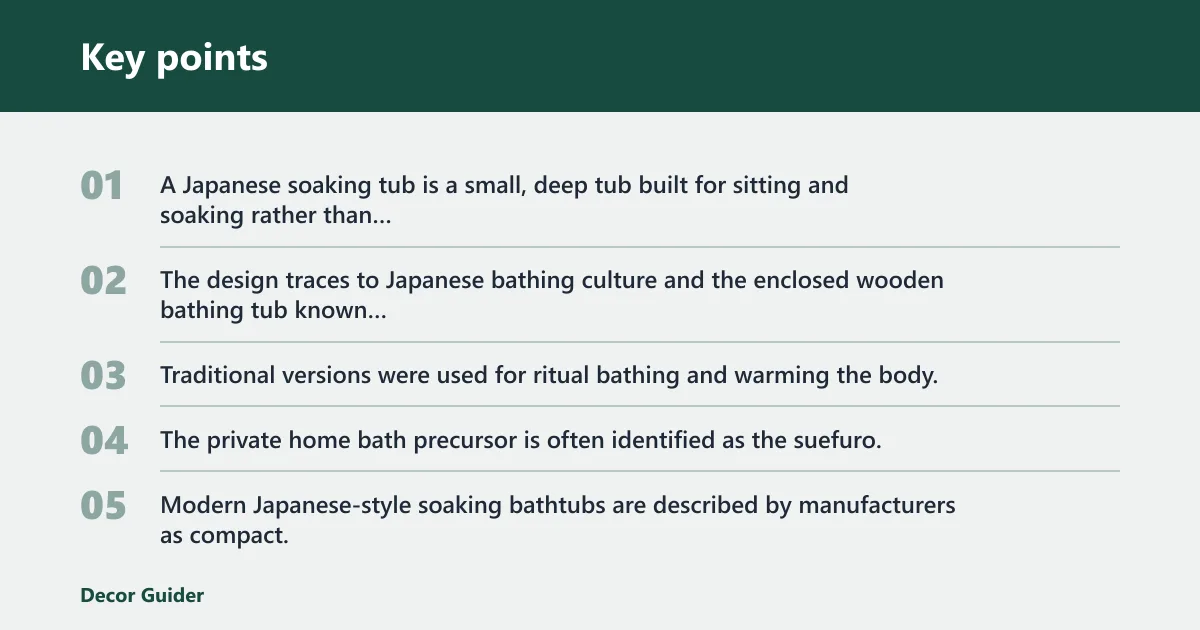

A Japanese soaking tub is a small, deep tub built for sitting and soaking rather than lying down. It is commonly called an ofuro or furo. The design traces to Japanese bathing culture and the enclosed wooden bathing tub known as a suefuro; modern versions retain the upright-soak format while using newer materials and plumbing layouts.
Traditional and modern forms
Traditional versions were used for ritual bathing and warming the body. The private home bath precursor is often identified as the suefuro, a wooden soaking tub used in Japanese homes and bath culture. Modern Japanese-style soaking bathtubs are described by manufacturers as compact, deep tubs designed for seated bathing, and they come in multiple sizes and styles.
Materials now include cedar, stone, copper, stainless steel, and acrylic, along with wood-look and custom-built options. Many contemporary models are sized around a seated soak rather than a reclining bath, which is why dimensions, capacity, and placement matter as much as appearance. If you’re weighing a standalone tub against a bathroom redesign, a Japanese soaking tub shower combo can change the layout and plumbing tradeoffs.
How much does a Japanese soaking tub weigh?
The empty tub weight depends heavily on material and size. A compact acrylic tub can stay near the low end, while stone and thick wood models can climb much higher. For planning, expect a one-person tub to land below a two-person model, sometimes by several hundred pounds before any water goes in.
Empty weight by material and size
Shipping weight and installed weight are usually close for a dry tub, but they are not the same as operating weight. Shipping weight is the number to use for delivery access, stair clearance, and moving equipment. Installed weight matters once the tub is set and plumbed. Filled operating weight matters for the floor below.
Use this planning formula: filled operating weight = empty tub weight + water weight + estimated bather weight. Water weighs about 8.34 pounds per gallon per USGS water science guidance. For planning, this article uses an estimated bather weight of 180 pounds, which is a transparent assumption rather than a manufacturer spec.
Say your bathroom is upstairs and you are comparing a 60-inch acrylic tub with a 72-inch stone model. The acrylic unit may be light enough for a two-person moving crew, while the stone version may require extra handling, wider clearances, and a more careful check of joists and subfloor support before purchase. Manufacturer spec sheets for compact soaking tubs commonly show this same size-and-material spread in weight and capacity.
How much does a Japanese soaking tub weigh when filled?
Filled operating weight is the number that surprises most buyers. Water weighs about 8.34 pounds per gallon, so a tub that holds 120 gallons adds roughly 1,001 pounds of water before you count the tub or the person inside it. That is why a modest-looking tub can create a very large floor load.
Why upstairs bathrooms need extra planning
A tub that feels manageable at the curb can become a structural problem inside the house. Upstairs bathrooms need attention to joist span, joist size, subfloor thickness, and the path from the door to the bathroom. If the floor system is not sized for the finished load, a contractor or structural engineer may need to specify reinforcement.
Residential floors are commonly designed to support a minimum live load of 40 pounds per square foot under modern code practice, but a soaking tub concentrates weight in a much smaller footprint. That means the relevant question is not just the total weight; it is how that weight is distributed across the tub base and framing below.
Subfloor reinforcement can include added framing, thicker sheathing, or changes around the tub platform, but the right fix depends on the structure below. Do not treat a deep soaking tub like a standard alcove bath. The deeper shell and larger water volume can shift the load far beyond a routine bathtub installation.
Japanese soaking tub weight table
The table below gives practical planning ranges for common tub materials and two size classes. Use it to compare empty tub weight, water load, and likely filled operating weight before you order. The formula used is empty tub weight + water weight + 180 pounds estimated bather weight. Treat these as planning ranges, not a substitute for a stamped structural review or the manufacturer’s spec sheet.
| Material | Size class | Typical empty weight | Typical water capacity | Planning formula | Approximate filled operating weight |
|---|---|---|---|---|---|
| Acrylic | One-person | 80 to 140 lb | 90 to 120 gal | 80 to 140 + (90 to 120 x 8.34) + 180 | 1,011 to 1,321 lb |
| Acrylic | Two-person | 120 to 220 lb | 140 to 180 gal | 120 to 220 + (140 to 180 x 8.34) + 180 | 1,468 to 2,000 lb |
| Cedar or cypress wood | One-person | 120 to 180 lb | 90 to 120 gal | 120 to 180 + (90 to 120 x 8.34) + 180 | 1,051 to 1,361 lb |
| Cedar or cypress wood | Two-person | 180 to 300 lb | 140 to 180 gal | 180 to 300 + (140 to 180 x 8.34) + 180 | 1,528 to 2,180 lb |
| Copper or stainless steel | One-person | 120 to 220 lb | 100 to 130 gal | 120 to 220 + (100 to 130 x 8.34) + 180 | 1,134 to 1,485 lb |
| Copper or stainless steel | Two-person | 180 to 300 lb | 150 to 200 gal | 180 to 300 + (150 to 200 x 8.34) + 180 | 1,611 to 2,154 lb |
| Stone | One-person | 250 to 400 lb | 100 to 130 gal | 250 to 400 + (100 to 130 x 8.34) + 180 | 1,264 to 1,664 lb |
| Stone | Two-person | 400 to 500 lb | 170 to 220 gal | 400 to 500 + (170 to 220 x 8.34) + 180 | 2,000 to 2,515 lb |
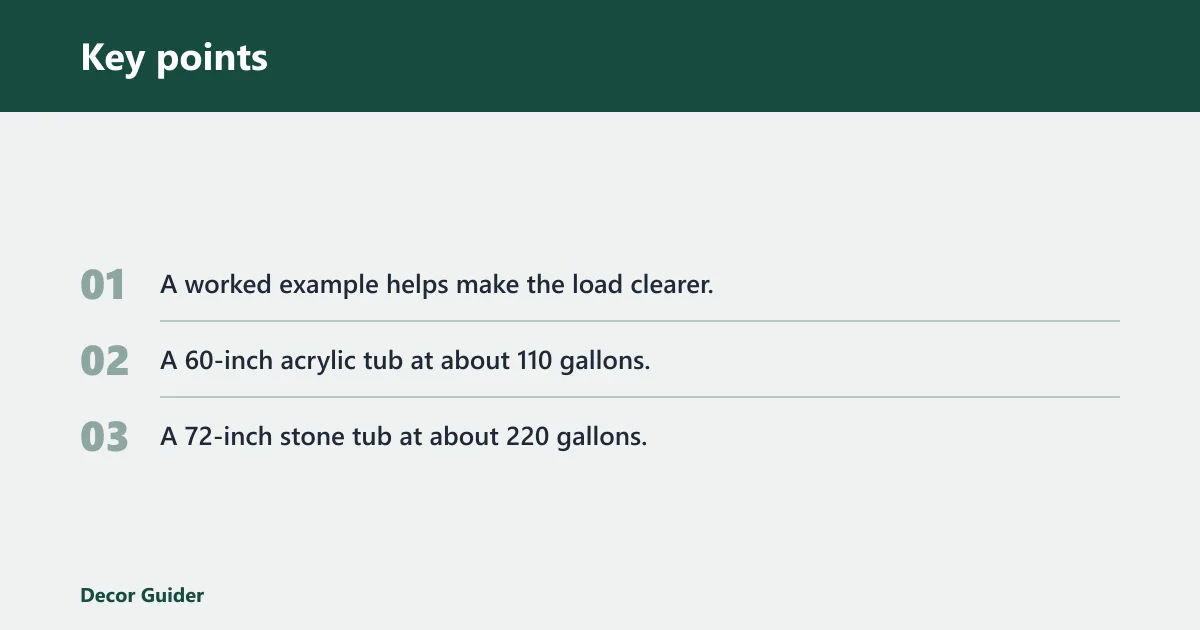
A worked example helps make the load clearer. A 60-inch acrylic tub at about 110 gallons, with a 120-pound empty shell and a 180-pound bather, lands near 1,217 pounds. A 72-inch stone tub at about 220 gallons, with a 500-pound empty shell and the same bather assumption, lands near 2,515 pounds.
How big is a soaking tub?
A Japanese soaking tub is usually smaller in footprint than a conventional bathtub, but it is much deeper. Many modern models are around 27 inches deep, which is consistent with manufacturer dimensions for seated soaking tubs and enough depth to let the water rise high on the torso. That depth is the core design feature, and it changes both comfort and load planning.
Length, width, and floor space
Most soaking tubs fall into compact one-person lengths or larger two-person formats. Common planning lengths start around 48 to 60 inches for a smaller model and run to about 66 to 72 inches or more for larger versions. Width often stays tighter than a standard tub, which is why the style can save floor space in cramped bathrooms.
What is the average size of a soaking tub? For planning, many buyers look at a footprint that is shorter and narrower than a standard built-in bath, but much deeper. The exact size depends on whether the tub is built for one bather or two, and whether it is round, oval, or rectangular.
Are Japanese soaking tubs comfortable?
Yes, if you want seated soaking instead of reclining. The deep shape supports an upright posture, and the higher water line can wrap more of the torso than a standard tub. Comfort depends on tub depth, seat shape, and whether the interior lets you sit without bracing your knees awkwardly.
When deeper makes sense
Traditional Japanese soaking tubs were designed for sitting, not lying down. That is why a deeper shell can feel more restful than a shallow tub when you want heat retention and shoulder coverage. If you prefer to stretch out flat, a soaking tub will feel restrictive. If you prefer upright soaking, the depth works in its favor.
A common first-timer mistake is ordering a deep tub for a small bathroom without checking the floor. The tub may fit the room plan, but the filled load can still overwhelm a lightly framed upstairs bath. Comfort and structure need to be judged together.
What to check before you buy?
Before you buy, verify the delivery path, the stair width, and the turn radius into the bathroom. Then confirm the manufacturer’s dry weight, water capacity, and the filled operating weight you will place on the floor. For upstairs rooms, a structural review is wise if the tub is stone, oversized, or intended for two bathers.
How much japanese soaking checklist
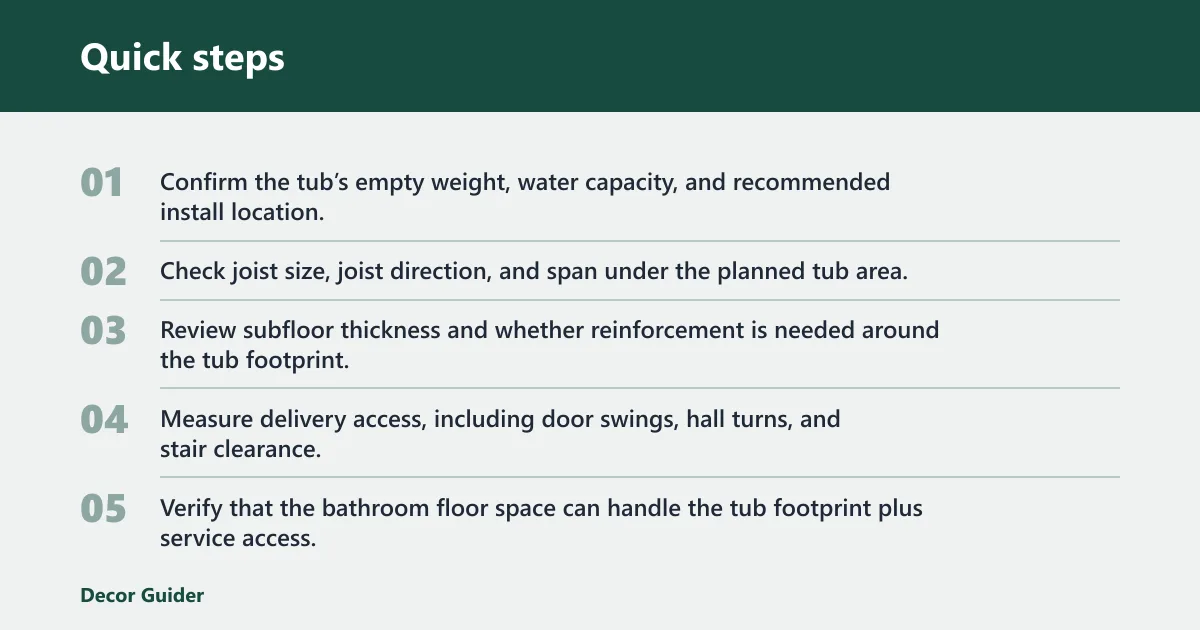
- Confirm the tub’s empty weight, water capacity, and recommended install location.
- Check joist size, joist direction, and span under the planned tub area.
- Review subfloor thickness and whether reinforcement is needed around the tub footprint.
- Measure delivery access, including door swings, hall turns, and stair clearance.
- Verify that the bathroom floor space can handle the tub footprint plus service access.
- Confirm plumbing placement, drain height, and whether the selected tub is compatible with the existing rough-in.
- Ask whether the final filled load stays within the structure’s safe working range.
Do Japanese soaking tubs use less water? Often, yes, compared with filling a long standard bathtub to full lounging depth. But the answer depends on tub capacity. A deep one-person model may still use a substantial volume because the water must rise high enough for seated soaking. Bigger tubs can erase that savings quickly.
Suppose you choose a two-person stone tub for a compact upstairs bath because it looks small on paper. The footprint may be space-saving, yet the filled load can still approach 3,000 pounds once you add the shell, water, and bather. That is the point where joist review and delivery planning stop being optional.
Frequently asked questions
What size Japanese soaking tub should I buy?
Choose the size based on who will use it, how much floor space you have, and what the floor can safely carry. One-person tubs suit compact rooms and lower loads. Two-person tubs need more capacity, more water, and a stronger structure, so they deserve a closer review before purchase.
Do Japanese soaking tubs use less water?
They can use less water than a full-length tub filled for reclining, but that is not automatic. A deep tub still needs enough water to cover the seated bather up to the desired level. Bigger models, especially those built for two, can use a lot of water and create a much heavier load.
Products related to this article
Sponsored / affiliate links. As an Amazon Associate I earn from qualifying purchases. I may earn additional commission from eligible campaigns.