How to Stop a Headboard From Hitting the Wall
Stop a headboard from hitting the wall by tightening the frame first, then filling any gap larger than about 1/4 inch with felt, rubber, or foam; if the bed still moves, anchoring the frame or adding wall protection may help. If ignored, the noise worsens, hardware loosens, paint scuffs, and drywall can chip. This guide shows how to diagnose the gap, the movement, and the best fix for your setup.
Why your headboard is banging the wall



Headboard noise usually comes from one of three places: the wall, the frame, or the floor. A hard bump against drywall needs cushioning. A loose bed frame needs hardware correction. A bed that slides on hardwood generally needs friction or anchoring before a pad can help.
Wall impact versus frame wobble versus floor slippage
If the sound happens when you shift pillows or sit up, the headboard may be striking the wall directly. If the whole bed moves first, the frame is wobbling. If the bed creeps away from the wall over time, floor slippage is part of the problem.
Wood headboards often flex at the joints and can scuff paint where the top rail touches the wall. Metal headboards transfer vibration more easily, so a small amount of movement can sound louder. Drywall is especially prone to paint scuffing and indentation when the contact point is narrow or repeated.
Signs the bolts are the real problem
Loose headboard mounting bolts can make the whole assembly shift before the wall ever gets hit. Check whether the bolt heads move in the frame holes, whether the headboard sits off-center, and whether the frame rails are fully aligned with the mounting points. If holes and bolts do not match cleanly, the wobble returns.
Silentnight notes that headboards can support sitting up in bed and can help prevent pillows slipping between the bed and wall. That benefit disappears when the hardware is loose, because the same structure meant to stabilize pillows starts acting like a rattle point.
Headboard troubleshooting matrix

Use this matrix to match the symptom to the movement source. Gap size matters because a pad that is too thin will compress flat, while a stopper with too much reach can leave the headboard unstable. Renter-safe choices prioritize removability, low residue, and paint-safe contact.
| Symptom | Likely cause | Gap size | Best fix | Tools needed | Renter-safe or not | Failure risk |
|---|---|---|---|---|---|---|
| Light tap when rolling over | Thin wall gap with minor contact | Under 1/4 inch | Thin EVA foam or silicone pad | Cleaner, tape measure, pad | Usually yes | Low if pad stays adhered |
| Repeated knock when sitting up | Headboard impact against drywall | 1/4 to 1 inch | Wall stopper with foam or silicone contact pad | Wrench, screwdriver, tape measure | Usually yes if removable | Medium if tension is too low |
| Metal buzz after each movement | Metal headboard vibration transfer | 1/4 to 2 inches | Threaded anti-shake tool plus pad | Wrench, screwdriver | Usually yes | Medium if bolts stay loose |
| Bed slides away on hardwood | Floor slippage, not just wall impact | Any gap | Non-slip pads or grippers under legs, then wall protection | Grippers, level, tape measure | Usually yes | Medium if floor is dusty |
| Headboard shifts side to side | Loose mounting bolts or frame holes misaligned | Any gap | Tighten and realign hardware first | Wrench set, screwdriver | Yes | High if skipped |
| Wall paint marks appear | Scuffing from repeated light contact | Under 1 inch | Clear silicone protector for low-visibility use | Cleaning cloth, protector | Usually yes | Low to medium |
| Hard thud on a heavy king frame | Large mass plus frame movement | 1 to 4 inches | Threaded stopper with tension mechanism | Wrench, screwdriver, tape measure | Usually yes if removable | Low if compression is adequate |
| Pad falls off after a few nights | Adhesive peel or dirty wall surface | Under 1 inch | Clean surface and switch to mechanical stopper | Cleaner, replacement pad | Maybe, depending on residue | High if the wall is dusty or textured |
| Noise returns after a week | Compression set or too-thin bumper | Under 1 inch | Thicker foam or adjustable stopper | Replacement bumpers, wrench | Usually yes | Medium |
How do you stop a headboard from hitting the wall?
Measure the gap behind the bed first, then check whether the headboard moves before it touches the wall. Tighten the mounting bolts, then pick a fix based on the movement source: foam or silicone for a small gap, or a threaded stopper if the headboard keeps shifting under load.
- Measure the gap from the back of the headboard to the wall.
- Check the headboard mounting bolts for looseness and alignment with the frame holes.
- Move the bed gently side to side and see whether the frame wobbles first.
- Choose a pad, protector, or adjustable stopper that matches the gap.
- Test again after tightening and installation.
A common first-timer mistake is adding foam before checking the bolts. If the hardware is loose, the foam only hides the symptom for a while. Picture a queen bed on hardwood with a 1-inch gap: a bumper may quiet the tap, but sliding feet can still pull the whole frame back into the wall.
What can you put behind a headboard?
For tight gaps, use EVA foam bumpers. For low-visibility protection, use silicone wall protectors. For recurring movement, a threaded anti-shake stopper is better because it fills the gap with tension instead of relying only on adhesive. The right choice depends on gap size, wall finish, and how much the bed moves.
EVA foam bumpers for tight gaps
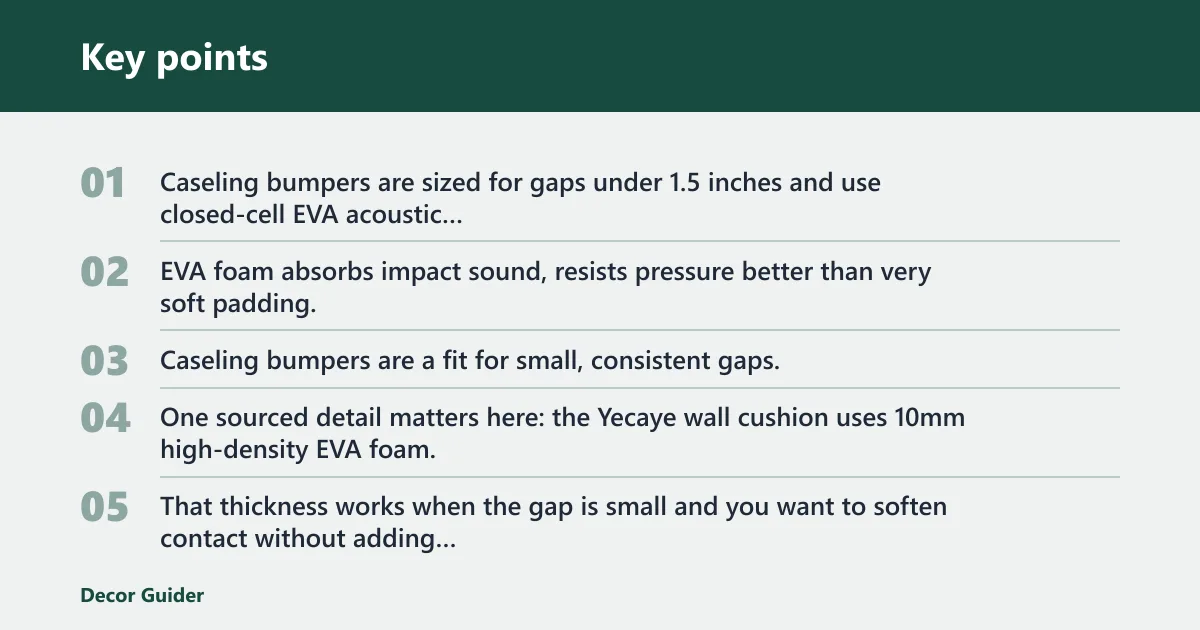
Caseling bumpers are sized for gaps under 1.5 inches and use closed-cell EVA acoustic foam. EVA foam absorbs impact sound, resists pressure better than very soft padding, and works best when the headboard sits close to the wall. Caseling bumpers are a fit for small, consistent gaps.
One sourced detail matters here: the Yecaye wall cushion uses 10mm high-density EVA foam. That thickness works when the gap is small and you want to soften contact without adding much visual bulk.
Silicone wall protectors for low-visibility protection
Silicone protectors suit bedrooms where the wall finish must stay as discreet as possible. Kraftex protectors are designed to be clear and discreet, and Kraftex uses a soft silicone polymer surface. That makes them a better visual match than opaque foam in rooms where the pad should disappear.
Silicone is often preferred where paint-safe contact matters, because it cushions the touch point while keeping the edge soft against the wall. Opaque versions can hide marks too, but clear versions are easier to place in visible areas without drawing attention.
When to choose a threaded anti-shake stopper
A headboard wall stopper or anti-shake tool works best when the problem is movement, not just contact. The Yecaye tool adjusts from 1.3 to 4.4 inches and uses a threaded tension mechanism with an adhesive mounting base. The Yecaye pack includes four complete threaded units, which helps when more than one contact point needs support.
Use a threaded stopper when the gap is too wide for simple foam, when the bed shifts repeatedly, or when the frame and wall contact happen together. The best use by bed type is usually wood or metal frames with visible wobble, rather than a perfectly rigid platform bed with only a small scuff point.
How do you stop a metal headboard from hitting the wall?
Metal headboards usually need more than a soft pad because they transfer vibration and amplify noise. Tighten the bolts first, then add a stopper or protector if the gap still lets the frame move. If the frame flexes, a pad alone may quiet the tap but not the rattle.
Why metal transfers vibration more easily
Metal does not damp movement the way heavier wood assemblies often do. A slight shift can travel through the frame and create a louder knock at the wall. Loose-bolt failure is common here, because one loose connection lets the entire frame act like a sounding board.
When an anti-shake tool beats simple pads
If the headboard keeps moving after the wall touch point is cushioned, use a threaded stop rather than stacking more foam. The BESy stopper is positioned for heavy king platform beds, and the BESy product uses a heavy wool felt buffer. That setup is better for heavier loads than a thin adhesive pad.
Suppose a metal king frame shifts half an inch every time someone sits down. A soft bumper may reduce the impact sound, but a tension-based stopper can hold the frame closer to the wall and reduce repeat contact.
How do you stop the bed frame from hitting the wall too?
If the bed frame is sliding, fix the floor contact before focusing on the headboard. On hardwood or other smooth floors, lateral wobble and leg slip can push the whole bed into the wall. Non-slip grippers, tightened joints, and level placement often do more than a wall pad alone.
Stopping floor slippage on hardwood
Hardwood increases the chance that the frame will creep backward or sideways under repeated movement. Use grippers or pads under the legs, then recheck the gap at the wall. If the frame keeps moving, the headboard noise is a symptom of the bed moving as a unit.
Fixing lateral wobble before adding a pad
Bed frame bolts should be tightened and the frame checked for square alignment. If the rails wobble, the headboard and footboard move together, and the wall contact returns even after padding. That is why a “pad only” fix often fails on heavier setups or platform beds.
Will stopping the bed frame from sliding also stop the headboard noise? Often, yes, if the slide is what creates the contact. If the headboard still rattles after the frame is stabilized, the remaining issue is usually loose hardware or too much empty gap behind the bed.
Which fix works best by gap size and bed type?
Tight gaps need thin foam or silicone. Medium gaps often need an adjustable stopper. Wide gaps usually need both re-positioning and hardware correction first. Bed type matters because wood flex, metal vibration, and platform-bed mass change how much movement reaches the wall.
| Gap size | Best fit | Best bed types | Why it works |
|---|---|---|---|
| Under 1/4 inch | Thin foam or silicone protector | Wood, metal, upholstered | Small clearance only needs light impact absorption |
| 1/4 to 1 inch | Foam bumper or clear silicone pad | Wood and metal headboards | Balances contact cushioning with low visual bulk |
| 1 to 4 inches | Threaded anti-shake stopper | Metal frames, heavy king platforms | Fills a larger gap with tension instead of only adhesive |
| More than 4 inches | Reposition the bed, then add hardware correction | Oversized or shifted layouts | Too much empty space usually means the bed is placed too far from the wall |
Wood headboards
Wood headboards are prone to frame flex and bolt looseness. They also scuff drywall easily when the finish rubs the wall. For wood, start with bolt tightening and then use foam, silicone, or a threaded stop depending on the remaining gap.
Metal headboards
Metal headboards often need both vibration control and wall contact control. If a simple pad fails, move up to a threaded tool that can hold the frame more firmly. In many cases, that is the only way to stop repeat knock noise from returning.
Platform beds and heavier setups
Heavier beds need more stable contact control because mass increases the force at each impact point. The BESy stopper is positioned for heavy king platform beds, which makes it a practical fit when the frame is large and the movement is hard to damp with foam alone.
Frequently asked questions
How do I stop my headboard from hitting the wall?
Tighten the headboard and frame hardware first, then measure the gap and add foam, silicone, or a threaded stopper that matches the size of the space. If the bed still shifts, stop the frame from sliding as well. Otherwise the wall contact will return.
What can I put behind a headboard to keep it from hitting the wall?
Use EVA foam for tight gaps, silicone for low-visibility wall protection, or a threaded anti-shake stopper for wider gaps or repeated movement. For renters, choose pads or removable stoppers that do not leave paint damage, and clean the wall before installation to improve adhesion.
How do I fix a headboard that is loose or wobbling?
Tighten the mounting bolts, check that they match the frame holes, and make sure the headboard sits square on the bed frame. If the wobble continues, the issue is not just wall contact. You may need a frame stabilizer or a different support point.
Will stopping the bed frame from sliding also stop the headboard noise?
Often it will, if the sliding is what moves the headboard into the wall. On hardwood and other smooth floors, leg grip can matter as much as wall padding. If the noise remains after the frame is stable, the remaining cause is usually loose hardware or a bad gap fit.
How do I stop headboard from hitting wall diy?
A simple DIY fix is to measure the gap, tighten the bolts, and add a foam or silicone pad at the contact point. Keep the pad thickness close to the gap. If the pad is too thin, it compresses flat and the noise returns.
Products related to this article
Sponsored / affiliate links. As an Amazon Associate I earn from qualifying purchases. I may earn additional commission from eligible campaigns.