How to Replace the Legs on a Dresser
First, identify whether the dresser leg screws in, bolts to a plate, or is part of a damaged frame, then replace it with the matching hardware or repair method. Guessing wrong can leave the dresser unstable, split the wood, or let the problem return under weight. This guide shows how to inspect the attachment point, choose the right replacement path, and install a new leg safely.
What you’ll need


- Replacement legs that match the dresser’s height, weight capacity, mounting style, material, and profile
- Threaded inserts or hanger bolts, if the dresser uses screw-in legs
- Mounting plates, if the legs bolt on instead of screwing directly into the frame
- Wood screws, machine bolts, washers, and the correct thread length for the hardware
- Drill with drill bits sized to the fastener or insert
- Screwdriver and wrench
- Mallet for light tapping only
- Level for final wobble checks
- Blanket, cardboard, or blocks for stability blocking while the dresser is tipped
- Wood glue and corner-block repair supplies if the frame is damaged
Dresser leg decision table
| dresser material | existing leg type | visible damage | recommended parts | tools | estimated difficulty | stop/repair conditions |
|---|---|---|---|---|---|---|
| solid wood | screw-in leg with threaded insert | none or minor wear | matching replacement leg, matching insert or bolt diameter and pitch | drill, screwdriver, wrench, level | easy to moderate | A common rule is to stop if the insert spins, the apron splits, or the mounting hole is ovaled out. |
| solid wood | plate-mounted leg | missing screws, bent plate | new plate with the same screw pattern and a leg that matches the plate thread | drill, screwdriver, wrench, level | moderate | A common rule is to stop if the plate has torn out wood or the corner block is cracked. |
| particleboard or MDF | screw-in leg | stripped hole, crumbling edge | repair insert, hanger bolt, or plate that spreads load over a wider area | drill, screwdriver, washers, level | moderate to difficult | A common rule is to stop if the board is swollen, blown out, or too weak to hold new threads. |
| veneer over engineered wood | fixed or hidden-frame leg | cracked veneer, loose rail | frame repair parts before any new leg hardware | drill, screwdriver, clamps if needed | difficult | Stop if the underside rail or corner block is damaged beyond a secure repair. |
| solid wood or MDF | mixed hardware | missing screw holes, loose joinery | plate, inserts, machine bolts, washers, and repair material for the frame | drill, wrench, screwdriver, level | moderate to difficult | Stop if the leg location is not supported by sound wood. |
How do you tell whether the legs are removable?
Inspect the underside before buying parts. Removable dresser legs often show threads, a mounting plate, a hanger bolt, or a clearly fastened corner block. Fixed legs look like part of the frame, with no separate hardware at the joint. Solid wood can accept repair better than thin particleboard or MDF, which may need insert repair or a plate that spreads load.
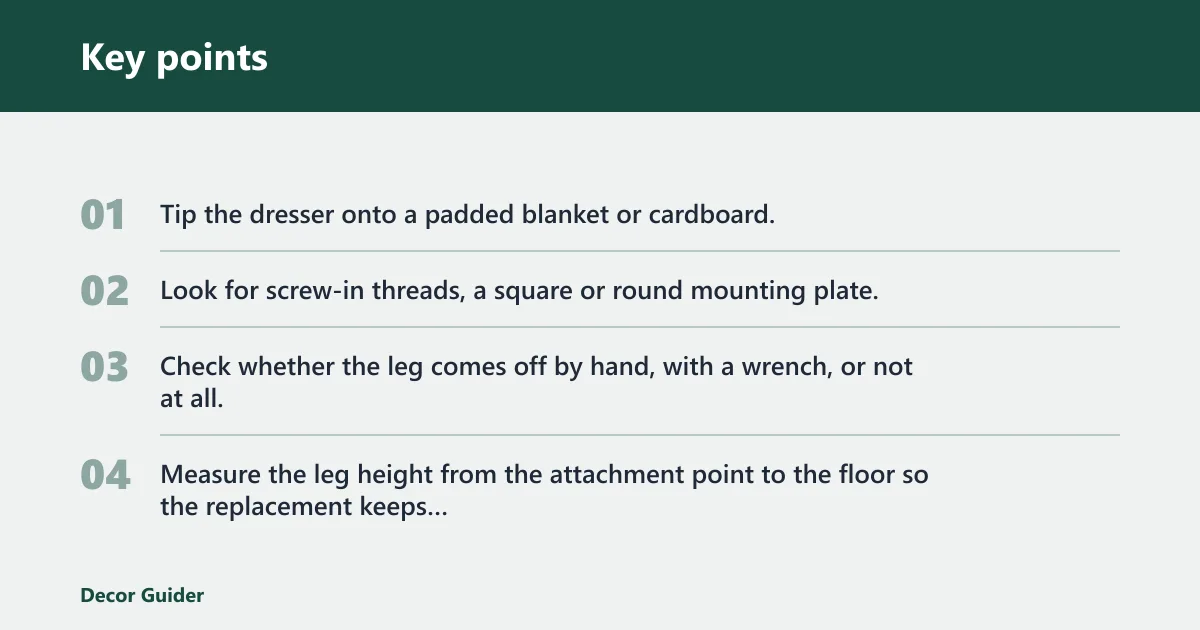
Check the underside for threads, plates, or corner blocks
- Tip the dresser onto a padded blanket or cardboard, and block the body so it cannot roll or twist.
- Look for screw-in threads, a square or round mounting plate, or a leg joined to a corner block.
- Check whether the leg comes off by hand, with a wrench, or not at all.
- Measure the leg height from the attachment point to the floor so the replacement keeps the same clearance or changes it on purpose.
Identify solid wood versus particleboard or MDF
Solid wood usually holds fasteners better and may accept a new insert if the old one pulls out. Particleboard and MDF are more likely to strip, crumble, or split, so the repair path often changes. Veneer on top does not change the underside structure. A common first-timer mistake is judging the repair by the outside finish instead of the material at the mount.
Look for stripped holes, cracks, or loose joinery
Inspect the rail area, corner block, and any hidden apron. If the screw hole is enlarged, the insert spins, or the block is cracked, do not force a new leg into place. That kind of damage usually needs repair first, because a new leg cannot stay tight on failing wood.
How do you remove the old leg or hardware?
Support the dresser before you remove anything. Forcing a stuck leg can split the frame, tear veneer, or damage drawers and trim. If the dresser is heavy, remove drawers first to reduce weight and make tipping safer. Use a helper if the cabinet is tall or top-heavy.
Remove screw-in legs, bolts, or plates carefully
- Take out drawers so the dresser is lighter and the fronts do not bind.
- Use a screwdriver, wrench, or socket to remove visible hardware in the reverse order of installation.
- Back out screw-in legs by hand if they will move without binding.
- If a plate is attached, remove the plate screws before lifting away the leg.
Free stuck hardware without splitting the frame
Apply steady pressure, not sudden force. If a screw-in leg resists, work it back and forth a few degrees, then try again. If a wood screw or hanger bolt is frozen, a drop of penetrating oil on metal threads may help, but keep it away from finished surfaces. Do not pry against thin particleboard edges.
Suppose a 48-inch dresser has one rear leg spinning in a loose insert. Tightening more will not solve that. The mount usually needs the insert replaced or the hole rebuilt before a new leg will hold weight.
How do you install the replacement legs?
Match the attachment style first, then the thread size, then the leg profile and finish. Screw-in legs commonly use threaded inserts, and those inserts must match the bolt diameter and pitch. Plate-mounted legs need the plate centered so the load sits under the cabinet, not out near the edge. Tighten only until the joint seats firmly.
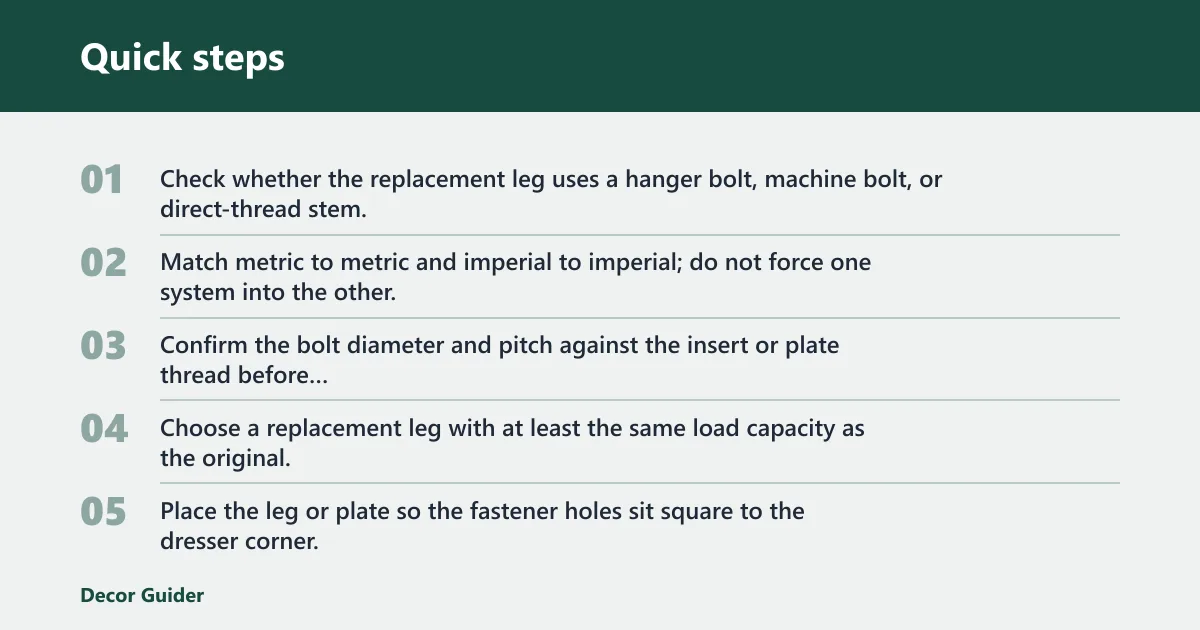
Match the attachment style and thread size
- Check whether the replacement leg uses a hanger bolt, machine bolt, or direct-thread stem.
- Match metric to metric and imperial to imperial; do not force one system into the other.
- Confirm the bolt diameter and pitch against the insert or plate thread before installation.
- Choose a replacement leg with at least the same load capacity as the original.
Set the new leg or plate in the correct position
- Place the leg or plate so the fastener holes sit square to the dresser corner.
- Mark pilot holes with the plate centered and aligned to the cabinet edge.
- Drill pilot holes with a bit sized to the wood screw, keeping the depth shallow enough to avoid punching through the panel.
- Use washers where needed to spread load on soft wood or engineered board.
Tighten fasteners and check clearance
- Thread the leg in by hand first, then finish with a wrench only until snug.
- Install wood screws or machine bolts without over-tightening.
- Set the dresser upright and check toe-kick clearance, drawer travel, and door swing if the piece has doors.
- Add height only in small increments if you are changing leg length; then recheck stability after each change.
Picture a dresser that sits too low for a rug edge. Raising each leg by 1 inch can solve the clearance issue, but it also raises the center of gravity. That is why taller replacement legs should be matched to the dresser’s width, weight, and anti-tip plan.
Common mistakes
Buying the wrong thread or plate size is the most common error. Metric and imperial fasteners look close enough to fool the eye, but the pitch must match or the insert will strip. Another frequent miss is installing new legs on cracked corner blocks or damaged rails. A level check at the end catches wobble before the dresser goes back into daily use.
- Do not force a leg into a thread that does not start by hand.
- Do not reuse a bent plate or a stripped insert just because it still fits loosely.
- Do not skip the floor-contact check on an uneven floor.
- Do not leave drawers in place while tipping a heavy dresser.
How much time and cost should you expect?
A simple screw-in leg swap can take 20 to 40 minutes. Plate-mounted repairs often take 45 to 90 minutes because you must align the plate and verify the fasteners. Cost varies with material and damage: replacement legs are often modest in price, while inserts, plates, and repair supplies add more if the frame is stripped or cracked.
Frequently asked questions
Can you change the legs on a dresser?
Yes, if the dresser has removable legs or a frame that can accept new mounting hardware. If the existing leg is fixed into a cracked rail, stripped insert, or thin engineered board, the frame needs repair first. The underside tells you which path is realistic.
Can I replace the legs on my dresser without damaging it?
Yes, if you support the cabinet, remove drawers, and use the correct attachment method. The safest approach is to tip the dresser onto padding, back out the fasteners by hand as much as possible, and avoid prying against veneer or soft particleboard edges.
What kind of screws or inserts do dresser legs use?
Many screw-in dresser legs use threaded inserts matched to a hanger bolt or machine bolt. The thread system must match exactly, including metric or imperial size and pitch. Plate-mounted legs usually use wood screws for the plate and a separate threaded stem for the leg.
How do I tell if my dresser legs are removable or fixed?
Look underneath for a visible thread, a mounting plate, or a leg attached to a corner block. If the leg is part of a continuous frame rail with no separate hardware, it is likely fixed. Stripped holes, loose blocks, and cracked rails change the repair plan.
Can I replace one dresser leg or should I replace all four?
You can replace one leg if the other three match in height and the mount is sound. Replace all four when the style, finish, or height changes, or when the original legs are worn unevenly. A full set makes height and floor contact easier to balance.
Products related to this article
Sponsored / affiliate links. As an Amazon Associate I earn from qualifying purchases. I may earn additional commission from eligible campaigns.