MDF Dresser Review: Is It Worth It?
Yes, an MDF dresser is worth it for everyday bedroom use if it has thick panels, sealed edges, and a solid drawer system. Skip it if the room is damp or the unit uses thin, unsealed boards. Poor MDF construction swells, chips, and loosens faster, turning a cheap buy into a short-lived one. This guide judges MDF dressers by moisture resistance, edge durability, drawer stress, and repairability.
Verdict

The practical split is simple. MDF works best in dry bedrooms, rentals, and painted or veneered dressers that see normal clothing storage. It is a weaker choice in humid rooms, child-heavy traffic, or any setup that expects repeated assembly, rough handling, or frequent moves.
Specs at a glance
| Factor | MDF dresser reality | What to look for |
|---|---|---|
| Core material | Furniture-grade composite board used for panels, carcasses, and drawer parts | Thicker panels and well-sealed edges |
| Moisture behavior | Vulnerable at raw edges, damaged by spills, and weaker in humid rooms | Sealed edges, protected top, dry placement |
| Edge durability | Chips more easily than solid wood at corners and seams | Wrapped or veneered edges with clean joins |
| Screw-holding | Good enough for normal furniture hardware, less forgiving after repeat assembly | Hardware seated into thicker stock and reinforced anchor points |
| Finish options | Paint-ready surfaces and veneer over MDF are common | Quality paint, stable veneer, low visible seam wear |
| Repairability | Minor filler and touch-up work is possible; deep edge damage is harder to fix | Damage prevention more important than repairs |
Who it
MDF is a sensible dresser choice for shoppers who want a finished look at a lower price than solid wood, and who plan to keep the piece in a controlled bedroom. It is also a common fit for painted dressers, veneer-faced designs, and mixed-material builds where the frame does most of the structural work.
Renter use case
Renters often get the most value from MDF because the furniture needs to look clean, hold clothing, and stay affordable. The main trade-off is move damage. If the piece will be carried up stairs, assembled again later, or bumped through narrow halls, edge chips and screw wear become real risks.
Family home use case
For family use, MDF can work if the dresser is anchored and kept away from wet cleaning habits or rough play. Safety matters more than material preference. An anti-tip kit is not optional in a child’s reach; wall anchoring should be part of the purchase decision, not an afterthought.
Humid bedroom use case
Skip MDF when the room stays damp, has poor ventilation, or sees regular condensation. Raw edges are the weak point. Once water gets in, swelling can show first at corners, lower panels, or around hardware holes, and that damage is hard to reverse cleanly.
Heavy clothing storage use case
MDF can handle normal folded clothing, but it is a weaker fit for heavy drawer loads, especially if the drawer system is basic. Large stacks of denim, sweaters, or bedding put more stress on slides, joinery, and the back panel, so sturdier construction matters more than a sleek finish.
What works
MDF performs well when the dresser is designed around its strengths: flat panels, smooth finishes, and consistent factory machining. It takes paint well, and veneer over MDF can create a cleaner surface than raw wood in budget and midrange furniture. That makes it useful for simple bedroom styles with minimal carving or heavy profiling.
Paint and veneer compatibility
Painted MDF can look very clean because the surface is uniform and free of knots. Veneer over MDF is also common, especially on visible dresser tops and side panels. The trade-off is that the finish layer can hide the core, but only until the veneer gets cut, lifted, or worn through at edges.
Drawer fronts and clean-lined styling
Flat drawer fronts and boxy shapes suit MDF well. The material is often chosen for modern dressers because it supports sharp, consistent lines without the grain mismatch you get in some solid wood assemblies. That clean look is useful in bedrooms where the dresser should disappear visually rather than dominate the room.
Mixed-material builds with a solid eucalyptus base
Mixed-material construction can be a smart middle ground. West Elm’s Wright dresser, for example, uses a solid eucalyptus base and frame component, while the top and side panels use walnut veneer over engineered wood. That split matters: the load-bearing frame is doing one job, while the surface layers are doing another.
The same dresser is priced at $1,799–$1,999, and West Elm describes it as not more durable than the Mid-Century Dresser. That is a reminder to judge the structure, not the finish alone. A walnut veneer surface can look premium, but darker finishes also make wear marks more visible.
What fails first on MDF dressers?
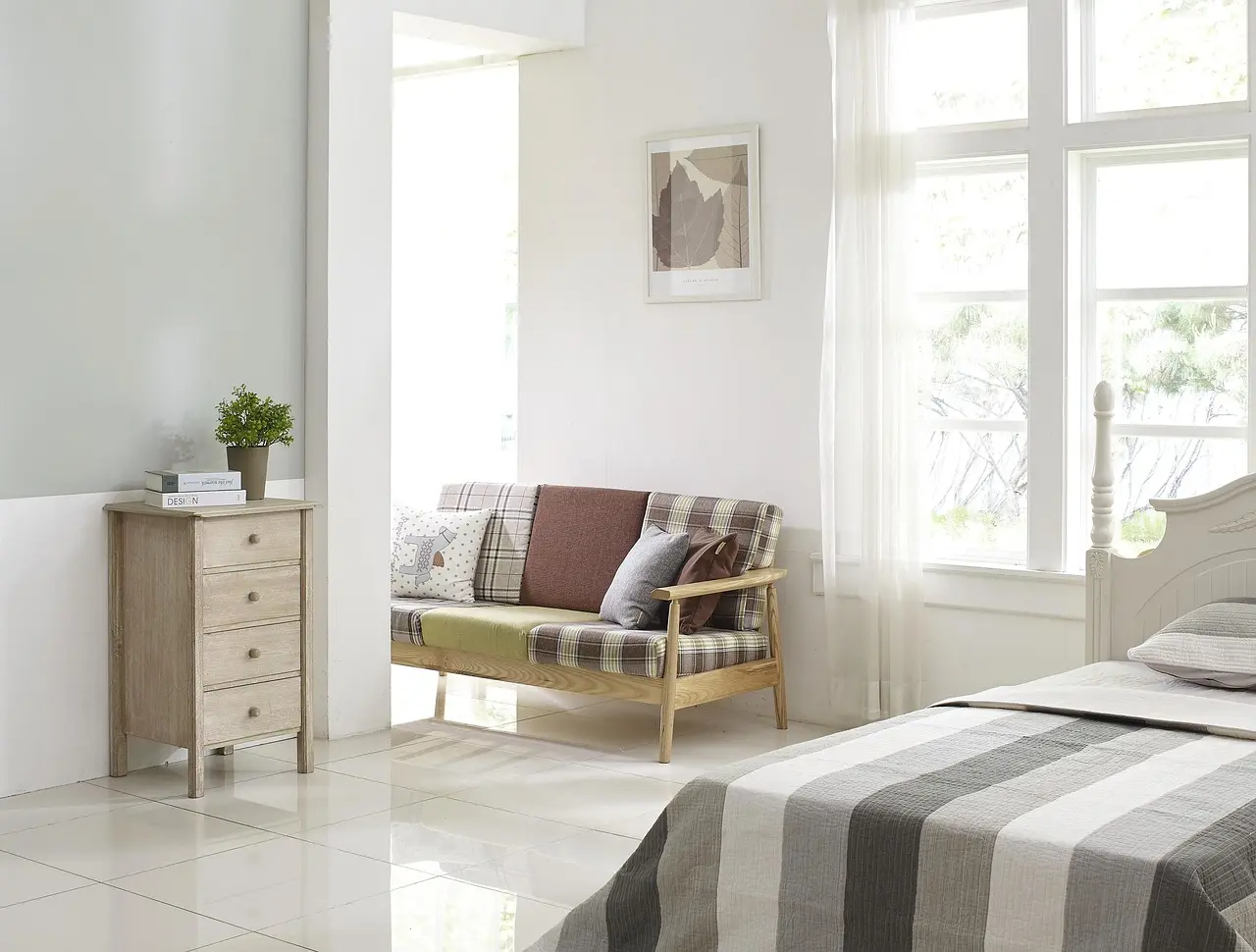
The first failures are usually not dramatic breakage. They are swollen edges, chipped corners, stripped screw holes, and top-surface wear where lamps, trays, or organizers sit every day. Those problems matter because they are the kinds of damage that make a dresser look tired long before the whole unit collapses.
Moisture and swollen edges
MDF is vulnerable where the core is exposed. A spilled drink, damp cloth, or humid room can cause swelling at raw edges and around seams. If the top has no strong finish barrier, ring marks and edge lift become more likely over time.
Chipped corners and exposed seams
Corners are where MDF usually loses the cosmetic battle. The material is dense, but it does not behave like solid wood when impacted. Once a corner chips, the repair can be visible unless the break is small and the finish matches well.
Stripped screw holes and hardware stress
MDF is serviceable for dressers, but repeated assembly can weaken screw holes. That matters for drawer hardware, back panels, and anti-tip anchoring points. If the dresser will be moved often, the risk of loose fittings rises, especially on thinner panels or low-cost construction.
Top-surface wear from daily accessories
The dresser top gets daily friction from lamps, jewelry trays, watches, and catchall bins. Scratch visibility depends on the finish, but dark tones often show wear sooner. Heat protection matters too, because hot items can leave marks on thin veneer or painted surfaces.
Say your dresser sits under a lamp and a ceramic tray in a dry bedroom. The top may stay usable for years, but the first visible wear is likely to appear where the lamp base shifts or where keys are dropped every day. That is not a structural failure. It is a finish problem that still affects how the piece reads in the room.
MDF dresser decision matrix
This matrix uses a simple 1-to-5 scale. A higher score means better performance for that factor. Moisture resistance and repairability are scored from the viewpoint of bedroom use, not workshop abuse. “Recommend” means the trade-off usually makes sense; “not recommend” means another material is the safer buy.
| Scenario | Moisture resistance | Edge durability | Screw-holding | Repairability | Value | Verdict |
|---|---|---|---|---|---|---|
| Renter | 3 | 3 | 3 | 2 | 5 | Recommend |
| Family home | 3 | 2 | 3 | 2 | 4 | Recommend with anchoring |
| Humid room | 1 | 2 | 2 | 1 | 2 | Not recommend |
| Heavy clothing load | 3 | 3 | 2 | 2 | 3 | Not recommend unless hardware is strong |
| Nightstand use | 4 | 3 | 3 | 2 | 4 | Recommend |
| Budget makeover | 3 | 3 | 3 | 2 | 5 | Recommend |
MDF vs solid wood and other boards

MDF is not automatically the weaker choice, but it is less forgiving than solid wood when damage shows up. Solid wood is generally easier to sand, patch, and refinish. MDF often costs less and accepts paint cleanly, yet it gives you less repair room after swelling, corner damage, or stripped hardware holes.
Solid wood versus MDF
Solid wood makes more sense when you want long service life, repeated moving, or future repair work. MDF makes more sense when you want a stable painted finish and lower upfront cost. In dresser use, the question is not whether one is always better. It is whether the owner needs repairability or a smoother finished face.
Laminate and particleboard in bedroom storage
Laminate over a lower-grade core can hide wear for a while, but edge damage exposes the substrate quickly. Particleboard is usually less dense than MDF and often weaker at fasteners, which can make screw pullout and corner damage show up sooner. In practical bedroom use, MDF often sits above basic particleboard and below solid wood for toughness.
Furniture-grade composite board and mixed-material construction
Furniture-grade composite board is the broad category that includes MDF and related manufactured panels used in dresser carcasses, drawer parts, and backs. Mixed-material construction can improve the result when the frame is stronger than the panels. That is why a solid wood base or eucalyptus base can matter as much as the face material.
Business Insider says Thuma’s dresser is made from repurposed solid wood, and the dresser has a limited lifetime warranty. Its 4×2 configuration measures 66 x 19 x 38 inches, with drawer dimensions listed at 30 x 15 x 5 inches. Thuma also offers multiple configurations, including 2×1 through 5×1, and setup reportedly took about 15 to 20 minutes. An included anti-tip kit is part of the package.
Should you buy it?
Buy an MDF dresser if you want a painted or veneered look, expect normal bedroom use, and can keep the piece in a dry room. It is also a reasonable choice if the dresser will not be moved often and the hardware feels solid. In that setup, MDF’s price-to-finish ratio often makes sense.
Skip it if you need a dresser that will face humidity, repeated disassembly, or rough daily use from kids and heavy storage loads. The material can work, but it does not hide abuse well. Once edges swell or screw holes loosen, repairs become more cosmetic than structural.
For safety, anchor any dresser within a child’s reach to the wall with an anti-tip kit. HomeStuffExpert references ASTM and JPMA safety standards for children’s dressers, which puts the focus where it belongs: stable installation and reduced tip risk. Safety starts with setup, not with finish quality.
Alternatives
The Spaco White 6 Drawer Dresser is the clearer budget-friendly MDF-style option in this group. Based on the published details, it fits shoppers who want six drawers, a white finish, and everyday storage without a premium price tag. The drawback is the usual MDF risk profile: moisture sensitivity, edge wear, and a finish that depends on careful use.

The Sauder Shoal Creek 4-Drawer bundle costs more at $505.96, but the published details point to a different ownership profile. Easy-glide metal runners and safety stops are useful, and the lower drawers are extra deep. The trade-off is that it has fewer drawers than the six-drawer option, so storage density may not suit everyone.
Frequently asked questions
Is mdf good for furniture?
Yes, MDF is good for furniture when the piece stays dry, the edges are sealed, and the hardware is well made. It is especially useful for painted or veneered dressers, shelves, and cabinets. It is less attractive where repeated impacts, humidity, or heavy repair needs are likely.
Why is mdf suitable for furniture?
MDF is suitable for furniture because it machines cleanly, takes paint well, and offers a uniform panel surface without knots or grain variation. That consistency helps with flat dresser sides, drawer fronts, and smooth finishes. It is a practical choice for factory-made furniture that needs repeatable results.
Is mdf furniture safe?
MDF furniture is generally safe when it is assembled correctly, kept stable, and anchored where tip-over risk exists. The key safety issue is not the core material alone; it is installation, load balance, and wall tethering. In child-access areas, an anti-tip kit should be treated as required.
Is mdf wear resistant?
MDF is moderately wear resistant in normal bedroom use, but its weak spots are edges, seams, and exposed corners. Surface wear can show on the top from lamps or trays, and moisture can make the damage worse. Good finish quality matters as much as the core itself.
Is mdf cheaper than wood?
Usually, yes. MDF furniture is often cheaper than solid wood because the core material is manufactured and the finish can be produced efficiently. The price gap shrinks when you compare higher-end veneer work, stronger hardware, or mixed-material construction with a solid frame.
What is furniture grade mdf?
Furniture-grade MDF is a manufactured panel intended for interior furniture use, with a denser, more consistent core than very low-cost board. It is used in dresser bodies, drawer parts, and panels where a smooth paint or veneer finish is needed. Edge sealing and thickness still matter.
Products related to this article
Sponsored / affiliate links. As an Amazon Associate I earn from qualifying purchases. I may earn additional commission from eligible campaigns.