How to Tell If a Dresser Is Solid Wood
Check the edges, drawer sides, and underside: solid wood shows continuous grain and the same wood inside and out, while veneer, MDF, and particleboard reveal a thin face layer, fuzzy fiber core, or visible chips. Miss it and you can overpay, buy a weak dresser, or ruin a veneered piece with the wrong sanding or stain. This guide gives you a no-tools inspection flow for edges, drawers, and the underside.
Is weight enough to tell?
Weight is one quick clue, not the final answer. Solid wood furniture is often heavy, but heavy MDF and dense hardwoods can fool you, and light pieces are not always low quality. Start with weight, then confirm it with edge, drawer, and underside checks.
A 48-inch dresser may feel unusually dense for its size. That may point to solid wood, but it can also be thick MDF with a heavy finish and hardware. The next step is not a guess; it is an edge inspection, because the material often gives itself away there.
Use weight as a quick filter
Lift one side slightly if the dresser is safe to move. A solid-wood dresser often feels heavy because wood has mass through the full panel, while MDF and particleboard can also weigh more than expected when the panels are thick. Use that feeling to decide whether to keep inspecting.
Watch for false positives
Dense hardwoods, thick tops, and large drawers can all add weight. Heavy MDF is the common false positive. So is a veneered piece built over a thick core. That is why weight alone cannot tell you how to tell if something is solid wood.
Check the edges and underside
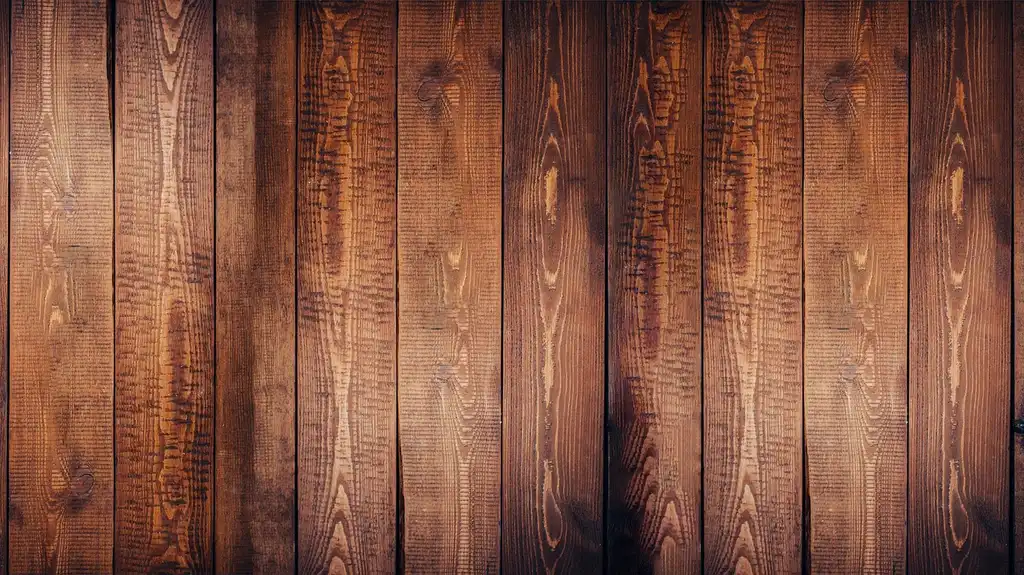
Edges and underside corners are the fastest places to separate solid wood from veneer, laminate, MDF, and particleboard. End grain is the strongest field check: solid wood shows continuous growth rings and natural pores through the thickness, and the face should visually connect to the edge. Veneer, by contrast, is a thin wood layer over a core.
Look for end grain and continuous growth rings
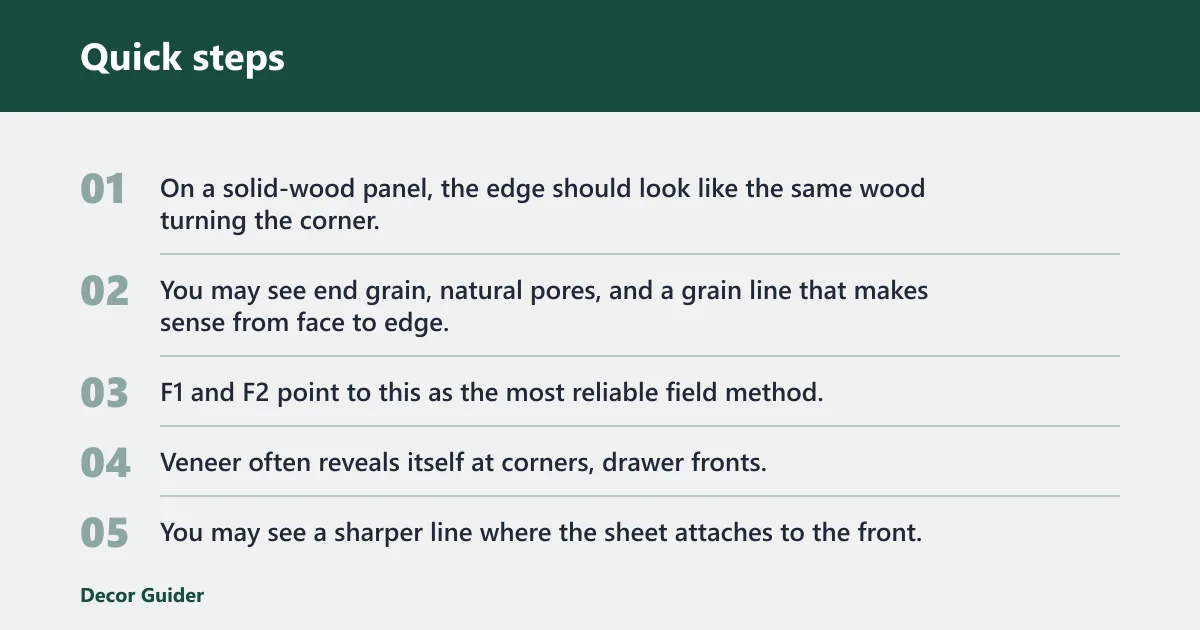
On a solid-wood panel, the edge should look like the same wood turning the corner. You may see end grain, natural pores, and a grain line that makes sense from face to edge. F1 and F2 point to this as the most reliable field method.
Spot veneer edges, wrapped panels, and seams
Veneer often reveals itself at corners, drawer fronts, or chipped spots where the thin face layer meets the core. You may see a sharper line where the sheet attaches to the front, or repeated grain that looks printed instead of random. Repeated grain patterns usually indicate veneer over engineered board.
Laminate can look similar from a distance, but it is a surface film, not wood veneer. If the edge shows a thin wrap, a plastic-looking seam, or a pattern that repeats exactly on another panel, treat it as a non-solid surface until proven otherwise.
Inspect the back and bottom
Flip the dresser or look underneath with a phone light. Unfinished wood underneath can indicate wood rather than laminate. A raw back, exposed edge, or plain board underside gives you clues about the core. Particle board often shows a compressed, irregular core of chips or fibers, while MDF presents a dense, homogenous structure.
A common first-timer mistake is trusting the visible front alone. A front panel can look like oak while the underside shows a manufactured core. The underside is where the truth often appears first.
What do the drawers tell you?
Drawer construction helps you separate better-built casegoods from low-cost furniture, but it does not prove the entire dresser is solid wood by itself. Dovetail construction is a great indicator of solid wood, yet a drawer can have good joinery and still sit inside an engineered case.
Look for dovetails and other joinery
Open the drawer and study the front corners. Dovetails are a strong sign of careful construction. Tongue-and-groove joints, clean joinery at the drawer front, and square, tight corners also point toward better workmanship. F13, the handmade dresser example, showed hand-cut dovetail joinery and square-head nails.
Check the drawer back and sides
Drawer backs often reveal more than the face does. Solid wood drawers usually show visible grain on the back and sides, while engineered material may show a flatter, more uniform texture or a thin veneer surface. If the drawer back looks like a different material from the front, stop and compare the two.
Separate construction quality from material type
Good joinery means the dresser was built well. It does not automatically mean every panel is solid wood. A dresser can have dovetailed drawers and still use MDF or particleboard elsewhere, especially in the case, back, or hidden rails.
How do grain and finish read?
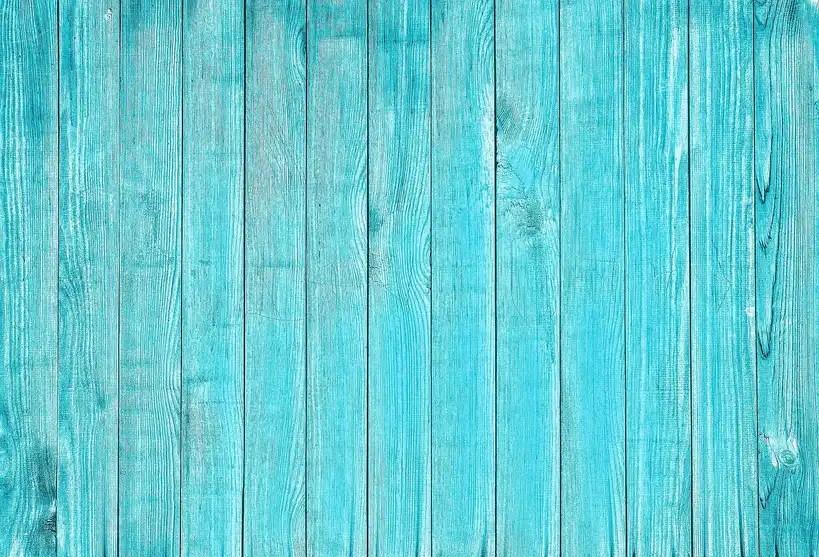
Natural grain is irregular. It varies in pore size, line direction, color shift, and knot pattern. Solid wood panels have unpredictable character like knots and uneven pore size, while repeated or mirrored grain often points to veneer or laminate. Texture matters too: real wood usually has depth you can feel, not only see.
Look for natural grain variation
Scan the face and then compare it to the edge. Solid wood usually shows a grain that changes direction in a believable way. Knots, pores, and small color changes are normal. If the pattern looks too orderly, it may be a printed surface rather than a full wood panel.
Spot repeated or mirrored grain
Veneer and laminate often repeat. You may see the same swirl on two drawer fronts or a mirrored grain pattern that matches too perfectly. That is a warning sign, especially when the pattern stays identical across a large flat area. F6 notes that repeated grain patterns usually indicate veneer over engineered board.
Picture two dresser drawers with nearly identical grain marks, right down to the dark streak near each pull. That symmetry is suspicious. Real wood can look similar from drawer to drawer, but exact repetition is a strong clue that the surface is printed or sliced from a matched sheet.
Use knots, pores, and color shifts as clues
Knots, uneven pores, and small shifts in tone are useful because they are difficult to fake convincingly at scale. If the finish has depth and the grain changes naturally across the panel, you are more likely looking at solid wood or a real wood veneer on top of another core.
Dresser inspection checklist
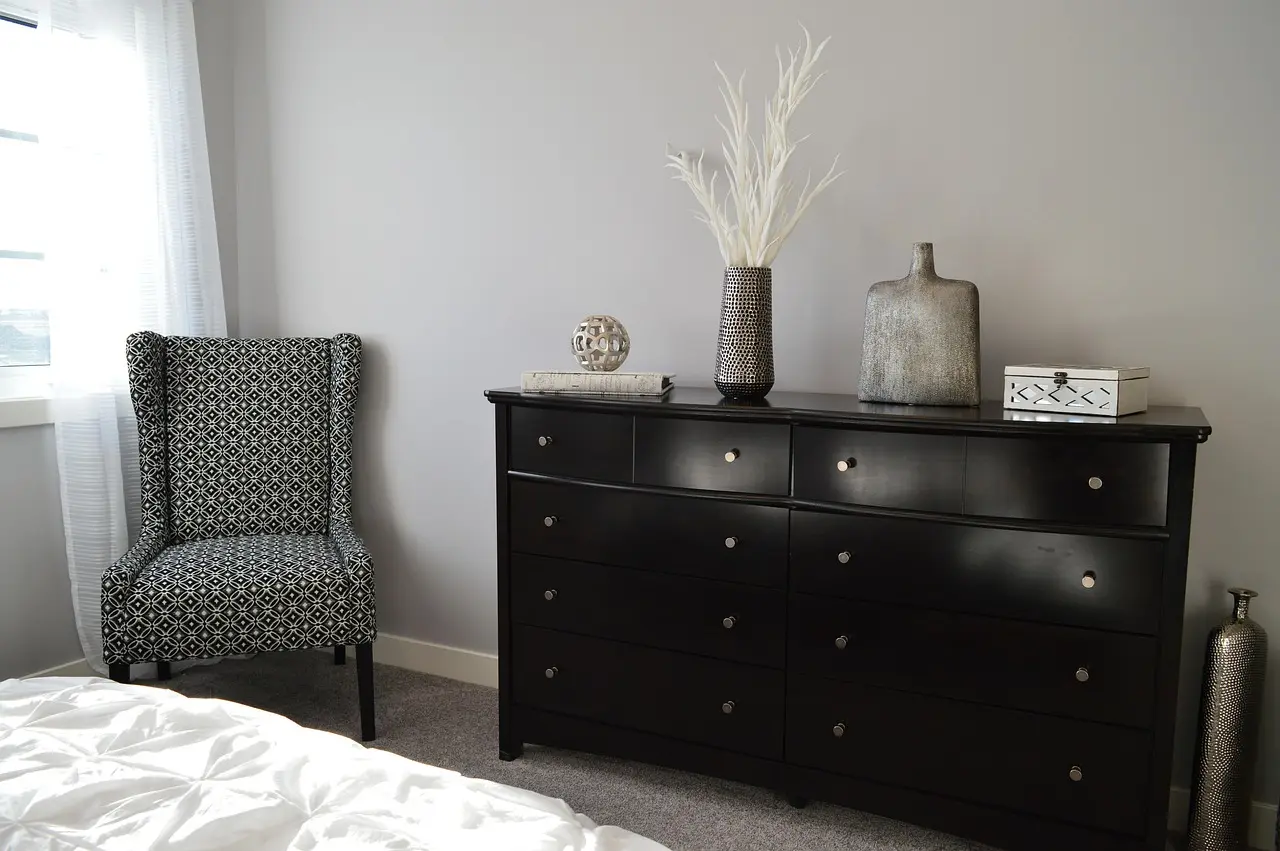
This one-page checklist gives you a quick decision path. Use it in order: edge first, then drawer, then underside. The final column helps you sort false positives, including heavy MDF, solid-wood veneer parts, and laminate.
| Check | What to look for | Likely material outcome | False positive to watch for |
|---|---|---|---|
| Edge test | End grain, continuous growth rings, natural pores, face matching the edge | Solid wood | Solid-wood veneer parts with a wood face over another core; laminate with a wood-look print |
| Edge test | Thin face layer, corner chip, repeating grain, visible seam at the front edge | Veneer over engineered board | Real wood veneer is still real wood on the face, but it is not solid wood |
| Drawer test | Dovetails, tongue-and-groove, visible grain on drawer sides and back | Better-built casegoods, often with more wood content | Drawer quality can be high while the case is MDF or particleboard |
| Underside test | Raw wood exposure, unfinished back, exposed board core, edge wrapping | Solid wood or wood-faced construction | Laminate can look clean on the outside while hiding a manufactured core |
| Weight check | Heavy feel compared with size | Could be solid wood | Heavy MDF and dense hardwoods can feel similar |
- Lift or tilt the dresser if it is safe to do so.
- Inspect one edge and one corner for end grain or a visible core.
- Open a drawer and check the front corners, sides, and back.
- Look underneath for raw wood, board chips, or a wrapped edge.
- Decide whether the result is solid wood, veneer, MDF, or particleboard.
Can carvings and age help?
Yes, but only as supporting clues. Deep carving points to a wood substrate because laminate and veneers cannot be carved deeply. Age can also help narrow the field, since older dressers often use different construction and back materials than many modern pieces, but age alone does not prove solid wood.
Read carved details as evidence of wood substrate
Ornate profiles, routed edges, and carved panels usually mean the surface is actual wood thick enough to cut into. If the detail is deep and clean, that is a strong clue for wood substrate. It does not tell you whether the whole dresser is solid wood, but it does rule out many thin-surface products.
Use patina and antique clues carefully
Older dressers often show square-head nails, simple back boards, and hand-cut joinery. F14 notes an old dresser with extra-wide barn planks as the back, which is a useful clue when you are checking antique casework. Still, worn finish, patina, and age do not prove a solid-wood build on their own.
How much is a solid wood dresser worth?
Material affects value, but condition, style, size, and construction matter too. Solid wood often costs more than MDF or particleboard furniture, and repairability is usually better. A dresser with good joinery, sound panels, and an intact finish is easier to refinish or repair than one with a damaged veneered core.
That said, price is not the best identification tool. A low-priced solid wood dresser exists, and an expensive dresser can still use veneer over engineered board. Use material checks first, then price as a separate buying clue.
Is solid wood good for furniture?
Solid wood is often a strong choice for many dressers because it can usually be sanded, repaired, and refinished more readily than particleboard or MDF. It also tends to hold screws better than lower-density engineered board. That said, veneer over a stable core can still be a good furniture build.
Frequently asked questions
How to tell if a dresser is solid wood or veneer
Check an edge or corner first. Solid wood shows continuous grain through the thickness, while veneer shows a thin face layer over another core. If the grain repeats too neatly, or the edge reveals a seam, you are likely seeing veneer rather than solid wood.
How to tell if furniture is solid wood or veneer
Check the corners, then the underside, then the drawer fronts. Solid wood stays visually consistent through the thickness, while veneer has a thin wood face that can chip or reveal a different core. Repeated grain and a thin edge layer usually point to veneer.
How do you know if a dresser is solid wood?
Use three clues together: end grain at the edge, natural grain that changes across the panel, and drawer or underside construction that matches the face. Dovetails help, but they do not prove the whole dresser is solid wood by themselves.
How much weight can a solid wood dresser hold?
There is no single safe number because capacity depends on the frame, joinery, drawer slides, fasteners, and how the load sits inside the dresser. Solid wood can support more than low-cost board furniture in many cases, but you should still follow the maker’s stated limit if it exists.
How to tell if a piece of furniture is real wood
Start with the edge, because that is where material type is easiest to see. Real wood may appear as solid wood or as wood veneer over another core. If the grain looks printed, the core looks fuzzy or chipped, or the back is wrapped, keep checking.
Products related to this article
Sponsored / affiliate links. As an Amazon Associate I earn from qualifying purchases. I may earn additional commission from eligible campaigns.