How to Move a Heavy Dresser by Yourself
Move a heavy dresser by yourself only if it can be emptied, loose parts can be removed, and it can stay on sliders, a dolly, or a moving strap; if it tips, catches on a threshold, or needs lifting above knee height, stop and get help. Poor handling can crack the frame, gouge a floor, or trap a hand or foot between the dresser and a wall, doorway, or stair edge. This guide shows how to pick the safest solo method for your floor, route, and dresser style.
Can you move it alone?


Yes, but only when the dresser stays stable after you empty it and it can travel without a hard lift. A low, boxy dresser on a clear, ground-floor path is a different job from a tall chest with drawers that still rattle when empty. If the piece feels top-heavy, binds in the doorway, or shifts on its base, do not force a solo move.
What you need to decide first
The main question is not weight alone. It is whether the dresser keeps its balance when empty, whether the route is flat and open, and whether you can turn it without twisting the frame. Tall, narrow dressers are more prone to tipping, and drawers can rack the slides if you leave weight inside.
Why dressers fail during solo moves
Common failure points are predictable: the dresser tips as the center of gravity moves, drawers slide open and rack the case, corners twist when you angle through a tight turn, and fingers get pinched when the piece shifts against a wall or threshold. Floor scuffs usually happen when people drag instead of guide the load.
Dresser move decision table
Use this table to match the dresser, floor, and route to the safest solo method. If your row lands in the high-risk column, do not treat the move as a one-person job.
| Dresser type | Floor type | Route | Stairs? | Safest method | Risk level |
|---|---|---|---|---|---|
| Low dresser, empty, stays rigid | Hard floor | Flat path, wide turns | No | Four-wheel furniture dolly, blanket-wrapped and balanced low | Moderate |
| Low dresser, empty, stays rigid | Carpet | Flat path, short distance | No | Furniture sliders under corners or legs | Moderate |
| Tall chest, top-heavy profile | Hard floor | Doorway turn | No | Usually not a safe solo move; use help rather than a dolly alone | High |
| Tall chest, top-heavy profile | Any | Stairs | Yes | Do not attempt solo; stairs are a no-go for a one-person move | Very high |
| Medium dresser, drawers removed, secure case | Hard floor or carpet | Long flat path, no turns | No | Sliders or a strapped dolly, depending on balance | Moderate |
| Any dresser that binds in a doorway | Any | Tight corner or narrow hall | No | Stop and measure again; do not force the angle | High |
How do you prep the dresser?
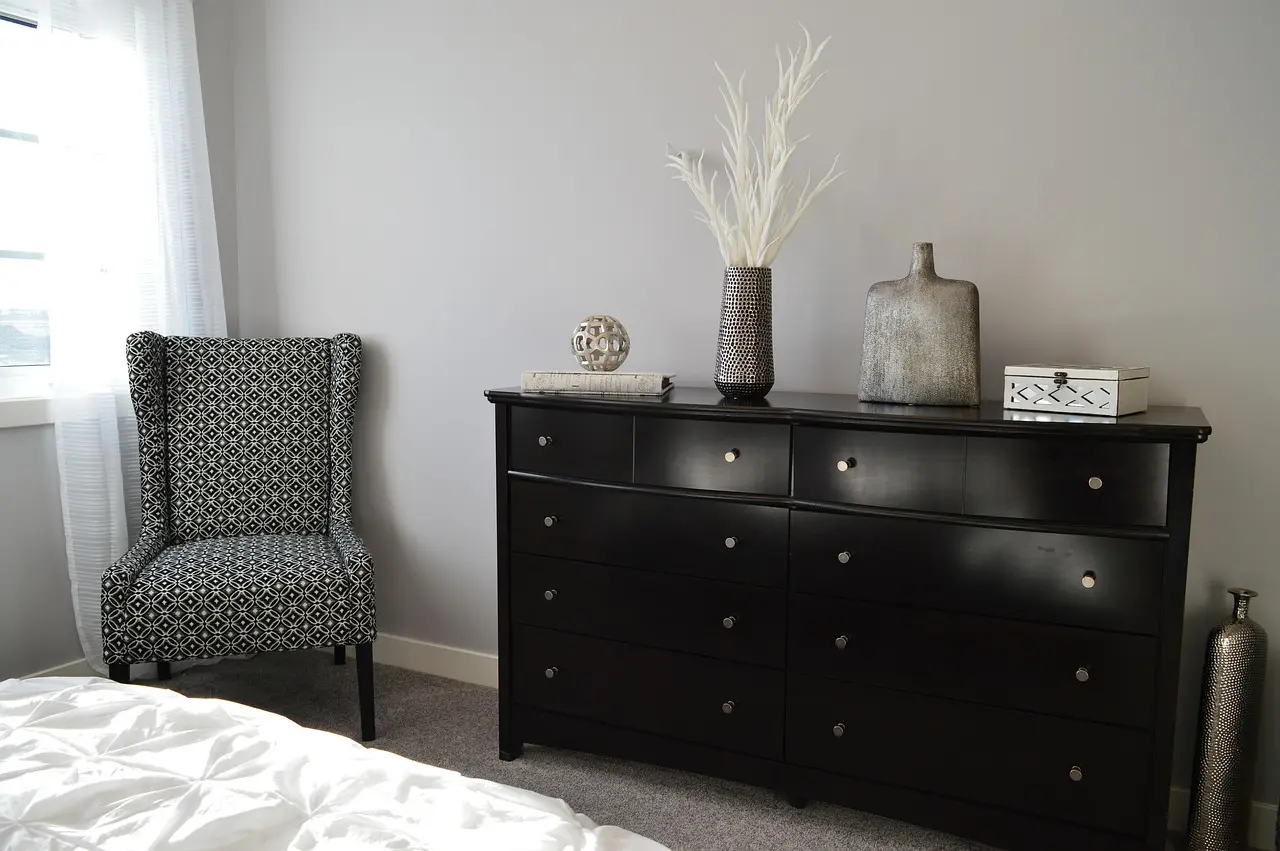
Empty the dresser, take out the drawers when you can, lock or tape shut any remaining drawers and doors, and remove a mirror if one is attached. That lowers the center of gravity, cuts drawer-slide stress, and removes loose parts that can swing or fall. If the dresser still feels wobbly when empty, it is warning you that the case itself is not a good solo candidate.
Empty and remove drawers
- Take every drawer out before the move if the design allows it.
- Bag hardware and label it by drawer or section.
- Leave drawers in only if removing them would make the frame less stable; even then, secure them fully closed.
Hustle and Muscle notes that tall, narrow dressers can be top-heavy, and that is exactly the kind of profile that should not carry extra weight in the drawers. If drawers stay in, tape them shut and move more slowly.
Secure doors, drawers, and mirrors
Close every moving part before you shift the case. Use painter’s tape, stretch wrap, or the dresser’s own hardware if it locks securely. If a mirror is attached, remove it first when that is practical, because glass adds a separate breakage and tip hazard.
Measure the route
Measure the narrowest doorway, the tightest turn, and the stair landing before you lift anything. Leave enough room for the dresser to clear the opening without forcing a twist. If a corner needs a sharp angle or the route leaves less than a few inches of comfortable clearance, treat that as a stop sign, not a challenge.
How do you move a heavy dresser by yourself?
On a flat, open route, the safest solo method is usually to keep the dresser low, centered, and controlled with sliders or a balanced dolly. Do not yank from one end. Use the tool to reduce friction or rolling resistance, then guide the piece in short, deliberate moves so it never starts to tip.
Use furniture sliders on the right floor
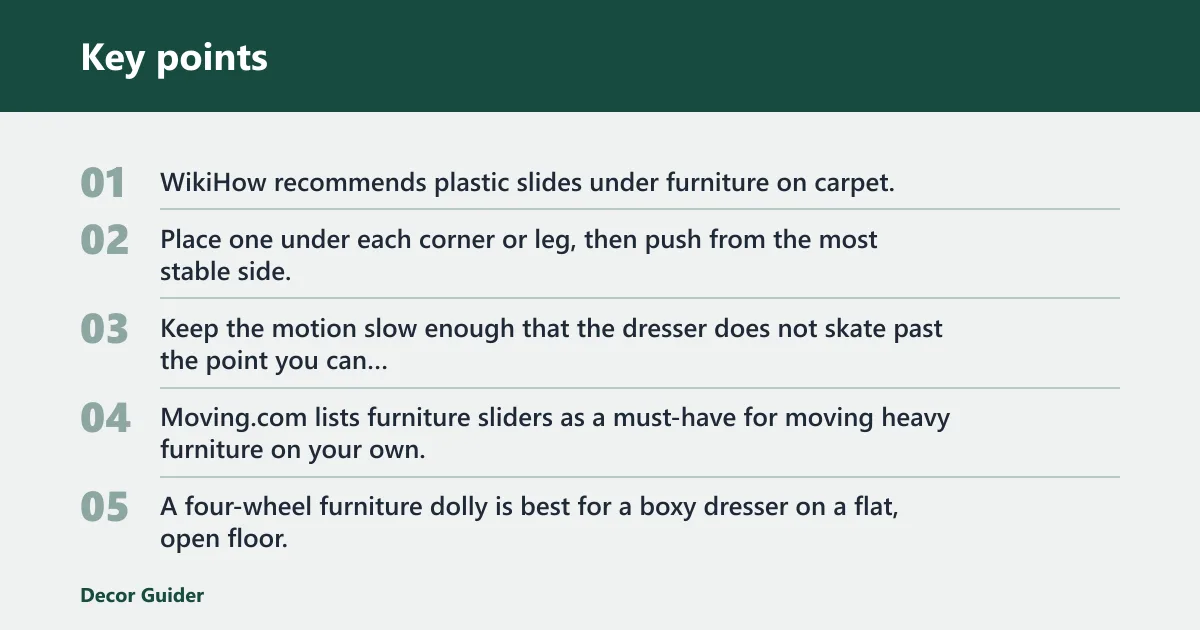
WikiHow recommends plastic slides under furniture on carpet, and sliders also work on hard floors when the material matches the surface. Place one under each corner or leg, then push from the most stable side. Keep the motion slow enough that the dresser does not skate past the point you can control.
Use a four-wheel dolly for open paths
Moving.com lists furniture sliders as a must-have for moving heavy furniture on your own, and it also includes dollies as a tool for hauling heavy items alone. A four-wheel furniture dolly is best for a boxy dresser on a flat, open floor. Center the load, secure it, and keep the base low.
Use moving straps only for controlled handling
Moving straps can transfer some weight off your back and arms, but they take practice and coordination. They work best when you are guiding, not lifting, and when the path is straight. The same source says a lifting strap is useful for small, bulky items, and that is the right scale to keep in mind.
Say your dresser is a low, empty three-drawer piece on hardwood, and the path is eight feet to a bedroom doorway. Sliders or a low dolly are the safer choice. If the same dresser needs a sharp turn into a narrow hall, the risk rises because the corner can twist the frame.
How do you handle doorways and stairs?
Doorways and stairs are the two places where a solo move most often fails. Measure before you lift, angle only when the piece still clears cleanly, and stop the moment the dresser binds, tilts, or starts to ride up on one corner. Stairs are commonly the highest-risk part of the move and are generally not a safe solo job for a heavy dresser.
Work through doorways and tight corners
- Measure the dresser’s widest point and the narrowest doorway opening.
- Pad the door frame with blankets so a small bump does not mark the trim.
- Approach the opening straight, then tilt only enough to keep the corners clear.
- If the dresser scrapes, stops, or needs a hard twist, back out and reassess.
Do not force the piece through a doorway that is too tight. Forcing creates twist-loaded corners, which can split the frame or pop a drawer rail loose.
Do not attempt solo stairs
Move one step at a time only when a second person is present. A stronger person usually controls the lower end because that end carries more of the load and has less margin for error. An appliance dolly can help with upright transport in some moves, but it is not a safe solo stair solution for a heavy dresser.
Suppose the only route out of an apartment includes ten steps and a landing turn. That is not a situation to solve with a one-person stair move. A safer option is to wait for help or hire movers with the right equipment.
Common mistakes
The most common mistake is leaving too much weight inside the dresser. That keeps the drawers acting like moving ballast and raises the chance of tip-over. Another mistake is using the wrong tool for the floor, which can scratch hardwood or make carpet drag harder than a person expects.
- Leaving drawers full: empty them first, then remove them when possible.
- Dragging instead of guiding: use sliders or a dolly so the base moves in a controlled way.
- Forcing a tight doorway: stop and remeasure instead of twisting the frame.
- Trying stairs alone: treat stairs as a no-go for solo moving.
- Skipping corner protection: wrap the dresser so walls, trim, and finish do not take the hit.
- Ignoring a wobble test: if the empty dresser feels unstable, do not trust it on your own.
Heavy dresser by yourself checklist
- The dresser still wobbles after being emptied.
- It is taller than it is stable, or the top feels heavier than the base.
- A drawer will not stay closed securely.
- The route requires a hard twist through a doorway or hall turn.
- The dresser needs lifting above knee height.
- You cannot keep both feet planted while guiding it.
- The move includes stairs and you are alone.
Frequently asked questions
How do I move a large dresser by myself without scratching floors?
Use the right surface tool: sliders on carpet or hard floors when they match the material, or a four-wheel dolly on a flat path. Protect the base with moving blankets where the dresser may brush a wall. Keep the load low, and never drag bare wood across the floor.
What is the easiest way to move a heavy dresser alone?
The easiest safe solo method is usually a low, empty dresser on sliders or a balanced four-wheel dolly, moving across a flat, open floor. If the dresser is tall, top-heavy, or needs stairs, the easiest safe answer is not solo movement. Get help before you start.
How do I move heavy furniture on carpet by myself?
Use furniture sliders designed for carpet, placed under the corners or legs. Push in short bursts and keep the piece level. If the carpet is thick or the load sinks into it, the drag may become too high for safe control, and a second person becomes the safer option.
How do I lift a heavy dresser by myself?
Do not try to dead-lift the full dresser. Empty it first, then use a tool that reduces the lift, such as sliders or a dolly. WikiHow advises bending with your knees, not your back, and wearing sleeves and closed-toed shoes. That protects you while you guide, not heave.
How do I move a heavy dresser upstairs by myself?
You should not move a heavy dresser upstairs alone. Stairs are the highest-risk part of the move, and an appliance dolly is not a safe solo stair fix for a dresser. Pause the move, get help, or use movers with stair-rated equipment and straps.
How do I move a heavy dresser downstairs by myself?
Do not attempt this as a one-person move. Downstairs travel shifts the balance point toward loss of control, especially on a tall dresser. If the route includes stairs, the safest answer is to stop and bring in another person rather than trying to manage the load alone.
Products related to this article
Sponsored / affiliate links. As an Amazon Associate I earn from qualifying purchases. I may earn additional commission from eligible campaigns.