How to Fix a Malm Dresser Drawer That Keeps Coming Off Track
A Malm dresser drawer that keeps coming off track usually points to misalignment, stripped mounts, worn glide points, or overload. Fix the cause before you adjust the rails. If you skip diagnosis, the drawer can keep binding, sagging, or dropping again, and the side panels or hardware can fail sooner. This guide shows how to test each failure point, reset the drawer, and repair the common hardware problems in order, using the same support approach IKEA gives for parts identification and replacement guidance.
Why the Malm drawer pops off track

- Smooth rolling structure supports easier drawer movement
- Replaces worn, cracked, or broken wheels
- Matches standard 6mm shaft size
Malm drawers use side runners, cabinet rails, and plastic glide points that depend on square alignment. Different Malm widths and drawer depths do not fail the same way. A shallow top drawer may pop on one side first, while a wider lower drawer may bind from load and racking before it drops free. Generic drawer-slide diagnosis starts with the failure pattern, then checks alignment, fastener hold, and wear at the contact points.
How the drawer, runner, and rail work together
The drawer side panel carries the runner contact points, the cabinet rail stays fixed to the dresser frame, and the glide or roller keeps travel smooth. On a Malm, the key parts to watch are the cabinet rail on the side panel, the drawer runner on the drawer box, the cam locks and screws that hold the side panel square, and the plastic glide or roller locations at the front and rear contact points. If one part sits out of plane, the drawer can climb the rail, twist, and drop off one side before the other side lets go.
That is why a drawer drops on one side usually points to a geometry problem rather than only a dirty track. Check left-right spacing, screw hold, and drawer squareness before you blame the rail itself.
What you’ll need
- Phillips screwdriver or the IKEA-style hex key that fits your fasteners
- Drill with a small bit for pilot holes or hole cleanup
- Wood filler for durable stripped-hole repair
- Toothpicks and wood glue for a temporary or light-duty hole repair
- Flashlight for checking the underside and rail faces
- Clean cloth for wiping dust and chips from the runners
- Flat work surface or floor space near the dresser
Tools and materials by repair type
Use the screwdriver and hex key for loosening, reseating, and tightening cam locks and screws. Use the drill only if a screw hole needs to be cleaned or re-punched. Use wood filler when a mount screw will not hold, and use the toothpick-and-glue method only as a short-term fix while you wait for a stronger repair.
Malm drawer diagnosis table
| Symptom | Likely failure point | What to inspect first | Repair action | When to replace parts |
|---|---|---|---|---|
| Left side pops first / right side stays engaged | Left cabinet rail sits low, loose, or out of parallel | Left rail screws, front and rear rail spacing, and the left glide contact point | Retighten, realign, and reseat the left rail; confirm the drawer side panel is square | Replace if the rail is bent, cracked, or will not stay aligned after tightening |
| Only when loaded | Weight is racking the drawer or exposing weak mounts | Drawer squareness, side panel stiffness, cam locks, and screw hold under load | Unpack, rebalance the contents, square the box, then retest the drawer empty and loaded | Replace if the drawer side panel is warped, split, or the mount keeps pulling free |
| Snag at the same spot | Debris, worn plastic glide, or a damaged runner contact point | Cabinet rail face, front and rear plastic glide or roller locations, and any rough patch on the runner | Clean the track, clear the snag point, and reseat or replace the worn glide | Replace if the roller is cracked, missing, or the rail has a permanent flat spot |
| Sits crooked when empty | Cabinet rail spacing is uneven or the drawer side panel is out of square | Front-to-back parallel alignment, screw tightness, and the cam lock connections on the side panel | Reset rail position, tighten the side panel hardware, and square the drawer box | Replace if the side panel is split or the rail cannot be brought back into plane |
| Repeated pop-off after reinstall | Stripped screw holes or loose mounts | Mount screws, cam locks, and hole integrity on the drawer side and cabinet side | Repair holes with filler or toothpick and glue, then reinstall with a snug pilot hole | Replace if screws still spin or pull free after a proper repair |
How do you remove the drawer safely?
Empty the drawer first, then lift and guide it off both runners without twisting it. A Malm drawer can catch on one side if you pull at an angle, and that twist can damage the glide point or widen a loose screw hole. Remove it straight, support both sides, and set it on a flat surface for inspection.
- Remove all contents from the drawer so the runners carry no weight.
- Pull the drawer straight out until it reaches its stop.
- Lift the front slightly while keeping both sides level.
- Pull forward with steady pressure until the drawer clears the rails.
- Set it on a flat surface for inspection.
Say your wide lower Malm drawer drops from the left side after a heavy stack of sweaters. Removing the load first often shows that the runner itself is fine, but the left mount has shifted enough to let the drawer twist under weight.
How do you check the rails and mounts?
Inspect the cabinet rail, mount screws, and gap consistency before touching the drawer side. If the left and right rails are not parallel, the drawer can ride up on one side and fall off even when the hardware looks intact. The fastest route is to compare both sides, then trace the mismatch back to the loose mount or bent rail.
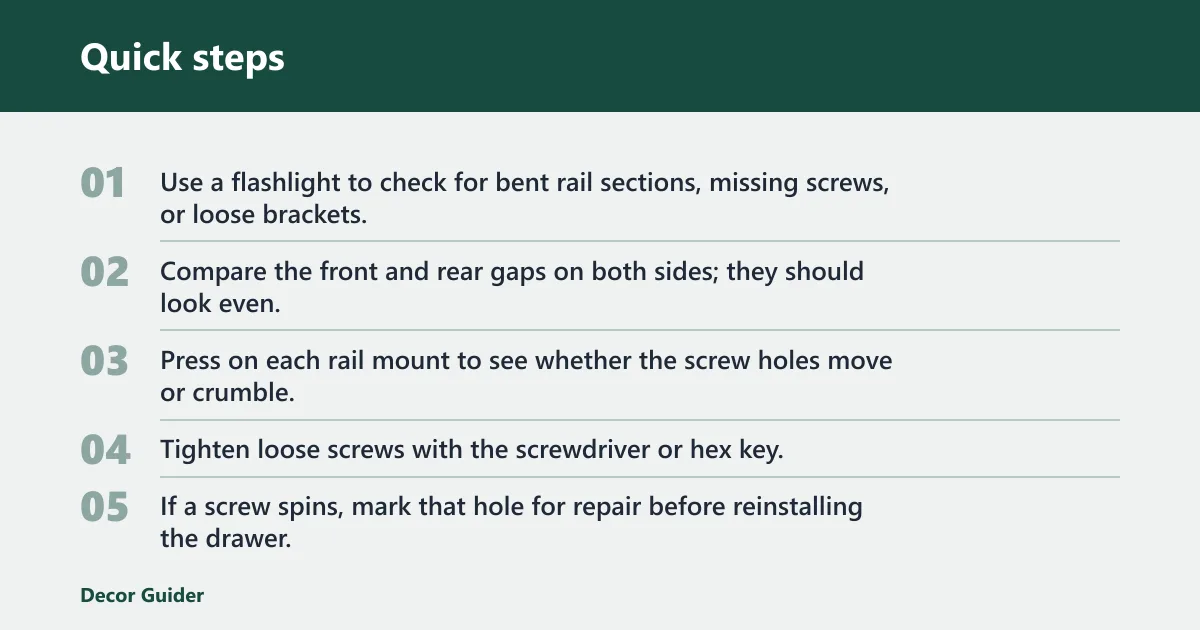
- Use a flashlight to check for bent rail sections, missing screws, or loose brackets.
- Compare the front and rear gaps on both sides; they should look even.
- Press on each rail mount to see whether the screw holes move or crumble.
- Tighten loose screws with the screwdriver or hex key.
- If a screw spins, mark that hole for repair before reinstalling the drawer.
How do you know if the rail or the drawer itself is damaged?
A damaged rail usually shows bend, looseness, or uneven spacing on the dresser frame. A damaged drawer usually shows cracked side panels, torn screw holes, or a runner that sits out of square. Check the fixed cabinet side first, then the moving drawer side, because the visible symptom can point to either one.
How do you fix the drawer side itself?
Look for cracks, racking, and stripped screw holes on the drawer side panel before you reattach the runner. If the drawer box is out of square, the runner will never sit correctly for long, and the pop-off will return after a few cycles. Focus on the cam locks, screws, and side panel fit so the drawer can ride the rail evenly.
- Check the cam locks and screws on both drawer sides.
- Retighten any loose fasteners until the panel feels rigid.
- Inspect the screw holes; if they are oval, powdery, or oversized, repair them.
- For a light repair, coat a toothpick with wood glue, pack the hole, and break it flush after it sets.
- For a stronger repair, fill the hole with wood filler, let it cure, then predrill a pilot hole and reinstall the screw.
Suppose a drawer on a smaller Malm unit pops free after a single screw backs out from a particleboard side panel. A fresh screw may hold for a while, but if the hole is already enlarged, the repair needs filler or toothpick-and-glue support first.
How do you stop repeat pop-offs?
Clean the track and reseat the glide point, then balance the load and test travel after each adjustment. Overloaded drawers and uneven loading are common reasons a Malm drawer keeps slipping, especially when heavy items sit all on one side. Start empty, then load it normally and watch for the same side to lift or release again.
- Wipe dust, chips, and broken plastic from the rail and glide path.
- Check for cracked rollers, missing plastic pieces, or flat spots.
- Reinstall the drawer and slide it partway in by hand.
- Recheck travel after each normal loading step, then stop if the same side starts to lift, snag, or pop free again.
- Keep heavier items low and centered so the drawer does not rack.
If that did not work, move to the next repair only after the drawer runs smoothly while empty. A rail that feels fine without load can still fail once the weight shifts to one side, so repeat the test with the intended contents before calling the job done.
Common mistakes
Forcing the drawer back onto a misaligned rail is the fastest way to bend a glide point or split a loose mount. Replacing parts before checking screw holes can also waste time, because a new runner will fail in the same place if the cabinet side is still loose.
- Do not shove the drawer on at an angle; keep both sides level.
- Do not ignore bent hardware, missing screws, or a cracked plastic glide.
- Do not treat every pop-off as a rail failure; drawer-side damage is common.
- Do not leave one drawer overloaded while the others are light.
Do I need to replace the drawer slides on a Malm dresser?
Replace the slides only when the rail is bent, cracked, missing a glide point, or no longer holds alignment after tightening. If the issue is loose screws, worn mounts, or stripped holes, repair those first. A straight, well-mounted rail often works again without new parts.
Broken plastic rollers, cracked bearing points, and warped metal rails are often treated as signs that replacement may be the better option than repair. If the part no longer tracks smoothly after a clean, a reset, and a tight mount, replacement is the safer option. IKEA support also points users toward the correct spare part or replacement path when the hardware cannot be restored securely.
Frequently asked questions
Why does my Malm dresser drawer keep coming off track?
Most repeat pop-offs come from one of four causes: misalignment, stripped mounts, worn glide points, or overload. Check the fixed rail first, then the drawer side, because a loose mount or racked drawer will keep forcing the same side off the runner even after you reinstall it.
How do I put a Malm dresser drawer back on the track?
Align both sides at the same height, guide the rear rollers or glide points onto the rails, and push straight in without twisting. If one side catches, pull back out and reset it. Forcing it can bend the rail or tear the screw holes.
What tools do I need to fix a Malm drawer that falls off?
A screwdriver and the correct hex key cover most re-tightening jobs. Keep a flashlight, cloth, drill, wood filler, and toothpicks with wood glue nearby if the screw holes are stripped or the mounts need a cleaner pilot hole before reinstallation.
How do I stop a Malm drawer from skipping or binding?
Check for debris, bent runners, and uneven loading, then make sure both rails sit parallel. After each adjustment, slide the drawer through its full travel once while empty and once with a normal load, because binding often appears only under weight.
Is the Malm dresser drawer failure caused by missing screws or a bent rail?
Either one can do it. Missing screws usually show up as wobble, shifting gap size, or a mount that pulls away from the frame; a bent rail usually shows a consistent snag point even after tightening. Inspect both before replacing anything.
When should I call IKEA support or replace the drawer parts?
Call for replacement parts if the rail is cracked, the roller is missing, or screw holes will not hold after filler repair. If the drawer side panel is split or the runner cannot stay parallel, replacement is the better fix than repeated tightening and patching. IKEA support can also help identify the exact rail, runner, or fitting needed for the Malm model.
Can you fix it without removing the whole dresser top?
Most checks can usually be done without removing the dresser top. Alignment, loose screws, stripped mounts, and rail bends can usually be checked from the front, sides, or underside without taking the top off. Only deeper frame repair or full rail replacement may require extra disassembly.
Products related to this article
Sponsored / affiliate links. As an Amazon Associate I earn from qualifying purchases. I may earn additional commission from eligible campaigns.