How to Fix a Dresser Leg That Broke Off
Fix a broken dresser leg by matching the repair to the failure: if the joint is a clean wood break, regluing and clamping can work; if the corner, insert, or panel is crushed, you need reinforcement, hardware replacement, or a new leg. A glue-only patch on particleboard, MDF, or any torn-out joint usually fails again under load.
Repair-or-replace checklist


- Repair if the break is clean, the parts meet tightly, and the leg or apron still has full thickness.
- Repair if the dresser is solid wood and the damage is limited to one leg or one corner block.
- Repair if removable-leg hardware can be matched and the surrounding wood is still firm.
- Replace the part if the leg is shattered, the corner is crushed, or the hole is blown out and cannot grip hardware.
- Replace the dresser if the base is particleboard or MDF and the load-bearing corner has crumbled or split repeatedly.
- Get a pro estimate if the finish is valuable, the break is structural, or the repair needs custom woodworking, matching hardware, or frame rebuilding.
How much does it cost to fix a broken furniture leg?
Most broken furniture leg repairs are inexpensive if the damage is clean and the construction is solid wood. DIY glue-and-clamp repairs usually cost little beyond supplies, while hardware replacement and pro repairs rise with the amount of rebuilding needed. A simple fix might run about $10 to $40 for glue, dowels, screws, or a small replacement part; a replacement leg often lands around $25 to $100 or more depending on style and finish; and professional furniture repair commonly starts around $75 to $200 for straightforward work and can go higher for matching finishes or structural rebuilds. Photo estimates make sense when the leg is missing, the corner is crushed, the dresser is an heirloom, or the repair path is unclear from the break alone.
What you’ll need
- Wood glue for clean wood-to-wood joints
- Clamps sized to the dresser parts
- Drill/driver
- Bits matched to dowels, screws, or hardware
- Measuring tape
- Square
- Scraper or chisel for old glue
- Sandpaper
- Level
- Dowels
- Replacement leg or matching hardware
- Corner block stock
- Screws
- Epoxy or filler for limited cosmetic work
- Finish touch-up supplies
How did the leg break?
Start by checking where the failure happened: at the wood grain, at the frame corner, or at the hardware. That tells you whether the dresser has solid wood, veneer over solid wood, or particleboard or MDF, and whether the attachment is glued, doweled, screwed, bracketed, or threaded.
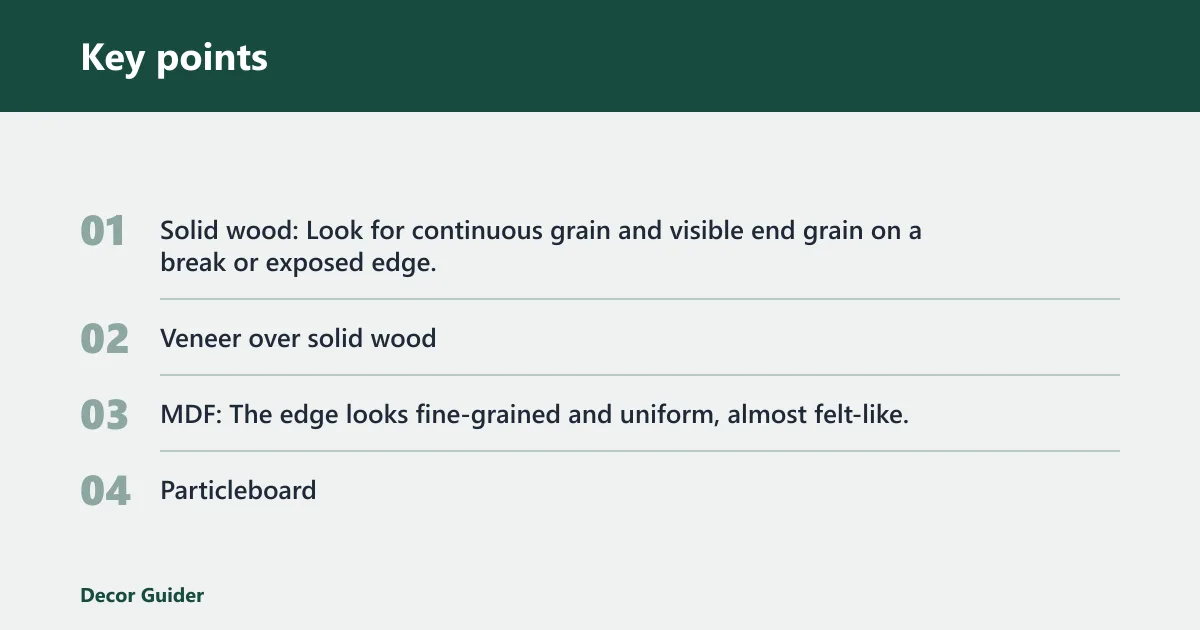
Quick material checklist
- Solid wood: Look for continuous grain and visible end grain on a break or exposed edge. Repair odds are best because the part can usually be reglued, doweled, or remade.
- Veneer over solid wood: A thin wood face may cover a stronger core. If the core is sound, repair odds are still good, but chipped veneer needs careful cosmetic patching after the structure is stable.
- MDF: The edge looks fine-grained and uniform, almost felt-like. It can hold some hardware when intact, but once the fibers are crushed or swollen, the repair gets less durable.
- Particleboard: The core looks coarse, crumbly, or chip-like at exposed edges. When a corner is torn out, screw-holding and long-term repair durability are poor because the material breaks down around fasteners instead of gripping them securely.
Look at the fracture line
A clean break along the grain usually means the wood itself split, which is often repairable. Crushed fibers, missing chunks, or a torn-out corner point to a different problem. If the crack runs through the apron or corner block, the leg may be fine but the frame connection is weak.
Check the attachment style
Removable legs often use a threaded insert or hanger bolt. Case-goods dressers often use a corner block, screws, or a bracket under the apron. Some legs are glued or doweled into a solid wood frame. The repair path changes with the attachment, not just with the visible crack.
Judge the material before you choose a fix
Solid wood furniture is usually repairable and can take regluing, dowels, or a remade part. Veneer over solid wood can also be repaired if the structural core is sound. Particleboard and MDF are different: if the corner is crushed or stripped, a simple glue repair usually will not hold. Wood Handbook guidance from the USDA Forest Service notes that fastener and joint performance depends heavily on sound wood and density; once the material is crushed, the repair loses holding power quickly.
Dresser leg failure table
| Failure type | Likely construction | Best repair method | Tools needed | Replace-vs-repair threshold |
|---|---|---|---|---|
| Clean break | Solid wood leg or apron with a clean joint failure | Reglue the faces, clamp evenly, and add dowels if enough original wood remains | Wood glue, clamps, scraper, drill, dowel bits, square | Repair if the break fits tightly and no major wood is missing; replace if the leg is shattered |
| Split apron or corner block | Frame weakness at a corner block, rail, or apron joint | Rebuild or replace the corner block, then screw and glue it back in place | Drill/driver, screws, glue, corner block stock, clamps | Replace if the rail or block is too split to hold fasteners |
| Stripped threaded insert | Removable leg on manufactured furniture | Replace the insert or hanger bolt with the matching thread size if the surrounding wood still holds | Drill, matching hardware, driver, measuring tape | Repair if the hole is still sound; replace if the insert spins or the hole is blown out |
| Crushed particleboard corner | Particleboard or MDF base | Reinforce with a plate or replace the damaged section; simple glue rarely lasts | Reinforcement plate, screws, drill, filler for minor cosmetic work | Replace if the corner is crushed, crumbling, or missing support under load |
How do you fix a broken dresser leg?
Fix it by removing the leg, cleaning the joint, and rebuilding only the part that failed. Use wood glue for clean wood-to-wood surfaces, dowels when enough solid wood remains, and hardware repair when the attachment point failed. Set the dresser on a level floor before loading drawers.
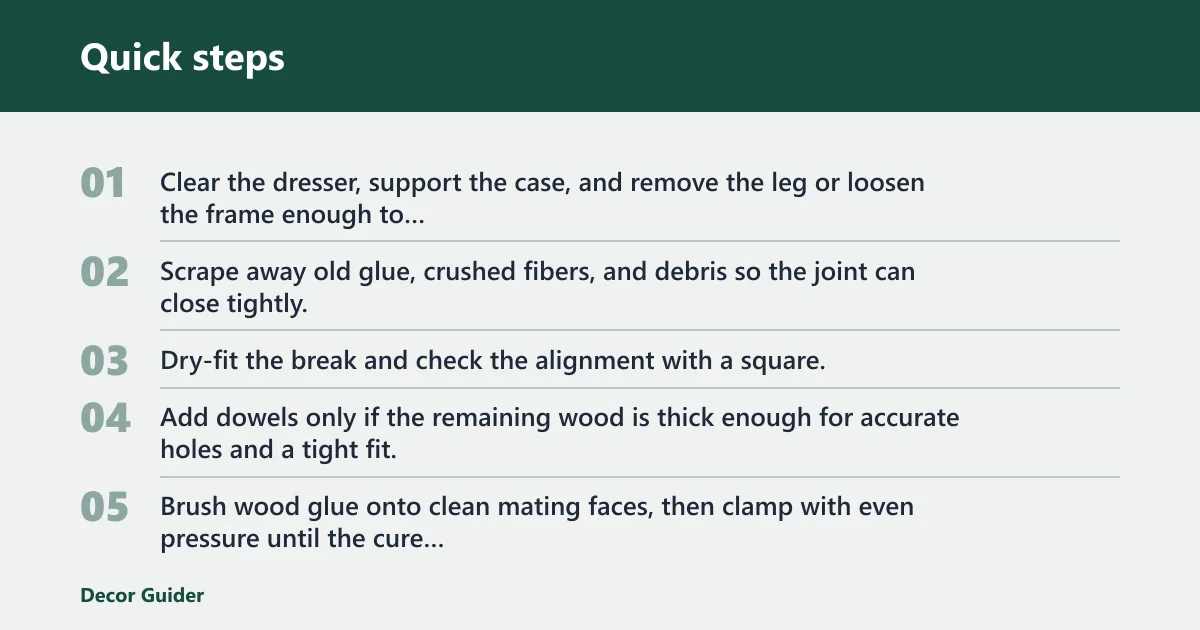
- Clear the dresser, support the case, and remove the leg or loosen the frame enough to inspect the break.
- Scrape away old glue, crushed fibers, and debris so the joint can close tightly.
- Dry-fit the break and check the alignment with a square; a crooked leg will leave the dresser wobbling.
- Add dowels only if the remaining wood is thick enough for accurate holes and a tight fit.
- Brush wood glue onto clean mating faces, then clamp with even pressure until the cure time is complete.
- Reattach the leg, then reinforce the mounting point with screws, a corner block, or replacement hardware if the original joint failed.
- Set the dresser on a level floor and test for wobble before loading drawers back in.
Wood glue works best when the break is clean and the surfaces meet tightly. It is not a fill material for missing wood, and it cannot rebuild crushed fibers. Clamps should hold the joint in place without crushing thin panels or forcing the leg out of square. Common woodworking guidance from Titebond and similar manufacturers is to clamp until the glue has set enough to hold, then allow full cure before loading the joint.
Use dowels only when the joint can support them
Dowels help when enough original wood remains to drill matching holes on both sides of the break. Diameter matters because oversized holes weaken the joint and undersized holes leave slop. If the hole walls are ragged or the leg is split away from the grain, dowels will not save it.
For threaded hardware, the insert and bolt must match. A common rule of thumb is to replace like with like rather than forcing a different thread into the hole. Insert sizing is typically based on the screw or bolt diameter and thread pitch, so the safest repair is the exact match, not the closest fit. If the insert spins or pulls out, the hole needs rebuilding or a larger repair, not more torque.
Say your 2-inch dresser leg snapped cleanly at the apron and both faces still meet flat. That is the type of break where glue, clamps, and one or two dowels can make sense. If the same leg tore off and left a ragged cavity in particleboard or MDF, the repair path usually shifts to reinforcement or replacement.
What if the corner or insert also failed?
If the leg came off and the corner, block, or insert failed too, repair the attachment point first. A weak frame connection will keep reopening the break. Replace spinning threaded inserts, rebuild split corner blocks when there is sound wood left, or fit a new leg if the old mount is gone.
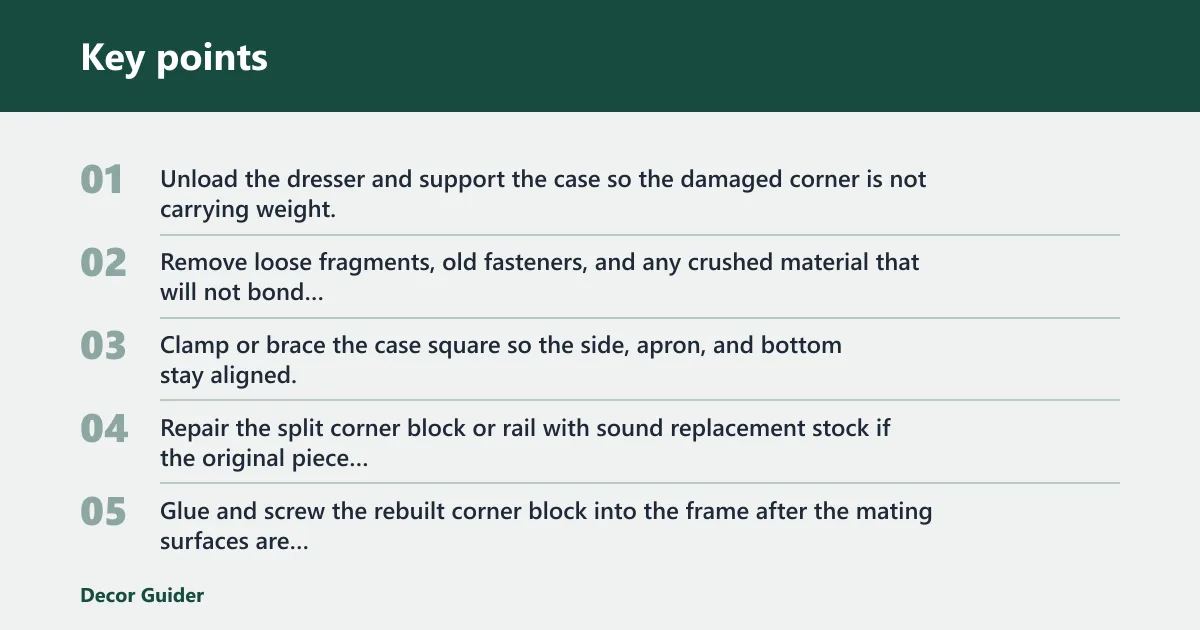
Compound failure: leg broke off plus the dresser corner split
When the leg breaks and the dresser corner or apron splits with it, treat the case as a structural repair, not a simple re-glue. Stabilize the box first so the crack does not spread, then rebuild the corner support, then reattach the leg.
- Unload the dresser and support the case so the damaged corner is not carrying weight.
- Remove loose fragments, old fasteners, and any crushed material that will not bond securely.
- Clamp or brace the case square so the side, apron, and bottom stay aligned.
- Repair the split corner block or rail with sound replacement stock if the original piece is too damaged to hold fasteners.
- Glue and screw the rebuilt corner block into the frame after the mating surfaces are clean and tight.
- Only after the corner is stable, reattach the leg with the correct hardware, dowels, or replacement mount.
- Let the repair cure fully, then check for wobble and re-tighten only if the hardware design calls for it.
Rebuild the corner block when the frame still has material
Corner blocks are common in case-goods frames and often carry part of the leg load. If the block split but the apron and side still have sound wood, glue and screw in a fresh block. If the rail is crushed or the screw holes are blown out, a new block may not hold without a larger rebuild.
Match the thread size on removable legs
Threaded inserts and hanger bolts need to match. If the insert spins, the threads are stripped, or the bolt pulls free, replacing the hardware is better than forcing a loose fit. Measure the thread before buying a replacement, because mismatched hardware will feel tight at first and fail under load.
Choose a replacement leg when the old one is gone
A replacement leg is often the better choice when the original is missing, shattered, or too short after trimming damaged wood. It also helps when the mounting surface is destroyed. A universal part may work, but a custom leg may be needed if the height, load, or finish has to match closely.
Common mistakes
Most weak repairs come from treating every failure like a glue job. Clean breaks, split frames, stripped inserts, and crushed panels do not need the same fix. The faster you identify the failure mode, the less likely you are to chase a wobble later.
- Using glue on missing or crushed material and expecting it to fill the gap
- Over-tightening clamps and squeezing the joint out of alignment
- Crushing thin panels with clamp pressure
- Mixing thread sizes on hanger bolts or inserts
- Skipping reinforcement when the apron, rail, or corner block is already weak
- Doing finish touch-up before the structure is sound
Do not assume particleboard or MDF will accept the same repair as solid wood. Once the fibers are crushed, a simple reglued seam often lacks enough material to hold the load. In that case, reinforcement plates or replacement parts are the more honest repair. That is why manufacturers and repair guides generally treat damaged composite corners as poor candidates for durable screw retention after the material has failed.
Finish repair comes last. After the structure is stable, touch up chipped edges, paint loss, or exposed stain with matching supplies. If the break was visible, this step helps the dresser look finished without hiding a weak joint under cosmetic work.
Frequently asked questions
How do you fix a table leg that broke off?
The same repair logic applies to tables: check whether the failure is a clean wood break, a loose corner block, a stripped insert, or a crushed panel. Clean breaks can usually be glued and clamped; threaded hardware must be matched; and damaged particleboard or MDF often needs reinforcement or replacement rather than a glue-only fix.
Can I glue a dresser leg back on?
Yes, if the break is a clean wood-to-wood joint with tight contact surfaces. Wood glue needs pressure from clamps and enough cure time to hold. It will not bridge missing wood, crushed particleboard, or a torn-out insert hole.
What is the strongest way to reattach a dresser leg?
The strongest repair is the one that matches the original construction and restores the load path. For solid wood, that often means glue plus dowels and clamping. For removable legs, a matched threaded insert or hanger bolt with sound surrounding wood is stronger than a loose screw fix.
When is a broken dresser leg not worth fixing?
It is usually not worth a simple repair when the dresser is particleboard and the corner is crushed, the mounting surface is blown out, or the leg is missing and the frame is destroyed. In those cases, replacement parts or replacement furniture are usually the better spend.
Do I need screws, dowels, or wood glue for a dresser leg repair?
Use the fastener that fits the failure. Wood glue suits clean wood joints, dowels strengthen a repair when enough wood remains, and screws help secure a corner block or bracket. Do not use all three automatically; the attachment style and remaining material should decide.
How do I tell if the dresser base is particleboard or solid wood?
Look at an exposed edge or a hidden corner. Solid wood shows continuous grain and end grain; particleboard or MDF looks uniform and layered or fibrous, with no visible wood grain running through the core. Veneer over solid wood has a thin wood face over a stronger core.
What should I do if the leg broke and the corner of the dresser split too?
Treat the corner as part of the failure. Rebuild or replace the corner block, repair the frame split if the wood is sound, and only then reattach the leg. If the corner is crushed or the screw holes no longer hold, a simple glue repair is unlikely to last.
Products related to this article
Sponsored / affiliate links. As an Amazon Associate I earn from qualifying purchases. I may earn additional commission from eligible campaigns.