
Sofa Weight Capacity Chart: Weights by Type
Many sofas are reported to weigh about 100 to 200 pounds; sleeper, sectional, and recliner models are often reported at about 250 to 350 pounds, so plan for two movers once a sofa is above about 150 pounds. If you ignore weight, you can strain backs, scrape walls, break legs, and trigger extra labor on move day. This guide gives a sofa weight capacity chart, by sofa type, plus simple rules for lifting, doorway checks, and buying decisions.
What does a sofa weight chart tell you?
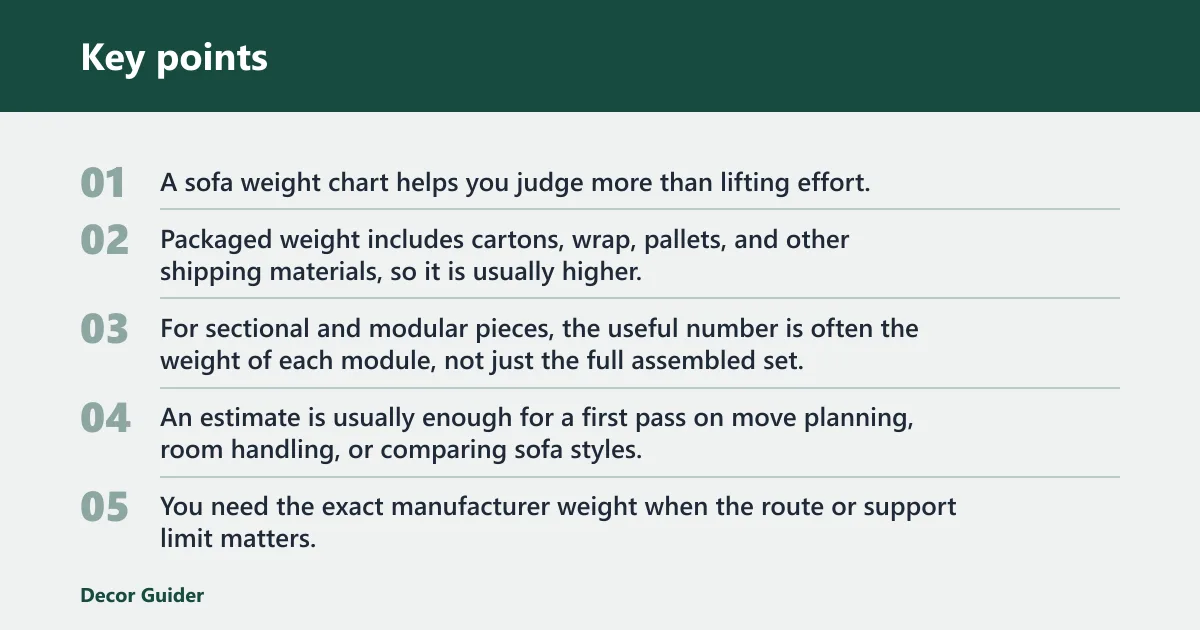


A sofa weight chart helps you judge more than lifting effort. It separates estimated sofa weight from packaged weight, shows which designs are likely to need two movers, and flags cases where you need the exact manufacturer weight for stairs, elevators, delivery quotes, or floor limits.
Net sofa weight is the product itself. Packaged weight includes cartons, wrap, pallets, and other shipping materials, so it is usually higher. For sectional and modular pieces, the useful number is often the weight of each module, not just the full assembled set.
When an estimate is good enough
An estimate is usually enough for a first pass on move planning, room handling, or comparing sofa styles. It helps you decide whether a loveseat can fit through a doorway, whether a sleeper is likely to need a dolly, and whether a sectional will be easier in pieces than as one assembled unit.
When you need the exact manufacturer weight
You need the exact manufacturer weight when the route or support limit matters. That includes delivery quotes, elevator bookings, stair carries, truck loading, lift gate limits, floor load checks, and any case where a building or retailer asks for a verified number rather than a range.
Sofa weight decision table

This table turns sofa weight estimates into a planning tool. It ties sofa type to a weight band, handling difficulty, and the situations where a verified manufacturer weight is worth getting before you move, buy, or schedule delivery.
| Sofa type | Estimated weight band | Typical handling difficulty | When exact manufacturer weight is required |
|---|---|---|---|
| Loveseat | 80-150 lb | Usually manageable for two people; one-person moves are risky on stairs or tight turns | Stairs, narrow halls, elevator limits, and any delivery quote that uses a strict weight cap |
| Standard three-seat sofa | 100-250 lb | Moderate to hard, depending on frame material and overall width | Doorway checks, truck loading, floor load limits, and building access rules |
| Sleeper sofa | 180-350 lb | Hard; mattress and mechanism make it awkward and heavy | Any stair carry, lift gate quote, or route with a tight landing or elevator limit |
| Sectional sofa | 200-500+ lb total | Hard as an assembly; easier if broken into modules | Always verify each module weight, plus total assembly limit for delivery and floor checks |
| Reclining sofa | 150-300+ lb | Hard to very hard because of recliner hardware and moving parts | Stairs, elevator limits, and any move that requires tilting through a doorway |
| Futon | 55-150 lb | Often the easiest full-size option to move | Only if access is tight or the packaged weight must be confirmed for shipping |
| Modular sofa piece | 50-150 lb per piece | Usually moderate; depends on connectors and module size | When a carrier needs the per-piece weight, or when one module must pass a lift, stair, or floor limit alone |
For planning, this table is better than a single broad number. A 140-pound loveseat and a 140-pound sleeper do not behave the same way in a hallway, and a 3-piece sectional can be easy or difficult depending on how each module is sized and oriented.
How much does a sofa weigh by type?

By type, sofa weight usually falls into predictable bands. Many conventional sofas weigh approximately 100-300 lb, but the exact number depends on size, frame material, cushions, and whether the sofa includes sleepers, recliners, storage, or modular connectors.
Loveseats and standard three-seat sofas
A loveseat is estimated at 80-150 lb. A basic three-seat sofa is approximately 120-200 lb, while a standard three-seat sofa is estimated at 100-250 lb. The spread comes from width, padding density, and frame construction, so two sofas with the same seat count can still feel very different to move.
For measuring, start with seat width, total width, and the overall footprint. Those numbers tell you more about turning radius and doorway clearance than weight alone, especially if the sofa has wide arms or a deep base.
Sleeper sofas and recliners
A sleeper sofa is estimated at 180-350 lb because the mattress and fold-out mechanism add substantial mass. A reclining sofa is estimated at 150-300+ lb because the hardware, motors on powered models, and reinforced frame parts raise the weight and make the piece harder to tilt or pivot.
Picture a 92-inch sleeper on the first floor. It may fit through the room opening, but the weight and bulk can still make the turn from hall to doorway the hard part. That is when exact weight and overall footprint matter more than the seat count.
Sectional sofas and modular pieces
A sectional sofa is estimated at 200-500+ lb total, but that total is less useful than the weight of each module. A modular sofa piece is estimated at 50-150 lb per piece, which is the number to check for stair carries, elevator limits, and delivery quotes.
Sectional configuration matters too. Compact chaise sectionals commonly run 72–96 inches long side, while standard L-shapes are 95–120 inches long side. Also check the return or chaise, overall depth, orientation, and number of modules, because those details change how the set moves through corners and landings.
Why do sofa weights vary so much?
Sofa weight changes with construction, hardware, and size. The same seat count can hide major differences in frame material, cushion density, and built-in mechanisms, so a simple catalog description is often not enough for route planning or loading.
Frame material and cushion density
Hardwood frames and denser cushions usually weigh more than lighter frames and lower-density fills. A sofa with thicker arms, deeper seats, or a heavier base can add pounds without changing the visible footprint very much, which is why a wide sofa is not always the heaviest sofa.
Sleepers, recliner hardware, and storage parts
Sleepers bring a mattress and fold-out metal parts. Recliners add hardware, springs, or powered components. Storage sofas can add lift mechanisms and reinforced boxes. Each added feature raises the net product weight and can make the sofa harder to balance during lifting.
Sectional size and module count
Sectionals vary because the total assembly can be built from several pieces of different sizes. More modules often means more connectors, more total frame material, and more chances that one piece will exceed a route limit even if the full set would fit when assembled in a room.
Suppose a 4-piece sectional has one chaise, two armless seats, and one corner unit. The corner may be awkward, but the chaise is often the heaviest piece. In that case, build the move plan around the heaviest individual module, not the lightest one.
How do you plan a move with sofa weight?
Sofa weight affects more than lifting. It changes whether you can clear stairs, make tight turns, fit an elevator, and load the item safely onto a truck or dolly. The right plan depends on both the estimated weight and the route shape.
-
Measure the route first. Check door width, hallway width, stair turning points, elevator cab size, and the tightest corner in the path. Compare those measurements with the sofa’s total width, depth, and footprint before you commit to a carry.
-
Use the heaviest piece. For sectionals and modular sofas, identify the single heaviest module and plan the move around that number. If one piece is 150 lb, that piece sets the crew size, grip plan, and turn strategy.
-
Match the crew to the load. Once a sofa tops 150 pounds, two movers are the safer default. A heavier sleeper or recliner may need extra help if the route includes stairs, narrow landings, or a lift gate.
-
Check support limits early. If the sofa will sit on a raised floor, use an elevator, or go through a delivery system with a posted limit, verify the manufacturer weight rather than relying on an estimate. That avoids access refusals and rescheduling.
-
Protect surfaces during the carry. Use furniture blankets, door jamb protection, and a dolly sized for the load. Heavy frames can scuff walls, dent corners, and stress legs if the move relies on dragging instead of lifting.
A common first-timer mistake is treating packaged weight as if it were the finished sofa weight. A boxed sofa can look manageable on paper, but the carton, pallet, and wrap raise the shipping weight, while the actual sofa still needs a separate handling plan once it is unpacked.
What weight capacity details should you verify?
Weight capacity is not the same as sofa weight. The first is a manufacturer limit for use or support, while the second is the sofa’s own mass. For planning, you need both: the sofa’s estimated weight for moving, and the rated limit for seating, shipping, or structure checks.
Per-seat, per-piece, and total assembly limits
Some manufacturers list a per-seat limit for use, a per-piece limit for modular sections, and a total assembly limit for a full sectional. If those limits are missing, ask for the exact product sheet. A safe handling margin also helps when a route limit is close to the sofa’s estimated weight.
Seat width, total width, and overall footprint
Seat width helps identify the model class, total width tells you whether it will fit through an opening, and overall footprint tells you how the sofa will rotate in the space. Those measurements matter as much as weight when a sofa must turn at the top of stairs or pass a tight entry.
Sectional orientation and individual module weight
For sectionals, note the long side, return or chaise direction, overall depth, orientation, and number of modules. Also record the weight of each module separately. That gives you a usable plan for moving, storage, and delivery, and it prevents one oversized piece from becoming a surprise on move day.
Frequently asked questions
How much does a sofa weigh?
Most sofas weigh 100 to 200 pounds, but common designs can sit outside that range. Check the exact manufacturer weight when access matters.
How much does an average sofa weigh?
An average sofa is often treated as a 100-200 pound piece for planning. That works for many conventional sofas, but it is too broad for sleepers, recliners, and sectionals. Use the sofa type, not the average, when you are judging stairs, elevators, or dolly use.
How heavy is a sofa?
A sofa can be light enough for one person to shift briefly or heavy enough to need a crew. A futon may be 55-150 lb, while a sectional can reach 500+ lb total. Weight alone is not the full story; shape, hardware, and route layout matter too.
How much does a sofa bed weigh?
A sleeper sofa is estimated at 180-350 lb. The mattress and fold-out mechanism are the main reasons it weighs more than a standard sofa. If the move involves stairs, an elevator, or a narrow turn, ask for the manufacturer’s exact weight before you schedule the carry.
How much weight can a couch hold?
Weight capacity depends on the manufacturer rated limit, which may be listed per seat, per piece, or for the full assembly. That number is separate from the couch’s own weight. If the label is missing, request the product sheet before you rely on the sofa for heavier daily use.
What is the average weight of a sofa in kg?
For planning, a common sofa estimate of 100 to 200 pounds is about 45 to 91 kg. A sleeper, sectional, or recliner can sit above that. If you need a precise number for shipping or access, use the manufacturer’s listed weight instead of converting a guess.
Products related to this article
Sponsored / affiliate links. As an Amazon Associate I earn from qualifying purchases. I may earn additional commission from eligible campaigns.