Ikea KALLAX Shelf Review: What It Does Best for Storage
IKEA’s KALLAX is a modular storage system for books, records, games, and room dividers, and it works best when you respect its roughly 13-inch cube size and keep heavier items low. Ignore that, and you invite sagging shelves, awkward fit, unstable stacks, and wasted money on inserts you do not need. This review covers the best KALLAX configurations, where it fails, and what renters should choose.
This guide is part of our Chairs guide: types, buying and care series.
Verdict


At about $120 for the reviewed configuration, KALLAX sits in the affordable range for cube storage and below many custom built-ins. The catch is fit. A 2×4 unit is a strong pick for vinyl or mixed media; a small 1×2 or 2×2 is better for toys and paper goods; a tall setup tips more easily if you skip wall anchoring.
Best use cases at a glance
- Buy it if you need modular cubes for LPs, board games, toys, bins, or a TV stand with open cubbies.
- Buy it if you want a room divider that still leaves access from both sides.
- Skip it if you need deep shelves for oversize art books, heavy archive boxes, or furniture that must survive rough moves without edge wear.
- Skip it if you want closed storage out of the box; you will need inserts.
Who should skip it
If you need a unit for dense, heavy books from top to bottom, KALLAX can become a poor fit fast. The cube size and load rating are not the same as a welded steel shelf or a thicker solid-wood bookcase. Buyers who want a one-piece, fully enclosed cabinet should also look elsewhere.
📊 The reviewed configuration is listed at approximately $120. Source: IKEA Kallax Review: Dimensions, Sizes & Owner Verdict (2026….
What is KALLAX, and what is it not?
KALLAX is a modular cube-storage system, not a traditional bookshelf. It gives you square openings, a range of sizes, and a flexible layout for bins, media, toys, and display items. It is affordable compared with custom built-ins, and IKEA sells inserts and accessories to change how the cubes behave.
How KALLAX differs from EXPEDIT
EXPEDIT is the older IKEA cube-storage line that still comes up in searches because many buyers owned it first or are replacing it. KALLAX is the current system, and the name matters because accessory fit, dimensions, and product listings are organized around KALLAX. Searchers often compare them because both look similar at a glance.
The practical difference is simple: shop KALLAX for the current modular system and its inserts. Treat EXPEDIT as the legacy reference point, not the product line to build around.
Specs at a glance
KALLAX is built around a square cube that is about 13 inches by 13 inches, with a structure made from particleboard and fiberboard with a honeycomb paper core. It has no back panel and supports wall mounting. The reviewed configuration is listed at approximately $120, assembly usually takes 60 to 90 minutes solo, and each cube is rated for approximately 29 lbs of load.
| Spec | What to know |
|---|---|
| Cube opening | About 13 inches by 13 inches |
| Construction | Particleboard and fiberboard with a honeycomb paper core |
| Back panel | No back panel |
| Wall mounting | Supported |
| Per-cube load rating | Approximately 29 lbs |
| Assembly time | 60 to 90 minutes solo |
| Reviewed price point | Approximately $120 |
| Common configurations | 1×2, 2×2, 2×4, 4×4 |
Sizes and common configurations
The sizes matter more than the brand name. A 1×2 works as a narrow side unit, a 2×2 is a tidy square, a 2×4 is the most debated size for records and media, and a 4×4 starts to behave like room-filling storage rather than a small shelf. Vertical layouts save floor width; horizontal layouts work better under windows or as TV stands.
How does KALLAX perform for books, records, and games?
KALLAX performs best when the item matches the cube. Books, records, and board games fit the square format better than odd-size decor or deep archive boxes. The shelf is not a heavy-duty library case, but it handles a wide range of household storage if you keep weight limits in mind and avoid overloading one cube or one span.
Books and binders
Paperbacks and standard binders fit well. Heavy art books and dense rows of hardcovers are less forgiving, especially in wide spans where weight builds at the center. For mixed book storage, keep the heaviest volumes in lower cubes and leave some cubes partially open so the unit does not become front-heavy.
Vinyl records and media
Vinyl is the use case that keeps KALLAX in the conversation. A cube holds roughly 60 to 80 records depending on sleeve thickness, and a fully loaded 2×4 KALLAX can hold around 500 to 640 LPs. That is why the 2×4 configuration is widely discussed for collectors.
Horizontal versus vertical orientation matters here. Vertical placement gives easier browsing and a cleaner record wall, but a long horizontal run can concentrate load in the center panels. If you fill a 2×4 with records, keep the weight even and avoid stacking extra mass on top.
Board games and toy storage
Board games, plush toys, and bins are where KALLAX is easiest to live with. The cube format accepts standard fabric boxes and game boxes without much trimming or fiddling. It is especially useful when you want open access and visual sorting rather than closed cabinetry.
Common first-timer mistake
A common first-timer mistake is buying a 2×4 for a mix of vinyl, books, and closed boxes, then filling every cube to the front edge. The unit still looks tidy at first. After a move or a room shift, the weight distribution and edge wear become obvious, especially if the shelf was never anchored.
What actually goes wrong with KALLAX?
The most common failures are sag, racking, move damage, and bad load planning. KALLAX is light for its size because of the honeycomb core, so it is not built like a solid-wood case. It can also tip if tall units are not anchored, which matters in homes with children or pets.
Sag, racking, and heavy-load limits
Each cube is rated for approximately 29 lbs, but the practical issue is not one cube alone. It is cumulative load on a long span and how evenly the weight is spread. Heavy books or records on one side can stress the center panel in a 2×4 or larger unit, especially in horizontal placement.
Move damage and edge wear
KALLAX can suffer edge chips and loose joints if it is dragged, bumped, or disassembled repeatedly. That risk rises when the unit is stuffed with heavy media, then moved without unloading it first. If you move often, closed bins and lighter contents help, but this is still furniture that prefers gentle handling.
Vertical or horizontal placement
Vertical KALLAX saves footprint and works well as a divider, but it needs anchoring. Horizontal KALLAX is easier for TV use and lower visual profiles, yet longer spans can make center support more important when you load the middle cubes with dense items. Either orientation can work; the better choice is the one that matches the load pattern.
Which accessories are worth buying?
KALLAX accessories are worth buying only when they solve a real problem. Drawer units and door inserts reduce visual clutter. DRONA fabric boxes turn open cubes into hidden storage. The glass shelf adds another level inside a cube. Planner tools help with fit, but they are most useful when you already know the job you want the unit to do.
Drawer and door inserts
Drawer units are useful for small parts, documents, remotes, and craft supplies. Door inserts make sense when you want a cleaner front but do not need drawer depth. Both reduce the open-cube feel, though they also reduce flexibility. If the contents change every month, plain cubes may be better.
DRONA fabric boxes
DRONA boxes are the simplest add-on for general storage. They work well for toys, seasonal items, cables, and miscellaneous household items that would otherwise look messy in an open cube. They are less useful for heavy contents or anything you need to access constantly, since soft sides do not organize small objects as precisely as drawers.
KALLAX glass shelf
The KALLAX glass shelf is sized 33×38 cm, sold in a 2-pack, and made of tempered glass. IKEA says it is dimensioned to fit the KALLAX shelving unit, and it adds an extra shelf level inside a cube. That makes it useful for smaller media, display items, or a cube that needs two tiers instead of one tall opening.
Planner and custom-fit add-ons
IKEA’s planner and tool ecosystem is useful if you are mapping a wall, checking door swing, or deciding between a single unit and a run of units. Custom-fit add-ons help most when you are pairing KALLAX with a wall, a desk zone, or a media setup. They do not fix poor load planning.
Best KALLAX setups by use case
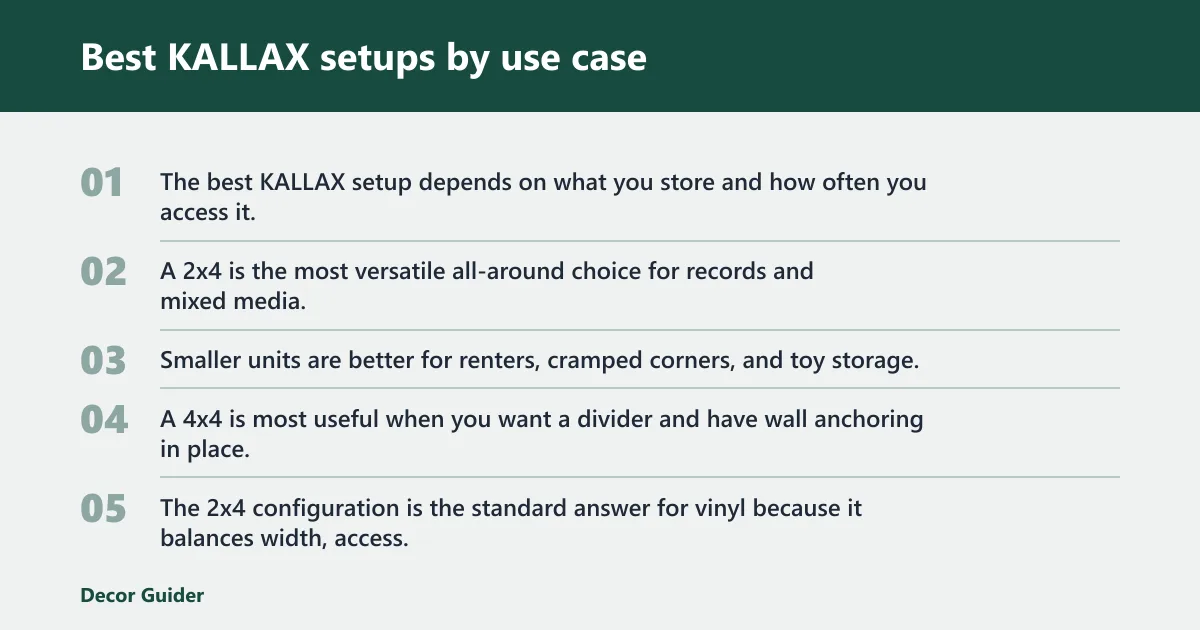
The best KALLAX setup depends on what you store and how often you access it. A 2×4 is the most versatile all-around choice for records and mixed media. Smaller units are better for renters, cramped corners, and toy storage. A 4×4 is most useful when you want a divider and have wall anchoring in place.
| Setup | Ideal content type | Expected weaknesses | Required accessories | Worth buying over alternatives? |
|---|---|---|---|---|
| 1×2 | Books, toys, office supplies | Limited capacity; can look undersized fast | DRONA box or door insert if you want concealment | Yes, for small rooms or tight budgets |
| 2×2 | Board games, mixed decor, media | Less efficient for records than larger layouts | Fabric boxes for mixed contents | Yes, if you want a balanced footprint |
| 2×4 | Vinyl records, media, mixed household storage | Center-panel sag risk under heavy loads; needs even loading | Wall anchoring, optional glass shelf for smaller items | Yes, especially for LPs and TV-side storage |
| 4×4 | Room divider storage, large mixed collections | Tip-over risk, move damage, takes up real floor space | Anti-tip hardware, boxes, possibly inserts | Only if you need large-scale storage |
Vinyl and media storage
The 2×4 configuration is the standard answer for vinyl because it balances width, access, and visual order. If you keep records in sleeves and do not overpack the top row, it is hard to beat for price and format match. If the collection keeps growing, a second unit usually makes more sense than overloading one shelf.
Room divider or TV stand
As a room divider, KALLAX works because both sides stay open and the cubes create a visual break without a full wall. As a TV unit, the low horizontal versions work best because they keep the screen at a comfortable height and leave room for consoles, routers, or speakers. Just remember that cords need planning because there is no back panel.
Renters and small spaces
Renters should think about size, anchoring, and how often the furniture will move. A 2×2 or 2×4 is easier to relocate than a huge stacked arrangement, and smaller units are less stressful in narrow hallways. If a lease change or move is likely, simpler setups are safer and cheaper to replace.
Say your studio apartment needs one divider and one media wall. A horizontal 2×4 can do both jobs, but only if the heaviest items stay low and the unit is anchored. If you then add drawer inserts to every cube, the cost rises fast and the flexibility drops.
What is the difference between EXPEDIT and KALLAX?
EXPEDIT is the older cube-storage line that people still use as a comparison point, while KALLAX is the current IKEA system. KALLAX is the relevant purchase because accessories, current dimensions, and product support are built around it. Shoppers searching for EXPEDIT are usually trying to replace an older unit or match a familiar layout.
Why the old name still matters
The old name matters because search results and owner forums still use it as shorthand for square IKEA cube storage. That can confuse accessory searches and comparison shopping. If you are buying new, focus on KALLAX sizes, KALLAX inserts, and KALLAX-specific accessories rather than assuming an old EXPEDIT mention equals a current match.
What shelves are similar to IKEA KALLAX?
Similar shelves are other cube-storage units with roughly square openings, but they differ on depth, strength, and accessory support. KALLAX is popular because it sits in the middle: affordable, configurable, and easy to dress up with bins or inserts. Better alternatives usually win on strength or finish, not on sheer modular convenience.
Comparison guide
If you want a cube system mainly for bins and toys, similar pieces from other storage brands can work. If you want heavier shelves for books, a sturdier bookcase is often the better buy. If you want a room divider with lots of open cubes, KALLAX still makes sense because the form factor is its biggest advantage.
What KALLAX accessories or inserts are worth buying?
The best KALLAX accessory is the one that fixes a storage problem you actually have. Drawer inserts help with small items. Door inserts hide clutter. DRONA boxes simplify mixed storage. The glass shelf is worth it when a cube needs two levels. Do not buy all of them by default; they reduce the flexibility that makes KALLAX useful.
Practical buying order
- Choose the size and orientation first.
- Anchor the unit if it is tall or likely to tip.
- Add DRONA boxes for general hidden storage.
- Use drawer or door inserts only for cubes that need frequent access or a cleaner front.
- Add the glass shelf only when one cube needs a second level.
Frequently asked questions
Is IKEA discontinuing KALLAX?
There is no basis here for saying KALLAX is being discontinued. The safer answer is that KALLAX remains an active IKEA system, and availability can vary by size, color, and market. If a specific version is out of stock, that does not mean the entire line is ending.
How often does IKEA restock KALLAX?
IKEA does not publish a universal restock schedule for KALLAX that applies to every store and every color. Restock timing depends on region, warehouse flow, and demand. If a specific unit matters, check local availability rather than assuming a weekly or monthly cycle.
What size is the IKEA KALLAX?
The cube is about 13 inches by 13 inches. The full unit comes in multiple configurations from 1×2 to 4×4, so the overall size depends on layout. That cube dimension is what matters most for records, bins, games, and inserts.
How much weight can a KALLAX cube hold?
Each cube is rated for approximately 29 lbs of load. That number is useful, but distribution matters more than a single cube figure. Heavy books or records should stay balanced across the unit, and tall setups should be anchored to reduce tip risk.
Products related to this article
Sponsored / affiliate links. As an Amazon Associate I earn from qualifying purchases. I may earn additional commission from eligible campaigns.