Couch Cleaning Service Review: Is It Worth It for Stains?
Professional couch cleaning is worth it when you need odor removal, set-in stains, pet accidents, or delicate fabric care. For loose dust and fresh surface spots, DIY vacuuming and spot cleaning is usually enough. Use the wrong method and you can push stains deeper, leave moisture in cushions, or pay for a clean that fades fast. This guide compares professional methods, fabric matchups, stain and odor results, and when the cost makes sense for your couch.
Professional couch cleaning vs DIY: what changes, what does not



DIY vacuuming and spot cleaning handle loose dust, crumbs, and fresh spills on the surface. Professional cleaning changes the result when soil, odor, or allergens have moved below the face fabric, into padding, or into seams where ordinary tools cannot reach. The trade-off is simple: more cost, more drying time, and less risk when the fabric is suitable.
What DIY vacuuming and spot cleaning can handle
Routine vacuuming removes surface debris before it works into the weave. A mild spot cleaner can deal with a fresh drink spill, a little mud, or a shallow mark if you blot early and avoid soaking the area. This is usually enough when the couch only looks dull, not contaminated.
Where professional cleaning changes the result
Professional cleaners use specialized equipment and fabric-safe products matched to the material, which matters when the soil sits deeper than the top layer. Hot water extraction can reach deep into couch fibers and is often used for embedded dirt and odors. Dry cleaning for upholstery uses a chemical solvent and does not require water or drying time, so it fits lower-moisture needs.
When the cost gap is worth paying
The spend makes more sense when a couch is expensive to replace, lightly damaged by a known spill, or exposed to pets and allergens. A common first-timer mistake is paying for a full service when the issue is only surface dust. Another mistake is trying a wet method on a fabric that needs lower moisture.
| Decision point | DIY vacuuming and spot cleaning | Professional couch cleaning |
|---|---|---|
| Surface dust and crumbs | Usually enough | Often more than needed |
| Embedded dirt and odors | Limited effect | Better chance of reset |
| Pet accidents and mystery stains | May only treat the top layer | Can target deeper contamination |
| Delicate fabric risk | Low if you stay dry and gentle | Lower risk only with correct fabric matching |
| Drying time | Short if moisture is minimal | Varies by method; dry cleaning is faster than wet cleaning |
📊 The company claims 320+ five-star reviews from homeowners. Source: Neighborhoodherocleaning.
Which cleaning method fits your couch?
The right method depends on fabric, soil level, and how fast you need the couch back in use. Hot water extraction fits deeper cleaning when the goal is to remove embedded dirt and odors. Dry cleaning for upholstery fits lower-moisture jobs, especially when drying time needs to stay short. Steam cleaning is not a universal safe choice.
Hot water extraction for deep soil and odor buildup
Professional cleaners can use hot water extraction machines. This method uses hot water and a specialized machine to remove dirt and stains, and it penetrates deep into couch fibers. It is the better fit for heavy buildup, recurring odor, or upholstery that has absorbed spills into the cushion layers.
Dry cleaning for upholstery when you need lower moisture and faster drying
Dry cleaning for upholstery uses a chemical solvent and does not require water or drying time. That makes it useful when a couch should return to service quickly, or when the fabric should not be exposed to a wet process. It is a method choice, not a guarantee of stronger stain removal.
When steam cleaning is safe, and when it is not
Steam cleaning uses hot water and a specialized machine to remove dirt and stains. It can work on some durable upholstery, but it is not a safe default for every sofa. Fabric code, dye stability, padding type, and seam construction all affect the risk of shrink, bleed, or texture change.

Can professional cleaners damage upholstery?
Yes, if the method does not match the fabric or the cleaner over-wets the upholstery. The main risks are shrink, color bleed, texture change, and distortion in the weave or pile. Good results start with a fabric code check, because silk and velvet need special care and are more likely to suffer from the wrong process.
Fabric code checks and why they matter
Most upholstery labels use codes that tell you whether the material should be cleaned with water, solvent, or only by a professional. That check matters because cleaning a water-sensitive fabric with a wet method can leave marks or alter the feel of the fabric. Ask for the code review before work begins.
Delicate upholstery fabrics: silk, velvet, and other higher-risk materials
Silk and velvet are examples of delicate fabrics needing special care. These materials can show water marks, flattening, or a change in sheen if treated with the wrong chemistry or too much agitation. For these couches, the cleaner should explain the exact method and the expected risk before starting.
Common failure cases: shrink risk, color bleed, texture change, and over-wetting
Failure often appears after the technician leaves. Moisture can wick soil back to the surface, dye can bleed at the seams, or a nap can look crushed and uneven. If the cleaner cannot explain how they will manage drying and fabric compatibility, the risk is too high for a valuable sofa.
Will professional cleaning remove pet stains and odors?
Professional cleaning can target wine spills, pet urine accidents, and mystery stains, but it is not a guarantee for every mark. Fresh contamination responds better than set-in contamination. Odor can also return if the source reached the backing or cushion fill, because the surface may look clean while deeper material still holds residue.
What works on pet urine, wine spills, and mystery stains
Pet urine often needs enzyme-based treatment, not just a standard rinse. Wine spills respond better when treated early, before pigment sets into the fibers. Mystery stains are harder because the source is unknown, so the cleaner may need to test a small area and explain the limits before committing to a method.
Why odor can return after drying
Odor relapse usually means the contamination moved beyond the face fabric. If the pad or cushion fill absorbed the spill, surface cleaning can reduce the smell briefly and then let it reappear as the couch dries. That is why deeper treatment matters more for pet accidents than for a simple surface stain.
What to ask about pre-treatment and enzyme steps
Ask whether the cleaner will pre-treat the spot, whether the product is enzyme-based, and whether they expect full odor removal or only odor reduction. A clear answer should mention the fabric type, the depth of the spill, and any limit on stain recovery. Vague promises are not useful here.
Is professional couch cleaning worth it for your household?

It is worth it when the cleaning result protects a costly couch, fixes contamination that DIY cannot reach, or reduces the chance that a stain or odor becomes permanent. Use a three-part value score: fabric risk, contamination severity, and replacement-cost protection. The higher the total, the stronger the case for hiring a pro.
3-part value score: fabric risk, contamination severity, replacement-cost protection
- Fabric risk: score 1 for durable, water-tolerant fabric; 2 for mixed or uncertain fabric; 3 for silk, velvet, or any label that calls for special care.
- Contamination severity: score 1 for dust and light soil; 2 for one or two fresh spots; 3 for pet urine, odor, or set-in stains.
- Replacement-cost protection: score 1 if replacement is cheap; 2 if the couch is midrange; 3 if the upholstery is expensive, custom, or hard to replace.
A total in the upper range usually supports booking a pro. A total in the lower range usually points to DIY, provided the cleaning is light and the fabric is compatible with your method.
Best-fit households: pet homes, allergy households, rentals, and high-value upholstery
Pet homes often get value from odor work and enzyme treatment. Allergy households may benefit when dust mites, pollen grains, and pet dander have built up in cushions, though cleaning is not a cure-all. Rentals and furnished units can also justify the expense when the goal is to reset appearance before a turnover. High-value upholstery deserves caution because damage costs more than cleaning.
When DIY is enough and when a pro is the better spend
DIY is enough when the couch only has light dust, a few crumbs, or a fresh spill that has not spread. A pro is the better spend when the stain is set, the odor is persistent, the fabric is delicate, or the sofa needs more than a surface reset. Say your sectional has one pet accident and a lingering smell in one cushion, that is closer to a professional job than a quick spot clean.
What should you ask before you book?
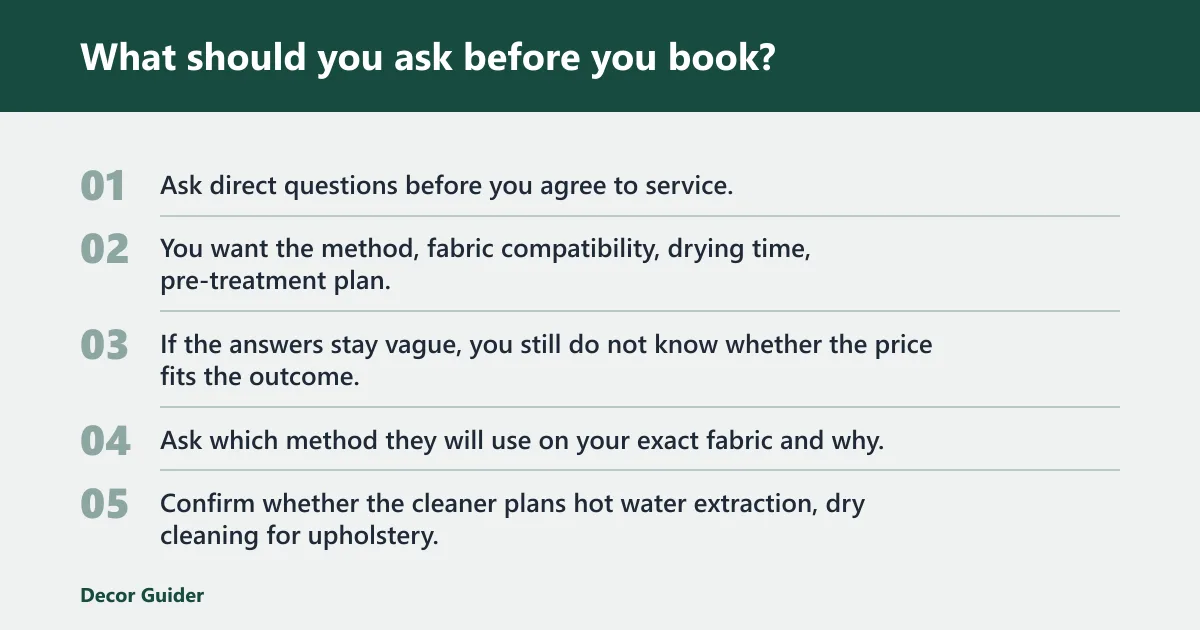
Ask direct questions before you agree to service. You want the method, fabric compatibility, drying time, pre-treatment plan, and any stain guarantee explained in plain language. If the answers stay vague, you still do not know whether the price fits the outcome.
Method, fabric compatibility, and drying time
Ask which method they will use on your exact fabric and why. Confirm whether the cleaner plans hot water extraction, dry cleaning for upholstery, or another low-moisture option. Then ask how long drying usually takes for that method and what they recommend for air flow after the visit.
Pricing factors: location, size, condition, fabric type, and add-ons
Service pricing factors include location, size of furniture, condition of furniture, fabric type, and additional services. A larger sectional costs more than a small loveseat. Heavy soil, tricky fabric, stair access, deodorizing, and stain treatment can all move the price. Compare quotes on the same scope, not just the headline number.
What guarantee or redo policy applies to stains and odors
Ask whether there is a redo policy for missed spots or a limited guarantee for odor work. The wording matters. No honest cleaner should promise that every stain disappears or that every odor is gone forever, especially when contamination has reached the fill or backing.
| Question to ask | Why it matters | Good answer includes |
|---|---|---|
| What fabric code do you see? | Sets the risk level | Code, material, and method match |
| Will you use hot water extraction or dry cleaning? | Changes moisture and drying | Clear method choice with reason |
| How long will drying take? | Affects use and odor control | Expected range and airflow advice |
| What pre-treatment will you use? | Improves stain and odor work | Product type and target stain |
| Is there a stain or odor redo policy? | Sets expectations | Written scope and limits |
Choose professional couch cleaning if… / choose DIY if…
Choose professional couch cleaning if the couch has set-in stains, pet urine, persistent odor, delicate fabric, or a high replacement cost. Choose DIY if the issue is light soil, surface dust, or one fresh spot on a fabric that tolerates your cleaner. The right call depends on outcome, not pride.
Choose professional couch cleaning if…
- You have wine spills, pet urine accidents, or mystery stains that keep returning.
- Your couch is silk, velvet, or another delicate upholstery fabric.
- You want deeper odor reduction or help with embedded dirt and allergens.
- The couch would be expensive or difficult to replace.
Choose DIY if…
- The couch only has dust, crumbs, or light surface soil.
- The spill is fresh and small, and the fabric tolerates mild spot cleaning.
- You can keep moisture low and avoid scrubbing.
- You are not trying to solve odor from padding or backing.
Use the post-clean expectations table to judge value
A service is worth the price only if the result matches the problem you hired it to solve. If the couch still smells after drying, or the stain returns after a day or two, the job may have treated the surface without fixing the source. That is a method problem, not a convenience problem.
| What you should see after cleaning | Good expectation | Warning sign |
|---|---|---|
| Drying | Dry-to-touch timing fits the method used, with no damp padding left behind | Visible moisture, musty smell, or cushions that stay wet too long |
| Odor removal | Odor drops clearly, especially after enzyme-based treatment on pet accidents | Smell fades at first, then returns as the couch dries |
| Stain recurrence | Set-in marks may lighten, but the source should not wick back quickly | Brown rings, yellowing, or shadowing reappear after drying |
Frequently asked questions
Is professional couch cleaning worth it?
It is worth it when the couch has odor, set-in stains, pet accidents, or fabric that should not be treated casually. For light dust and minor surface spots, DIY is usually the better spend. The value comes from solving a deeper problem, not from making already-clean upholstery look slightly fresher.
How much does professional couch cleaning cost?
Pricing varies by location, size of furniture, condition of furniture, fabric type, and additional services. A small, lightly soiled sofa generally costs less than a large sectional with stain treatment and deodorizing. The fairest comparison is a quote that spells out method, add-ons, and any limit on stain removal.
How often should a couch be professionally cleaned?
Frequency depends on use, pets, allergies, and fabric type. Busy households with children or pets usually need service more often than a low-use guest room sofa. If soil builds up, odors linger, or dust settles into the fibers faster than vacuuming can handle, the couch has likely waited too long.
Will professional cleaning remove pet stains and odors?
It can help, especially when the cleaner uses pre-treatment and enzyme-based treatment for pet urine. Fresh accidents respond better than old ones, and odors can come back if they reached the backing or fill. That means the result may be improvement rather than total removal for deep contamination.
Is steam cleaning safe for my sofa fabric?
Not always. Steam cleaning uses hot water and a specialized machine to remove dirt and stains, but fabric code and construction determine whether that moisture level is safe. Silk, velvet, and other delicate fabrics need special care, and some sofas do better with dry cleaning for upholstery instead.
What is the difference between steam cleaning and dry cleaning for couches?
Steam cleaning uses hot water and a specialized machine, while dry cleaning for upholstery uses a chemical solvent and does not require water or drying time. Steam cleaning can suit durable fabrics with deeper soil. Dry cleaning fits lower-moisture needs and can be a safer choice for some delicate pieces.
Products related to this article
Sponsored / affiliate links. As an Amazon Associate I earn from qualifying purchases. I may earn additional commission from eligible campaigns.