McCulloch Steam Cleaner Review: Worth It for Couches?
McCulloch steam cleaners are worth it for couches only when your upholstery is steam-safe, your stains are light to moderate, and you are willing to work in short passes with controlled moisture. They fit a single sofa or sectional sections better than delicate, moisture-sensitive furniture that can ring, shrink, or stay damp for hours.
This guide is part of our Sofa cleaning and stain removal series.
Verdict
For couch cleaning, the MC1385 is a strong pick because its fairly large tank, long continuous steam time, strong steam pressure, multiple accessories, roughly 12 minute heat-up, and a long cord give you a good chance of finishing a full sofa without constant refills. The MC1375 is the faster-starting option for standard sofas and loveseats, while the MC1275 is better for quick cleanups, not whole-couch jobs.
📊 Popular Mechanics says steam cleaners can kill 99.9 percent of bacteria, viruses, mold and mildew. Source: The 7 Best Steam Cleaners of 2023.
Pros and cons
Pros
- Canister design is the better McCulloch format for upholstery, because it is easier to use with attachments on cushions, seams, and armrests than a floor-only tool.
- Every McCulloch canister model heats water to over 200°F, which meets the minimum practical benchmark for upholstery steam cleaning.
- The MC1385’s 58 PSI helps push steam farther into fabric fibers than low-pressure handheld units.
- The right attachments can reach seams, corners, and tight spots around sofa arms and tufting.
Cons
- Steam can still leave water rings or over-wet cushion fills if you linger too long in one spot.
- Delicate fabrics, glued trims, and moisture-sensitive cushions are real risk cases.
- The MC1275 is short on runtime for larger sectionals, so it can force a rush job.
- Accessory count matters less than fit; if the upholstery tool is awkward, couch use gets frustrating fast.
Specs at a glance
| Model | Tank / runtime | Heat-up | Pressure | Accessories | Couch-use read |
|---|---|---|---|---|---|
| McCulloch MC1385 Deluxe Canister Steam Cleaner | 64 ounce water tank; up to 2 hours of continuous steam | About 12 minutes | 58 PSI | 23 accessories | Best for sectionals and full-sofa cleaning if you manage moisture carefully |
| McCulloch MC1375 Canister Steam Cleaner | 90 minute runtime | Around 8 to 10 minutes | Over 200°F steam | 20 versatile accessories | Good for standard sofas and loveseats when you want quicker start-up |
| McCulloch MC1275 Heavy Duty Steam Cleaner | 45 minute runtime; smaller tank | Under 8 minutes | Over 200°F steam | 18 accessories | Better for quick cleaning sessions or single area jobs |
For upholstery, the most useful numbers are runtime, tank size, heat, pressure, and cord reach. Those decide whether you can move across a sofa in order, then let each section dry before the next pass. A long runtime helps only if you still avoid over-steaming one cushion after another.
Who it is for
This is for homeowners who want one canister machine that can handle a couch, sealed floors, and other hard surfaces, and who are willing to prep the sofa first. It is a better fit for people cleaning a sectional, loveseat, or a family-room sofa with removable cushions than for anyone who wants a light, grab-and-go spot cleaner.
It is not for delicate upholstery, glued decorative trims, moisture-sensitive cushions, or any sofa where the fabric label warns against steam or wet cleaning. If your main goal is a tiny spot on an armrest, a lighter upholstery tool may be the better buy.
What works
Fabric safety starts with the label
Steam cleaning can work on some sofa fabrics, but not all. The safest use cases are sturdier, steam-tolerant upholstery fabrics where you can keep the nozzle moving and avoid soaking the fill. Popular Mechanics notes steam cleaners can kill 99.9 percent of bacteria, viruses, mold and mildew, but that does not mean every couch fabric should be steamed.
Heat above 200°F matters because it gives you a better chance of loosening grime and helping with sanitizing. A common practical benchmark for furniture is around 3 bar of pressure, because pressure helps push steam deeper into fibers rather than just warming the surface.
What the attachments should do on a couch
Attachments are important because different surfaces need different contact and reach. The upholstery attachment is the first thing that matters. A fabric or upholstery tool helps spread steam across a wider patch without concentrating too much heat in one spot. A detail brush helps with seam lines and set-in debris, and an angled nozzle helps get into tight corners around piping, skirt edges, and cushion gaps.
If a machine has many tools but no comfortable upholstery attachment, that accessory count is mostly noise for couch buyers. Fit matters more than the number on the box.
What steam can do to common couch messes
Steam is most promising for old food stains, pet hair residue, and general grime, but results depend on stain age, fabric type, and prep. Loose debris and dried surface dirt respond better than deep dye stains or oily marks that have settled into the weave. Odors may improve, but steam does not guarantee odor removal.
Picture a 3-seat sofa with dried snack crumbs, light pet hair, and a darkened armrest. Steam may lift the grime if you vacuum first and make short passes, but a ketchup stain from last week may still need a separate upholstery-safe cleaner.
Moisture control and drying time
The biggest couch risk is not the steam itself. It is over-wetting. Short passes, a steady hand, and immediate blotting help keep moisture from soaking into the foam. Drying time can stretch for hours if the fabric is dense, the room is humid, or the cushion fill is thick.
A common first-timer mistake is treating one cushion like a floor tile. That usually leaves a visible ring, a damp core, or both. Work one section at a time and give each area recovery time before moving on.
What does not
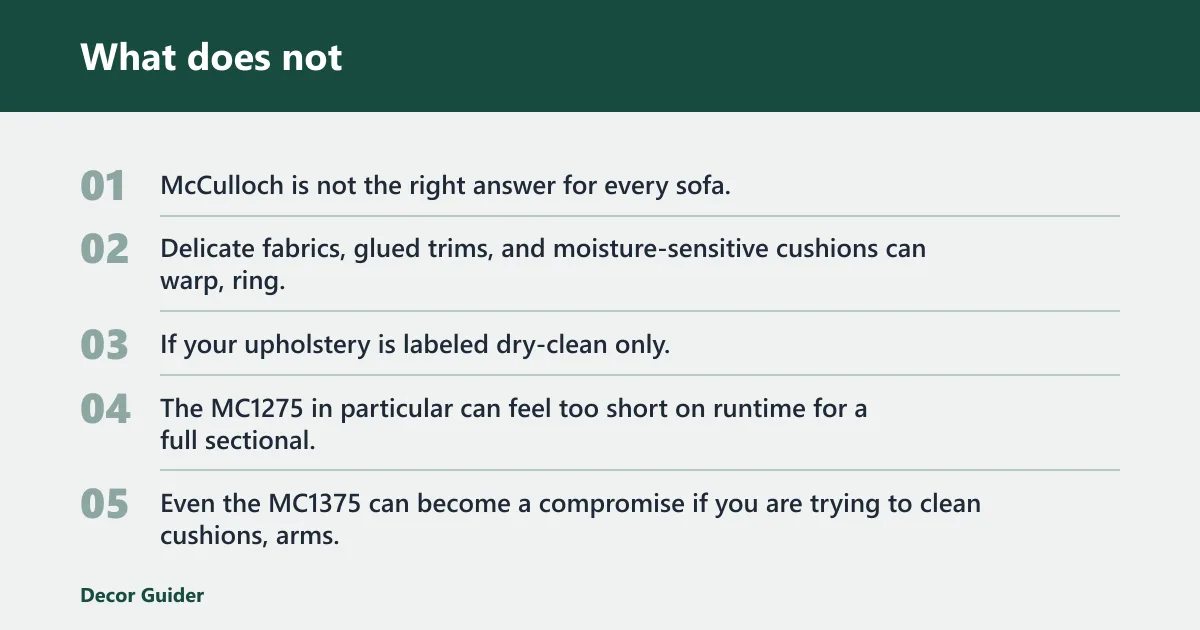
McCulloch is not the right answer for every sofa. Delicate fabrics, glued trims, and moisture-sensitive cushions can warp, ring, or hold dampness longer than expected. If your upholstery is labeled dry-clean only, or if the sofa has decorative adhesive details, steam is a risk, not a shortcut.
The MC1275 in particular can feel too short on runtime for a full sectional. Even the MC1375 can become a compromise if you are trying to clean cushions, arms, and a chaise in one pass without pausing for refills or drying checks. And no McCulloch should be treated as a stain-removal guarantee.
Can you use a McCulloch steamer on upholstery safely?
Yes, but only on steam-tolerant upholstery and only with careful technique. The machine should be used with the upholstery tool, brief passes, and low moisture output. Hidden-fabric testing is essential because a safe result on one sofa fabric can become a bad result on another, especially with glued trims or dense foam cushions.
Before steaming, vacuum thoroughly, check the tag, and test a hidden area such as the back skirt or lower rear panel. If the fabric darkens, puckers, or feels tacky after drying, stop there.
Safe fabrics and safer use cases
Sturdier woven synthetics and some blend fabrics are generally better candidates than soft, fragile, or bonded materials. The safer use case is light refresh work, not saturating a whole cushion. Short, controlled passes also fit loveseats better than oversized sectionals because you can manage drying between sections.
Risky fabrics, glued trims, and moisture-sensitive cushions
Avoid steam when the sofa has glued-on trim, loosened seams, or cushions that seem prone to retaining moisture. Even if the surface looks fine, hidden fill can hold dampness long enough to create odor or a slow-drying interior. That is the failure case many product pages skip.
Why hidden-fabric testing matters before you steam
Hidden testing tells you whether the fabric changes color, warps, or rings after moisture exposure. It is the fastest way to catch a bad match before the damage shows on the front of the sofa. Test, wait for it to dry, then decide.
Will steam cleaning a sofa remove stains and odors?
Sometimes, but not always. Steam is best at loosening surface grime, softening old food residue, and freshening fabric that holds light odors. It is less reliable on deep dye stains, set-in oil, or upholstery that already has a strong odor in the cushion core, because the problem may be below the surface.
Pre-cleaning matters here. Vacuum first, treat visible spills with an upholstery-safe method if needed, and only then use steam. If you skip prep, steam may spread the stain or create a water ring around it.
What a fabric sofa cleaning test should check
- Old food stains: see whether dried residue softens without spreading.
- Pet hair residue: check whether the tool lifts embedded hair from weave and seams.
- General grime: look for visible brightening after a controlled pass.
- Penetration: judge whether steam reaches the surface without soaking the cushion.
- Dampness: confirm that the fabric feels only lightly moist, not wet.
How long does a McCulloch steam cleaner run on one tank?
The MC1385 gives you up to 2 hours of continuous steam, the MC1375 offers a 90 minute runtime, and the MC1275 delivers 45 minutes. For couch cleaning, those numbers matter less in the abstract than in seat-by-seat coverage, because upholstery work is slower than cleaning floors or sealed tile.
For a large sectional, the MC1385 is the most practical of the three because it gives you the best chance to move section by section without stopping often. The MC1375 fits a standard sofa or loveseat well, while the MC1275 is best for a quick refresh on one seat cushion, one arm, or a small spill area.
Runtime in sofa terms
A long runtime only helps if you are not over-steaming. On a couch, a full tank should be used with pauses between sections so each area can dry down before the next pass. That means refill timing is only part of the question; recovery time between cushions is just as important.
Refill timing and seat-by-seat coverage
Say your sectional has six removable cushions and a chaise. A shorter-runtime machine may force you to stop halfway through, then return after the first side has begun drying. That can complicate even coverage, which is why MC1275 makes more sense for spot-only use than for a whole sofa.
What should I look for in a steam cleaner for upholstery?
Start with the right fabric attachment, not the biggest spec sheet. For upholstery, the best machine is the one that gives you controllable steam, a comfortable upholstery tool, enough cord reach to move around a couch, and runtime that matches the furniture size without rushing your passes.
Pressure, heat, and tank size matter next. Over 200°F is a practical baseline for McCulloch canister models, 212°F and above is the ideal sanitizing zone, and about 3 bar is a useful furniture benchmark for pressure. After that, choose the model that fits your couch size and cleaning frequency.
Sofa-specific decision checklist
| Check | Good fit | Warning sign | McCulloch read |
|---|---|---|---|
| Fabric safety | Steam-safe woven upholstery | Delicate fabric, glued trims, moisture-sensitive cushions | Proceed only after label check and hidden test |
| Moisture load | Short, controlled passes with quick drying | Thick fill, visible dampness, long drying time | MC1385 and MC1375 are better than MC1275 for control on larger jobs |
| Attachment match | Upholstery tool, detail brush, angled nozzle | No comfortable fabric tool for seams and corners | Strongest on the MC1385 and MC1375 accessory sets |
| Prep work | Vacuumed, spot-tested, room ready to dry | Dust, pet hair, or loose grit still on the sofa | Prep is required before any of these models touch fabric |
| Stain type | Light grime, old food residue, surface odor | Deep dye stains, oil, or long-set discoloration | Best for refresh work, not miracle stain removal |
| Drying time | Can dry before the next seating section | Family needs the couch immediately after cleaning | Plan recovery time between cushions |
| Best fit by couch size | Sectional, loveseat, or spot-only use matched to runtime | Large sofa cleaned in one rushed pass | MC1385 for sectionals, MC1375 for standard sofas, MC1275 for spots |
How to score your couch before you buy
- Check the fabric label and mark any steam warnings.
- Inspect for glued trim, loose seams, or fragile piping.
- Decide whether you need full-sofa cleaning or only spot cleaning.
- Match runtime to sofa size and how many sections you need to finish.
- Confirm the upholstery attachment and corner tool fit the couch shape.
- Plan drying space and time before you start.
What can you clean besides couches?
McCulloch canister models are not sofa-only machines. Popular Mechanics describes cylinder steam cleaners as more versatile and suitable for upholstery and curtains, and they also make sense on sealed hardwood, tile, grout, granite, and car interiors when the surface can handle steam. Sofa buyers should care about that only if those jobs are also on the list.
If you mainly want upholstery and a little sealed-surface cleanup, the canister format is logical. If you only want a couch touch-up, the extra reach and accessory set may be more machine than you need.
Sealed hardwood and tile
These surfaces are easier than upholstery because they do not absorb moisture the same way fabric does. That means the steam cleaner’s reach is helpful, but the couch rules about rings and drying are less important there.
Grout and granite
Grout often benefits from concentrated steam and a narrow nozzle. Granite and other sealed stone surfaces can also be cleaned with the right approach, though finish compatibility still matters. These uses do not replace upholstery-specific checks.
Car interiors
Car seats and seams are closer to couch work than floors are, which is why upholstery tools matter. Still, the same caution applies: hidden testing, light passes, and moisture control.
Alternatives

- Steam-on-demand trigger prevents over-wetting surfaces
- High-temperature steam reaches up to 275°F
- Includes 9 tools for multi-surface cleaning
The Bissell PowerFresh Slim 3‑in‑1 makes more sense if you want a lighter multi-surface machine and value steam-on-demand for limiting moisture. It is less of a pure canister couch tool, though, so its shape and tool kit make it a better fit for quick upholstery touch-ups than for methodical whole-sofa cleaning.

- Rapid 40-second heat-up time for quick starts
- Flexible nozzle joint enhances reach for tight spots
- Lamella technology ensures wide edge-to-edge steam coverage
The Kärcher Steam Cleaner SC 3 EasyFix is the faster-start option here, with a 40 second heat-up and a flexible nozzle that helps in tight spots. That speed is useful for spot cleaning and small upholstery tasks, but its quick-start appeal matters less if you need long, steady couch coverage without refilling or repositioning often.

- 45 minutes of runtime covers large sofa sections
- 48-ounce tank heats up in under 8 minutes
- Includes 18 versatile accessories for various tasks
The McCulloch MC1275 Heavy-Duty Steam Cleaner is the budget-leaning McCulloch choice for short jobs, but its 45 minute runtime and 18 accessories place it firmly in quick-clean territory. It works for an armrest, one cushion, or a small sectional section, yet it is the easiest of the McCullochs to outgrow for full sofa work.
Should you buy it
Buy McCulloch if your sofa is steam-safe, your goal is cleaning a loveseat, standard sofa, or sectional in controlled sections, and you want a canister that can also handle sealed hard surfaces. Choose the MC1385 if you want the best couch fit of the group, the MC1375 if quicker startup matters more, and the MC1275 only if your couch use is occasional and spot-based.
Skip McCulloch if your furniture is delicate, heavily glued, or moisture-sensitive, or if you need a machine for tiny touch-ups and nothing else. In that case, a lighter upholstery tool is the cleaner match.
Frequently asked questions
Is the McCulloch steam cleaner worth it for couches?
It is worth it only for steam-safe couches where you can control moisture and work in sections. The MC1385 is the strongest couch fit because it offers long runtime and higher pressure, while the MC1275 is better for smaller jobs. Delicate fabrics can make the answer a no.
Can you use a McCulloch steamer on upholstery safely?
Yes, if the upholstery is steam-tolerant and you test a hidden area first. Use the upholstery tool, keep passes short, and avoid soaking the cushion fill. Glued trims, fragile fabric, and moisture-sensitive cushions are the main reasons to stop before you start.
Will steam cleaning a sofa remove stains and odors?
It can help with light grime, old food residue, and some mild odors, but it is not a guarantee. Deep stains and trapped odors may need pre-treatment or a different cleaning method. Fabric type, stain age, and how well you prep the sofa decide the outcome.
How long does a McCulloch steam cleaner run on one tank?
The MC1385 delivers up to 2 hours of continuous steam, the MC1375 offers a 90 minute runtime, and the MC1275 runs for 45 minutes. For couches, the key question is not just runtime but whether you can clean and dry one section before moving to the next.
What attachments do you need for cleaning a couch with steam?
The most useful tools are the fabric or upholstery attachment, a detail brush, and an angled nozzle. The upholstery tool covers the broad fabric area, the detail brush helps seams and texture, and the angled nozzle reaches corners, piping, and narrow gaps where dirt hides.
Does steam cleaning damage fabric sofas?
It can. Damage usually comes from too much moisture, too much heat in one spot, or using steam on the wrong fabric. Water rings, shrinkage, and lingering damp smells are the common failure cases. Hidden testing and short passes are the main defenses.
Products related to this article
Sponsored / affiliate links. As an Amazon Associate I earn from qualifying purchases. I may earn additional commission from eligible campaigns.