Prepac Bookcase Review: Is It Worth It for You?
Prepac bookcases are best for light-to-moderate household storage, not heavy library loads; if you need a stable, apartment-friendly shelf, anchor it and keep the heaviest items on the lower shelves. Skip it if you leave it unanchored: particleboard can rack, tip, or sag under books and electronics. This review covers load limits, stability, assembly, and which rooms and buyers it fits best.
This guide is part of our Chairs guide: types, buying and care series.
Verdict at a glance


Choose Prepac if you want straightforward storage for paperbacks, mixed decor, and office clutter at a midrange price. It fits readers who want enclosed dust control or simple open display, not anyone building a dense floor-to-ceiling book wall with heavy hardcovers.
The best Prepac buy for many households is the model style that matches the job: open bookcase for display and quick access, enclosed storage cabinet for hiding clutter and reducing dust. The weaker fit is a tall, unanchored unit loaded with heavy books on upper shelves.
Prepac bookcase features and build
Prepac’s open bookcases usually use laminated engineered wood rather than solid wood. That matters because the surface wipes clean easily, but the core is lighter and less tolerant of impact, moisture, and overloading than plywood or hardwood. Edge banding covers cut edges, but it does not make the panel chip-proof.
Shelf material and edge treatment
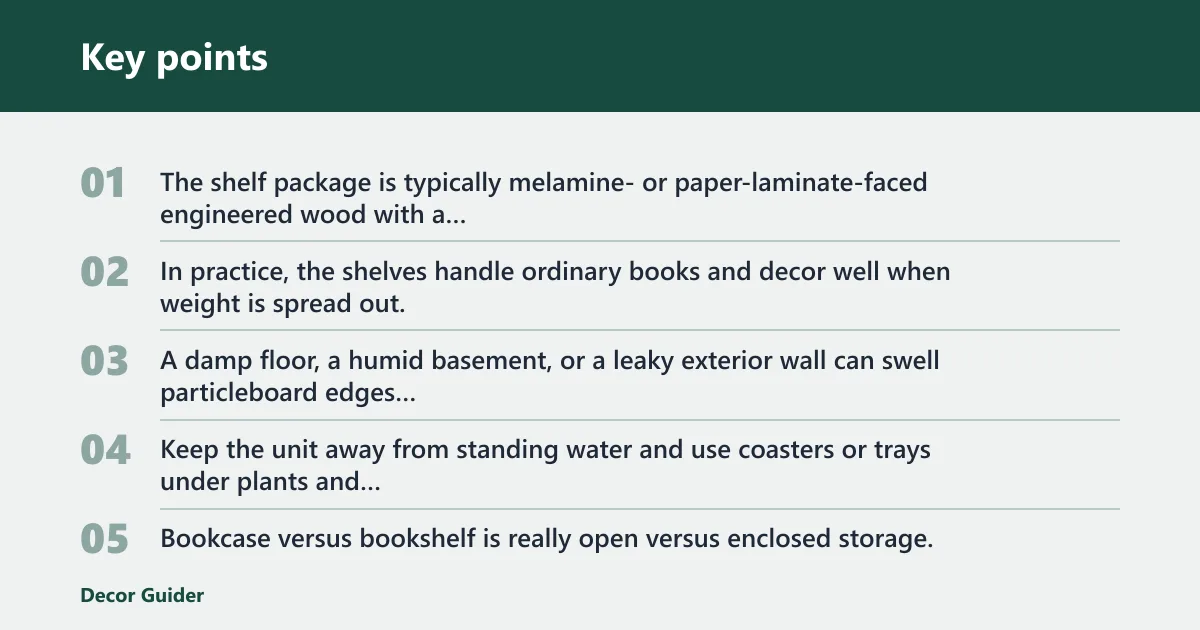
The shelf package is typically melamine- or paper-laminate-faced engineered wood with a thickness suited to flat-pack furniture, not heirloom casework. In practice, the shelves handle ordinary books and decor well when weight is spread out, but they can sag if you stack heavy reference books in one center section.
Moisture is the weak point. A damp floor, a humid basement, or a leaky exterior wall can swell particleboard edges faster than a solid-wood shelf would. Keep the unit away from standing water and use coasters or trays under plants and humidifiers.
Open shelving versus enclosed storage
Bookcase versus bookshelf is really open versus enclosed storage. Open shelves suit display, fast access, and visual lightness. Enclosed cabinets hide cords, binders, games, and office supplies, and the doors cut dust buildup on stored items.
Prepac storage cabinet models add doors, usually with adjustable shelves behind the front panels. That setup works better in a home office or living room when you want the room to look calmer. The tradeoff is slower access and less display space.
What the finish means in daily use
Prepac’s laminate finish is easy to clean with a dry or slightly damp cloth. It is also less forgiving of knife marks, drag marks from metal bookends, and moisture left to sit. Treat it as practical furniture, not a scrub-resistant work surface.
Is the Prepac bookcase sturdy enough?
For normal household books, yes, provided you respect the shelf limit, spread weight evenly, and anchor the unit. For heavy book collections, the answer becomes conditional: the lower shelves are the safest place for dense loads, while the top shelves should stay light to reduce sway and tip risk.
Per-shelf and total load limits
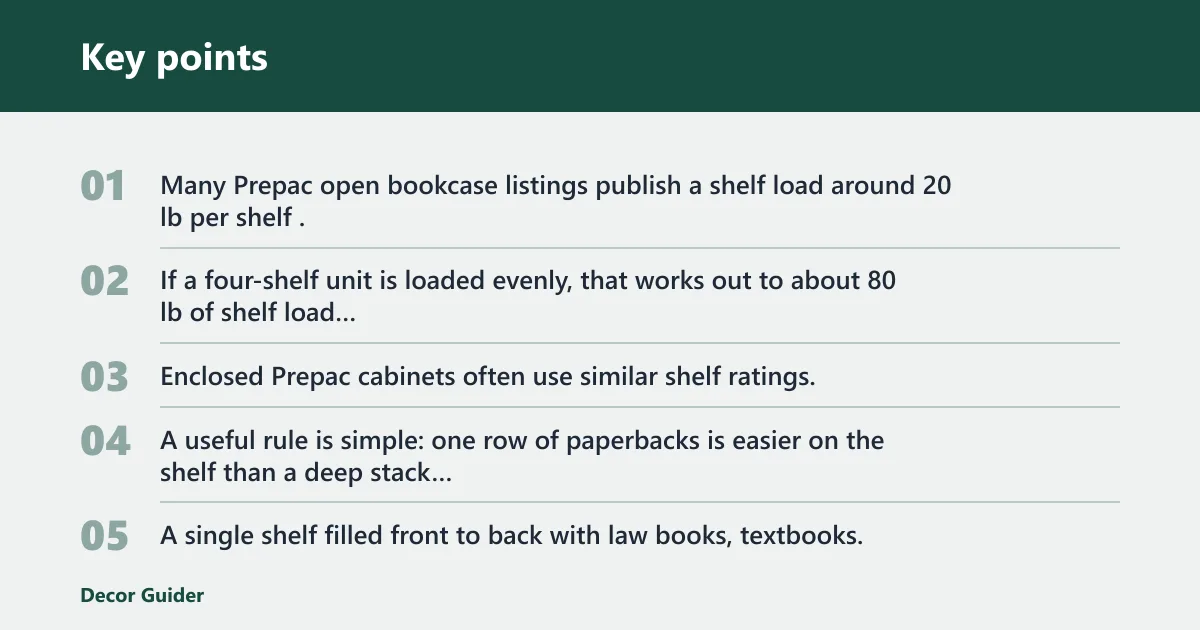
Many Prepac open bookcase listings publish a shelf load around 20 lb per shelf. If a four-shelf unit is loaded evenly, that works out to about 80 lb of shelf load across the case, not counting the cabinet weight itself. Enclosed Prepac cabinets often use similar shelf ratings, but always check the exact listing or assembly sheet for the number tied to your model.
A useful rule is simple: one row of paperbacks is easier on the shelf than a deep stack of hardcovers. A single shelf filled front to back with law books, textbooks, or art volumes can push a flat panel harder than the same shelf holding decor and a few paperbacks.
Heavy books versus decor weight
Decor, framed photos, small baskets, and novels are easy for these units. Heavy encyclopedias, dense textbooks, and boxed media belong low. Put the heaviest items on the bottom shelf or two, and keep the top shelves for lighter objects so the center of gravity stays down.
A common first-timer mistake is loading the top shelf with hardcovers because that shelf feels empty. The result is more sway when a door closes or someone bumps the side panel, which is exactly when a tall particleboard case becomes less stable.
Sag and tip-over risk
Sagging usually shows up first in the middle of a long shelf. Tip-over risk shows up when the unit is tall, loaded high, and unanchored. Those are different problems, and both matter. A shelf can look fine while still being unsafe if the weight is distributed badly.
For best practice, treat wall anchoring as required on tall units, especially in homes with children, pets, or earthquakes. Use the supplied anti-tip hardware if it is included, and have a stud-finder, drill, level, screwdriver, and the correct wall fasteners for drywall or plaster on hand if the package does not include them.
How does it fit in a small room?
Prepac works well in a small room when you choose a narrow footprint, keep aisle clearance in mind, and measure the wall from baseboard to ceiling before buying. A compact apartment or office can take one well, but a tall cabinet beside a door or window can crowd the room quickly.
Narrow-room and apartment sizing
For narrow rooms, look for the slimmer open bookcase or the 24-inch-size cabinet variant rather than a wide storage piece. A narrower case leaves more walking space and usually looks less bulky against a hallway wall or beside a desk. Measure width, depth, and the swing path of nearby doors.
Ceiling height and door-clearance checks
Check ceiling height if you are considering a tall bookcase or enclosed cabinet. Leave room for the unit itself, baseboards, and a little top clearance so you can level it and reach the anchoring point. Also check whether cabinet doors can open fully without hitting a sofa arm, trim, or radiator.
Renter-friendly placement and anchoring
- Measure the wall width, ceiling height, and door swing before purchase.
- Place the heaviest books on the lowest shelf.
- Keep the back panel flush so the unit sits square.
- Anchor the case to wall studs when possible; use approved wall anchors only when studs are not available.
- Recheck the fasteners after moving the unit or adding more books.
Suppose a 24-inch cabinet fits beside a desk in a rental office. That is a good sign, but it still should be anchored if it is tall. The footprint may be small, yet the tipping force from loaded doors or a pulled-open shelf remains the same.
Bookcase buyer-fit table
| Room size | Book load type | Recommended Prepac configuration | Risk notes |
|---|---|---|---|
| Small apartment, narrow wall | Paperback-heavy shelves | Open bookcase with 4 shelves; anchor to wall | Low sag risk if weight is spread out; keep top shelf light |
| Home office with closed storage preference | Mixed books plus office supplies | Prepac storage cabinet with doors and adjustable shelves | Better dust control; door hinges need clearance and anchoring |
| Living room against a long wall | Hardcover-heavy shelves | Lower shelves only for books; upper shelves for decor or use an enclosed cabinet | Heavy loads belong low; watch for mid-shelf sag |
| Rental unit near a door or walkway | Mixed decor storage | 24-inch-size cabinet variant or slim open bookcase, fully anchored | Check door swing and baseboard clearance; tipping risk rises if unanchored |
Pros and cons
Pros
- Good value for basic book and decor storage
- Open shelves make items easy to reach and display
- Enclosed cabinets reduce dust and hide clutter
- Adjustable shelves on cabinet models improve flexibility
- Laminate surfaces are easy to wipe clean
Cons
- Engineered wood is less forgiving than solid wood
- Heavy books can cause sag if loaded carelessly
- Tall units should be anchored to the wall.
- Edges can chip if bumped hard
- Moisture can damage panels faster than hardwood
Who it’s for
Prepac is a good fit for home office buyers, apartment dwellers, and living room users who need tidy storage without paying for solid wood casework. It suits readers with paperbacks, mixed decor, and moderate book loads more than collectors with very dense hardcovers or rare volumes.
Choose a different brand if you want thicker shelves, a more furniture-grade finish, or a unit that will carry a deep run of heavy reference books for years. Open bookcase buyers should lean toward display and quick access; enclosed cabinet buyers should lean toward hiding clutter and dust control.
Prepac compared with IKEA and Sauder
Compared with IKEA, Prepac often lands in a similar flat-pack category but tends to suit buyers who want straightforward book storage and enclosed cabinet options without moving into a higher design tier. IKEA frequently offers broader style variation, while Prepac’s strength is direct utility.
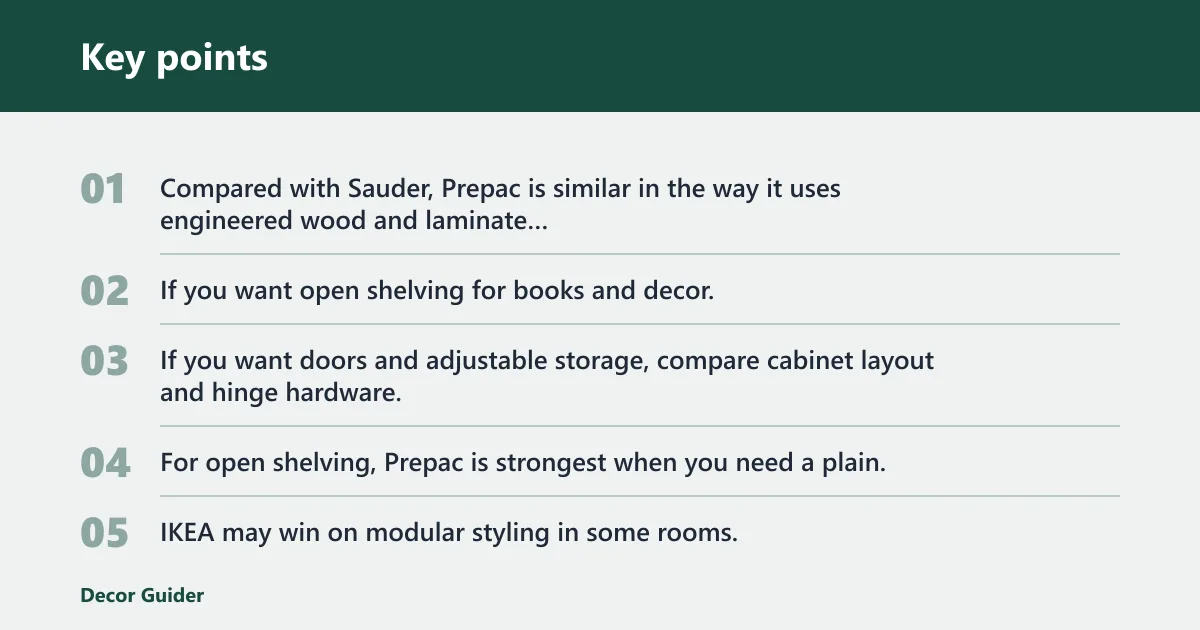
Compared with Sauder, Prepac is similar in the way it uses engineered wood and laminate surfaces, but the right choice depends on the use case. If you want open shelving for books and decor, compare shelf depth and listed load ratings. If you want doors and adjustable storage, compare cabinet layout and hinge hardware.
Open shelving value comparison
For open shelving, Prepac is strongest when you need a plain, practical case at a moderate price. IKEA may win on modular styling in some rooms, while Sauder often competes closely on size and finish options. Pick the unit with the better shelf rating and the better fit for your wall, not the prettier product photo.
Enclosed cabinet comparison
For enclosed storage, Prepac storage cabinet models and the Elite line are useful in home office or living room settings where hiding clutter matters. The Prepac Elite storage cabinet line generally sits in the more polished part of the brand’s lineup, with door-front storage, adjustable shelves, multiple finish options, and sizes that include 24-inch variants for tighter spaces.
That Elite positioning makes sense for buyers who want a cleaner look and a cabinet that reads more like furniture than utilitarian shelving. It is less suitable if your main need is a wide open run of shelves for visible books.
Which buyer profile each brand suits?
Choose Prepac if you want simple storage, a reasonable finish, and clear shelving or cabinet choices. Choose IKEA if modular design and room coordination matter more. Choose Sauder if you are comparing similar flat-pack storage and want to shop by dimensions, finish, and shelf layout rather than by brand identity alone.
Frequently asked questions
Is the Prepac bookcase sturdy enough for heavy books?
It is sturdy enough for normal household use when the load is spread out, the heaviest books stay low, and the case is anchored. It is not the best choice for dense library-style shelving on upper shelves. Heavy hardcovers are safer in the bottom section or behind enclosed doors.
Which Prepac bookcase is best for a small apartment?
The best fit is usually a narrow open bookcase or a 24-inch-size storage cabinet variant, depending on whether you want display or hidden storage. In a small apartment, measure wall width, door clearance, and walking space first. A slim anchored unit is usually the safest choice.
How much weight can a Prepac bookcase hold per shelf?
Many Prepac listings use a per-shelf rating around 20 lb, though the exact number depends on the model. That rating is more useful than guessing by shelf count. If your books are heavy, keep the top shelves lighter and spread the load across more shelves.
Does Prepac use particle board or solid wood?
Prepac bookcases and cabinets are generally made from engineered wood, often particleboard or similar composite panels with laminate surfaces and edge banding. They are not solid wood case goods. That construction keeps cost down and weight manageable, but it also means more care around moisture and impact.
Is a Prepac bookcase easy to assemble by one person?
Many Prepac units are manageable for one person if the room is clear and the pieces are organized, but a second person helps when lifting tall panels and holding the case square for anchoring. Assembly is usually straightforward flat-pack work with common tools, not a difficult carpentry project.
Which Prepac bookcase models have doors or enclosed storage?
Prepac storage cabinet models and the Elite storage cabinet line are the enclosed-storage options to look for. They use doors, adjustable shelves, and a more concealed front than an open bookcase. They are a better match when you want to hide clutter, cords, or office supplies.
Products related to this article
Sponsored / affiliate links. As an Amazon Associate I earn from qualifying purchases. I may earn additional commission from eligible campaigns.