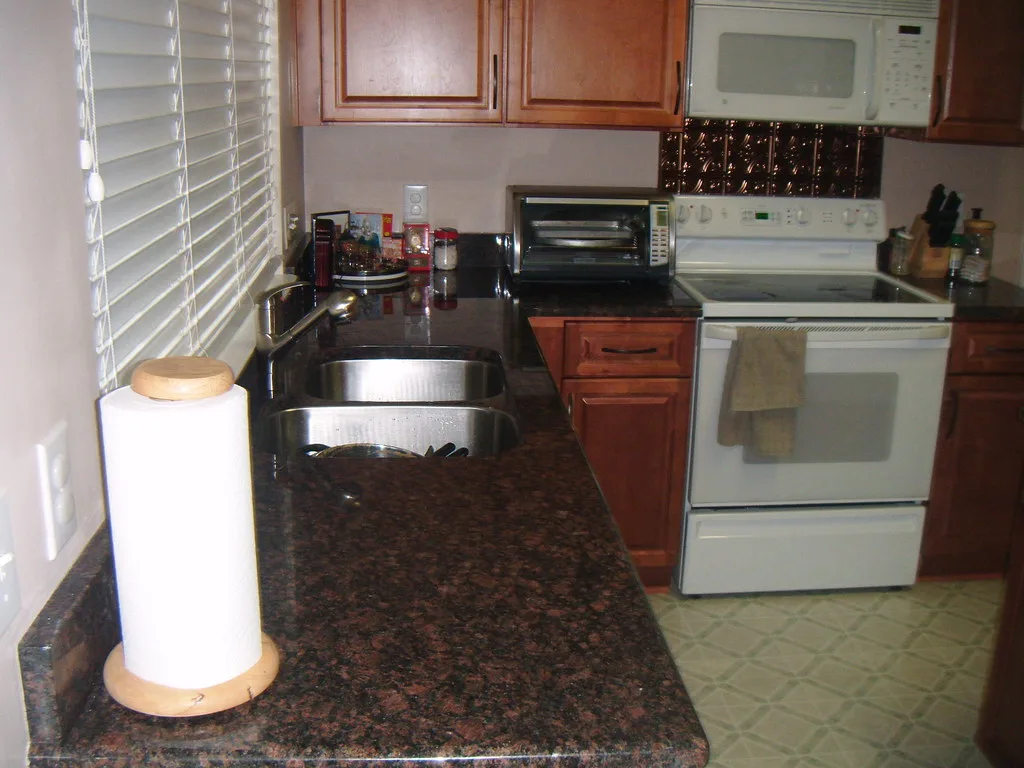
Face Frame Cabinets vs Frameless Cabinets: Key Differences
Choose face frame cabinets if your walls are a bit out of plumb or square, you want easier alignment, or you like a mounting surface for hinges; choose frameless when you want a little more storage and have a flatter, more precise install. Pick the wrong build and you end up cutting filler strips, fighting sticky doors, wasting usable space, and spending extra hours on the install. This guide compares fit, storage, hardware, cost, and DIY difficulty so you can match the cabinet build to your layout.
Face frame cabinets vs frameless cabinets: the real trade-off


The real choice is not style. It is how much installation tolerance your kitchen needs against how much interior access you want to gain. Face frame cabinets are the more traditional, American-style cabinet, with a wood frame on the front of the box that supports hinges and adds stiffness. Frameless cabinets remove that front frame, so the doors attach directly to the cabinet sides and the interior opens up fully.
That one structural change changes the job in the field. A framed cabinet can usually hide a little more error in wall flatness and cabinet alignment. A frameless cabinet usually needs tighter wall prep, tighter layout, and cleaner fastening, but it can give back a bit of space at the opening and inside the box.
| Decision factor | Face Frame Cabinets | Frameless Cabinets | Winner |
|---|---|---|---|
| Usable opening and storage | Slightly reduced opening because the front frame sits in front of the box | Full access to the cabinet interior with no face frame blocking the opening | Frameless Cabinets |
| Wall tolerance and racking control | Face frame helps resist racking and hides small out-of-square conditions better | More dependent on flat walls, square layout, and precise fastening | Face Frame Cabinets |
| Hardware setup | Fastening through the frame allows longer screws, usually 2-1/2 inches | Fastening through side panels usually uses a shorter screw length, 1-1/4 inches max | Face Frame Cabinets |
| Install difficulty | More forgiving during adjustment and alignment | Less forgiving; hidden hinges and tight reveals need more precision | Face Frame Cabinets |
| Layout flexibility | More options in sizes and modifications | Fewer size and modification options | Face Frame Cabinets |
Usable opening and storage
Frameless cabinets win the pure access contest. With no face frame blocking the opening, the box gives full access to the interior, and drawer boxes can usually be larger. The gain is real, but it shows up most in repeated base cabinets, deep drawers, and tall pantry stacks where every bit of opening space adds up across the run.
Wall tolerance and racking control
Face frame cabinets are easier to live with when the room is not perfect. The face frame limits racking, so the cabinet resists out-of-square twisting better as it gets fastened, leveled, and shimmed. Frameless cabinets can still work well, but the install has less forgiveness when the wall bows or the floor varies across the run.
Hardware setup
Framed cabinets usually allow longer screws, and that extra bite helps when fastening into the frame. Frameless cabinets typically depend on side-panel attachment and hidden or European hinges mounted inside the cabinet, which means screw choice and hole placement matter more. The box is doing more of the work, so sloppy fastening shows up faster.
Install difficulty
Face frame cabinets are generally easier for a standard remodel crew or a capable DIYer because the front frame gives a clear reference for doors, fillers, and final reveal. Frameless cabinets ask for tighter precision on the front edge, the side panels, and the hinge setup. If the install is off, the doors and drawers reveal it immediately.
According to Framed vs. Frameless Kitchen Cabinets — Framed cabinets allow longer screw length, usually 2-1/2 inches.
What is the difference between face frame and frameless cabinets
Face frame cabinets have a wood frame on the front of the box. Frameless cabinets do not. That one structural change affects hinge mounting, cabinet stiffness, the size of the opening, and how much error the layout can absorb before doors and drawers start to look wrong or bind.
Box structure and opening geometry
A face frame adds material around the opening, which reduces interior space slightly but adds structural support. Frameless construction keeps the front edge open and uses thicker side panels, often 3/4-inch thick, to carry the load. That creates the full-access interior many homeowners want, especially in base cabinets and tall pantry units.
Overlay, inset, and reveal terms
Overlay refers to how much of the cabinet opening the door covers. Full overlay covers most of the face, partial overlay leaves more frame visible, and inset sits inside the frame opening. Reveal amount is the visible gap or margin around the door or drawer front, and it matters because small layout errors become visible when the reveal is tight.
Which cabinet style gives you more usable space?
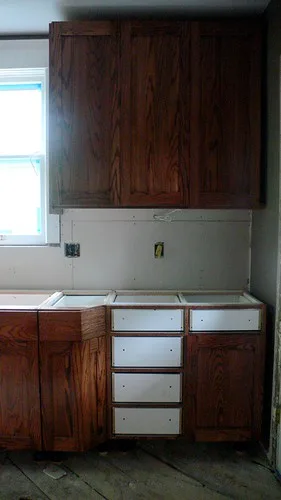
Frameless cabinets usually give more usable space because the box has no front frame blocking the opening, and drawer boxes can be larger. The gain is real, but it is not endless; in a short run or a shallow cabinet, the difference may feel modest. In deeper or wider cabinets, the extra access and box volume are easier to notice.
Drawer box capacity and interior access
Drawer box capacity is typically larger in frameless cabinets because the drawer front can span the cabinet opening without working around a frame. That matters in base cabinets where wide pans, lids, and nested containers need clear side-to-side access. Face frame cabinets give up a bit of that volume to the frame, though many buyers accept the trade for easier fitting.
Where the gain is small
The storage gain is less dramatic when the cabinet is already shallow or narrow. A 12-inch pantry filler situation, for example, can eat up more potential storage than the frame itself. In those rooms, planning the run and limiting fillers matters more than the frame label on the box.
How do installation and hardware needs differ?
Face frame cabinets are usually simpler to fasten and adjust because the frame gives installers a stable edge and a longer screw path. Frameless cabinets rely more on side-panel fastening, hidden hinges, and exact spacing. That means the hardware layout, not just the cabinet box, becomes part of the design decision.
Fastening through a face frame vs through side panels
With framed cabinets, attachment goes through the frame, which can accept longer screws and offers a more forgiving target for shimming. With frameless cabinets, the installer works through the side panels, so the screw length is shorter and the fastening surface has less margin for error. Good install practice matters in both, but frameless punishes rushed work more quickly.
Hidden or European hinges
Hidden or European hinges are common with frameless cabinets because they mount inside the cabinet and keep the front clean. They also demand tighter precision in drilling, setback, and door alignment. If the hinge cup location or reveal is off, the correction range is smaller than what a face frame often allows.
Why frameless asks more from the installer
Frameless installs stack tolerances from the walls, the floor, the cabinet boxes, and the door hardware. A small error on one cabinet can compound across a long run. On a short galley, that may be manageable. On a long kitchen with appliances and fillers, it becomes a layout problem, not just a cabinet problem.
Do frameless cabinets need more fillers and planning?
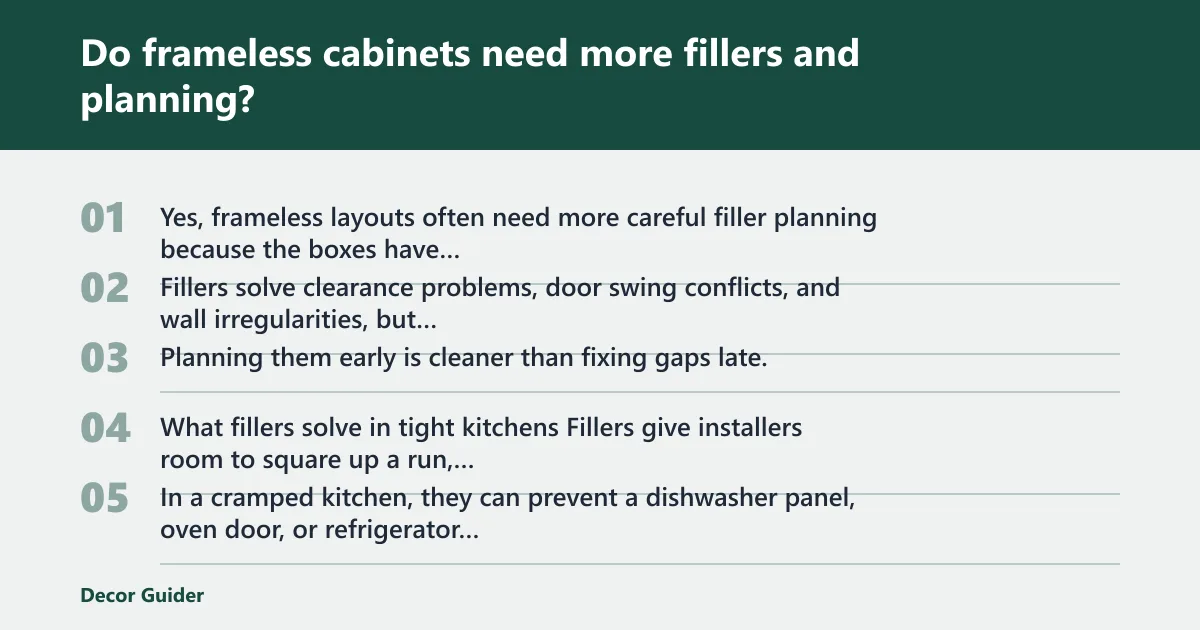
Yes, frameless layouts often need more careful filler planning because the boxes have less front-frame forgiveness at the ends and around appliance openings. Fillers solve clearance problems, door swing conflicts, and wall irregularities, but they also reduce net storage and can steal aisle width if they are oversized. Planning them early is cleaner than fixing gaps late.
What fillers solve in tight kitchens
Fillers give installers room to square up a run, clear door handles, and maintain working gaps at walls and appliances. In a cramped kitchen, they can prevent a dishwasher panel, oven door, or refrigerator trim from fighting the cabinet fronts. They are not wasted space when they protect function, but they are still space taken away from storage.
How fillers affect aisle width and storage
Every filler shifts the line of cabinets and can shrink the net storage footprint. In a narrow galley, that can matter more than the difference between framed and frameless construction. A well-planned framed run may need fewer large fillers when the walls are imperfect, while a frameless run often needs more deliberate spacing to avoid rubbing doors and uneven reveals.
When framed layouts hide wall problems better
Framed cabinets can hide small wall issues more effectively because the face frame offers a wider visual margin. If the room is out of square, the frame helps the doors read as aligned even when the wall behind them is not perfect. That is one reason framed cabinets often feel easier in older homes with uneven plaster or wavy drywall.
What happens when the walls are out of square?
Out-of-square walls create cabinet racking, door misalignment, and uneven reveals. Face frame cabinets handle that abuse better because the front frame helps resist twisting and gives more tolerance at the front edge. Frameless cabinets can still be installed in imperfect rooms, but they ask for more shimming, more checking, and more patience during the fit.
Cabinet racking and misalignment
Cabinet racking is the twisting or out-of-square movement of a box. It shows up as doors that do not line up, drawers that bind, or gaps that vary from top to bottom. The face frame helps resist that movement, so the cabinet stays truer as it is tied into the wall and adjacent boxes.
Long runs and stack-up
Long cabinet runs expose small errors. One cabinet that is a touch high, one wall that bows, and one hinge set a little proud can create visible stack-up by the time the run reaches a range or refrigerator. Frameless construction is less forgiving in that situation because the reveal is often cleaner and the tolerance band narrower.
Comparison table: framed vs frameless at a glance
Use the table below for planning, not for judging style. Build quality matters more than the label alone, and a well-built framed cabinet can outperform a cheap frameless box every time. The best choice depends on wall condition, install skill, and how much storage the room can actually hold after fillers and clearances are accounted for.
| Buyer scenario | Face Frame Cabinets | Frameless Cabinets | Winner |
|---|---|---|---|
| Uneven walls in an older home | More forgiving | Less forgiving | Face Frame Cabinets |
| Storage-first pantry or drawer plan | Slightly less usable opening | Full access interior and larger drawer boxes | Frameless Cabinets |
| DIY install with limited cabinet experience | Easier alignment and fastening | Higher precision needed | Face Frame Cabinets |
| Long straight run with flat walls | Works well | Works very well if laid out precisely | Frameless Cabinets |
| Rental property remodel | Forgiving and serviceable | Good if the installer is precise | Face Frame Cabinets |
| Premium custom kitchen | Strong option with many modification choices | Strong option with cleaner full-overlay look | Tie |
| Appliance panels and tight clearances | More forgiving around transitions | Needs more filler and layout control | Face Frame Cabinets |
| Modern kitchen with precise install crew | Can work, but less box access | Matches the build and the installation method | Frameless Cabinets |
Choose Face Frame Cabinets if… / Choose Frameless Cabinets if…
Choose face frame cabinets if the room is out of square, the install crew needs more forgiveness, or the project includes older walls, rentals, or mixed appliance clearances. Choose frameless cabinets if the walls are flatter, the installer is precise, and the design puts storage capacity and full access ahead of layout tolerance.
Choose Face Frame Cabinets if…
Pick face frame cabinets when the kitchen has uneven walls, long-established floors, or awkward transitions around appliances. They also make sense for DIY installs and for homeowners who want more size and modification options. The front frame gives the install a stronger reference and helps control racking.
Choose Frameless Cabinets if…
Pick frameless cabinets when storage access matters most and the room is ready for a tighter install. They fit modern kitchens well, especially when full overlay is part of the design and the walls are true. They are also a good match for projects where the cabinet line is clean, straight, and planned with the right fillers from the start.
Frequently asked questions
face frame vs frameless cabinets
Face frame cabinets use a front wood frame that adds stiffness, supports hinges, and slightly reduces the opening. Frameless cabinets remove that frame, so the doors attach to the side panels and the interior opens up more fully. The better choice depends on layout tolerance, storage needs, and install precision.
what is the difference between face frame and frameless cabinets
The difference is structural. Face frame cabinets have a front frame that helps resist racking and offers a mounting surface; frameless cabinets do not, which creates a cleaner full-access opening. That change affects hardware choice, filler planning, and how much wall error the install can absorb.
are frameless cabinets better
Frameless cabinets are better when the job is storage-first and the install is accurate. They offer full access to the cabinet interior and can provide larger drawer boxes. They are not better in every room, especially when walls are uneven or the installation team needs more tolerance.
what is the difference between frameless and face frame cabinets
Frameless cabinets use side panels as the main front structure, while face frame cabinets add a frame across the front opening. That frame can help limit racking, support hinge mounting, and make installation more forgiving. Frameless cabinets trade some of that for more interior access.
are framed or frameless cabinets better
Neither is better in every case. Framed cabinets usually win in older homes, DIY projects, and layouts with more tolerance problems. Frameless cabinets usually win when a kitchen has flat walls, a precise installer, and a goal of maximizing access and drawer volume.
which cabinets give more storage space
Frameless cabinets usually give more storage space because there is no front frame narrowing the opening, and the drawer boxes can be larger. The difference is most useful in base cabinets, pantries, and repeated runs where a few extra millimeters of access add up. Fillers and appliance clearances can reduce that gain quickly.
which cabinet style is easier to install
Face frame cabinets are generally easier to install because the frame offers a stable mounting surface and more tolerance for adjustment. Frameless cabinets rely on tighter alignment, shorter screws, and precise hinge setup. If the room is not square, the framed option is usually the safer installation choice.
which cabinet style works better for modern kitchens
Frameless cabinets usually fit modern kitchens better because they have a sleeker, more European look and a full-overlay appearance. The style pairs well with flat-panel doors and clean lines. Still, the room conditions and install quality matter more than the visual trend alone.
do frameless cabinets need more fillers
Often, yes. Frameless layouts may need more fillers to handle wall irregularities, appliance clearances, and door swing space, especially on long runs. Those fillers reduce net storage and can shrink aisle width if they are not planned carefully, so they should be set early in the layout process.
are face frame cabinets more durable
They can be more forgiving and feel sturdier at the front because the frame helps resist racking. That does not mean every face frame cabinet is more durable than every frameless cabinet. Box quality, joinery, panel thickness, and installation quality still matter more than the construction label by itself.
Products related to this article
Sponsored / affiliate links. As an Amazon Associate I earn from qualifying purchases. I may earn additional commission from eligible campaigns.