Thermofoil Cabinets vs Wood Cabinets: Which Fits Best?
Choose thermofoil cabinets if you want a lower upfront price and simple wipe-clean care. Choose wood cabinets if heat, moisture, or later repairs matter more; wood usually makes sense for kitchens and baths with heavier use. Wrong material choice can mean peeling doors, swollen panels, or higher replacement costs. This guide compares cost, failure risk, cleaning, and repair burden so you can choose the right cabinet type for your remodel or refacing project.
Thermofoil vs wood: the real trade-off
Thermofoil cabinets cost less and clean faster. Wood cabinets handle heat better, allow more repair options, and can last longer when the finish stays in good shape. The better choice usually depends on how hard the room works, not only on how the doors look on day one.
| Decision factor | Thermofoil Cabinets | Wood Cabinets | Winner |
|---|---|---|---|
| Upfront cost | Lower | Higher; often 25-50% more expensive than thermofoil | Thermofoil Cabinets |
| Daily cleaning | Easy-clean, low-maintenance surface | Depends on species and finish; painted finishes need more care | Thermofoil Cabinets |
| Heat and steam tolerance | More sensitive at edges, seams, and near appliances | Generally better in hot, busy rooms when properly finished | Wood Cabinets |
| Repair tolerance | Limited; damage often means part replacement | Better; scratches, dents, and finish wear can often be repaired | Wood Cabinets |
| Best fit | Budget remodels, rentals, light-to-moderate use | Frequent-cook kitchens, humid baths, long-term ownership | Tie |
Upfront price favors thermofoil
Thermofoil usually costs less because it uses a manufactured surface over a machined core, not a full wood door. Wood pricing often rises with species choice, door profile, and finish complexity, so the gap can widen on more detailed or custom work.
Maintenance and repair favor wood
Thermofoil is easy to wipe down, but once a corner lifts or a face bubbles, repair options are limited. Wood needs more finish care, yet it handles touch-ups, sanding, and localized repair better than a vinyl surface bonded to a substrate.
Heat and moisture exposure favor wood
Thermofoil can do well in ordinary kitchens, but it is less forgiving near ovens, dishwashers, toaster ovens, coffee makers, and sinks. Wood, especially with a stable finish and good edge sealing, handles those conditions better over time.
📊 Rigid Thermofoil is also called RTF and 3d laminate. Source: Thermofoil vs. Wood: The Ultimate Guide to Choosing the Perfect….
What are thermofoil cabinets, and how are they made?
Thermofoil cabinets use a vinyl face that is glued and vacuum-pressed onto a machined component. Rigid Thermofoil is also called RTF and 3d laminate. The result is a seam and joint free surface that cleans easily, but cut edges and heat-exposed spots need careful detailing.
Why edges and cutouts matter
Cabinet doors are not one flat piece of vinyl. Corners, sink bases, appliance-adjacent panels, and routed profiles create stress points where heat and steam can find weak spots. That is why thermofoil often performs best on simpler door shapes with controlled exposure.
What 3D laminate changes
Some 3d laminates mimic real wood grain with texture and chatoyance. Some have a velvety feel and ultra-low sheen, and some can be self-healing or repairable. Those claims are real product features on certain lines, but they are not the same as full wood repairability.
What are wood cabinets, and where do they fit best?
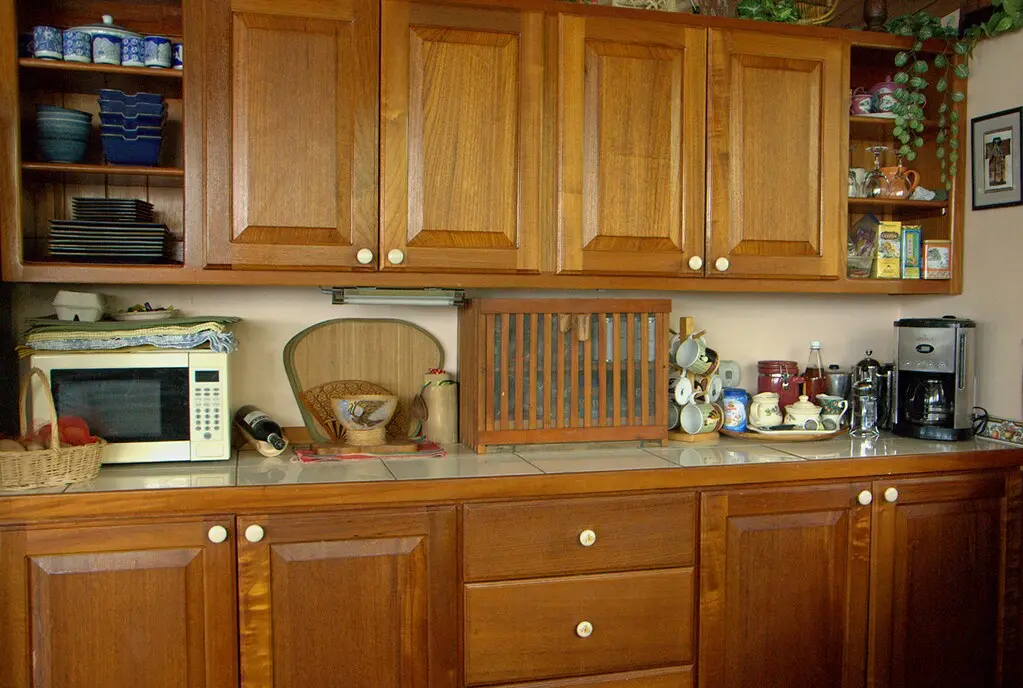
Wood cabinets use real wood species, or they may use wood veneer over a stable core. The look depends on species, grain pattern, and finish type. Wood is usually the stronger choice when you want repairable doors and better tolerance for cooking heat and moisture swings.
Solid wood versus wood veneer
Solid wood gives you natural grain through the full thickness of the part, while veneer uses a thin layer of wood over another core. Veneer can be a smart middle ground when you want wood appearance with more dimensional stability and lower cost than full solid-wood doors.
Painted versus clear-finished wood
Painted wood hides grain and creates a more uniform look, but F9 and F10 matter here: this source usually does not recommend wood for a painted kitchen finish, and paint chips easily in busy kitchens. Clear-finished wood usually suits frequent-cook spaces better because the finish and grain can age with less obvious chipping.
Which costs more: thermofoil or wood?
Wood cabinets cost more than thermofoil in most projects, and the source places wood at 25-50% more expensive than thermofoil. Door style, species choice, and finish level can widen that gap, especially when you move from flat slab fronts to more detailed profiles.
What drives thermofoil pricing
Thermofoil stays relatively affordable because it is a manufactured finish over a machined substrate. Costs rise when you add more complex door shapes, better core materials, or 3D laminate textures that try to mimic wood grain with more realism.
What drives wood pricing
Species matters. Walnut typically costs more than a basic wood option, while riftsawn white oak can sit in a strong mid-to-upper tier because of the milling needed for its look. Finish labor also matters, especially if you want a painted or specialty clear coat.
How refacing changes the math
Cabinet refacing can narrow the gap because you are often replacing door and drawer fronts while keeping the box structure. In that context, you can choose thermofoil components for lower cost, or wood and wood veneer components when you want better repair value and heat tolerance without replacing the whole cabinet run.
Which material is easier to clean and maintain?
Thermofoil is easier to clean in most kitchens because the surface is smooth and low-maintenance. Wood usually needs more care, especially if it is painted or has a clear finish that can show wear, water marks, or abrasion near handles and sinks.
Thermofoil cleaning basics
Use a soft cloth and a mild cleaner. Avoid harsh abrasives, strong solvents, and prolonged steam exposure at the door edge. The smooth face makes everyday grease and fingerprints easy to remove, which is useful in busy households.
Wood cleaning basics
Wood cabinets also clean with mild soap and a damp cloth, but you should dry them promptly. Painted surfaces can chip at corners, and clear finishes can show scratches or dull spots where hands, rings, or cleaning tools repeatedly touch the same area.
Common household habits that matter
- Do not let kettle steam hit the same upper cabinet edge every day.
- Wipe sink splashes promptly, especially under a bathroom mirror cabinet.
- Use exhaust fans near cooktops to cut grease and heat exposure.
- Open dishwasher doors carefully if cabinets sit close by.
How long do thermofoil cabinets last compared with wood?
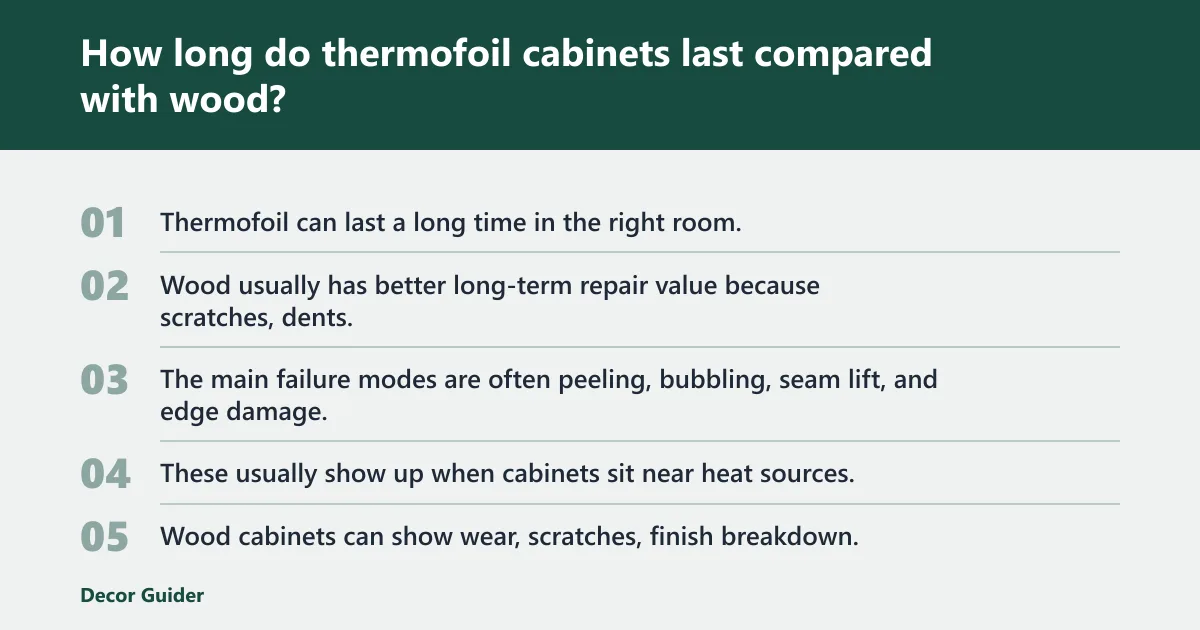
Thermofoil can last a long time in the right room, but its service life depends heavily on heat, moisture, and edge quality. Wood usually has better long-term repair value because scratches, dents, and finish wear can be addressed more directly, even though the finish still needs upkeep.
Common thermofoil failure cases
The main failure modes are often peeling, bubbling, seam lift, and edge damage. These usually show up when cabinets sit near heat sources, when steam repeatedly hits a door edge, or when the substrate movement stresses the bond between the vinyl and the core.
Common wood failure cases
Wood cabinets can show wear, scratches, finish breakdown, and swelling if moisture gets into an unprotected area. Painted wood can chip in high-traffic kitchens, and the damage tends to be visible on corners, rails, and handles before it becomes structural.
What shortens service life
In kitchens, the biggest risk factors are oven adjacency, poor ventilation, repeated steam, and sloppy cleanup after spills. In bathrooms, humidity swings and splashed water matter more. A cabinet that looks fine in a dry showroom can fail early in a steamy room with weak exhaust.
Say your galley kitchen has a dishwasher under the right counter run and a toaster oven below the upper cabinet. A thermofoil door above that heat zone may look fine for months, then start lifting at the lower edge first. A wood door with a stable finish usually has a better margin in that exact spot.
Repairability and replacement
Thermofoil repairs are limited, and larger failures may mean replacing the door or drawer front. Small damage may be hidden only temporarily, and larger failures often mean replacing the door or drawer front. Wood can usually be filled, sanded, stained, painted, or refinished more successfully, which can matter if you expect occasional bumps or want easier repair options.
What cabinet material is best for kitchens and bathrooms?
For kitchens, the better material depends on how much heat and cooking activity the room sees. For bathrooms, moisture exposure and temperature swings matter more, so wood often has the edge if you want better long-term stability and repair options. Thermofoil works best in milder rooms or low-stress setups.
Kitchens with frequent cooking
Choose wood if the kitchen gets heavy use, especially near ovens, ranges, dishwashers, or small appliances that throw heat. Thermofoil can still work in a kitchen, but the failure risk climbs where steam and heat collect near the door edges.
Bathrooms and powder rooms
Bathroom cabinets deal with humidity spikes, sink splashes, and temperature swings. Wood with a good finish usually gives you more predictable long-term performance, while thermofoil is best kept away from vanity areas that see repeated steam or standing moisture.
Rental units and lower-touch spaces
Thermofoil makes sense when you want controlled upfront spending and simple cleaning. It can be a practical choice for rentals, guest baths, and modest-use kitchens where replacement planning matters more than long-term refinishing.
Choose thermofoil cabinets if… / Choose wood cabinets if…
Choose thermofoil cabinets if your priority is a lower upfront cost, simple wipe-clean care, and a cabinet run that will see moderate heat and moisture. Choose wood cabinets if your room gets heavy daily use, if you want better repair options, or if you expect the cabinets to stay in place long enough for refinishing to matter.
Choose thermofoil cabinets if…
- You are refacing on a tight budget and want a cleaner install path.
- Your kitchen has light-to-moderate cooking activity.
- The cabinets sit away from direct oven heat, steam vents, and dishwashers.
- You prefer the easiest day-to-day cleaning routine.
Choose wood cabinets if…
- You cook often and want better heat tolerance.
- Your bathroom or kitchen sees humidity, steam, or frequent splashes.
- You care about future repair, touch-up, and refinishing options.
- You are willing to pay more for species choice, door detail, and finish quality.
When wood veneer is the middle option
Wood veneer can bridge the gap when you want the look of wood without paying for all-solid wood doors. It is especially useful in refacing projects where dimensional stability matters, but you still want a more natural surface than thermofoil offers.
Suppose a family kitchen uses a painted island and a sink wall with open steam exposure from a dishwasher. Wood veneer or clear-finished wood on the sink wall, with a simpler thermofoil panel elsewhere, can be a practical split decision when the layout allows it.
Frequently asked questions
Are thermofoil cabinets better than wood cabinets?
Thermofoil is better when lower cost and easy cleaning matter most. Wood is better when heat, moisture, and repairability matter more. In real homes, the better material depends on how hard the room works, how long you plan to keep the cabinets, and whether you expect future touch-ups or replacement.
How long do thermofoil cabinets last compared with wood?
There is no single lifespan number that fits every kitchen, because exposure and build quality matter more than the label alone. Thermofoil can last well in low-stress spaces, but wood usually offers better long-term service because damaged areas can be repaired more directly instead of replaced outright.
Do thermofoil cabinets peel or warp in heat?
They can, especially near ovens, dishwashers, coffee makers, and other heat sources. Peeling, bubbling, and seam lift usually start at edges or cutouts where heat and steam concentrate. Good ventilation and careful placement help, but thermofoil is still less forgiving than wood in hot zones.
Are wood cabinets worth the extra cost?
They often are if your kitchen gets frequent use or you want a longer repair path. Wood costs more up front, but the added value comes from species choice, better tolerance for heat and moisture, and the ability to refinish or repair localized damage rather than replacing a failed door.
Which is easier to clean, thermofoil or wood?
Thermofoil is easier to clean because the finish is smooth and low-maintenance. Wood needs a little more care, especially painted wood, which can chip in busy kitchens according to the source. Clear-finished wood is often simpler to maintain than paint in high-traffic areas, but it still needs prompt drying after spills.
Can thermofoil cabinets be painted or repaired?
Minor touch-ups are limited, and larger damage usually means replacement of the door or drawer front. Painting thermofoil is not a simple fix because adhesion and edge durability can be problematic. If repairability is a priority, wood usually gives you more options for sanding, refinishing, and targeted restoration.
How much more do wood cabinets cost than thermofoil?
The source places wood at 25-50% more expensive than thermofoil, though the real gap depends on species, door style, and finish. A simple slab door in a basic wood species may sit closer to the lower end of that range, while detailed doors or higher-end species push the gap upward.
Products related to this article
Sponsored / affiliate links. As an Amazon Associate I earn from qualifying purchases. I may earn additional commission from eligible campaigns.