Fabuwood Cabinets Review: Are They Worth It?
Fabuwood Cabinets are a mid-range choice with wider design options than basic stock lines, and the best pick depends on the collection. Allure fits most kitchens, Quest suits tighter budgets, and Illume works when you want a frameless look and can accept a different build style.
Fabuwood cabinets review verdict
Fabuwood fits the value-to-mid-range space well, but the right buy depends on collection, finish, and dealer execution. The better lines use plywood box construction, recognizable hardware, and KCMA-tested components, while the lower-cost choices trade material depth and features for price.
The strongest case for Fabuwood is simple: you can move up from entry-level cabinets without jumping to many semi-custom price brackets. The weakest case is also simple: finish durability, delivery condition, and collection differences matter enough that you should not treat every Fabuwood order the same.
Main strengths
Allure gives you all-plywood cabinet boxes, ½-inch plywood backs, dovetail drawer construction, and Blum hardware as standard. The line also gives you more finish choice than many buyers expect, with 100+ finishes listed.
Main tradeoffs
Finish wear can still show on corners, sink bases, and high-touch doors. Touch-up is possible on many painted or stained surfaces, but color matching is often less forgiving than buyers expect. Delivery or handling damage can also matter because factory specs do not protect a panel from a bad truck run or a rough install.
Who should lean?
Choose Fabuwood if you want a better-looking kitchen than basic builder cabinets and you care about soft-close hardware, plywood construction, and a wide finish menu. Keep shopping if you want ultra-thick materials, fully custom sizing, or the most forgiving finish in a busy kitchen.
What are Fabuwood cabinets made of?
Fabuwood’s materials change by collection, but Allure is the clearest benchmark: all-plywood cabinet boxes, ½-inch plywood backs, and ⅝-inch solid birch drawer boxes with dovetail joinery. In daily use, that means a stiffer box, stronger drawer joinery than stapled alternatives, and fewer weak points at the back panel.
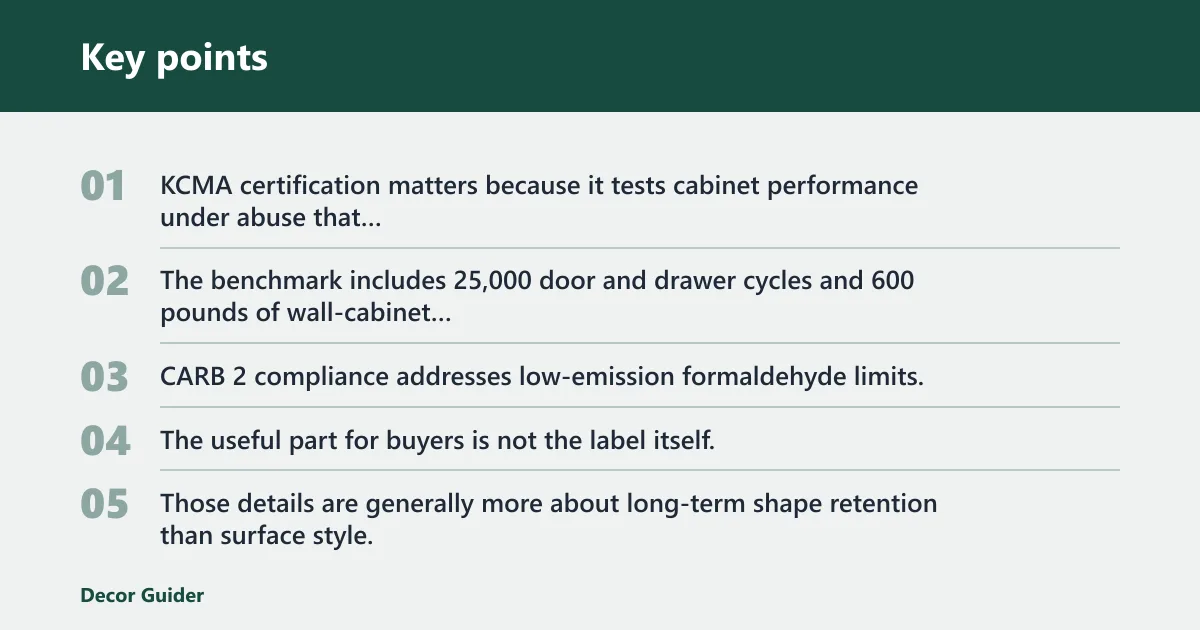
KCMA certification matters because it tests cabinet performance under abuse that resembles real use, not showroom use. The benchmark includes 25,000 door and drawer cycles and 600 pounds of wall-cabinet loading. CARB 2 compliance addresses low-emission formaldehyde limits, which matters for indoor air quality in enclosed kitchens.
Q12 is Fabuwood’s internal quality system. The useful part for buyers is not the label itself, but what it is meant to cover: twelve construction checkpoints, Grade-A lumber sourcing, and anti-warp engineering. Those details are generally more about long-term shape retention than surface style.
Say your sink base sees daily moisture from wet dish towels and a dish rack. Plywood sides and a solid drawer box help more than a thin particleboard build, but they do not make poor sealing or standing water harmless. A cabinet can still fail early if water is allowed to sit at seams.
Fabuwood cabinet comparison table
This table maps the main collections to likely buyer fit, build level, finish style, and tradeoffs. It is the fastest way to decide whether you should start with Allure, Quest, or Illume.
| Collection | Buyer type | Construction level | Finish style | Likely tradeoffs |
|---|---|---|---|---|
| Allure | Most homeowners seeking the strongest all-around value | All-plywood boxes, ½-inch plywood backs, dovetail drawers, Blum hardware standard on this line | Broadest selection, including painted, stained, and textured looks | Costs more than entry tiers; finish choice can make pricing vary fast by dealer |
| Quest | Value-first remodels, rentals, and simpler kitchen updates | Stock/semi-custom positioning with more limited construction scope than Allure | Door style options and finish options, but a narrower menu than Allure | Less flexibility; buyers may need to accept fewer details or fewer premium upgrades |
| Illume | Design-forward buyers who want a frameless, European-style look | Frameless construction with Threespine snap-together assembly | Glossy and matte finish options | Style is the draw; the visual system is less traditional than framed lines |
Which Fabuwood collection is best?
Allure is the best starting point for most buyers because it combines stronger construction cues with broad finish choice. Quest is commonly positioned as the budget-minded option when your priority is a lower entry price and a simpler cabinet package. Illume is a good fit if you want frameless, modern styling rather than a classic framed cabinet look.
Allure for most kitchens
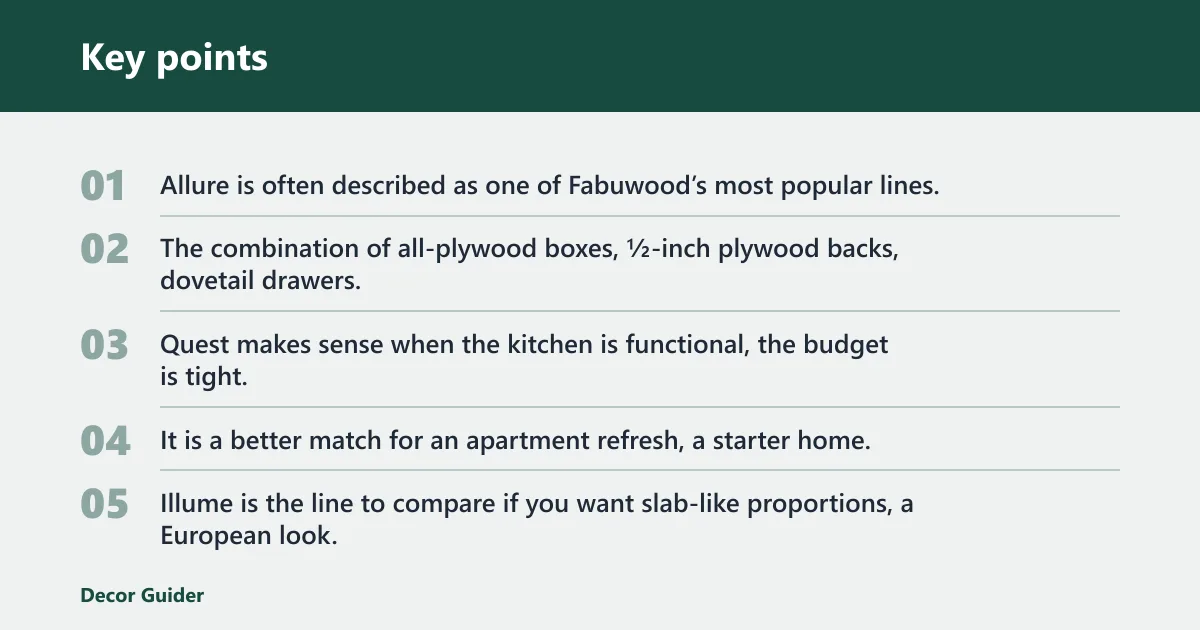
Allure is often described as one of Fabuwood’s most popular lines, and it is a good one to compare first. The combination of all-plywood boxes, ½-inch plywood backs, dovetail drawers, and Blum hardware makes it easier to justify for a primary kitchen than a simpler tier.
Quest for value-first projects
Quest makes sense when the kitchen is functional, the budget is tight, and you want a cleaner result than builder grade without paying for the most feature-heavy line. It is a better match for an apartment refresh, a starter home, or a short-horizon resale plan.
Illume for frameless design
Illume is the line to compare if you want slab-like proportions, a European look, and finish options that lean modern. The tradeoff is straightforward: you are buying style and format first, so construction preferences should be checked line by line before you commit.
How good is the hardware?
Fabuwood’s better hardware package is a real selling point. Blum Compact Clip hinges are concealed, six-way adjustable hinges with soft-close function, and Tandem plus Blumotion runners provide full-extension, concealed drawer action with soft close. Fabuwood includes that hardware as standard on some lines, but you should verify the exact collection before ordering.
Blum hardware is rated at 200K cycles, while KCMA validation covers 25,000 door and drawer cycles. Those are not the same test, but together they point in the same direction: the hardware and cabinet platform are built for repeated use, not short-term staging.
What matters in daily use is adjustability. Six-way hinge adjustment makes door alignment easier after installation, and full-extension runners let you reach the back of a deep drawer without fighting the pull-out.
- Ask the dealer which collection includes Blum Compact Clip hinges.
- Confirm whether Tandem plus Blumotion runners are standard on the line you are quoting.
- Check if any finish or upgrade package changes the hardware package.
- Get the exact drawer box material before approving the order.
Do Fabuwood cabinets chip easily?
Fabuwood is not immune to chipping, and buyers should not expect a finish that shrugs off impacts. Painted and high-contrast finishes are the most likely to show edge wear, while stained and textured surfaces can hide small marks better, even if they still get damaged. The bigger issue is often touch-up difficulty, not just the chip itself.
Finish damage usually shows first on sink bases, door edges near trash pull-outs, and cabinet corners where shoes, carts, or vacuum heads make contact. Delivery damage is a separate issue from manufacturer finish quality. A ding from transit is not the same as a weak finish, and you should inspect boxes before installation begins.
Suppose a lower cabinet door gets nicked during appliance delivery. A small chip on a matte finish may be less visible than the same nick on a glossy white door, but the repair can still stand out under natural light. That is why buyers who hate visible imperfections should favor lower-gloss, less reflective finishes.
Are Fabuwood cabinets expensive?
Fabuwood is not cheap, but it is usually cheaper than many semi-custom competitors. The quoted Allure range is $300–500 per linear foot, and that range changes by collection, finish, and dealer markup. One quoted kitchen comparison put the same layout at $12,000 versus $30,000 for a competing quote, which shows why Fabuwood often lands in the value conversation.
Here is a simple budget model using the quoted Allure range:
| Kitchen size | Linear feet assumption | At $300/ft | At $500/ft |
|---|---|---|---|
| Small | 20 linear feet | $6,000 | $10,000 |
| Medium | 30 linear feet | $9,000 | $15,000 |
| Large | 40 linear feet | $12,000 | $20,000 |
Final cost changes when you add finish upgrades, specialty storage, accessories, delivery fees, and install labor. Stocked items have a 5-day lead time, but speed does not equal lower cost. A faster order can still price higher if you choose a premium finish or a dealer with a stronger markup.
Who are Fabuwood cabinets for?
Fabuwood is a good fit for first-time remodelers who want a cleaner cabinet package than entry-level lines, for busy families who value soft-close hardware and sturdier box construction, and for rental owners who want a presentable kitchen without going fully custom. It is less ideal for buyers who want the most forgiving painted finish or the highest-end cabinet build.
Picture a 12-by-10 kitchen in a family home where the drawers get opened dozens of times a day. Allure is the better choice than a simpler tier because the better drawer joinery, plywood back panels, and standard soft-close hardware are more useful over time than a lower sticker price.
Best fit
Choose Allure if you want the strongest balance of build and style. Choose Quest if cost control matters most. Choose Illume if your design brief is modern and frameless.
Who should compare other brands?
If you want very thick painted doors, highly customized sizing, or a finish that can take more abuse before showing wear, compare higher tiers. If your budget is tighter and the kitchen is short-term, compare lower-cost lines as well.
Pros and cons
Pros
- Allure offers all-plywood cabinet boxes and ½-inch plywood backs.
- Blum Compact Clip hinges and Tandem plus Blumotion runners add useful soft-close performance on supported lines.
- KCMA testing and CARB 2 compliance give buyers a clearer performance and indoor-air baseline.
- The finish menu is wide, with 100+ finishes on Allure.
- Pricing can beat many semi-custom competitors on the same layout.
Cons
- Finish durability is good, not bulletproof.
- Touch-up can be hard to match on some colors.
- Hardware and build details vary by collection, so you must verify the exact line.
- Dealer pricing can change the value equation quickly.
- Delivery damage and install quality can affect the final result as much as the cabinet spec sheet.
Frequently asked questions
Are Fabuwood cabinets worth it?
Yes, if you want a better-than-basic cabinet with stronger construction cues and a broad finish menu. They are worth a close look for buyers who care about soft-close hardware, plywood boxes, and a balanced price point. They are less compelling if you need top-tier finish toughness or highly custom sizing.
How much do Fabuwood cabinets cost per linear foot?
The quoted Allure range is $300–500 per linear foot. That figure is a starting point, not a fixed quote, because finish, collection, dealer pricing, and accessory choices can move the final number. Use it as a planning band, then compare it with your exact kitchen layout.
What finishes and door styles does Fabuwood offer?
Fabuwood gives buyers a wide mix of painted, stained, glossy, and matte looks, depending on the collection. The same source lists 100+ finishes, Quest offers a more limited set of door and finish options, and Illume leans modern with glossy and matte choices. Always check the exact door profile with the dealer.
Products related to this article
Sponsored / affiliate links. As an Amazon Associate I earn from qualifying purchases. I may earn additional commission from eligible campaigns.