Cabinet Door Bumpers Review: Which Type Fits Best?
For most cabinets, pick the thinnest bumper that still lets the door close cleanly: about 1/16 inch for tight gaps, about 1/8 inch for standard face frames, and adhesive felt for light-duty touch points. Oversizing leads to sticky doors, chipped finishes, rattles, and repeat replacements. This review compares cabinet door bumpers by fit, profile, visibility, and replacement use case.
Verdict and top picks
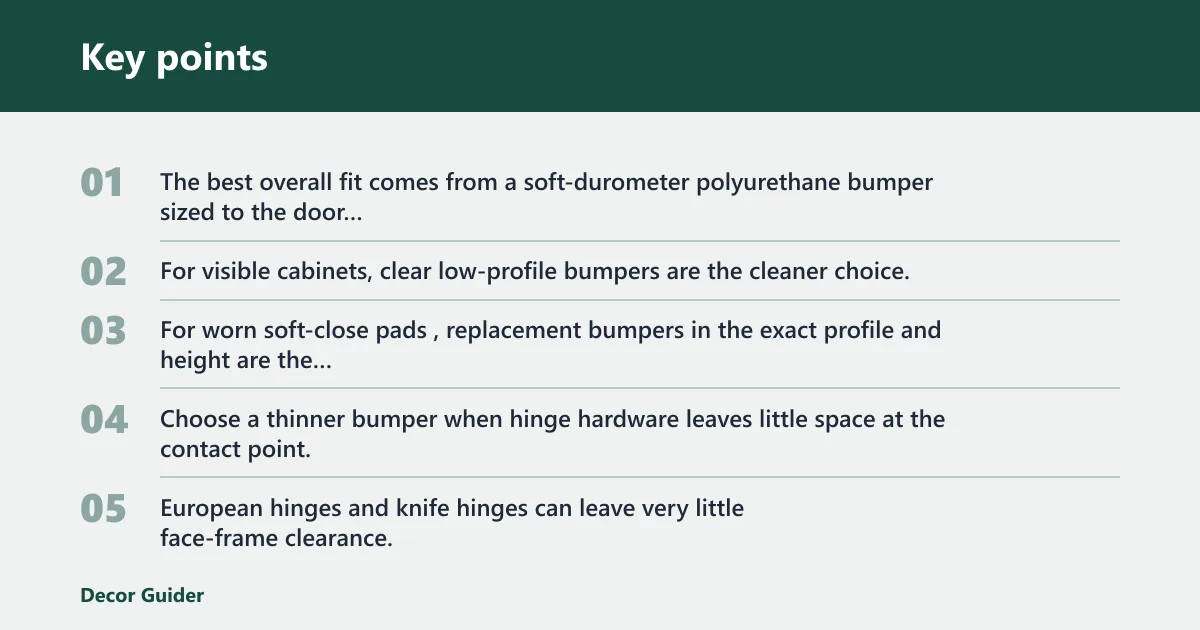


The best overall fit comes from a soft-durometer polyurethane bumper sized to the door gap, not from the largest pad on the shelf. For visible cabinets, clear low-profile bumpers are the cleaner choice. For worn soft-close pads, replacement bumpers in the exact profile and height are the safer choice.
Best fit for tight-clearance doors
Choose a thinner bumper when hinge hardware leaves little space at the contact point. European hinges and knife hinges can leave very little face-frame clearance, so a tall or wide pad can stop the door from seating fully. In that case, a low-profile clear or polyurethane bumper is the better fit.
Best low-visibility choice
Clear cabinet bumpers are the lowest-visibility option for finished wood, melamine, and laminate. Small dome styles hide better on stained doors, while flat-top styles read more like a faint dot than a raised bubble. On light finishes, clear is usually less noticeable than white or black.
Best replacement option for worn soft-close pads
If a cabinet already used soft-close stoppers, use a replacement bumper that matches the original contact height as closely as possible. KraftMaid sells Permaset Bumpers as replacement parts for cabinet doors, and each order contains 10 rubber door stoppers for cabinets. That is the right lane for repair, not a random oversized pad.
Pros and cons
Pros
- Soft-durometer polyurethane gives quiet closing without a hard slap at the frame.
- Clear bumpers are easier to hide on finished wood, melamine, and laminate.
- Peel-and-stick backing speeds first-time installation on clean surfaces.
- Replacement bumpers can restore a worn door stop without changing the hinge or latch.
- Bulk counts help when you are outfitting a full kitchen or several rooms.
Cons
- Too much thickness can stop a door from latching or sitting flush.
- Adhesive can fail on dusty, greasy, or uneven cabinet surfaces.
- Large diameters leave a bigger visible footprint on high-end finishes.
- Some soft-close pads are replacement-only parts and do not solve a latch problem.
- Wrong profile choice can create a sticky door or repeated peel-off at the same spot.
Who it’s for
This review fits homeowners replacing worn pads, DIYers matching hinge and gap limits, and shoppers buying in bulk for many cabinets. It is less useful if your cabinet problem is a loose door, a failed latch, or misaligned hinges, because a bumper will not fix those issues.
Suppose a kitchen has 24 doors and the stop point is spread across upper and lower cabinets. A 10-pack may cover a repair on one door, but it will not finish the room. In that case, pack count matters as much as diameter.
Cabinet bumper selection table
| Cabinet condition | Recommended bumper profile/thickness | Failure risk |
|---|---|---|
| Tight hinge clearance | Thin clear or polyurethane pad, about 5/64 inch to 1/16 inch high | Over-thick pads can keep the door from closing or make the edge sit proud |
| Face-frame refacing | Low-profile bumper with a small diameter, usually closer to 0.335 inch to 1/4 inch footprint | Large pads can land on the wrong spot after the frame is altered |
| Invisible install | Clear flat-top or small dome bumper, thin enough to hide behind the door edge | Thick clear pads still show if they sit on a bright painted surface |
| Slammed drawers | Soft-durometer polyurethane or replacement soft-close pad with a firmer contact profile | Too-soft pads may compress too much and lose stopping force over time |
One-line prep note: clean the surface with a residue-free cleaner, let it dry fully, and press firmly before loading the door; removal is easier with gentle heat and slow peeling than with a dry snap-off pull.
Which bumper size fits your cabinet?
Use hinge clearance and door gap first, then choose shape. A bumper that fits the gap but misses the landing spot is still the wrong part. Diameter affects how forgiving the bumper is, while thickness controls how far the door stands off from the frame.
Diameter and visible footprint
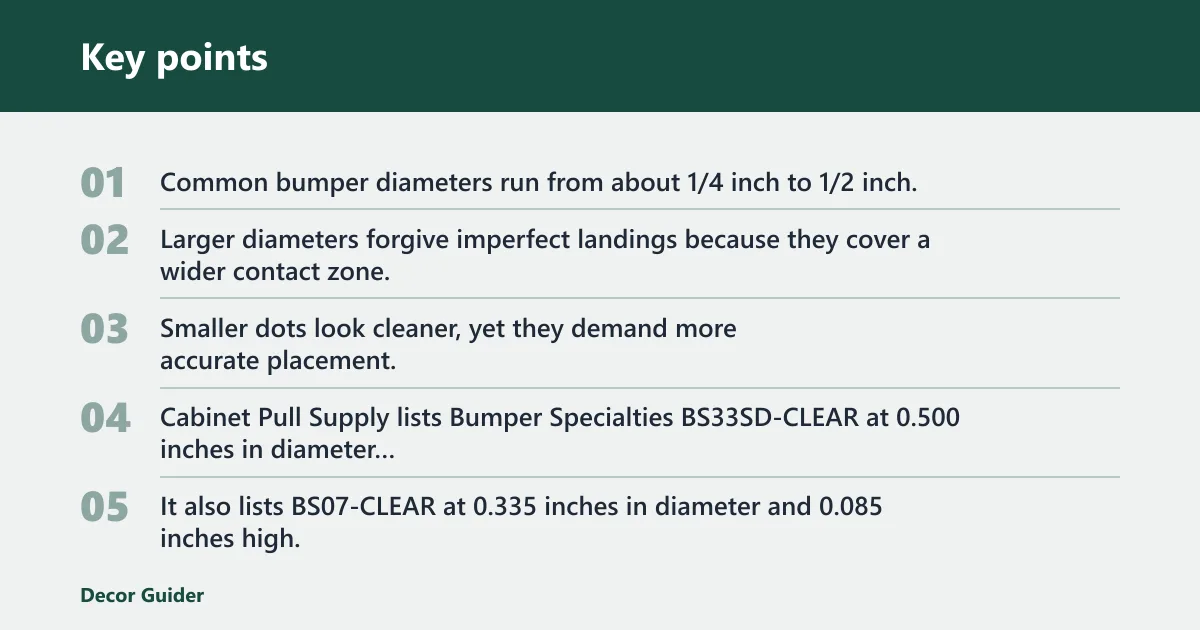
Common bumper diameters run from about 1/4 inch to 1/2 inch. Larger diameters forgive imperfect landings because they cover a wider contact zone, but they also leave a bigger visible footprint. Smaller dots look cleaner, yet they demand more accurate placement.
Cabinet Pull Supply lists Bumper Specialties BS33SD-CLEAR at 0.500 inches in diameter and 0.150 inches high. It also lists BS07-CLEAR at 0.335 inches in diameter and 0.085 inches high. Those two sizes show the tradeoff plainly: more coverage versus less visibility.
Thickness and door stand-off
Thickness matters even more than diameter in tight cabinets. Bumper height commonly ranges from about 5/64 inch to 1/4 inch, and that height determines how far the door stands off before it contacts the frame. A thin bumper is safer where closure space is limited.
The same source lists BS05SD-CLEAR at 0.500 inches in diameter and 0.060 inches high, and BS58SD-CLEAR at 0.500 inches in diameter and about 0.200 inches high. That spread is large enough to change door closure behavior on the same cabinet.
When a thinner profile wins
Choose the thinner profile when the hinge hardware already eats into the closing path. That includes European and knife hinges, plus any cabinet where the door only has a narrow landing zone on the frame. Thin pads are also safer for refaced cabinets where geometry changed.
A common first-timer mistake is buying a thick bumper because it looks softer, then finding the door has to be pushed twice to latch. The pad is not at fault. The fit is.
Do clear bumpers show on finished cabinets?
Clear bumpers usually show less than black or white, but they do not disappear. On finished wood, melamine, and laminate, the lowest-visibility choices are small dome or flat-top clear pads placed directly on the stop point. A large clear bumper still reads as a dot.
Clear versus white versus black
Clear is the default low-visibility choice for most cabinets. White can stand out on dark stain, and black can read as a hard contrast on light paint or pale laminate. Clear also pairs better with mixed-finish kitchens where the cabinet runs change tone from room to room.
The same source lists 3M Clear Cabinet Bumpers under door bumpers and identifies SKU SJ5312. It prices that item at about $6.77. KraftMaid also says its Permaset Bumpers are clear door bumpers, which fits the same low-visibility use case.
Dome and flat-top styles
Dome styles compress a little more gradually and can feel softer at contact. Flat-top styles often look flatter against the cabinet and can be less obvious when viewed straight on. The better choice depends on whether you want a softer stop or a lower visual profile.
Finish match on wood, melamine, and laminate
Clear bumpers usually suit finished wood best when the grain and stain should stay visible. On melamine and laminate, they also avoid the color-mismatch issue that can happen with white or black pads. Adhesive hold still depends on prep, especially on slick laminated surfaces.
How many bumpers do you need?
Count doors and contact points before you buy. Many cabinets need two bumpers per door, but some use one centered pad and some need more because the contact is uneven. Add drawers separately if they slam into the frame or the side rail.
Per-door counts
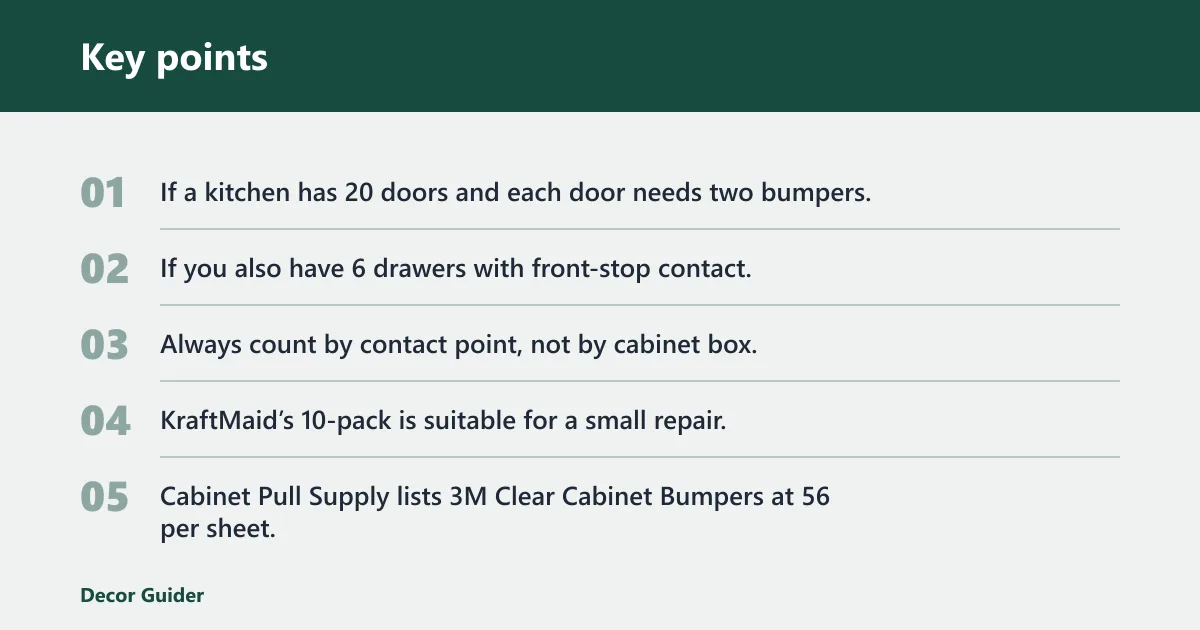
If a kitchen has 20 doors and each door needs two bumpers, that is 40 pieces before spares. If you also have 6 drawers with front-stop contact, you may need 12 more pieces if each drawer uses two pads. Always count by contact point, not by cabinet box.
Pack quantity and cost per door
Pack size changes the math fast. KraftMaid’s 10-pack is suitable for a small repair. The same source lists 3M Clear Cabinet Bumpers at 56 per sheet, BS33SD-CLEAR as 200 pieces, and BS07-CLEAR as a card of 488 pieces, which is more practical for a whole-house project.
For a small kitchen, a 10-pack can be enough if you only need one or two doors fixed. For a full run of cabinets, the higher piece counts usually drop the cost per door and reduce the chance that you run short halfway through the install.
When bulk counts make sense
Bulk counts make sense when you are replacing old pads across multiple rooms, managing rental turnover, or matching a manufacturer’s stop profile on many doors at once. They also make sense when you expect some placement waste during the first install and want a margin for mistakes.
What materials last longest?
Polyurethane is the safest baseline for quiet closing because it is soft enough to cushion impact while staying non-staining and non-marring in most cabinet uses. Rubber is common for replacement pads and can last well, but quality varies. Silicone can stay flexible, yet some clear silicone pads are more noticeable and can collect dust.
For cabinet doors, the best material is the one that keeps its shape, stays put, and does not leave marks on painted or stained surfaces. That makes soft-durometer polyurethane the most balanced choice when the goal is quiet contact without cosmetic damage.
What if the bumper peels or shifts?
Adhesive failure usually points to dirty wood, wax residue, oily laminate, or a bumper that is too thick for the landing point. If a pad keeps slipping, remove it, clean the spot again, and replace it with a lower-profile piece. A bumper cannot compensate for a bad surface.
- Warm the old pad slightly with a hair dryer if it is stubborn.
- Lift one edge with a plastic scraper or a fingernail, not a metal blade.
- Peel slowly so the adhesive comes off in one piece when possible.
- Remove residue with a cabinet-safe adhesive remover, then wipe dry.
- Place the new bumper only after the surface is clean and fully dry.
Say your cabinet door leaves a 1/16 inch gap and the old clear pad keeps sliding sideways. The fix is not a larger dot. A thinner bumper with better surface prep is more likely to stay put and still let the door close cleanly.
Frequently asked questions
What are the best cabinet door bumpers for quiet closing?
Soft-durometer polyurethane cabinet bumpers are the best all-around choice for quiet closing because they cushion impact without leaving marks. For most cabinets, a clear low-profile adhesive bumper works well. If the door already has a stopper position, match the height before you change the material.
How do I choose cabinet door bumpers by thickness and shape?
Start with thickness, then choose shape. Thin bumpers fit tight gaps and hinge-heavy doors; thicker bumpers work only when you have room for extra stand-off. Small dome styles are softer at contact, while flat-top styles usually look less obvious on finished cabinets.
Will clear cabinet door bumpers show on finished cabinets?
Clear bumpers show less than white or black, but they are still visible if they are oversized or placed in an exposed spot. Small clear dome or flat-top styles blend best on wood, melamine, and laminate. Diameter and placement matter as much as color.
Do rubber bumpers or polyurethane bumpers last longer on cabinet doors?
Polyurethane is usually the better all-around pick for cabinet doors because it balances softness, quiet closing, and non-marring contact. Rubber can last well in replacement kits, but the quality range is wider. For visible cabinets, clear polyurethane also gives a cleaner look.
Can cabinet door bumpers replace worn soft-close stoppers?
Yes, if the old part was only acting as a stop pad. Replacement soft-close bumpers are sold for that job, and KraftMaid lists Permaset Bumpers as replacement parts for cabinet doors. If the door also needs latching force, a bumper alone will not solve the problem.
Which cabinet door bumper works with tight hinge clearance?
Choose the thinnest bumper that still gives clean closure, usually a low-profile clear or polyurethane pad. Tight-clearance cabinets, especially those with European or knife hinges, need thinner profiles because the hinge hardware already limits the contact zone. Thick pads can stop the door from closing fully.
How many cabinet door bumpers do I need per kitchen?
Count contact points, then add a few spares. Many doors use two bumpers each, so a kitchen with 20 doors may need about 40 pieces before extras. If you are also replacing drawer stops, count those separately. Bulk packs make more sense as the room count goes up.
Products related to this article
Sponsored / affiliate links. As an Amazon Associate I earn from qualifying purchases. I may earn additional commission from eligible campaigns.