Cabinet Refacing Kit Review: Best Picks and Fit
The best cabinet refacing kit matches the cabinet substrate: paintable veneer or laminate kits for sound surfaces, peel-and-stick vinyl only for smooth, intact boxes, and full veneer systems for the highest-wear jobs. Choose the wrong system and you can get peeling edges, visible seams, swollen panels, and a redo that costs more than replacing the doors. This review ranks cabinet refacing kits by substrate fit, prep burden, and failure risk so you can compare options before buying.
Best refacing kits for different cabinet types

- Trimming gridlines on backing for precise cuts
- Self-adhesive — no extra glue needed
- Waterproof PVC vinyl surface
The strongest buy for most DIY remodels is a full veneer or laminate refacing kit for solid, flat cabinet boxes that are square, dry, and free of swelling. It gives you the best chance of a clean result when the box surface is stable and you can handle careful prep, trimming, and edge finishing.
Quick picks
- Best for laminate boxes: Plastic laminate refacing kits, because they suit smooth, intact boxes and resist everyday wear better than paint-only systems.
- Best for solid wood boxes: Full veneer systems, especially when you want a wood-grain finish and the boxes are flat and sound.
- Best for low-prep DIY: Paint-based cabinet kits such as a water-based acrylic kit, but only when the surface is already stable and you accept a finish-only change.
- Best for full door replacement: Kits that pair new doors with matching veneer or laminate skins, because they solve style mismatch better than a surface-only kit.
What is a true cabinet refacing kit?
A true cabinet refacing kit includes the materials needed to cover the cabinet box faces, not just paint. Look for veneer or laminate sheets, adhesive, edge treatment, and a plan for doors or drawer fronts. If the product only changes color with paint or stain, it is a refinishing kit, not a refacing kit.
Core parts in a full kit
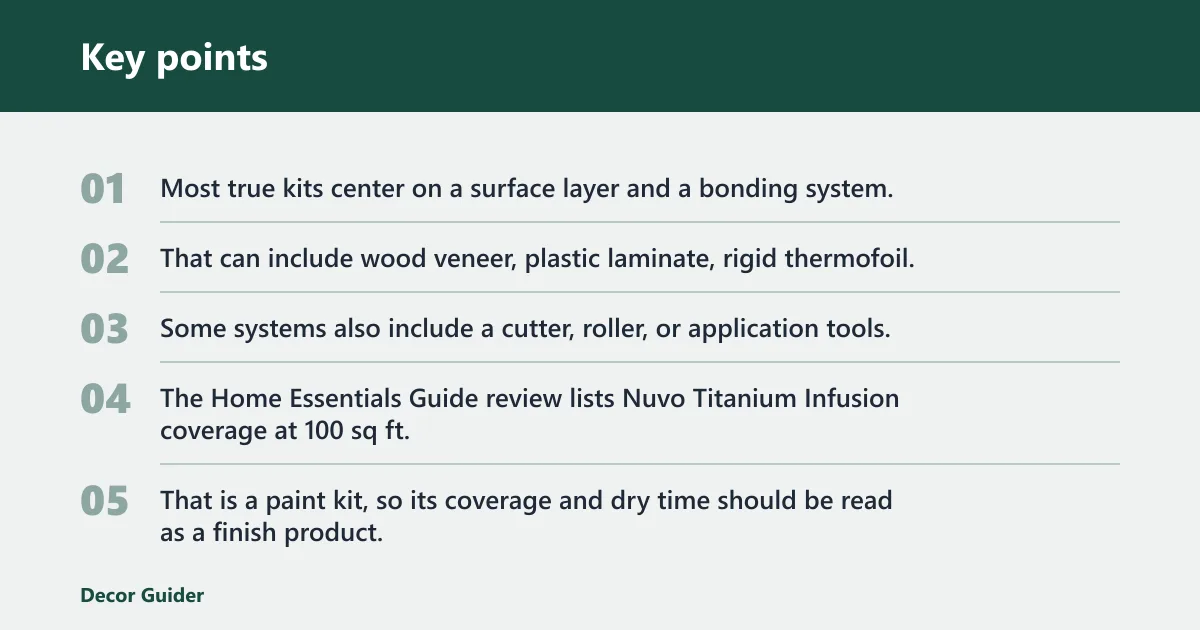
Most true kits center on a surface layer and a bonding system. That can include wood veneer, plastic laminate, rigid thermofoil, contact adhesive or another bond coat, edge banding, and installation pieces for door and drawer fronts. Some systems also include a cutter, roller, or application tools.
Coverage matters too. The Home Essentials Guide review lists Nuvo Titanium Infusion coverage at 100 sq ft, with dry time at 2 to 4 hours, and describes it as a water-based acrylic formula. That is a paint kit, so its coverage and dry time should be read as a finish product, not a veneer replacement system.
How it differs from refinishing kits
Refinishing kits change the surface color with paint or stain. They do not add a new wear layer. That means they can work on solid wood or already-finished cabinets, but they do little for chipped edges, worn laminate, peeling veneer, or a style mismatch that needs new fronts.
How it differs from replacement doors alone
Replacement doors solve the visible style problem, but they do not reface the cabinet boxes unless you add matching side panels and edge treatment. The Door Maker lists cabinet doors starting at $27.00 per square foot, offers Skinny Shaker doors from $58.00 per square foot, and notes that door styles do not alter the door cost. Their illustrated doors are untreated MDF.
Cabinet refacing fit checklist
Use this table before buying anything. The right path depends less on finish taste and more on whether the box is flat, dry, and compatible with the adhesive and edge system you plan to use.
| Cabinet substrate | Box condition | Door style | Prep hours | Tool needs | Adhesion risk | Best fit |
|---|---|---|---|---|---|---|
| Laminate | Flat, intact, no swelling | Flat panel or simple shaker | 3 to 6 | Cleaner, roller, utility knife | Low if the surface is sound | Refacing |
| MDF | Edges clean, no moisture damage | Shaker, slab, or routed panel | 4 to 8 | Clamps, saw, sander, filler | Medium at chipped edges | Refacing or refinishing |
| Particleboard | Dry, firm, no crumble at fasteners | Flat panel or replacement door | 5 to 10 | Driver, filler, edge banding tools | Medium to high if edges are damaged | Refacing only if damage is minor |
| Solid wood | Sound, square, no warp | Shaker, raised panel, slab | 4 to 8 | Router or saw, clamps, roller | Low to medium | Refacing or refinishing |
| Thermofoil | Loose edges, blistering, or no damage | Usually replacement doors | 6 to 12 | Heat caution, adhesive tools, replacement hardware | High if film is peeling | Refacing with caution or replacement |
| Warped box | Out of square, sagging, or swollen | Any style | 8+ or more | Joinery repair tools | High | Replacement |
Choose refacing, refinishing, or replacement
Pick refacing when the cabinet box is structurally sound, but the surface looks dated or worn. Pick refinishing when the cabinet surface is paintable or stainable and the box still looks good. Pick replacement when the box is warped, the drawer boxes are bad, or the layout itself no longer works.
Which kit fits your cabinets?
Match the kit to the box material first, then to the damage level. Laminate and thermofoil need a different approach than raw wood, and MDF or particleboard need edge repair before you trust any adhesive. The wrong surface choice is the fastest route to peeling or a poor bond.
Laminate and thermofoil boxes
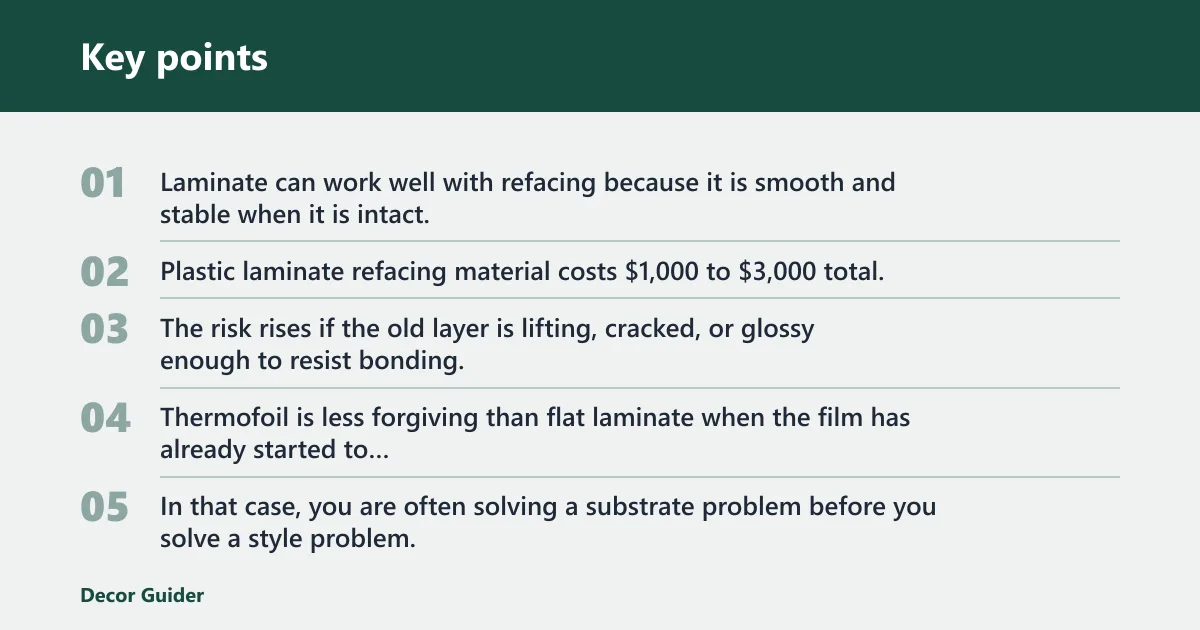
Laminate can work well with refacing because it is smooth and stable when it is intact. Plastic laminate refacing material costs $1,000 to $3,000 total, and rigid thermofoil laminate also costs $1,000 to $3,000 total. The risk rises if the old layer is lifting, cracked, or glossy enough to resist bonding.
Thermofoil is less forgiving than flat laminate when the film has already started to separate. In that case, you are often solving a substrate problem before you solve a style problem.
MDF and particleboard boxes
MDF can accept refacing if the edges are solid and dry. Particleboard can be acceptable when it is firm and not crumbly at the corners or hinge mounts. If the fasteners have chewed out the structure, a kit may hide the problem for a while but will not correct it.
Say your 10-foot galley has clean MDF boxes but chipped toe-kick edges. A veneer or laminate kit can fit, but you will spend extra time filling and sanding those edges before the adhesive goes on. The kit works because the structure is still sound, not because the finish is forgiving.
Solid wood boxes
Solid wood gives you the broadest set of choices. You can refinish it, reface it, or replace the doors. Wood veneer has a natural look and can be repaired locally if a small section chips. Laminate usually resists everyday wear better on exposed edges, but it will not mimic wood grain as convincingly.
Warped or damaged boxes
Refacing fails when the cabinet box is warped, the drawer boxes are bad, or the layout is wrong for the room. No veneer or paint kit fixes sagging sides, loose joinery, or boxes that pull away from the wall. In those cases, replacement is usually the safer spend.
How do cabinet doors and fronts change the choice?
Door choice changes the kit because doors are the visible part of the job and the easiest place to spot a mismatch. Replacement doors can solve style and fit problems at once, while refacing over old fronts depends on exact measurements, edge profiles, and hinge alignment.
Replacement doors versus new faces over existing boxes
Replacement doors are better when the current fronts are warped, cracked, or an odd size that no longer fits the room. New faces over existing boxes work when the cabinet box is square and the current layout is worth keeping. The best kit is the one that matches the door plan, not just the color chart.
Panel styles, edge profiles, and material options
Flat panel and Shaker-style doors are the easiest to pair with refacing because the edges are simple. Raised panel doors can work, but they demand cleaner alignment and more precise measurements. MDF is common for painted looks, thermofoil is often used for smooth low-cost fronts, and wood veneer suits users who want a wood-grain finish.
When hinges and pulls must be replaced
Cabinet hardware matters more than many shoppers expect. New doors may require new hinges if the old hinge pattern no longer fits. New pulls are often the easiest add-on, but misaligned holes or worn hinge cups can turn a simple kit into a frustrating install. Minor repair work is fine if the box is solid; stripped mounting points are not.
Cabinet refacing cost vs replacement
Cabinet refacing costs $4,501 to $10,546 on average, and Bob Vila gives a national average cabinet refacing cost of $7,220. Refacing costs about $210 to $750 per linear foot. Cabinet replacement averages $400 to $3,500 per linear foot, which is why refacing is often 30 to 50 percent less than replacing.
Average project cost and per-linear-foot range
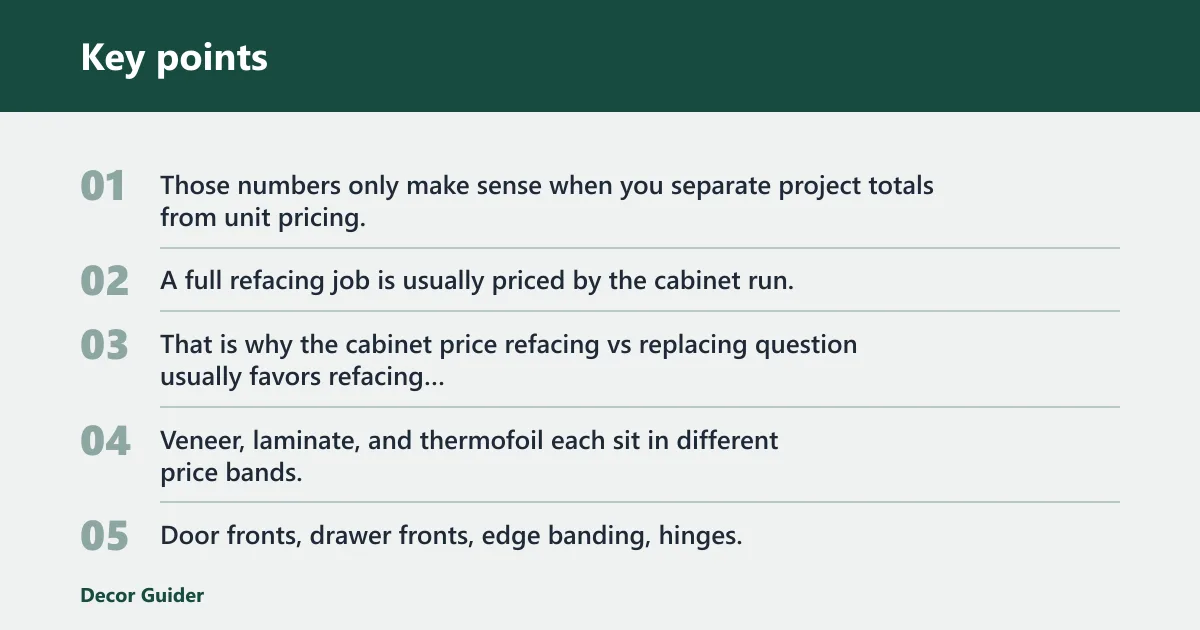
Those numbers only make sense when you separate project totals from unit pricing. A full refacing job is usually priced by the cabinet run, while a replacement job can climb much faster because it includes more demolition, more carpentry, and more finish work. That is why the cabinet price refacing vs replacing question usually favors refacing unless the layout is broken.
Material, labor, and add-on costs
Material choice changes the total quickly. Veneer, laminate, and thermofoil each sit in different price bands. Door fronts, drawer fronts, edge banding, hinges, and pulls add cost whether you DIY or hire out the labor. A kit that looks inexpensive can become costly once you add replacement doors and hardware.
When new cabinets make more sense
New cabinets beat refacing when the room needs a new layout, the boxes are failing, or the drawer boxes are beyond simple repair. If you are moving appliances, changing door swings, or correcting a bad work triangle, refacing only buys a prettier version of the same problem.
Picture a kitchen with solid boxes but a pantry door that keeps clipping the fridge because the opening is too tight. A refacing kit can refresh the look, but it will not fix the clearance issue. New cabinets make more sense because the failure is in the layout, not the finish.
Frequently asked questions
Cabinet refacing vs replacing
Cabinet refacing keeps the existing boxes and updates the visible parts with new fronts, veneer, or laminate. Replacement removes the old boxes and starts over. Refacing is the better fit when the structure is sound and the layout still works. Replacement is better when the cabinet run is damaged or poorly planned.
New cabinets vs refacing
New cabinets give you a clean start, new dimensions, and a chance to fix storage problems. Refacing keeps the footprint and is usually the lower-cost route when the current cabinets are stable. If the room functions well and the boxes are solid, refacing often makes more financial sense.
Is cabinet refacing worth it?
Cabinet refacing is worth it when the boxes are sound, the layout works, and you want a major visual change without full replacement costs. It is not worth it if you are hiding warped boxes, bad drawers, or a layout that already frustrates you. Those problems will still be there after the finish change.
Do it yourself cabinet refacing
Do it yourself cabinet refacing makes sense for square boxes, patient installers, and kits with clear surface requirements. The job gets harder when the project includes new doors, tight reveals, or damaged edges. If the cabinet faces are uneven or peeling, the workload rises fast and the risk of a bad bond follows.
Refacing vs replacing kitchen cabinets
Refacing is the better value when you want a fresh look and the cabinet carcasses are still usable. Replacing is the better choice when the boxes are warped, the drawer boxes fail, or the kitchen needs a different layout. The deciding factor is structure, not finish.
Products related to this article
Sponsored / affiliate links. As an Amazon Associate I earn from qualifying purchases. I may earn additional commission from eligible campaigns.