Home Depot Kitchen Cabinets Review
Home Depot kitchen cabinets are worth buying only if you choose the stronger stock or semi-custom lines and pay for better hardware; the cheapest options are weaker than IKEA on consistency. Pick the wrong box, and you can end up with short drawer life, uneven door alignment, and replacement costs that wipe out the upfront savings. This guide breaks down the brands, the specs that matter, and how they stack up against IKEA on price, construction, and risk.
Which Home Depot cabinets are worth buying?
The best Home Depot cabinets are the ones that fit the job, not the cheapest ones on the shelf. For a rental or quick flip, a basic stock line can work if the layout is simple and water exposure is low. For a family kitchen, semi-custom is usually the safer buy because you get better box materials, more size options, and stronger hardware packages.
Where the money goes
The cabinet itself is only part of the bill. Fillers, end panels, crown, toe kicks, upgraded drawers, better hinges, and installation labor can add a meaningful amount to the landed cost, especially when the plan has odd wall lengths or appliance gaps.
Measurement mistakes matter too. A missing filler or a wrong-width sink base can turn a budget order into a return, a reorder, or an installation delay. That is why the real value question is not just cabinet price, but how much correction the project will need before the boxes are usable.
Home Depot cabinet tiers at a glance
Home Depot sells kitchen cabinets from multiple manufacturers, not one single line. The main names most buyers see are KraftMaid, Merillat, and Thomasville, plus the house-brand Hampton Bay. The tiers differ most in box material, hardware, and how much customization you can order.
| Tier | Typical positioning | Construction signal | Best fit |
|---|---|---|---|
| Stock / budget | Lowest-cost entry point | Often particleboard with veneer fronts or laminate-style construction | Rental, temporary refresh, tight budget |
| Mid-tier | More flexible than stock | Better parts mix, stronger hardware options, more layout choices | Everyday family kitchen, moderate budget |
| Semi-custom | Higher material and sizing flexibility | Often plywood boxes and better hardware packages | Primary kitchen, resale-minded remodel, awkward layouts |
| IKEA SEKTION | Modular benchmark | Flat-packed system with Blum hinges and drawer runners | DIY project, cost control, standardized layout |
Best fit by project type
A rental kitchen usually rewards low complexity more than premium materials. A family kitchen usually rewards better box material and hardware because the doors and drawers get more daily use. A resale flip sits in the middle: buyers notice fit, finish, and smooth operation quickly, but they do not need the most expensive customization package.
Suppose a 10-by-12-foot kitchen has a standard U-shaped layout with one sink base and no unusual corners. A stock or mid-tier Home Depot package can work if the boxes are straight, the finish is durable enough, and the installer can avoid heavy filler use. Add a wet island sink or an uneven wall, and the risk climbs fast.
How do Home Depot cabinets compare to IKEA?
Home Depot and IKEA solve different problems. Home Depot gives you more brand variety and a wider spread from budget to semi-custom, while IKEA SEKTION gives you a modular, flat-packed system with a 25-year warranty and a hardware package that is often stronger than the cheapest cabinet boxes at Home Depot. If your priority is DIY consistency, IKEA is often the cleaner value.
Box construction and flat-pack assembly
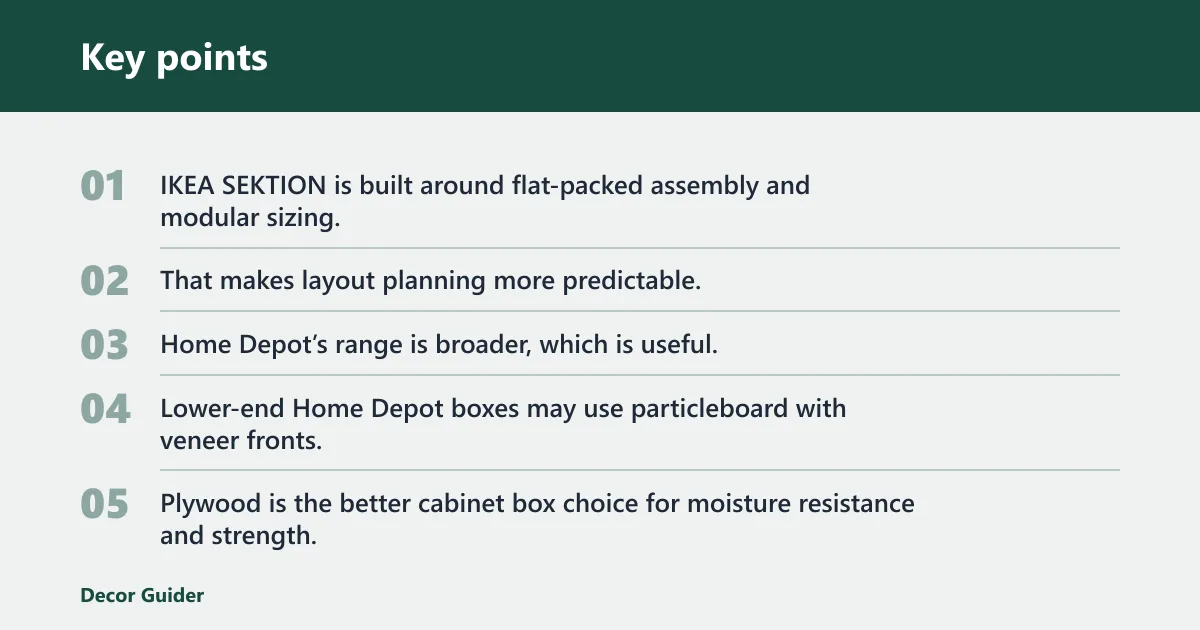
IKEA SEKTION is built around flat-packed assembly and modular sizing. That makes layout planning more predictable, especially for a homeowner who can follow a measured parts list. Home Depot’s range is broader, which is useful, but it also means quality varies by model and by manufacturer.
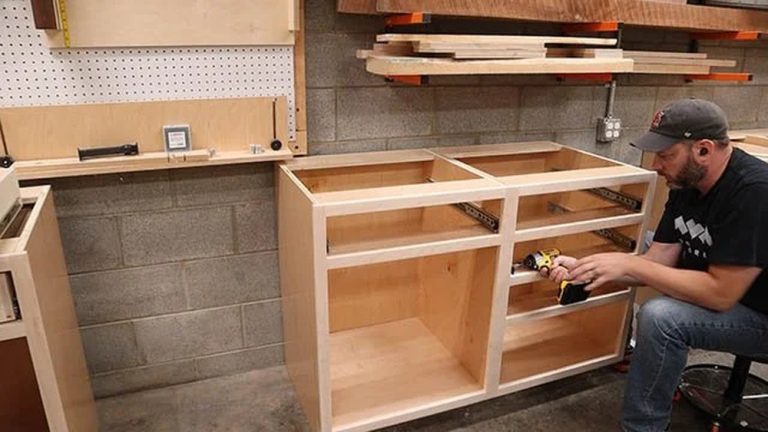
Lower-end Home Depot boxes may use particleboard with veneer fronts. Higher-tier offerings may use plywood boxes. Plywood is the better cabinet box choice for moisture resistance and strength, especially around sinks, dishwashers, and leak-prone plumbing runs.
Warranty, hardware, and DIY tolerance
The comparison is not only about warranty length. IKEA’s 25-year warranty sits beside Blum hinges and drawer runners, which is a strong package for a flat-pack system. Hampton Bay is listed with a 5-year warranty, while KraftMaid is listed with a lifetime limited warranty, but warranty strength only matters if the underlying parts and installation are sound.
Soft-close hardware is a useful differentiator, not a small add-on. Full-extension drawer glides are better than basic slides because they improve access and usually feel more stable under load. Concealed hinges are preferred for a cleaner look and a more finished result.
When IKEA is the better value
IKEA is often the better value when the plan is DIY, the layout is standard, and you want predictable hardware quality without paying for higher-end customization. It is also easier to judge landed cost because the system is more modular and the parts list tends to be clearer.
Home Depot can still win when you need a semi-custom fit, a showroom process, or a finish that better suits the room. But if the project depends on you assembling, hanging, and fine-tuning every cabinet yourself, IKEA is usually easier to control.
Cabinet materials and box construction
Cabinet material is where most long-term risk starts. Particleboard is common in budget cabinets, but it has lower moisture resistance than plywood and can swell after spills or leaks. Plywood is stronger, more stable, and the better choice for sink bases and high-use kitchens.
Particleboard vs plywood in real use
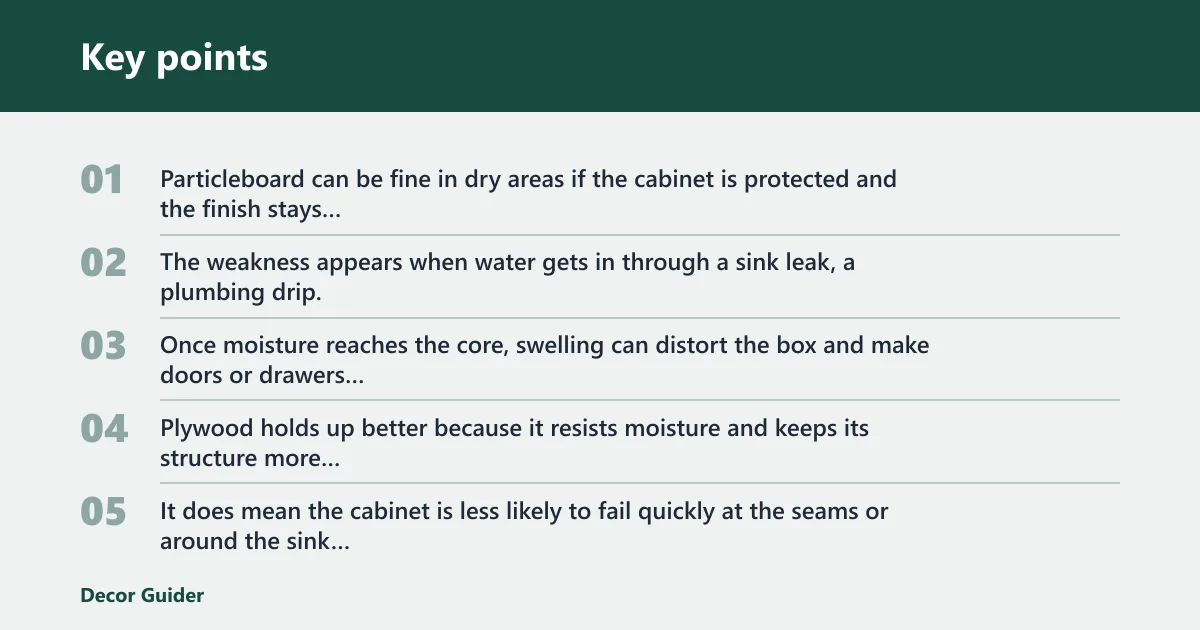
Particleboard can be fine in dry areas if the cabinet is protected and the finish stays intact. The weakness appears when water gets in through a sink leak, a plumbing drip, or a chipped edge. Once moisture reaches the core, swelling can distort the box and make doors or drawers misalign.
Plywood holds up better because it resists moisture and keeps its structure more effectively. That does not make it waterproof. It does mean the cabinet is less likely to fail quickly at the seams or around the sink base.
Back panels, sides, and sink-base risk
Back panel thickness matters because it affects rigidity and how well the cabinet stays square during installation. Thin backs are more likely to flex, which can contribute to hinge sag or an out-of-plumb run. Cabinet sides matter too, since they carry the load from counters, drawers, and doors over time.
Sink-base cabinets deserve the most attention. A cabinet near the sink sees the highest risk of swelling, finish damage, and hidden leaks. If the sink base is particleboard and the plumbing connection fails, the damage can move from cosmetic to structural faster than many buyers expect.
Why material choice matters most near water
Picture a 30-inch sink base under a heavy single-bowl sink. A slow leak at the trap can drip for weeks before anyone notices. In a particleboard box, the bottom edge may swell first, then the door starts rubbing, and the fix becomes replacement instead of repair.
That is why the cabinet next to the sink should carry more weight in the decision than the pantry cabinet across the room. Same kitchen. Different risk.
What should you check before you order?
Before you order, verify the cabinet spec sheet and the order form, not just the showroom sample. The sample can look solid while the actual model uses thinner panels, simpler slides, or a different finish package. What matters is the exact box material, hardware, and configuration you are buying.
In-store checks versus spec-sheet checks
In the store, inspect the doors, drawer motion, hinge feel, finish uniformity, and how the corners are assembled. On the spec sheet, confirm the box material, back panel construction, drawer glide type, hinge type, and warranty terms. Those are not always the same thing across a line.
- Confirm the exact cabinet series and size.
- Check whether the box material is particleboard or plywood.
- Verify drawer glides are full-extension.
- Confirm concealed hinges and soft-close hardware.
- Review finish type for cleaning and moisture exposure.
- Count fillers, panels, and trim pieces before pricing.
- Ask whether the layout increases install complexity.
- Confirm the warranty on the exact line, not the display sample.
Finish type, moisture exposure, and install complexity
Finish quality affects both appearance and cleaning. A smooth, durable finish is easier to wipe down and less likely to peel at wear points. If a model uses a lower-grade coating and the kitchen sees frequent splashes, the edges can age faster than the face frame.
Install complexity also changes the value equation. Tall pantry runs, crown molding, end panels, and filler-heavy designs take more labor and leave more room for measurement mistakes. Those costs belong in the decision before the order is placed.
Brand-by-brand: Hampton Bay, thomasville, and kraftMaid
The Home Depot cabinet brands do not sit at the same quality level. Hampton Bay is the budget house brand and quality varies by model. Thomasville sits in the middle with more flexibility than stock lines. KraftMaid is the semi-custom option with better materials and more hardware upgrades.
Hampton Bay: budget positioning and model variation
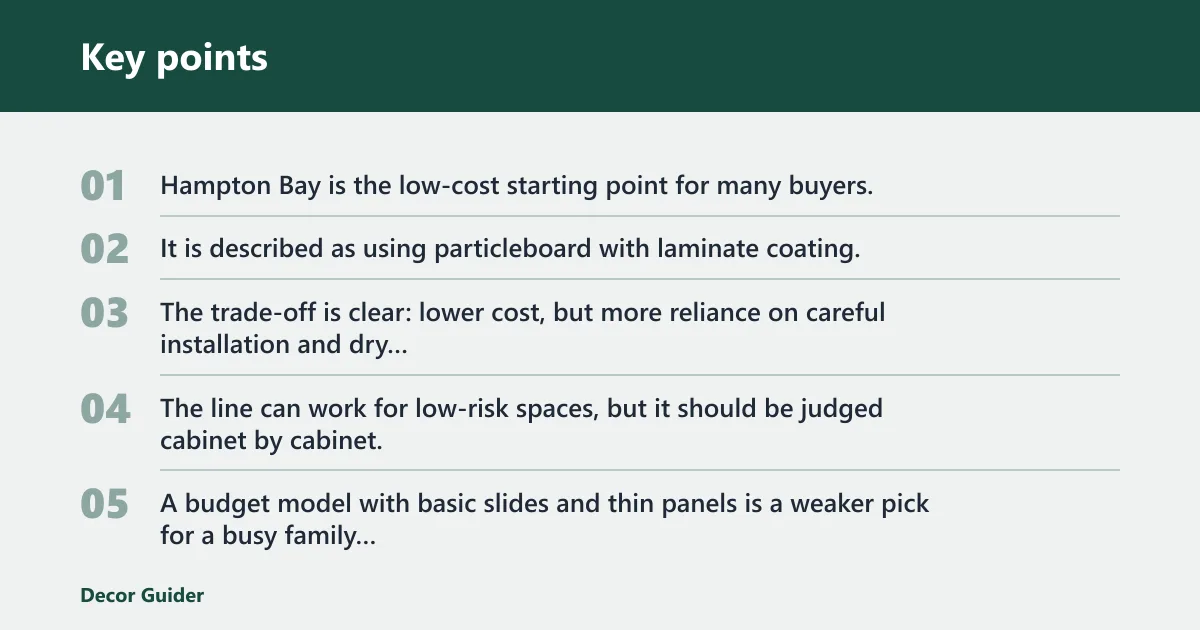
Hampton Bay is the low-cost starting point for many buyers. It is described as using particleboard with laminate coating, and it is listed with a 5-year warranty. The trade-off is clear: lower cost, but more reliance on careful installation and dry conditions.
The line can work for low-risk spaces, but it should be judged cabinet by cabinet, not by the brand name alone. A budget model with basic slides and thin panels is a weaker pick for a busy family kitchen than for a light-use rental.
Thomasville: mid-tier flexibility and showroom service
Thomasville is positioned between budget and premium and is sold through Home Depot’s showroom and service model. That middle position matters because it usually offers more flexibility than stock cabinets without jumping all the way to the most expensive semi-custom package.
For buyers who want more finish options and a smoother ordering experience, Thomasville can make sense. The key is still to confirm the actual build details, because mid-tier does not automatically mean plywood everywhere or top-tier hardware on every door.
KraftMaid: semi-custom options and better hardware
KraftMaid is the stronger Home Depot option when the goal is material quality and design flexibility. It is described as using plywood or furniture board on its cabinet box, and it is listed with a lifetime limited warranty. That makes it the clearest upgrade path in the Home Depot lineup.
It is not the cheapest choice, and it should not be bought as one. The value comes from better sizing options, stronger hardware packages, and a build spec that is better suited to a primary kitchen or a harder-working home.
Cabinet buyer’s scorecard
This scorecard turns the purchase into eight checks. Use it to compare budget, mid-range, and semi-custom choices before you order. For each row, the recommendation tells you whether the line is a pass, fail, or monitor for that scenario.
| Check | Budget | Mid-range | Semi-custom |
|---|---|---|---|
| Box material | Monitor | Monitor | Pass |
| Back panel | Monitor | Pass | Pass |
| Drawer slides | Fail if basic slides only | Monitor | Pass |
| Hinge type | Monitor | Pass | Pass |
| Finish type | Monitor | Pass | Pass |
| Moisture risk | Fail near sink bases | Monitor | Pass |
| Warranty strength | Monitor | Monitor | Pass |
| Install complexity | Pass for simple runs | Monitor | Fail if layout is highly custom |
Choose Home Depot if… / Choose IKEA if…
Choose Home Depot if you want a wider range of styles, need a showroom-backed order, or are moving into semi-custom territory where plywood boxes and better hardware matter. Choose IKEA if your layout is standard, your budget is tight, and you want a modular system with stronger consistency than many budget cabinet lines.
Choose Home Depot if…
Choose Home Depot if you need more finish choices than a flat-pack system gives you. Choose it if your project benefits from KraftMaid or Thomasville rather than a basic stock cabinet. Choose it if you are comfortable verifying the exact spec sheet and paying for the install details that make the plan work.
Choose IKEA if…
Choose IKEA if the project is DIY-friendly and you want a predictable hardware package. Choose it if you value modular assembly, a 25-year warranty, and less brand-to-brand variation. Choose it if you would rather control the layout tightly than pay for extra customization.
A common first-timer mistake is buying the cheapest cabinet line and then adding so many fillers, panels, and upgrades that the final bill no longer looks budget-friendly. The smarter approach is to price the whole kitchen, not just the base cabinet.
Frequently asked questions
Which Home Depot cabinets are best?
KraftMaid is usually the best Home Depot option for buyers who want stronger materials, more customization, and better hardware. Thomasville can be a solid mid-tier choice if you want more flexibility than stock cabinets. Hampton Bay is the budget option and should be judged carefully by model, not by brand alone.
Does Home Depot have good kitchen cabinets?
Yes, but only in the right tier. Home Depot has good kitchen cabinets when you move beyond the cheapest stock boxes and into better-built lines with plywood, stronger slides, and soft-close hardware. The lower end is more price-sensitive and less forgiving around moisture and installation mistakes.
What should I check before buying Home Depot kitchen cabinets?
Check the box material, back panel, drawer slides, hinge type, finish type, and warranty on the exact model. Then price the full order, including fillers, panels, trim, and installation. A cabinet that looks affordable on paper can become expensive once the missing parts are added.
Are Home Depot kitchen cabinets durable?
The durable ones can be, especially the semi-custom lines with plywood boxes and better hardware. The budget lines are more exposed to swelling, hinge wear, and finish damage if the kitchen sees moisture or heavy daily use. Durability depends on the exact construction, not the store name.
Are Home Depot kitchen cabinets worth it?
They are worth it when the line matches the job. A simple rental, a controlled remodel, or a better semi-custom package can make sense. They are not worth it if the cheapest box forces you into upgrades, corrections, and install problems that erase the savings.
Products related to this article
Sponsored / affiliate links. As an Amazon Associate I earn from qualifying purchases. I may earn additional commission from eligible campaigns.