Stock Cabinets vs Semi-Custom Cabinets: Which Fits?
Stock cabinets cost less and arrive faster, but semi-custom is the better pick when your kitchen needs odd widths, stronger storage options, or fewer fillers. Paying more for semi-custom often buys a cleaner fit without moving to full custom pricing. Pick the wrong tier, and you can end up paying for wasted space, awkward gaps, and later layout fixes. This guide compares price, lead time, sizing, and the decision points that favor each option.
Stock cabinets vs semi-custom cabinets: the real trade-off
| Decision factor | Stock Cabinets | Semi-Custom Cabinets | Winner |
|---|---|---|---|
| Fit options | Fixed sizes with zero customization options; widths move in 3-inch increments | Made to order from a catalog with width, depth, height, and finish options | Semi-Custom Cabinets |
| Price | About $160 to $380 per linear foot | About $250 to $400 per linear foot | Stock Cabinets |
| Lead time | Fast lead time | Typical lead time of 4 to 8 weeks | Stock Cabinets |
| Odd layouts | Often needs fillers, panels, or layout compromises | Often reduces filler width and correction labor | Semi-Custom Cabinets |
| Custom look potential | Limited by stock sizes and finishes | Broader finish matching and modification options | Semi-Custom Cabinets |
Fit options
Stock cabinets win on speed. Semi-custom wins on fit. Stock cabinetry uses fixed modules, while semi-custom cabinets let you adjust more dimensions before the order is placed or produced.
That matters most when a kitchen run does not land neatly on standard cabinet widths. A smaller filler strip can separate a tight layout from one that looks patched together.
Price
Stock cabinets usually cost less at the cabinet-only level. The average cost of stock kitchen cabinets is about $160 to $380 per linear foot, while semi-custom cabinets sit around $250 to $400 per linear foot.
That gap narrows when stock needs extra fillers, end panels, or labor to force standard boxes into a difficult layout.
Lead time
Stock cabinets usually arrive faster, which helps when flooring, counters, and appliances are already on the schedule. Semi-custom cabinets take longer because they are made to order from a defined catalog.
If you need countertops templated soon, lead time can matter as much as price.
What is the difference between stock, semi-custom, and custom cabinets?
Stock cabinets are ready-made, pre-manufactured products with zero customization options. Semi-custom cabinets are manufactured to order based on your selections from a defined catalog. Custom cabinets are built from scratch and can be made to fit many dimensions, but they usually take the longest to produce.
Stock cabinets: fixed sizes and limited finish sets
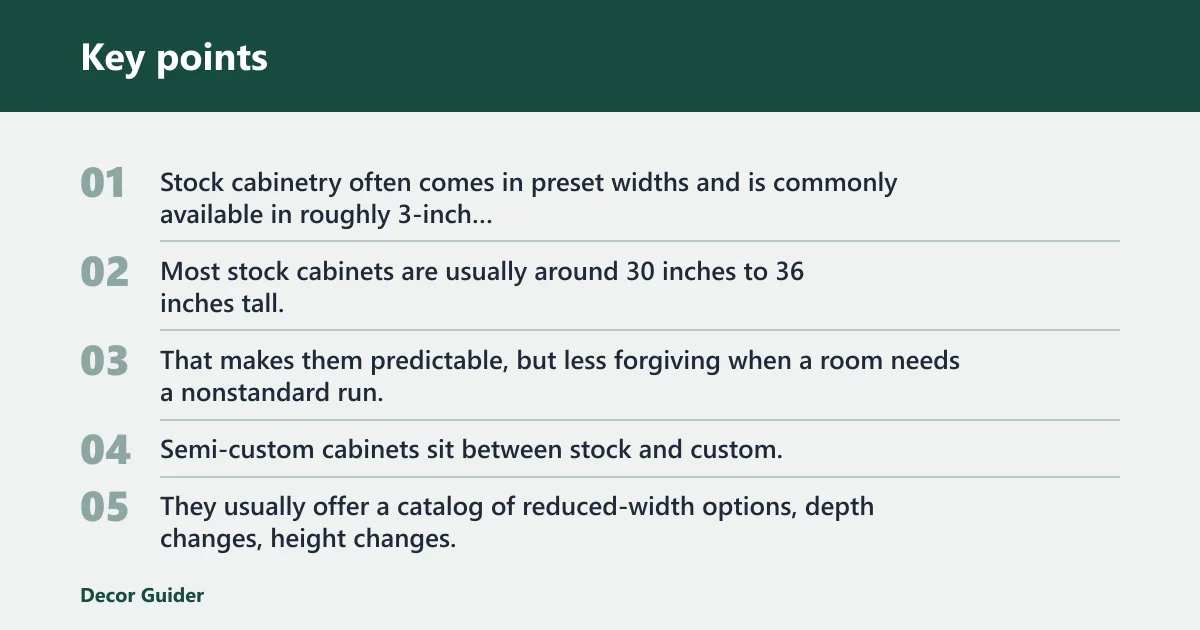
Stock cabinetry often comes in preset widths and is commonly available in roughly 3-inch increments. Most stock cabinets are usually around 30 inches to 36 inches tall, and they often use affordable materials such as melamine and plywood with veneers.
That makes them predictable, but less forgiving when a room needs a nonstandard run.
Semi-custom cabinets: made to order with modification options
Semi-custom cabinets sit between stock and custom. They usually offer a catalog of reduced-width options, depth changes, height changes, finish matching, and factory-built interior accessories.
This tier helps when your plan is close to standard but not close enough for a clean stock install.
Custom cabinets: built from scratch for exact dimensions
Custom cabinets are built from scratch to fit exact spaces. They are the best fit when the room is highly irregular, the ceiling height is unusual, or the plan calls for a very specific interior layout.
They also carry the longest lead times and the highest price band.
How do cabinet sizes affect fit and filler use?
Cabinet size sets the limits of the whole layout. Stock cabinets come in fixed width steps, common wall cabinet heights, and standard depths, so the plan must absorb any leftover space through fillers, panels, or resized adjacent runs.
Common base cabinet widths, wall cabinet heights, and depths
Most stock base cabinets follow common width increments, which is why some runs fit more easily than others. Wall cabinet heights are commonly offered in standard steps, and common depths are fixed around typical kitchen clearances.
Once room dimensions drift away from those steps, the gaps show up at corners, ends, and appliance bays.
Why 3-inch increments matter in real layouts
A 3-inch increment system works well for standard walls, but it can leave awkward leftover space in older homes and remodels. A 2-inch or 5-inch gap is not usually a usable cabinet width, so installers fill it with trim or a filler strip.
That filler does not store anything. It only hides the mismatch.
How filler strips change the final cost and look
Filler strips can be small, but they still affect labor and material use. Extra fillers, panels, and scribe work add installed cost even when the cabinet price looks low on paper.
Say your wall length leaves a 4-inch gap next to a range. Stock may need a filler and extra trim work, while semi-custom may let you reduce the gap to a cleaner fit.
Stock, semi-custom, and custom: price and lead time side by side
Stock is usually the lowest cabinet-only price and the fastest to get. Semi-custom sits in the middle for price and timing, while custom is the most expensive and slowest because it is built from scratch.
| Cabinet tier | Cabinet-only price band | 10×10 kitchen example | Lead time |
|---|---|---|---|
| Stock cabinets | About $160 to $380 per linear foot | Home Depot estimate at $5,280; IKEA stock cabinetry might cost between $6,000 and $8,000 | Fast lead time |
| Semi-custom cabinets | About $250 to $400 per linear foot | Varies by options and modifications | 4 to 8 weeks |
| Custom cabinets | Highest price band | Usually highest once design changes and labor are included | 8 to 16+ weeks |
Installed cost versus cabinet-only cost
Cabinet-only pricing can hide the real job total. Fillers, end panels, appliance panels, and modification fees can raise the installed cost, especially when stock cabinets need several fixes to fit a room well.
A cheap box is not always the cheaper project if the installer has to spend more time making it work.
Lead time and project scheduling
Lead time affects more than cabinet arrival. Countertop templating usually waits until cabinets are set, flooring transitions may depend on cabinet clearances, and appliance delivery must match final openings.
Stock helps when the schedule is tight. Semi-custom helps when you can wait for a better fit and still keep the remodel moving.
When does semi-custom beat stock on value?
Semi-custom beats stock when a small upgrade removes fillers, cuts trim labor, or solves a layout problem that stock cannot handle cleanly. If the room is standard and filler waste is tiny, stock usually stays cheaper.
Odd-shaped kitchens and corner runs
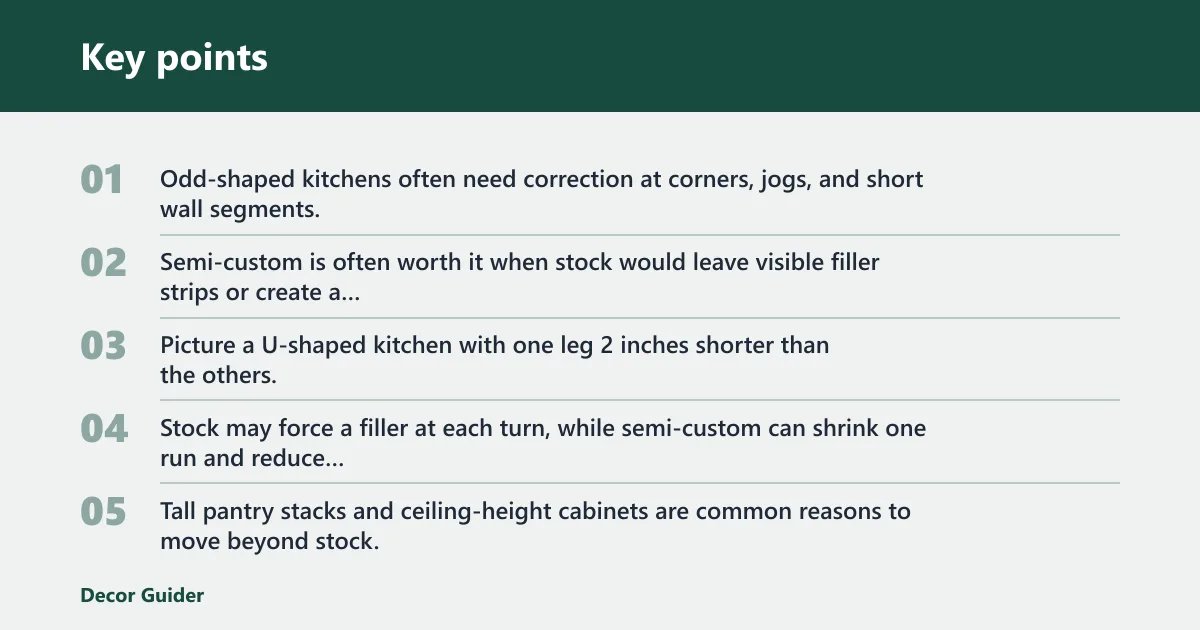
Odd-shaped kitchens often need correction at corners, jogs, and short wall segments. Semi-custom is often worth it when stock would leave visible filler strips or create a clumsy corner solution.
Picture a U-shaped kitchen with one leg 2 inches shorter than the others. Stock may force a filler at each turn, while semi-custom can shrink one run and reduce the patchwork effect.
Ceiling-height issues and tall pantry runs
Tall pantry stacks and ceiling-height cabinets are common reasons to move beyond stock. When upper cabinets stop short of the ceiling by too much, the gap often needs a valance, trim, or custom filler treatment.
Semi-custom can close that gap better if the manufacturer offers height changes.
Appliance surrounds and pantry stacks
Wall ovens, refrigerator panels, and pantry stacks often need more than standard widths. Stock can work only if the appliance openings and surrounding cabinets line up with the available modules.
If the fridge bay or oven wall leaves extra space that cannot be hidden neatly, semi-custom may save both material waste and install time.
When fillers and extra labor erase the stock savings
If stock needs several fillers, decorative panels, and custom trim pieces, the apparent savings can shrink fast. In those cases, semi-custom may cost a little more on the cabinet order but less on the finished job.
The key question is not only what the boxes cost. It is what it takes to make them look intentional.
Decision table: cheapest workable cabinet tier by kitchen scenario
The cheapest workable tier is the lowest-cost option that fits the layout without major compromises. In some rooms that is stock. In others, the added labor and waste make semi-custom the better value even before custom enters the picture.
| Kitchen scenario | Cheapest workable tier | Typical filler width | Lead time | When semi-custom saves enough to justify it |
|---|---|---|---|---|
| Simple galley with standard wall lengths | Stock cabinets | 0 to 1 inch | Fast lead time | Usually not; stock fits standard runs well |
| L-shaped kitchen with one short return | Stock cabinets | 1 to 3 inches | Fast lead time | Yes, if a corner fix or end panel would otherwise add extra labor |
| U-shaped kitchen with mismatched wall lengths | Semi-custom cabinets | 0 to 2 inches | 4 to 8 weeks | Yes, when stock would leave multiple fillers at turns and appliance runs |
| Galley with appliance gaps around a range or fridge | Semi-custom cabinets | 2 to 4 inches | 4 to 8 weeks | Yes, if a resized cabinet removes a dead gap next to appliances |
| Irregular room with angled walls or odd ceiling transitions | Custom cabinets | Variable | 8 to 16+ weeks | Sometimes, but only if semi-custom cannot solve the layout without visible patches |
Choose stock cabinets if… / Choose semi-custom cabinets if…
Choose stock cabinets if your kitchen uses standard wall lengths, the layout fits cabinet modules with minimal filler, and speed matters more than flexibility. Choose semi-custom cabinets if standard sizes would force filler strips, awkward corner fixes, appliance gaps, or tall-run compromises that add labor and waste.
Choose stock cabinets if…
Stock is the better call when your room is straightforward, your finish needs are simple, and your schedule is tight. It is also the practical choice when you want the lower cabinet-only price and can live with standard sizing.
If the run is straight, the walls are square, and the cabinet plan lands close to standard widths, stock usually wins.
Choose semi-custom cabinets if…
Semi-custom is the smarter buy when a few dimension changes remove a lot of visible compromise. That is especially true for kitchens with corner runs, ceiling-height changes, appliance surrounds, or enough filler waste to erase the stock savings.
It also helps when you want more door styles, more finish choices, or factory-built interior accessories without moving into full custom pricing.
When custom cabinets are the better call
Custom cabinets are worth it when the room is highly irregular, the dimensions are exacting, or the plan calls for a built-in look that stock and semi-custom cannot match. They are overkill when the layout is standard and the only issue is wanting more finish choices.
Custom is the top tier for fit, but not always the smart buy for a typical remodel.
Can stock cabinets be modified for a custom look?
Yes, stock cabinets can be modified for a custom look, but only within limits. You can add trim, panels, fillers, crown molding, and hardware to improve the appearance, yet the base box sizes and fixed finishes stay the same.
That means stock can look more finished, but it does not become semi-custom. If the layout itself is the problem, surface upgrades will not solve it.
What is stock cabinetry?
Stock cabinetry is ready-made, pre-manufactured cabinetry with zero customization options. It is sold in standard sizes, usually in 3-inch increments, with limited styles and finishes.
This category works best when you need a quick, predictable solution and your kitchen plan already matches common dimensions.
What are semi custom kitchen cabinets?
Semi custom kitchen cabinets are made to order from a defined catalog of options. They allow changes such as reduced widths, depth adjustments, height changes, finish matching, and some factory-built accessories.
That makes them a middle path for kitchens that are close to standard but need a cleaner fit than stock can provide.
How much more do semi-custom cabinets cost than stock cabinets?
Semi-custom cabinets usually cost more than stock cabinets at the cabinet-only level, but the gap is not fixed because options change the final price. Stock averages about $160 to $380 per linear foot, while semi-custom sits around $250 to $400 per linear foot.
The bigger question is often installed cost, because fillers, panels, and labor can shrink the apparent savings from stock.
Which cabinet type works best for an odd-shaped kitchen?
Semi-custom cabinets usually work best for an odd-shaped kitchen if the room is only moderately irregular. If the layout is severely irregular or requires exact dimensions at many points, custom cabinets may be the better fit.
Stock can still work in odd rooms, but only when the filler space stays small and the installer can hide the mismatch without heavy trim work.
How long do stock, semi-custom, and custom cabinets take to arrive?
Stock cabinets have a major advantage in fast lead time. Semi-custom cabinets are typically 4 to 8 weeks, while custom cabinets are often 8 to 16+ weeks because they are built from scratch.
That timing affects the whole remodel sequence, from demolition to counters to appliance installation.
custom kitchen cabinets vs stock cabinets
Custom kitchen cabinets are built from scratch to fit exact dimensions, while stock cabinets are pre-made in standard sizes. Custom gives you the most layout control, but it also brings the longest lead times and the highest price band.
Choose custom only when standard modules cannot solve the space cleanly.
custom vs semi custom cabinets
Custom cabinets are fully made to exact measurements, while semi-custom cabinets are adjusted from a catalog of options. Semi-custom is the better value when you need some changes, but not a complete one-off build.
If the room needs exact fit at multiple points, custom wins. If one or two dimension changes will solve the problem, semi-custom often makes more sense.
box cabinets vs custom cabinets
Box cabinets usually refers to standard cabinet construction in fixed sizes, which is closer to stock than to custom. Custom cabinets are built to order and can match spaces that box cabinets cannot fill neatly.
The difference is not only appearance. It is how much layout correction the project needs before the kitchen works.
what are semi custom kitchen cabinets
Semi custom kitchen cabinets are made to order from a set catalog, with more size and finish choices than stock. They sit between fixed stock boxes and fully bespoke custom cabinets.
They are often the best choice when you want a cleaner fit than stock without paying for a full custom build.
Frequently asked questions
What is the difference between stock and semi-custom cabinets?
Stock cabinets are ready-made and sold in fixed sizes with no customization options. Semi-custom cabinets are manufactured to order from a defined catalog, so you can change more dimensions, finishes, and some storage details. The trade-off is lower price and faster availability versus better fit.
Are semi-custom cabinets worth the extra cost over stock cabinets?
They are worth it when stock would need several fillers, awkward corner fixes, or appliance gaps that add labor. If your layout is standard, stock is usually the cheaper choice. If the plan is close but not quite right, semi-custom can save money on installation waste.
What is stock cabinetry?
Stock cabinetry is pre-manufactured cabinetry sold in standard widths, heights, and depths. It starts at 9 inches wide and moves up in 3-inch increments. Most stock cabinets are around 30 inches to 36 inches tall, with limited style and finish choices.
How long do stock, semi-custom, and custom cabinets take to arrive?
Stock cabinets are the fastest option and often ship quickly. Semi-custom cabinets commonly take 4 to 8 weeks. Custom cabinets usually take 8 to 16+ weeks, so they require the most schedule coordination with flooring, counters, and appliances.
Can stock cabinets be modified for a custom look?
Yes, stock cabinets can be trimmed out with panels, fillers, crown molding, and hardware to look more finished. But those changes do not alter the fixed box sizes or the limited finish set. If the layout itself is the issue, modified stock may still fall short.
What are semi custom kitchen cabinets?
Semi custom kitchen cabinets are made to order from a set catalog and allow more choices than stock. They can include reduced widths, depth changes, height changes, finish matching, and factory-built interior accessories. They are a middle tier for kitchens that need more fit control.
Products related to this article
Sponsored / affiliate links. As an Amazon Associate I earn from qualifying purchases. I may earn additional commission from eligible campaigns.