Painted Cabinets vs Stained Cabinets: Which Lasts Longer?
Painted cabinets give you a relatively flat, even color and can make small spot repairs easier. Stained cabinets usually leave some grain visible and can be a good choice when you want the wood character to show and the cabinets will see heavy use. Pick the wrong finish, and chips, grain telegraphing, or mismatched repairs can raise repaint costs and cut the finish’s good looks. This guide compares durability, repairability, cleaning, and which cabinet substrates work best with each finish.
| Decision factor | Painted Cabinets | Stained Cabinets | Winner |
|---|---|---|---|
| Up-front labor and prep | Higher: sanding, priming, masking, and usually more coats | Lower to moderate: still needs prep, but fewer finish coats | Stained Cabinets |
| Wear visibility in daily use | Shows chips, edge wear, and scratches more clearly | Hides minor dents and everyday scuffs better on grained wood | Stained Cabinets |
| Touch-up ease | Easier for small spots only when color matches are exact | Harder to blend if grain, tone, or sheen vary | Painted Cabinets |
| Wood-grain visibility | Minimal to none | Visible by design | Stained Cabinets |
| Color flexibility | Very high | Limited to wood tones and tinted stains | Painted Cabinets |
| Moisture resistance | Depends heavily on primer and topcoat quality | Also depends on sealer and topcoat; exposed grain can be vulnerable | Tie |
| Resale appeal | Strong for neutral, current kitchens; trend risk if color is bold | Strong for buyers who prefer natural wood and warmer finishes | Tie |
| Best substrate | Maple, MDF, and paint-grade plywood | Oak, maple, birch, walnut, and veneer plywood | Tie |
Painted cabinets vs stained cabinets: the core trade-off
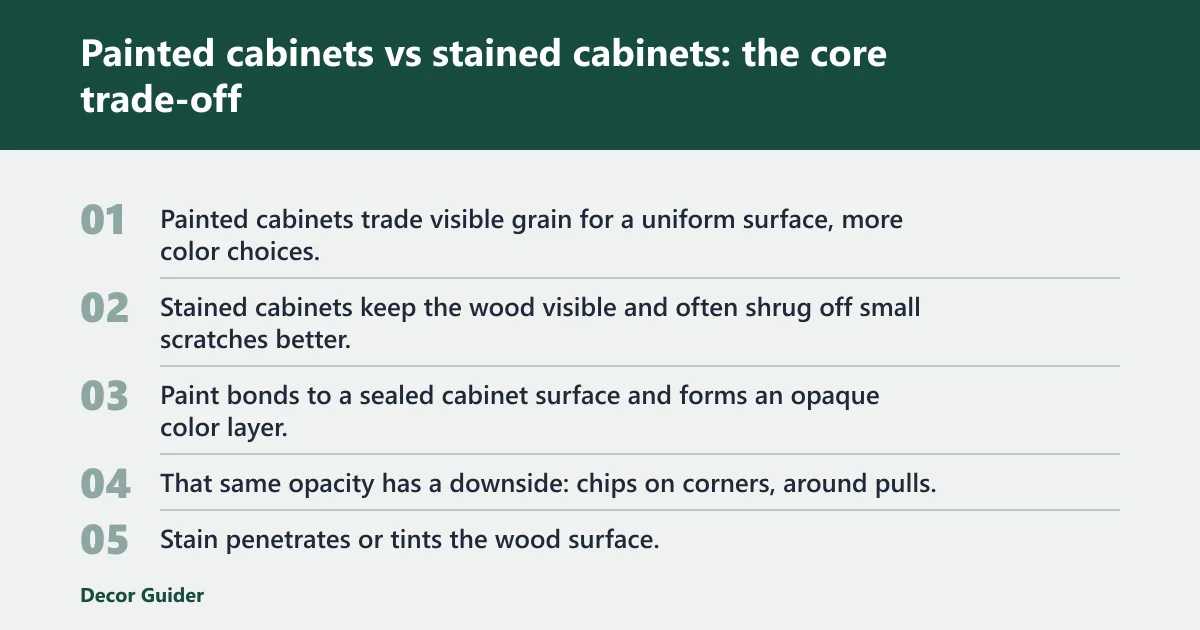


Painted cabinets trade visible grain for a uniform surface, more color choices, and tighter control over the room’s color plan. Stained cabinets keep the wood visible and often shrug off small scratches better, but the result depends more on the species, the grain pattern, and how well the sealer was applied.
What painted cabinets change about the look and upkeep
Paint bonds to a sealed cabinet surface and forms an opaque color layer, so the wood species matters less to the final look than the quality of prep. That same opacity has a downside: chips on corners, around pulls, and near dishwashers stand out fast, especially on satin and semi-gloss finishes.
What stained cabinets change about grain, color, and repair
Stain penetrates or tints the wood surface, letting the grain show through instead of covering it. That can hide light wear better, but color matching is harder after repairs because tone, absorption, and grain pattern all shape the result.
How each finish behaves on different cabinet substrates
Oak, maple, and birch: grain pattern and finish outcome
Oak has open grain, so stain reads strongly and gives the clearest wood pattern. Maple is tight-grained, which can make it a good candidate for painted cabinets because the surface may look smoother after proper priming, while birch is a middle-ground option and can blotch under stain if the stain system is not chosen carefully.
Plywood and MDF: compatibility, edge wear, and coating behavior
Plywood and MDF are common in painted cabinet boxes and doors because they can take a stable painted finish when edges are sealed well. MDF paints smoothly, but unsealed edges are vulnerable to moisture and swelling; plywood edges can telegraph layers unless they are filled and primed correctly.
Why substrate matters more than color choice
A white painted door over MDF and a white painted door over oak do not age the same way. Grain telegraphing, seasonal movement, edge swelling, and how the primer bites into the surface all change the final wear pattern more than the color name printed on the sample.
Which finish is easier to maintain and repair?
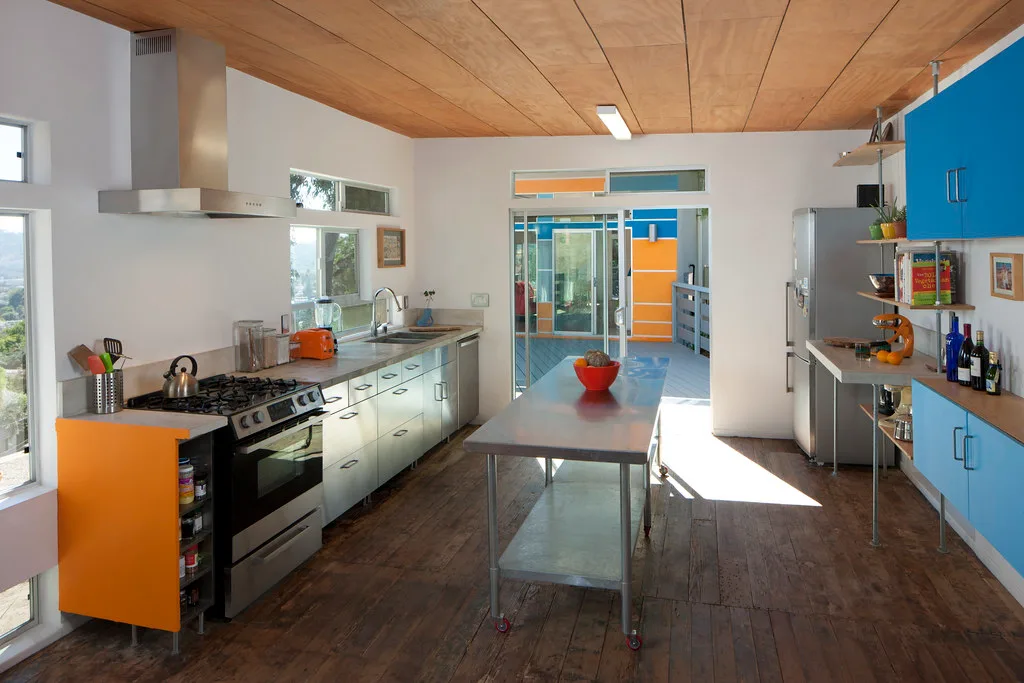
Painted cabinets are usually easier to spot-touch when the color is standard and the sheen is known, but they are less forgiving of edge damage and chips. Stained cabinets can hide minor wear on the right wood, yet true repairs often spread beyond the damaged spot because matching stain tone and grain absorption is difficult.
Touch-up limits for painted cabinets
Small nicks can often be filled, sanded, and touched up with matching paint, but the repair may flash under certain lighting if the sheen does not match. On high-touch zones, repeated repairs can create a patchwork look faster than on stained wood.
Restaining and blending limits for stained cabinets
Stain repairs depend on the original species, existing finish, and how much of the damaged area can be feathered into surrounding wood. If the stain has aged from sunlight or kitchen grease, blending becomes harder, especially on wide doors with visible grain changes.
High-touch zones, edge chipping, and moisture exposure
Pulls, sink bases, trash pullouts, and dishwasher-adjacent doors take the most abuse. Painted edges chip more visibly there, while stained doors may disguise the scuff but can show finish thinning or darkened wear where hands and moisture repeatedly contact the surface.
What do painted cabinets and stained cabinets really cost?
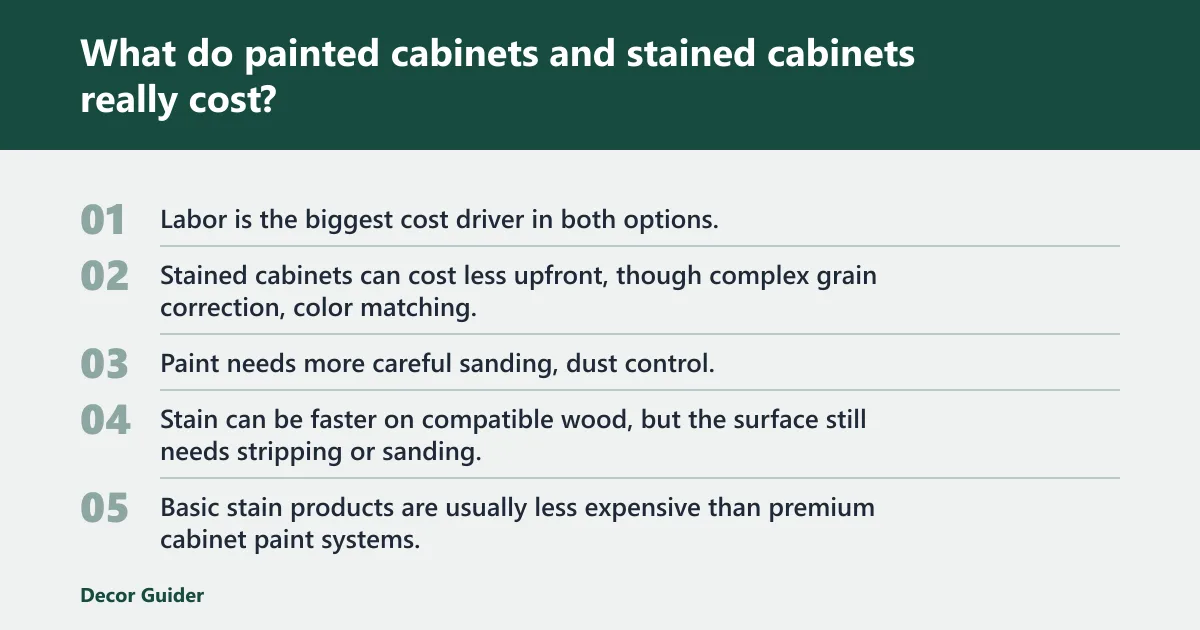
Labor is the biggest cost driver in both options, but painted cabinets usually cost more to finish because prep, priming, masking, drying, and cure time are longer. Stained cabinets can cost less upfront, though complex grain correction, color matching, or a high-end clear topcoat can narrow the gap.
Labor, prep time, and curing as the main cost drivers
Paint needs more careful sanding, dust control, and multiple coats to avoid lap marks and brush texture. Stain can be faster on compatible wood, but the surface still needs stripping or sanding, conditioning in some cases, and a clear protective coat that has its own cure time.
Material costs, custom color premiums, and refinishing complexity
Basic stain products are usually less expensive than premium cabinet paint systems, but custom paint colors can add cost through tinting and extra mixing. Refinishing costs also rise when cabinets need repair-grade prep, deglossing, grain filling, or specialty primers to block old finishes.
Paint vs stain in replacement versus refacing decisions
If you are replacing doors and drawer fronts, paint opens more design options without requiring premium wood species. If you are refacing existing wood fronts, stain may be cheaper when the original grain is attractive and the old color can be corrected without full substrate replacement.
How sheen, sealer, and topcoat change performance
Sheen changes more than appearance. Matte hides small surface flaws, satin balances cleanup and glare, semi-gloss improves wipeability, and gloss shows scratches and dust the fastest, even though it can clean easily when the finish is intact.
Matte, satin, semi-gloss, and gloss are the common sheen options
Matte finishes make surface irregularities less obvious, but they can hold grime more readily in busy kitchens. Satin is often the practical middle ground for painted cabinets, while semi-gloss is common where cleanup matters more than hiding wear.
Moisture resistance, cleanup, and yellowing risk
Topcoats and sealers matter because they slow moisture intrusion and help cabinet surfaces resist grease. Some clear coats, especially over certain paints or under strong sunlight, can yellow over time; that matters most in kitchens with bright windows or warm artificial lighting.
Scratch visibility and wear patterns by sheen
Higher sheen usually makes scratches, dents, and touch-up edges easier to see. Lower sheen can soften the look of wear, but it may not clean as easily, so the right choice depends on whether your kitchen sees more handprints or more abrasion.
Decision matrix: painted cabinets vs stained cabinets
This scorecard uses a practical 1-to-5 scale, with higher numbers indicating a stronger result for that factor. It is meant to guide real decisions, not replace substrate-specific planning, because oak, maple, birch, plywood, and MDF do not all perform the same way.
| Factor | Painted Cabinets | Stained Cabinets | Best pick |
|---|---|---|---|
| Cost | 3 | 4 | Stained Cabinets |
| Durability | 3 | 4 | Stained Cabinets |
| Touch-up ease | 4 | 2 | Painted Cabinets |
| Wood-grain visibility | 1 | 5 | Stained Cabinets |
| Color flexibility | 5 | 2 | Painted Cabinets |
| Moisture resistance | 3 | 3 | Tie |
| Resale appeal | 4 | 4 | Tie |
| Best substrate | MDF, maple, paint-grade plywood | Oak, maple, birch, walnut, veneer plywood | Tie |
Best for by kitchen type
- Painted cabinets: best for modern kitchens, smaller rooms that need a lighter look, and homes that want a strict color match across islands, pantry walls, and trim.
- Stained cabinets: best for warm, traditional kitchens, active family kitchens with frequent contact, and rooms where natural grain helps hide everyday wear.
- High sunlight kitchens: choose carefully either way, but stained wood can age with tone shifts while painted surfaces can fade or yellow depending on the coating system.
- Humidity-prone kitchens: choose a well-sealed system over a raw substrate; MDF needs especially careful edge sealing if painted.
Painted cabinets vs stained cabinets: the core trade-off in real kitchens
Say your kitchen has a trash pullout next to the sink and kids open it many times a day. Painted doors will give you a smooth, consistent look, but the corners and pull edges will show wear sooner; stained wood will hide that abuse better if the grain and tone are favorable.
Say your cabinet layout includes two tall pantry doors in direct afternoon sun. A painted finish may keep the room feeling crisp, while a stained finish can better disguise small dings; either way, the topcoat and substrate choice will matter more than the finish sample on the showroom card.
Choose Painted Cabinets if… / Choose Stained Cabinets if…
Choose painted cabinets if you want a modern, transitional, or crisp look; need a specific color; are working with MDF, maple, or paint-grade plywood; or expect occasional touch-ups to be part of normal upkeep. Choose stained cabinets if you want warm, traditional, or farmhouse character; your doors are oak, maple, birch, walnut, or veneer plywood; and you prefer a finish that can hide everyday scuffs better on grained wood.
- Choose painted cabinets if your kitchen needs a neutral backdrop for resale, your design calls for white, black, or another exact color, or you want easier spot repairs on small chips.
- Choose stained cabinets if your cabinets already have attractive grain, your kitchen gets heavy use, or you want repairs to disappear a little more naturally than paint chips do.
- Choose painted cabinets if the surface is MDF and the edges can be sealed well; otherwise moisture exposure can become a weak point.
- Choose stained cabinets if your goal is to keep wood character visible and you are comfortable with more limited color choices.
White stained cabinets vs white painted cabinets
White painted cabinets are opaque, even, and easier to match in a standard paint system. White stained cabinets are usually a whitewash or pickled look that still lets grain show through, which means they read warmer, less solid, and often less contemporary than true white paint.
Black stained cabinets vs black painted cabinets
Black painted cabinets give a dense, solid look that fits modern kitchens and can be easier to coordinate across mixed materials. Black stained cabinets are less common and usually keep grain visible, so they read softer and more wood-forward, but they can be harder to touch up cleanly if the stain tone shifts under light.
Frequently asked questions
Are painted cabinets or stained cabinets more expensive?
Painted cabinets are usually more expensive to finish because the process often needs more prep, priming, masking, coats, and drying time. Stained cabinets can cost less on compatible wood, but the gap shrinks when the work involves heavy sanding, grain correction, custom color blending, or a high-end clear protective system.
Stained wood cabinets vs painted cabinets
Stained wood cabinets keep the grain visible and often hide minor dents and scuffs better on species like oak or maple. Painted cabinets create a more uniform look and offer far more color options, but chips and edge wear tend to stand out more, especially in busy kitchens.
White stained cabinets vs white painted cabinets
White painted cabinets are fully opaque and usually feel cleaner, flatter, and more contemporary. White stained cabinets keep some wood movement and grain visible, so they read warmer and less uniform; they are better when you want a softened wood look rather than a true solid white surface.
Black stained cabinets vs black painted cabinets
Black painted cabinets deliver the most even and exact black finish, which suits modern and transitional kitchens. Black stained cabinets still show grain, so they feel more wood-based and less graphic, but matching repairs is harder if the color or sheen changes after wear.
Painted kitchen cabinets vs stained
Painted kitchen cabinets work best when color control, a crisp look, and easier small touch-ups matter more than wood character. Stained cabinets work best when you want natural grain, a warmer appearance, and a finish that can hide minor wear more easily on the right substrate.
Paint vs stain for cabinets
Paint covers the substrate and gives you broad color flexibility, but it depends heavily on primer, edge sealing, and topcoat quality. Stain works with the wood instead of covering it, which limits color range but can make the finish look more natural and less prone to obvious chip lines.
Which lasts longer painted cabinets or stained cabinets?
Neither finish automatically lasts longer in every kitchen. Stained cabinets often hide wear better on wood with visible grain, while painted cabinets can hold up well when the prep is excellent and the kitchen is not constantly abrading edges, so substrate, sheen, and topcoat matter as much as the finish type.
Which is easier to touch up painted or stained cabinets?
Painted cabinets are usually easier to touch up for small, localized damage because color matching is more straightforward than matching stain tone and grain absorption. Stained cabinets can be harder to repair invisibly, especially when sunlight, age, and surrounding grain make the original blend difficult to repeat.
Products related to this article
Sponsored / affiliate links. As an Amazon Associate I earn from qualifying purchases. I may earn additional commission from eligible campaigns.