Best Paint for Doors (2026): Based on Specs and Reviews
A 100% acrylic alkyd enamel in satin or semi-gloss is a common all-around choice for interior doors; semi-gloss is often preferred for high-traffic doors, while satin can help reduce the look of brush marks. Poor paint choice leads to chipped edges, sticky doors, yellowing, and brush marks that are hard to fix once cured. This guide covers the best paint by failure risk first, then sheen and room type.
Best overall: waterborne alkyd trim paint

Waterborne alkyd trim paint is the strongest all-around answer for interior doors because it levels well, dries to a harder furniture-like finish, and still cleans up with water. It is made for doors, trim, and cabinetry, so it fits the exact wear pattern that wall paint usually struggles with.
Why it beats standard wall paint on doors
Interior doors get touched, slammed, wiped, and cleaned far more often than walls. They need stronger chip resistance, tighter adhesion, and a harder cure than a standard wall coating delivers.
Standard wall paint often looks fine at first, then starts showing edge wear, handle-area scuffs, and blocking where the door sticks to the jamb. Waterborne alkyd trim paint is a better fit because it is designed to dry harder and level out brush marks before it sets.
Where the self-leveling finish helps most
The leveling benefit matters most on paneled doors, brushed-on flat slabs, and doors with visible grain or minor repair marks. A smoother cure can make a modest prep job look cleaner.
That does not erase dents, scratches, or poor sanding. It just reduces the chance that the paint itself becomes the problem.
When low-VOC options are worth paying
Low-VOC versions are worth the higher price in bedrooms, hallways, and occupied homes where odor matters. They are also useful when you need doors back in service quickly and want less lingering smell during drying.
Paying more for a better trim enamel can be cheaper than repainting after chip-out or brush-mark complaints. On a door-by-door basis, the premium often buys fewer touch-ups and less rework.
Quick comparison
| Product | Badge | Best for | Price | ||
|---|---|---|---|---|---|
 |
Rust-Oleum 7779730 Stops Rust Brush On Paint, Half Pint,Rust-Oleum | Our pick | $14.85
Price as of 31 Oct 2026
|
View | |
 |
INSL-X Cabinet Coat – Urethane Acrylic Satin Sheen EnamelINSL-X | Also great | Quart · satin · cabinet enamel | $26.99
Price as of 31 Oct 2026
|
View |
 |
Rust-Oleum 380227 White Sure Color Interior Paint + Primer,Rust-Oleum | Budget pick | 1 gallon · semi-gloss · interior paint + primer | $40.86
Price as of 31 Oct 2026
|
View |
 |
PRESTIGE Paints Interior Paint and Primer In One, 1-Gallon,PRESTIGE | Pair with it | 1 gallon · satin · interior paint + primer | $53.99
Price as of 31 Oct 2026
|
View |
|
Evolve Interior Paint & Primer, Four Sheens, 1-Gallon &EVOLVE | Also great | 1 gallon · semi-gloss · paint and primer | $36.99
Price as of 31 Oct 2026
|
View |
Use this section to sort by failure risk first: chipping, brush marks, yellowing, or stickiness. Then choose sheen based on traffic, room humidity, and how smooth the door surface already is.
How we chose
The ranking starts with the failures that show up fastest on interior doors: chipped edges, visible brush marks, yellowing on bright whites, and sticky close-up contact.
Next comes adhesion. Slick factory finishes, old oil paint, bare wood, MDF edges, and patched spots all change what primer and topcoat you need.
Sheen matters too. Higher sheen cleans more easily. It also exposes surface flaws.
Finally, room use changes the answer. Hallways, entryways, bathrooms, and laundry rooms need tougher coatings than a low-touch closet door.
Acrylic enamel: best for most homes
Acrylic enamel is a strong choice for most residential doors because it dries faster than traditional oil, has low odor, and resists fading and yellowing well. It suits homes that want a durable finish without the longer wait and stronger smell of old-school oil paint.
It is a good fit for everyday bedroom, hall, and closet doors where you want a clean finish and easier cleanup. The main drawback is that some acrylic enamels do not level as smoothly as a top-tier waterborne alkyd, so brush marks can be more visible if the surface prep is weak.
Semi-gloss for most doors: best for washability
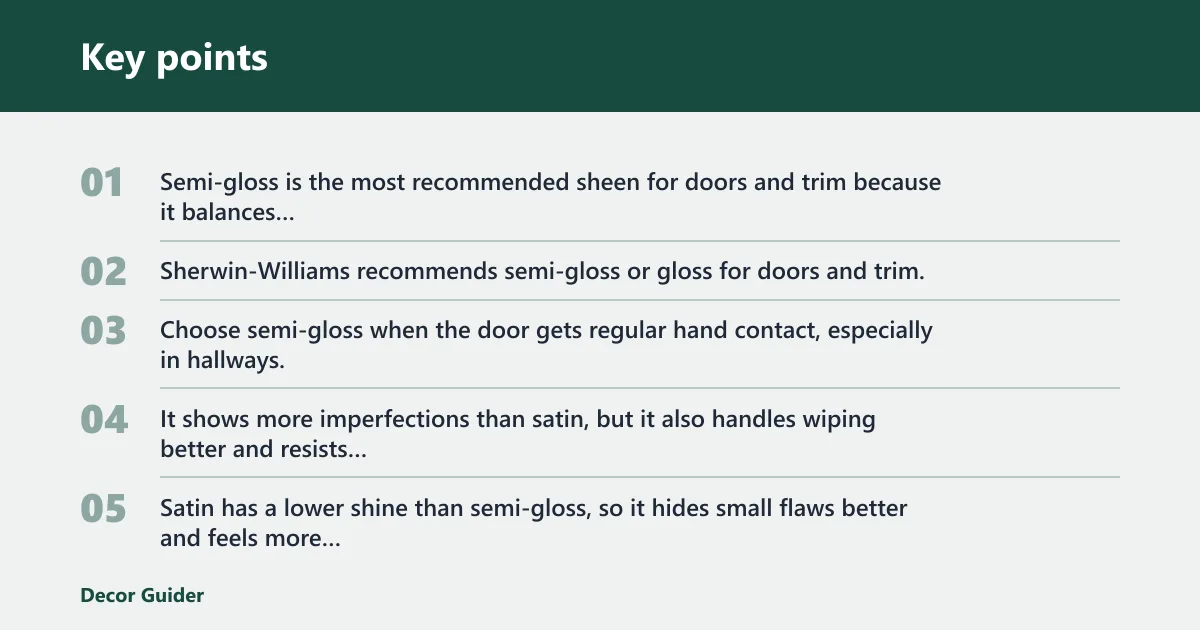
Semi-gloss is the most recommended sheen for doors and trim because it balances cleanability, moisture resistance, and durability. Sherwin-Williams recommends semi-gloss or gloss for doors and trim, and eggshell and matte are not recommended for those surfaces.
Choose semi-gloss when the door gets regular hand contact, especially in hallways, entryways, bathrooms, and laundry rooms. It shows more imperfections than satin, but it also handles wiping better and resists grime more easily.
Satin for softer-looking doors
Satin has a lower shine than semi-gloss, so it hides small flaws better and feels more modern on many interiors. It works well on lower-traffic doors, especially where visible texture matters more than maximum washability.
Use satin if the door has minor roller marks, grain variation, or slight patchwork that you do not want to spotlight. The tradeoff is simple: you give up some cleanability for a calmer look.
Gloss for very smooth surfaces
Gloss gives the highest shine and the easiest wipe-down. It is best on very smooth, well-prepared doors where you want a crisp, polished finish and can accept that every defect will stand out.
Use gloss sparingly. It is unforgiving on dents, grain, patch edges, and sanding mistakes.
Interior door paint decision table
| Door material | Existing coating | Traffic level | Room humidity | Recommended paint chemistry | Recommended sheen | Primer needed | Common failure to avoid |
|---|---|---|---|---|---|---|---|
| Wood | Bare or stripped | High | Medium to high | Waterborne alkyd trim paint | Semi-gloss | Yes, especially before topcoat | Grain raise, stain bleed, uneven absorption |
| Wood | Old oil paint | High | Any | Acrylic enamel or waterborne alkyd | Semi-gloss | Yes, use a bonding primer | Poor adhesion over glossy oil finish |
| MDF | Bare edges or patched spots | Medium to high | Low to medium | Acrylic enamel or waterborne alkyd | Satin or semi-gloss | Yes, especially on edges | Swollen edges, flashing, weak edge adhesion |
| Hollow-core | Factory skin, previously painted | Medium | Low to medium | Acrylic enamel | Satin or semi-gloss | Often yes if glossy or slick | Brush marks, poor bite on slick skins |
| Prefinished or engineered | Glossy factory coating | High | Medium to high | Waterborne alkyd trim paint | Semi-gloss | Yes, bonding primer | Peeling from inadequate deglossing |
Which one should you buy?
If you want the safest all-around option, start with a waterborne alkyd trim enamel in satin or semi-gloss. It gives you the best mix of leveling, hardness, and durability for most interior doors.
If budget matters more than maximum leveling, acrylic enamel is the practical choice for most residential doors. It is a solid step up from ordinary wall paint, and it dries fast with low odor.
For bathrooms and laundry rooms, pick the tougher, more washable route: semi-gloss in a durable trim enamel. Those rooms see more moisture, more wiping, and more chance of blocking.
For older doors with repairs or patching, spend more on prep and primer before you spend more on paint. Better paint cannot hide loose filler, rough sanding, or flaking undercoats.
Say your hallway door has a few patch spots near the knob and a factory-smooth face. Satin may hide the repairs better than semi-gloss, but only if you prep the surface well; otherwise the patch edges will still telegraph through.
Suppose a bathroom door is already coated in old glossy white paint. A bonding primer plus semi-gloss topcoat is the safer path than painting straight over the sheen and hoping adhesion holds.
What paint works best for your door material?
Door material changes the prep and primer decision as much as the paint choice. Wood, MDF, hollow-core, and prefinished or engineered doors do not behave the same way once you sand and topcoat them.
Wood doors
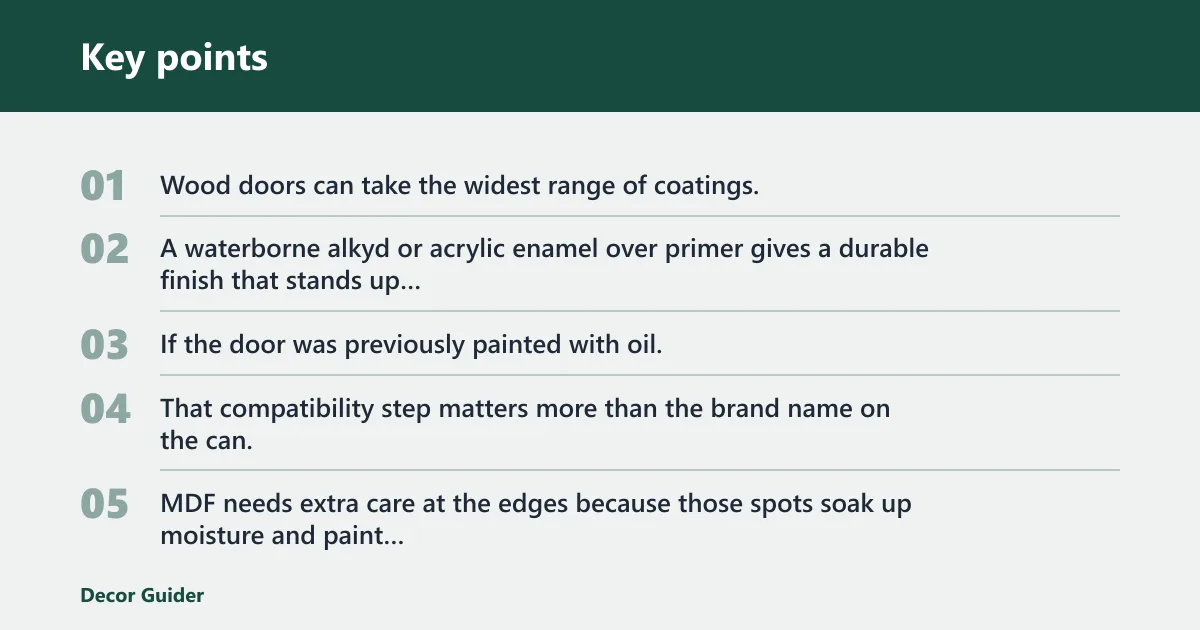
Wood doors can take the widest range of coatings, but bare wood needs proper sealing to prevent uneven absorption and grain raise. A waterborne alkyd or acrylic enamel over primer gives a durable finish that stands up to contact.
If the door was previously painted with oil, use a bonding primer before a water-based topcoat. That compatibility step matters more than the brand name on the can.
MDF doors and edges
MDF needs extra care at the edges because those spots soak up moisture and paint differently from the face. A bonding primer or good sealing primer on the edges helps prevent fuzzy swelling and blotchy absorption.
For MDF, satin can be helpful if the face has minor texture or repaired spots, while semi-gloss is better if the goal is easier cleanup. Do not skip edge sealing.
Hollow-core and prefinished doors
Hollow-core doors often have factory skins that are smooth but slick, so adhesion depends on deglossing and primer. Prefinished or engineered doors can be even harder to coat unless you scuff-sand and prime properly.
These doors usually benefit from a bonding primer under an acrylic enamel or waterborne alkyd topcoat. Without that step, chipping at the edges is a common failure.
Surface preparation is not optional. It is the difference between a finish that holds and one that chips, sticks, or peels.
- Remove hardware or mask it carefully.
- Clean oils, dust, and hand grime from both faces and edges.
- Scuff-sand glossy or slick surfaces so the new coating can grip.
- Fill dents, nail holes, and deeper scratches, then let repairs cure fully.
- Prime bare wood, MDF edges, glossy factory finishes, or old oil paint with the right primer.
- Sand lightly between coats if the surface feels rough or the primer raised texture.
The Decorators Forum UK says internal doors need primer undercoat to seal the timber. That advice lines up with the practical problem: raw timber drinks paint unevenly and can telegraph defects through the finish.
Compatibility check for old oil paint
Before using a water-based topcoat over an older door, check whether the existing layer is oil or a slick factory coating. If the old paint is glossy and you cannot confirm compatibility, treat it as an adhesion risk and use a bonding primer after deglossing.
That check matters because failure often starts at the interface, not on the surface. A topcoat can look fine for a while and still lift at the first hard knock if the bond is weak.
Best color choices for interior doors
White is still the safest default because it pairs with most trim, hides less visual mismatch, and keeps a room bright. Many homeowners choose a warm white for consistency with baseboards and casing.
Black can look sharp on doors with good prep and smooth panels, especially in modern or high-contrast interiors. It also shows dust, brush marks, and edge defects more clearly, so it rewards careful sanding and a cleaner substrate.
Color choice matters less than sheen and adhesion. A good white or black finish still fails if the door was not cleaned, sanded, and primed properly.
Budget and cost tradeoffs
Premium enamels usually cost more per door, but they can reduce rework because they level better and hold up longer. That matters on doors you touch every day.
Cheaper paints may be fine for a lightly used closet or storage door, but they are a poor gamble on a bathroom, entryway, or hallway. If you have to repaint sooner because of chipping or stickiness, the cheaper can was not actually cheaper.
As a simple rule, spend more on the topcoat when the door is high-contact or the finish must look smooth from a close distance. Spend less only when the door is low-traffic and the existing surface is already in good shape.
Frequently asked questions
What is the best paint for interior doors and trim?
The best paint for interior doors and trim is a durable trim enamel, especially a waterborne alkyd or high-quality acrylic enamel in satin or semi-gloss. Those coatings are made for harder wear than wall paint and clean more easily after hand contact and grime buildup.
What is the best paint for interior doors?
The best paint for interior doors is usually a 100% acrylic alkyd enamel or acrylic enamel in semi-gloss. That combination gives you strong adhesion, better washability, and less risk of yellowing than ordinary wall paint.
What is the best finish for interior doors?
Semi-gloss is the best finish for most interior doors because it balances durability, cleanability, and moisture resistance. Satin is a good second choice when the surface has minor flaws or you want a softer look with less shine.
What is the best paint sheen for interior doors?
Semi-gloss is the safest sheen for most doors. Satin works better when the room is lower traffic or the door surface has more visible repairs, while gloss is best only when the door is very smooth and you want maximum cleanability.
What is the best white paint for interior doors?
The best white paint for interior doors is a durable trim enamel in semi-gloss or satin, not a flat wall finish. White shows brush marks and dirt more quickly, so choose a formula that levels well and resists yellowing.
What is the best type of paint for interior doors and trim?
The best type of paint for interior doors and trim is waterborne alkyd trim paint for the toughest finish, with acrylic enamel as a strong alternative for faster drying and lower odor. Both are better suited to touch, cleaning, and repeated closing than standard wall paint.
Products related to this article
Sponsored / affiliate links. As an Amazon Associate I earn from qualifying purchases. I may earn additional commission from eligible campaigns.