What Size Hinges Do I Need for an Interior Door?
Start with the door’s weight, thickness, and existing mortise. For many interior doors, 3.5-inch butt hinges are the common baseline; 4-inch hinges make sense when the slab is heavier, thicker, taller, or worn enough to need more support. Correct sizing helps prevent sagging, rubbing, and loose screws. BHMA/ANSI hardware standards and manufacturer catalogs consistently treat hinge selection as a fit-and-duty decision, not just a length choice.
Standard hinge specs for common doors

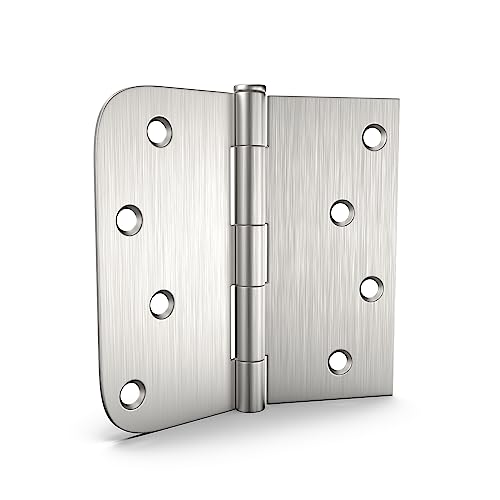

For most residential interior doors, the default starting point is a 3.5-inch butt hinge. In hinge catalogs and millwork references, the listed size is typically the hinge’s height by open width; on a square hinge, those numbers are often the same, so a 3.5-inch x 3.5-inch hinge is the familiar “3.5-inch hinge” many installers mean.
That size fits standard interior slab proportions without adding unnecessary bulk. Major hardware references and manufacturer technical sheets commonly show 3.5-inch hinges for typical 1-3/8-inch interior doors, with larger sizes reserved for heavier or more demanding openings. Square-corner and radius-corner versions are both common on interior doors, so corner style matters as much as nominal size.
What the parts do
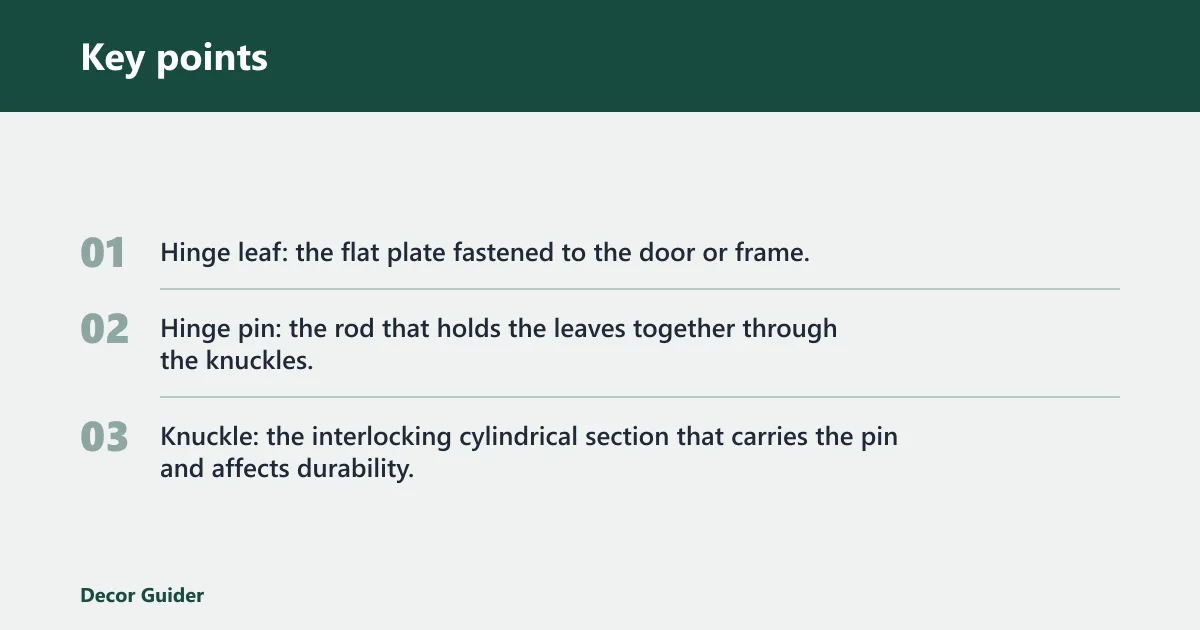
- Hinge leaf: the flat plate fastened to the door or frame.
- Hinge pin: the rod that holds the leaves together through the knuckles.
- Knuckle: the interlocking cylindrical section that carries the pin and affects durability.
Those parts affect fit and performance. A door may be the right height for a 3.5-inch hinge but still need a different leaf shape, corner style, bearing type, or screw pattern if the existing mortise and hole layout do not match. BHMA/ANSI hinge classifications focus on duty, size, and construction details for exactly that reason.
What size hinges do I need for an interior door?
Start with the door’s weight and thickness, then check its height and width. Standard interior residential doors usually fall in the lighter-duty range, so 3.5-inch butt hinges are the baseline. Taller, wider, thicker, or heavier doors may need 4-inch, 4.5-inch, 5-inch, or even 6-inch hinges, plus an extra hinge if the door is long, used hard, or shows wear.
Door size alone does not set the answer. A common 80-inch by 36-inch slab is typical, but interior widths also include 18, 24, 28, 30, and 36 inches. Hardware clearance matters too, because hinges, handles, and locks all need room to move without binding. Manufacturer catalogs from Hager, Stanley, McKinney, and Bommer show that size and duty are tied together, not chosen in isolation.
When three hinges are enough
Three hinges are standard for most 80-inch interior doors. For common residential slabs, that is usually the right starting point unless the door is unusually heavy, badly worn, or used in a high-traffic opening. In practice, 3.5-inch butt hinges are the normal choice here, with 4-inch hinges reserved for added support or wear correction.
Say your bedroom door is 80 inches tall, 30 inches wide, and closes without sagging. That door usually stays with three 3.5-inch hinges. If the slab starts rubbing the latch side or drops at the strike, the problem is often wear, loose screws, or poor alignment, not just hinge length.
Door hinge size chart

This selector starts with 3.5-inch hinges and moves up only when the slab is heavier, larger, thicker, or showing wear that the smaller hinge cannot handle. The “mortise change” column shows whether replacing 3.5-inch hinges with 4-inch hinges usually requires recutting or filling. Most swaps need at least a fit check; some need minor mortise work.
| Door thickness | Approximate weight / use case | Recommended hinge size | Hinge type | Hinge count | Mortise change if moving from 3.5-inch to 4-inch? |
|---|---|---|---|---|---|
| 1-3/8 in. | Light interior door, typical bedroom/closet use | 3.5 in. x 3.5 in. butt hinge | Butt; square- or radius-corner as existing | 3 | Often yes if the 4-inch leaf exceeds the existing cutout; verify mortise depth and outline |
| 1-3/8 in. | Light door with frequent use or minor sagging | 3.5 in. to 4 in. butt hinge | Ball-bearing butt hinge if the door is used often | 3 | Maybe; larger leaves can expose old mortises or require hole relocation |
| 1-3/4 in. | Heavier interior door, solid-core, higher traffic | 4 in. butt hinge | Ball-bearing butt hinge | 3 | Often yes; thicker slabs may need deeper or larger mortises for a clean flush fit |
| 1-3/4 in. | Wide, tall, or heavy interior door, or one with wear | 4.5 in. to 5 in. butt hinge | Ball-bearing butt hinge | 3 or 4 | Yes; expect mortise and screw pattern changes, especially when upsizing from 3.5 in. |
| 1-3/4 in. or thicker | Very heavy interior door, specialty room, or commercial-style use | 5 in. to 6 in. or larger hinge | Heavy-duty butt, continuous/piano, or specified specialty hinge | 4 or per spec | Yes; larger hinges usually require re-layout and may need reinforced framing |
| Any thickness | Self-closing, fire-rated, or special-function door | Specified by hardware schedule | Spring hinge, concealed hinge, or continuous hinge as required | Follow spec | Usually yes if switching hinge families; function often drives the mortise more than size alone |
BHMA/ANSI hinge standards and manufacturer technical literature support this range-based approach: lighter interior doors commonly use 3.5-inch hinges, while heavier-duty applications step up to 4-inch and beyond. In practical terms, the hinge has to match both the door load and the existing prep, not just the nominal door size.
How do you measure a hinge size?
Measure the hinge in its open position and read the nominal size as height x open width, not simply “leaf height.” For a square hinge, those dimensions are often the same, such as 3.5 in. x 3.5 in. A hinge can be the correct nominal size and still fail to fit if the corner style, screw pattern, or mortise depth differs.
- Measure the hinge leaf from top to bottom.
- Measure the leaf width when the hinge is open flat.
- Check whether the corners are square or radius.
- Compare the screw holes and spacing to the old hinge.
- Measure the mortise depth and outline on the door and frame.
- Confirm pin style and whether the pin is removable or fixed.
That checklist matters when you are reusing existing cutouts. Interior doors may require clearance for hinges, handles, and locks, so a leaf that is even slightly larger can leave visible gaps or force new drilling. If the mortise is shallow, the new hinge can sit proud and throw off the door alignment.
Example: a standard interior door often uses a 3.5 in. x 3.5 in. hinge, especially on a 1-3/8 in. slab. If the old hinge is 3.5 inches with a radius corner but the new one is square-corner, the nominal size may match and the installation still fail. In that case, the safest swap is the same size, same corner style, and same screw pattern.
What size hinge should I use for a heavy interior door?
Move from 3.5 inches to 4 inches when the door is heavier than a standard light interior slab, or when wear has started to show at the hinges and frame. For very heavy interior doors, 4.5-inch to 5-inch hinges make more sense, and doors with especially high loads or repeated use may need 5-inch to 6-inch or larger hinges. Ball-bearing construction usually affects function more than nominal size, but it becomes more important as weight goes up.
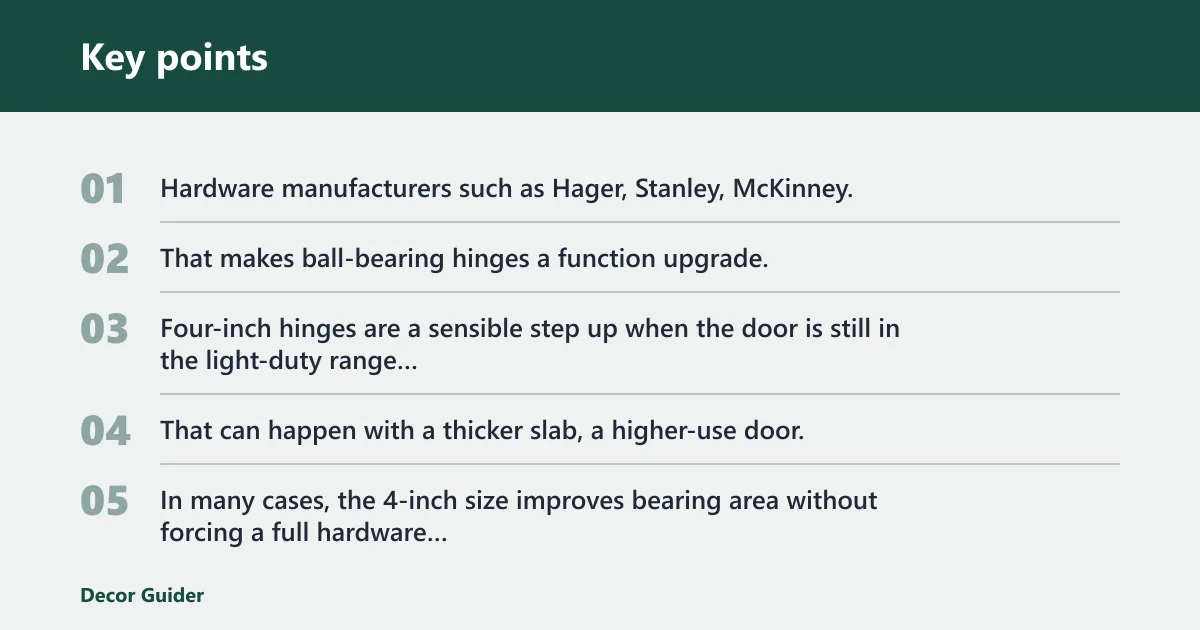
Hardware manufacturers such as Hager, Stanley, McKinney, and Bommer publish heavy-duty butt hinge lines and ball-bearing options for doors that need smoother movement and better wear resistance. That makes ball-bearing hinges a function upgrade, while size still follows the door’s load, height, and thickness.
When 4 inches is enough
Four-inch hinges are a sensible step up when the door is still in the light-duty range but needs more support than a standard 3.5-inch hinge can provide. That can happen with a thicker slab, a higher-use door, or a door that has begun to sag from age rather than from extreme weight. In many cases, the 4-inch size improves bearing area without forcing a full hardware redesign.
When 4.5 inches or larger makes sense
Use 4.5-inch to 5-inch hinges when the door is clearly heavier, wider, or both, and when three standard hinges no longer control the drop at the latch side. For heavier doors, the larger hinge body, stronger knuckles, and ball-bearing design can improve durability and reduce friction. For very heavy or special-use doors, continuous or spring hinges may be specified for function, not just size.
A common first-timer mistake is choosing 4.5-inch hinges for a typical 80-inch hollow-core slab just because larger sounds stronger. That can create fit problems without adding useful support. For a normal interior door, the better move is still to start at 3.5 inches and upgrade only when the door’s weight, thickness, or wear justifies it.
Can you replace 3.5-inch hinges with 4-inch hinges?
Yes, but only if the mortise, corner style, and screw pattern allow it. A 4-inch hinge can work as an upgrade on some interior doors, especially when the old 3.5-inch hinge has left the door under-supported. If the new leaf is larger than the existing cutout, though, you may need to recut the mortise, fill old holes, or both.
What to verify before drilling new holes
Check whether the new hinge leaf fully covers the old mortise. If it does not, the exposed edge can leave a gap or force the door out of alignment. Also confirm the hinge pin style, because a removable pin and a fixed pin affect both installation and future maintenance. Manufacturer sheets from major hinge brands routinely show that leaf dimensions, screw patterns, and mortise prep have to match for a clean swap.
Hardware references also show that thickness matters before you drill anything. For example, concealed hinge systems and specialty interior hinges are often specified by door thickness, such as 1-3/8-inch versus 1-3/4-inch slabs, because the leaf geometry has to fit the door body as well as the frame cutout.
Interior door thickness and hinge count
Standard interior doors in hardware catalogs are often listed at about 1-3/8 inches or 1-3/4 inches thick. That thickness helps determine which hinge will sit flush and whether the screws have enough bite. A thicker slab usually carries more weight, which can push you toward larger or heavier-duty hinges, but thickness alone does not automatically change the hinge family.
1-3/8-inch doors
These lighter interior doors usually pair well with 3.5-inch butt hinges, especially on standard 80-inch slabs. If the door is hollow-core and in good shape, three hinges are usually enough. If it is damaged, warped, or used heavily, a stronger hinge may be a better fix than simply adding one more of the same type.
1-3/4-inch doors
These thicker doors often weigh more and may justify 4-inch hinges or ball-bearing hardware, especially if the door sees frequent use. The thickness does not automatically require a larger hinge, but it raises the odds that 3.5-inch hardware will feel underbuilt over time. That is where manufacturer technical sheets and BHMA-style duty selection become useful.
When thickness changes the hinge choice
Thickness matters most when it changes how much load the hinge must carry and how deeply the leaf can recess into the mortise. If a thicker door also has a wider slab, more traffic, or fix a sagging interior door., move up a size before the hardware starts pulling loose from the frame.
Frequently asked questions
How do I measure a door hinge size?
Measure the leaf height first, then check leaf width, corner style, screw pattern, and mortise size. The hinge size usually refers to the open size, meaning height by width, so a 3.5-inch hinge may still differ in corner radius or hole placement. Those details matter when you are reusing the existing cutout.
Are 3.5-inch hinges standard for interior doors?
Yes. A 3.5-inch butt hinge is a common residential door size and the normal starting point for many interior slabs. That is the right baseline for standard interior doors unless the door is unusually heavy, worn, or built with thicker material that needs more support. Manufacturer catalogs and millwork references regularly use that size for typical 1-3/8-inch doors.
How many hinges does an interior door need?
Most standard 80-inch interior doors use three hinges. For typical residential interior doors, that is the usual setup unless the door is unusually tall, heavy, or subject to extra stress. Taller doors may need four hinges, while shorter doors can sometimes use two if the hardware and door weight allow it.
Do hollow core doors need smaller hinges?
Not automatically. Hollow-core doors are often lighter, so 3.5-inch hinges are usually enough, but the door’s condition still matters. If the slab is damaged, used heavily, or out of square, a small hinge change may not fix the problem. Fit and wear matter more than the core type alone.
Which hinge types change size choice versus function only?
Butt hinges and concealed hinges affect both size and fit, because leaf dimensions and door prep can change. Continuous/piano hinges mainly affect load distribution and the amount of edge support, while spring hinges change closing action and often follow a separate hardware spec. Ball-bearing hinges usually improve durability and smoothness without changing nominal size by themselves.
When should I choose a spring hinge?
Use a spring hinge when the door needs self-closing action, not just support. That is a function choice first and a size choice second. Spring hinges are common on utility spaces, some code-driven openings, and doors where closing force matters more than a standard free-swing setup.
When does a continuous or piano hinge make sense?
A continuous or piano hinge makes sense when you want load spread along most of the door edge. It is less about a larger nominal size and more about distributing weight and reducing point stress. That can be useful on specialty interior doors, heavy-use openings, or doors that need extra edge support.
Products related to this article
Sponsored / affiliate links. As an Amazon Associate I earn from qualifying purchases. I may earn additional commission from eligible campaigns.
 QWORK Butt Hinges Stainless Steel Ball Bearing Hinges, 40Pcs 1.73"/44 mm Thickened Inner Door Hinges with Screws for Home Door, Window, Storage Box Repair
 Doodlream 12PCS 4 x 4 Inch Ball Bearing Door Hinges, 304 Stainless Steel Brushed Satin Silver Hinges with Square Corners, Smooth Quiet Interior/Exterior Heavy Duty Door Hardware with Non-Removable Pin