How to Open a Locked Interior Door with a Credit Card
Use a credit card only on a spring-latch interior knob with a slanted latch edge, not a deadbolt. If the latch is beveled and the door has no deadbolt, the card trick may work. Trying the method on a deadbolt, a tight frame, or a door with heavy weatherstripping can waste time, bend the card, or scratch the trim. This guide shows how to confirm the lock type first, then use the card method only when that setup is present, plus the faster fallback options if it is not.
What you’ll need
- A flexible plastic card, such as a credit card, debit card, rewards card, or gift card
- A straightened paperclip
- A small flathead screwdriver
- A flashlight
📊 The card is tilted about 45 degrees toward the doorknob. Source: Wikihow.
Before you try the card
Check the lock type first. The card method only works on a simple spring latch or slanted-latch interior knob or lever, and it will not open a deadbolt. Look at the gap at the latch side, note any weatherstripping, and check which way the door swings before you decide whether the card is worth trying.
Match the lock to the method
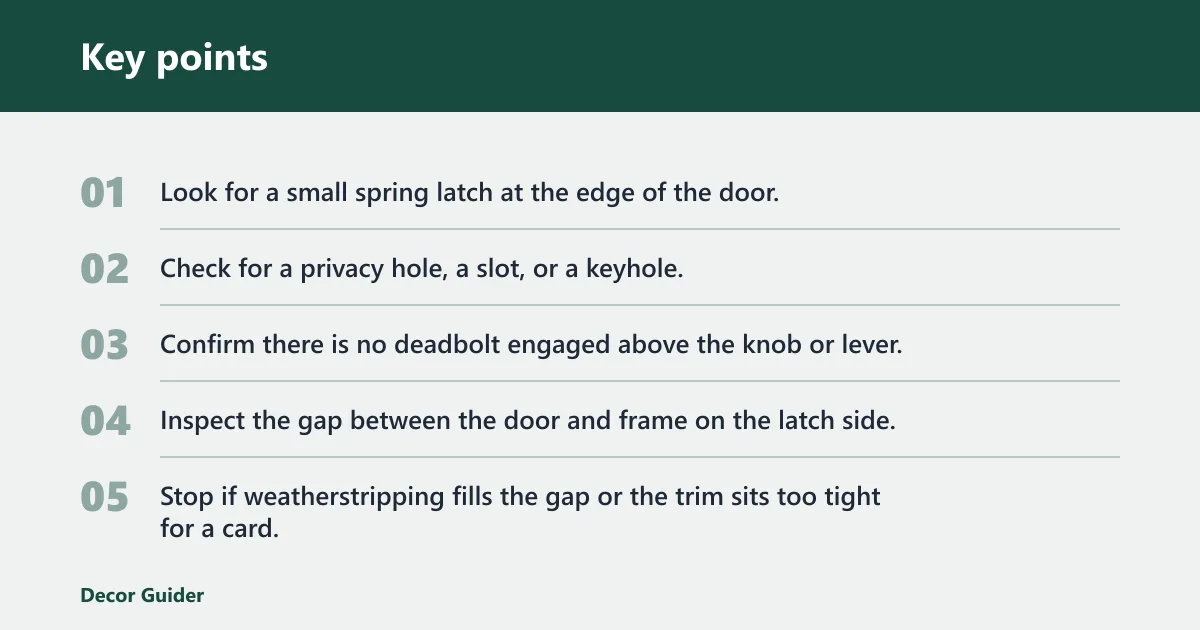
- Look for a small spring latch at the edge of the door.
- Check for a privacy hole, a slot, or a keyhole.
- Confirm there is no deadbolt engaged above the knob or lever.
- Inspect the gap between the door and frame on the latch side.
- Stop if weatherstripping fills the gap or the trim sits too tight for a card.
Say your bathroom door has a standard knob, a visible beveled latch, and a gap wide enough for a thin card. That is the setup where the card trick can be worth a try. If the same door also has a deadbolt, the card is the wrong tool and the effort will go nowhere.
Will a credit card work on a bedroom door lock?
A credit card can work on a bedroom door lock only when the lock is a simple spring latch and the door gap leaves room for the card to reach the angled bolt. It will fail on deadbolts, many tight frames, and doors with weatherstripping that blocks access to the latch.
When the card trick has a chance
The latch needs a beveled edge that the card can push back while the door is pressed toward the frame. A flexible, laminated card works best, and you should expect some wear. The card may scratch, crease, or break if the trim is tight or the latch sits deep.
When it usually fails
It will not work if the door is deadbolted, if the frame is too tight, or if the latch does not have an angled edge to ride over. A card also struggles when the door swings inward and the gap closes as you press on it.
Interior door lock decision table
Use the visible clues below to match the lock type to the right entry method. If the card is the wrong fit, move straight to the backup tool listed here rather than forcing it.
| Visible clues | Can a credit card work? | Best backup tool | Common failure reason | When to stop and call a locksmith |
|---|---|---|---|---|
| Standard interior knob or lever, slanted latch edge, no deadbolt | Yes, sometimes | Flexible plastic card | Gap too tight, latch not beveled, or weatherstripping blocks the blade | Stop if the card bends hard, the trim marks, or the latch will not move |
| Small round release hole in the knob or lever | No | Straightened paperclip or small flathead screwdriver | Card cannot reach the release mechanism | Stop if the hole will not depress or the parts feel jammed |
| Slot or turn-type privacy release | No | Small flathead screwdriver | The card does not rotate or depress the release | Stop if the slot resists or the mechanism feels stripped |
| Keyhole on the interior knob | No | The key | The lock needs keyed entry | Stop if you do not have the key or the cylinder feels damaged |
| Deadbolt above the knob or lever | No | Key or locksmith | A card cannot retract a deadbolt | Stop at once if the deadbolt is engaged and you need non-destructive entry |
Start at the latch side, slide the card into the gap at a ninety-degree angle, then tilt it about 45 degrees toward the doorknob. Push the door while you work the card, because the latch often needs pressure off the strike plate before it will retract.
Step-by-step
- Hold the card flat to the door and insert it at the latch side gap.
- Angle the card toward the doorknob so it rides toward the beveled latch.
- Slide and flex the card while pressing the door toward the frame.
- Increase pressure on the door as the latch starts to move free.
- Pull the door open once the latch clears the strike plate.
Suppose the door is a painted hollow-core bedroom door with about a 2 mm gap and no weatherstripping. The card may get past the latch with light flexing. If the same door has thick foam weatherstripping, the card will likely stall before it reaches the bolt.
What if the door has a privacy lock?
A privacy lock is a different problem. Many have a small round hole in the center of the knob or lever, and others use a slot that turns about a quarter turn. A credit card will not open a pushed-in privacy lock, so switch to a paperclip or small flathead screwdriver.
Use a release hole
- Straighten a paperclip.
- Push it into the small hole until the release clicks.
- Turn the knob or lever as soon as the mechanism releases.
Use a slot or turn release
- Insert a small flathead screwdriver into the slot.
- Rotate it about a quarter turn or depress the release, depending on the knob.
- Open the door as the latch frees up.
If the mechanism feels stuck, stop right there. Forcing a privacy lock can strip the release or crack the trim around a cheap interior knob.
What if the door has a keyed lock?
A keyed interior lock needs the key. A paperclip for simple bypass attempts, but that is not a reliable fix for a keyed knob. If the key is lost, get the spare key, call building management, or contact a locksmith.
If that didn’t work, try this next
- Check whether another household key fits the interior knob.
- Look for a spare key with building management or a trusted holder.
- Call a locksmith for non-destructive entry if the key is unavailable.
A keyed lock does not behave like a spring latch. If the cylinder is damaged or the key is missing, a locksmith can open it without turning a small lockout into a broken knob.
Common mistakes
The biggest mistake is using the card on the wrong lock. Deadbolts cannot be opened with a credit card, and privacy locks usually need a paperclip or screwdriver instead. Another common problem is forcing the card through a narrow gap and scratching painted trim or snapping the card. (Wikihow)
- Using a card on a deadbolt: stop and use the key or locksmith help.
- Forcing a tight gap: if weatherstripping blocks the edge, the card method is unlikely to work.
- Ignoring door swing: pressure and card angle change with the swing direction.
- Using a rigid card: a stiff card is more likely to crease or jam.
- Missing the stop point: if the latch does not move after a few tries, move to the backup tool or call a locksmith.
Lockout services can cost $30 to $60, which is useful to weigh against a damaged card, marred trim, or a lock that gets worse from repeated forcing. A locksmith is also the right call when you need non-destructive entry or a replacement lock after the door is opened.
Keep a spare key for keyed interior locks in a known spot, and replace weak privacy hardware before it binds. If a bedroom or bathroom knob sticks often, that usually means the latch or strike plate needs adjustment rather than more force.
Frequently asked questions
How do I open a locked interior door with a credit card?
Use the card only on a spring-latch interior knob with a beveled latch edge. Slide the card at the latch side, tilt it toward the knob, and press the door while flexing the card. If the latch does not move after a few tries, switch methods.
Can you open a deadbolt with a credit card?
No. A deadbolt does not retract with a card, even if the door gap looks generous. Use the key, a spare key, or a locksmith. Forcing the card on a deadbolt usually bends the card and can mar the trim around the lock.
What kind of card works best for a spring latch?
A flexible, laminated card works best. Credit cards, debit cards, rewards cards, or gift cards can work, but they may scratch, crease, or break. A stiff card is harder to bend around the latch, and a butter knife is a poor substitute compared with a plastic shim.
What if the interior door has a privacy lock with a hole?
A straightened paperclip is commonly used in the small release hole, or a small flathead screwdriver if the knob has a slot. A turn-type privacy lock usually rotates about a quarter turn. The card trick will not open a privacy lock that has been pushed in.
How do I open a keyed interior door if the key is lost?
Use the spare key if one exists, then contact the landlord, building manager, or a locksmith. A keyed interior lock needs the key, and a credit card is not the right tool. If the cylinder feels damaged, stop before the knob gets worse.
What should I do if a child is locked inside the room?
If a child is inside and cannot open the door, call emergency services or a locksmith right away if there is any sign of distress, breathing trouble, or heat exposure. Do not keep forcing a deadbolt, keyed lock, or jammed privacy mechanism while the child remains inside.
Products related to this article
Sponsored / affiliate links. As an Amazon Associate I earn from qualifying purchases. I may earn additional commission from eligible campaigns.