How to Trim the Bottom of a Hollow Core Door
Trim a hollow-core door by about 1/4 to 1/2 inch from the bottom. If you need more than about 1/2 inch, rebuild the bottom rail or replace the slab. Cut too much and the hollow core, edge banding, or veneer can fail. This guide shows how to judge the trim limit, then cut, seal, or choose a better fix.
Before you cut



Check door construction
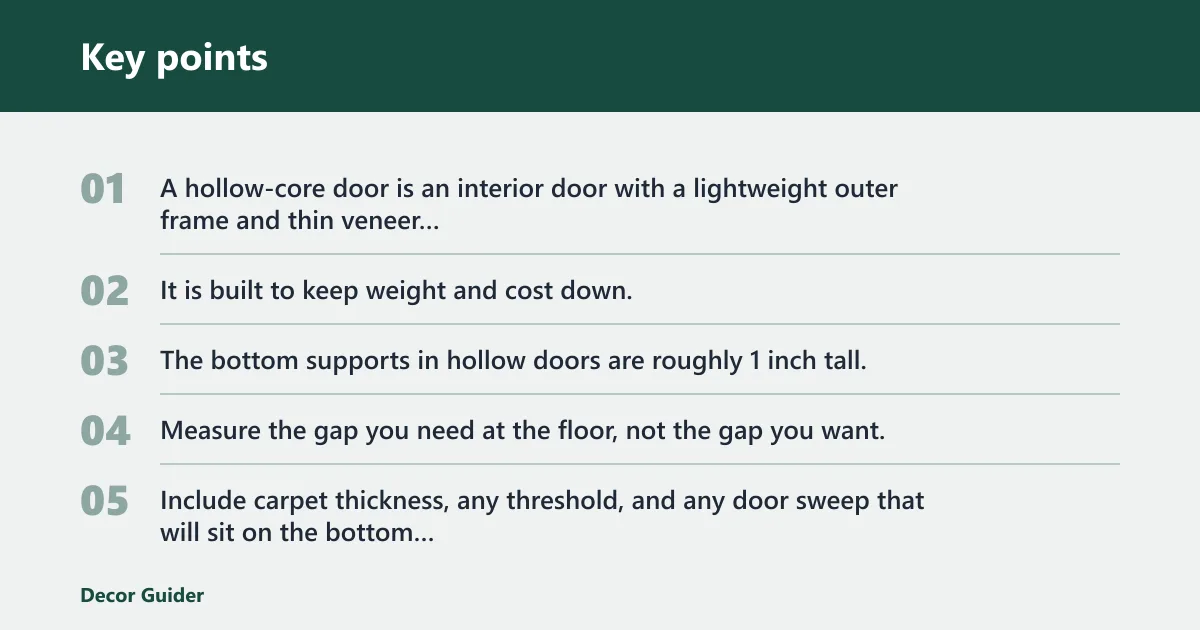
A hollow-core door is an interior door with a lightweight outer frame and thin veneer face. It is built to keep weight and cost down, but that light build also gives the bottom edge less margin than a solid wood door. The bottom supports in hollow doors are roughly 1 inch tall, so the rail matters more than the saw line.
Measure the actual clearance
Measure the gap you need at the floor, not the gap you want. Include carpet thickness, any threshold, and any door sweep that will sit on the bottom edge. Building America guidance says you may not want to undercut hollow doors, so the safest trim choice starts with the smallest cut that still clears the finished floor.
Remove the door and support it
Take the door off the hinges before cutting, then set it on sawhorses or clamp it so the panel stays flat and the cut stays controlled. A supported door is less likely to wander, chip at the veneer, or close up on the blade.
What you’ll need
- Table saw or circular saw with a fine-tooth blade
- Straightedge or saw fence for a square cut line
- Speed square for marking the cut
- Clamps and sawhorses
- Eye protection
- Dust mask
- Hearing protection
- Wood filler or a replacement bottom rail for repair
- Sandpaper and a sealer or finish for the cut edge
- Optional: jigsaw with a fine-cut blade for cleanup, not the main cut
How much can you trim off a hollow core door?
For many hollow-core interior doors, a practical limit is about 1/4 to 1/2 inch from the bottom. That range usually preserves the bottom support and avoids opening the hollow interior. If the cut would expose the core or reduce the bottom rail too far, stop and switch to rebuilding or replacement.
Bare floor clearance
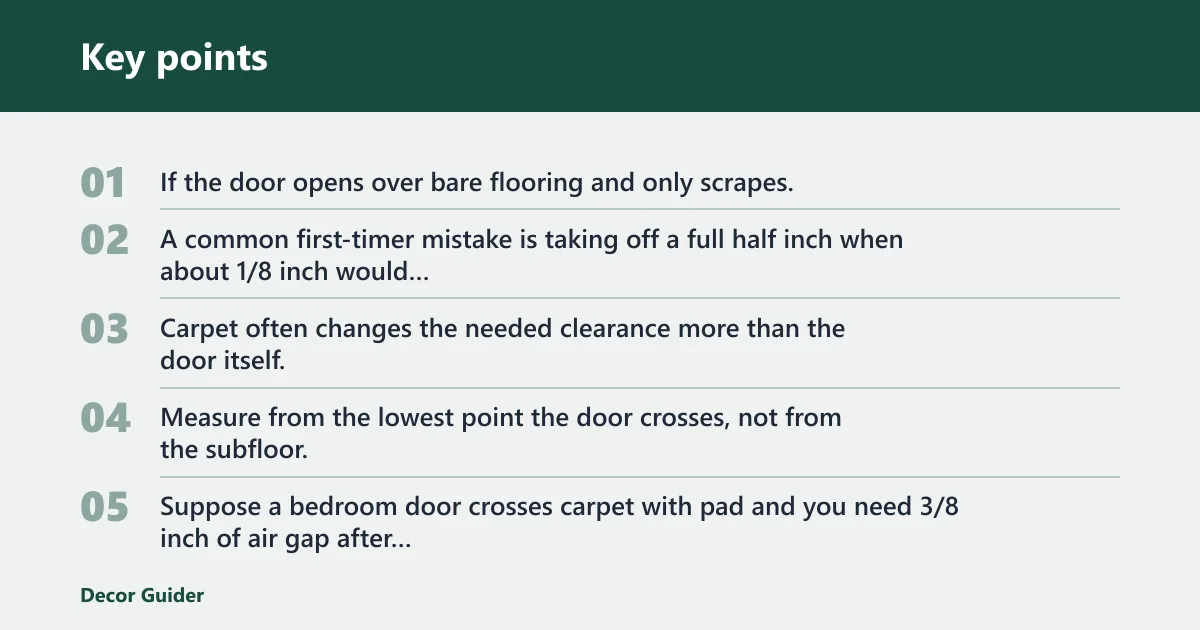
If the door opens over bare flooring and only scrapes, start with the smallest trim that solves the rub. A common first-timer mistake is taking off a full half inch when about 1/8 inch would have cleared the floor after rehanging. Recheck the swing after each adjustment.
Carpet and flooring thickness
Carpet often changes the needed clearance more than the door itself. Measure from the lowest point the door crosses, not from the subfloor. Suppose a bedroom door crosses carpet with pad and you need 3/8 inch of air gap after rehanging; that may still fit within the safe trim range, while a much deeper cut may not.
Undercut for a sweep
If you need space for a sweep, account for the sweep body as well as the floor. Do not trim for the sweep alone and then discover the sweep still drags. A clean fit usually means the cut edge plus the installed sweep still leaves a little clearance above the finished floor.
When the bottom rail would be exposed
If the planned cut would break into the bottom support, you are out of the easy trim range. The bottom supports in hollow doors are roughly 1 inch tall, so once the cut reaches that structural area, the door can lose edge integrity and the hollow interior may show. That is the point to rebuild or replace.
Bottom hollow core door table
| Existing clearance needed | Maximum safe trim range | Recommended fix |
|---|---|---|
| Bare floor, light rub | About 1/4 inch | Trim the bottom edge, then seal and rehung-test |
| Carpet or pad clearance | About 1/4 to 3/8 inch | Trim only what the finished floor actually needs |
| Space for a door sweep | About 1/4 to 1/2 inch | Trim, then install the sweep and check final drag |
| Bottom rail would be exposed | More than 1/2 inch | Rebuild the bottom rail or replace the slab |
How do you cut the bottom edge cleanly?
Use a straight saw setup, not a freehand cut. Mark a square line with a speed square by holding the square against the door edge and drawing across the full width at the trim mark, then cut with a table saw or a circular saw with a fine-tooth blade and a guide fence or straightedge. A jigsaw is better for cleanup than for the main cut on a hollow-core door.
- Mark the cut line across the full width of the door with a speed square.
- Tape the veneer along the cut line if the face is delicate.
- Set the door on stable supports so the waste piece can fall away cleanly.
- Guide the saw with a fence or straightedge and keep the blade perpendicular to the edge.
- Cut from the finished face when possible to reduce visible tear-out.
- Finish the edge by sanding it lightly, then brush on sealer or finish.
If the blade starts to wander, stop and reset the guide before continuing. A shallow, corrected pass is better than an angled edge that leaves the latch side of the door looking out of square. Say your door only needs 3/8 inch removed to clear a hallway rug. A fine-tooth circular saw blade on a straightedge usually gives a cleaner result than trying to steer a jigsaw through the full width.
What if the bottom rail would be exposed?
Stop the cut plan and rebuild the edge. If a deeper cut would reach the hollow area, wood filler alone is not enough for the whole repair. A deeper cut may require adding a new bottom support, because the bottom rail is the structure that keeps the edge from crumbling and the veneer from breaking away.
Rebuild the edge
Use a replacement bottom rail or a properly fitted wood block to restore the missing support. Glue and clamp the repair so the new edge is solid before sanding and finishing. Then re-cut only the amount needed for clearance. This is the better route when the door still has enough panel left to justify repair.
Use filler only for minor damage
Wood filler works for small chips, nail holes, and light veneer damage after a normal trim. It is not a substitute for a missing structural edge. Use it to smooth the cut face, then seal the end grain so moisture and impact do not start a new failure.
Replace the slab when the cut is too deep
Replace the door if the required cut removes too much of the bottom support or leaves the opening weak. That is especially true if the door is already warped, damaged, or being asked to clear a floor condition that changed the opening far beyond a normal trim. A hollow-core slab that needs major surgery is often the wrong door for the opening.
Common mistakes
- Measuring to the subfloor instead of the finished floor. Fix: measure with carpet, threshold, and sweep in place.
- Using a rough blade. Fix: choose a fine-tooth blade for a cleaner cut.
- Skipping the straightedge. Fix: keep the cut guided so it stays square.
- Cutting into the bottom support. Fix: stop at the trim limit and rebuild the edge if needed.
- Leaving the cut edge open. Fix: seal, fill, or rebuild it so the veneer and core do not absorb damage.
- Trying to take off too much at once. Fix: remove the least amount that clears the floor, then rehang and recheck.
A common first-timer mistake is trimming for a new rug, then finding the door still drags once the sweep is installed. Another is cutting for carpet without accounting for pad compression, which can turn a close fit into a scrape after a few days of use.
For repeat adjustments, keep the new clearance modest and note the finished-floor height before you reinstall the door. That makes the next adjustment easier if the flooring changes later.
Frequently asked questions
How to cut the bottom of a hollow core door
Remove the door, mark a square cut line, and cut with a table saw or a circular saw fitted with a fine-tooth blade. Keep the door supported on sawhorses or clamps, then seal the cut edge when you are done. If the cut reaches the bottom rail, switch to repair instead of taking more off.
How to cut the bottom of a hollow interior door
Treat it like a lightweight interior panel, not a solid slab. The safest approach is a guided straight cut with a fine-tooth blade, then edge sealing after the cut. Always measure the real floor clearance first, including carpet or a sweep, so you do not remove more than the door can spare.
How much can you trim the bottom of a hollow core door?
A practical trim range is about 1/4 to 1/2 inch. That usually preserves the bottom support and keeps the hollow interior covered. If the job needs more than 1/2 inch, the better fix is rebuilding the bottom rail or replacing the slab.
Can I trim the bottom of a hollow core door?
Yes, if the cut stays within the trim limit and does not expose the hollow core. Measure the actual clearance, then remove only the amount needed for the finished floor and any sweep. If the bottom rail is already thin, use a repair approach instead of a deeper cut.
Can you trim a hollow core door?
Yes, but the door construction controls how far you can go. A hollow-core slab has a lightweight outer frame, thin veneer face, and a bottom support that limits deep cuts. For that reason, a straight, small trim is common; a major trim is a sign to rebuild or replace.
How much can you trim off the top and bottom of a hollow core door?
That depends on the door’s frame layout and where the supports sit, but the bottom is usually the critical limit. For an interior door, keep the total removal conservative and avoid cutting into the bottom support. If both top and bottom need work, check the combined amount before you cut either edge.
Products related to this article
Sponsored / affiliate links. As an Amazon Associate I earn from qualifying purchases. I may earn additional commission from eligible campaigns.