How to Add a Soft-Close to a Barn Door
Yes, you can add a soft-close to many barn doors, but only if the track has room for the damper and the door weight matches the kit. Check the maker’s weight limit and clearance before you drill. A mismatched kit can cause slamming, binding, or damage to the track, wall, or door edge. This guide shows how to tell whether your setup can accept a retrofit, then choose and install the right soft-close hardware. For related planning details, see barn door sizing, barn door rough opening measurement, header board installation, pocket door vs barn door, and barn door hardware weight ratings.
Can you add soft close to a barn door?



A soft-close mechanism can work on rolling barn door hardware when the track, hangers, and door weight all fall within the kit’s limits. It slows opening and closing automatically, stays hidden from view, and some packages may include two mechanisms for a two-way or two-door setup. If the door is out of spec, a softer stop or full hardware replacement may be the better move.
Retrofit vs. new-install kits
Retrofitting means adding soft-close parts to an installed door and existing track. A new-install kit bundles the rolling hardware, rollers, stoppers, anti-jump discs, and finish options around the soft-close unit from the start. Retrofit kits need more fit checks because the track is already fixed in place and may not have enough travel or clearance for the damper body. Exact compatibility varies by track brand and kit design.
When a barn door is not a fit
Skip soft-close if the door is too heavy for the kit, too light for smooth engagement, or so close to the wall that the damper or hanger rubs trim. A wall with weak framing, missing studs, or no room for a header board can also make the setup poor for a retrofit. In those cases, simple stops or a different door system may be safer.
What you’ll need
- A soft-close kit matched to the track brand or rolling hardware kit
- Door weight and size information from the manufacturer label or product sheet
- Stud finder, tape measure, pencil, level, drill, and driver bits
- Lag screws or fasteners specified by the track maker
- Clear safety glasses and snug work gloves
- Helper for lifting and holding the door
- Anti-jump discs and stoppers, if not already included
- Shims or blocking for header board work
How do you check fit before buying?
Check the door weight, clearance, and travel before you order anything. The door must stay within the hardware rating, the track needs room for the mechanism, and the wall needs enough space for the door to slide without rubbing. A soft-close kit cannot fix a mismatch in size, support, or hanger position. For a step-by-step measurement flow, see barn door rough opening measurement.
Measure door weight and compare it to the hardware rating
The door’s weight should stay below the kit rating. For example, some manufacturer spec sheets list one soft-close mechanism at up to 176 lbs, while some full hardware kits are rated for doors up to 220 lbs. Those figures are example manufacturer limits, not universal rules. If the door is near the limit, the added drag from the damper can make closing uneven or incomplete.
Check top clearance, wall clearance, and door overlap
For example, some manufacturer instructions call for a minimum of 6-1/2 inches above the door for the soft-close body and hanger clearance. Also confirm that the door can lift about 1/2 inch off the floor to roll and still clear the rail, hangers, and mechanism. A common example recommendation is 2 inches of overlap on each side so the door still covers the opening after stops are set, but the exact overlap varies by track brand and opening size.
Confirm track type, stops, and anti-jump discs
A soft-close option is commonly available for rolling hardware kits, but not every track brand or layout accepts the same parts. Make sure the kit includes or allows anti-jump discs, because many manufacturers require them for safe operation. Stoppers define the open and closed positions, and the soft-close needs those positions to be set correctly; exact stop placement varies by kit design.
Barn door compatibility checklist table
| Track type | Door weight range | Open/close travel | Top clearance | Wall clearance | Soft-close recommended? | Common failure modes |
|---|---|---|---|---|---|---|
| Rolling barn door track with compatible hanger profile | Go if under the specific kit limit; example manufacturer caps include 176 lbs per mechanism or 220 lbs per hardware kit | Go if the door reaches both stops without binding and with room for catch engagement | Go if the maker’s spec provides at least 6-1/2 inches above the door | Go if the door thickness and trim clear the wall through the full travel | Yes, if the track maker lists soft-close support | Bounce-back, incomplete closing, hanger noise, catch miss |
| Rolling track already mounted with tight headroom | No-go if the door is near the upper kit rating or above it | No-go if the stop points are too close together for the damper stroke | No-go if clearance is less than the manufacturer minimum | No-go if trim or casing touches the leading edge at any point | No, unless the kit maker approves the layout | Rubbing, rail contact, damaged finish, early stop failure |
| Double-door setup with two leaves on one rail or split rails | Go only if each door stays within its rated share of the system | Go only if both doors have independent stop and damper space | Go only if the header area has room for both hangers and both dampers | Go only if the closed position still leaves the needed center seam overlap | Yes, but only with a kit meant for double-door layouts | One door closes early, center seam mismatch, asymmetric pull |
How do you install the soft-close kit?
Install the kit only after the fit checks pass. The safest sequence is to remove the door, confirm support, mount or verify the track components, and then test the stop positions before final hanging. Hanging a door is a two-person job, and safety gear is required.
Install the support and track components
Start by confirming that the wall and header can carry the load. If the wall framing is not enough, a header board transfers the track load into studs and gives the kit a stable mounting surface. Keep the flow strict: support first, track second, hardware third, and damper last.
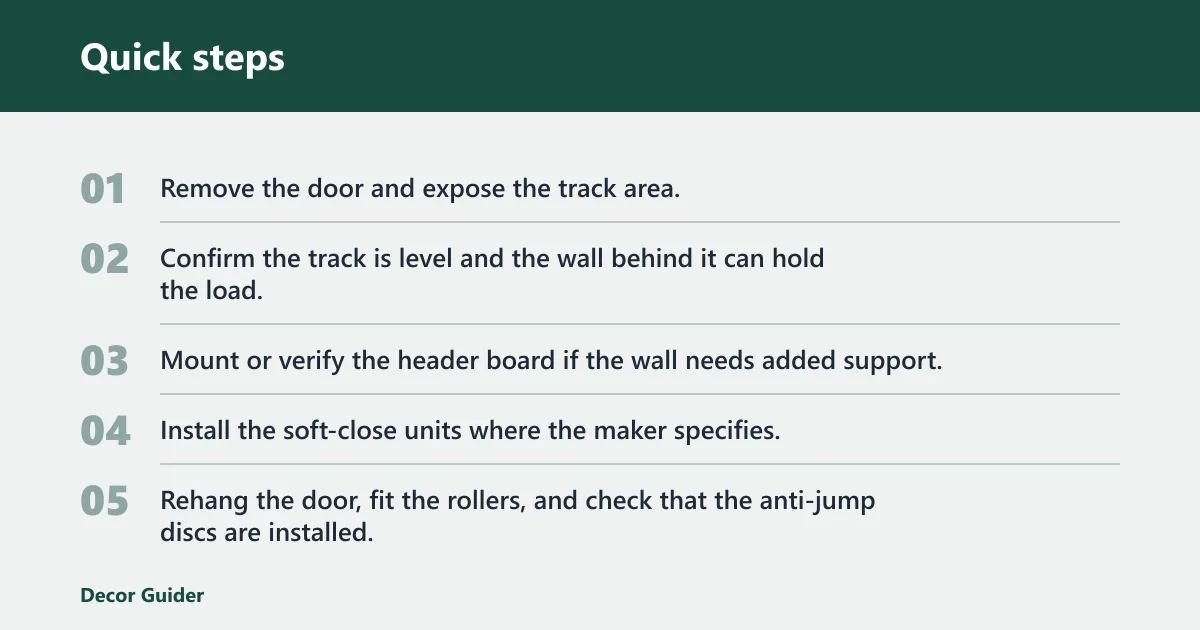
- Remove the door and expose the track area.
- Confirm the track is level and the wall behind it can hold the load.
- Mount or verify the header board if the wall needs added support; it fastens directly into studs.
- Install the soft-close units where the maker specifies, then set the open and closed stops.
- Rehang the door, fit the rollers, and check that the anti-jump discs are installed.
- Test the door through a full open-and-close cycle before tightening every fastener.
- Adjust the stop position in about 1/8-inch increments, then recheck the latch point and final pull.
Set the catch activation point
The catch needs to engage before the door reaches the hard stop, but not so early that it steals usable travel. Set the activation point where the damper begins to pull the door in smoothly during the last inches of travel. If the catch fires too soon, the door may stall; if it fires too late, the door can still slam.
Calibrate the stop positions
Set the open and closed stops after the damper is mounted, then fine-tune them in small increments. Exact travel varies by track brand and kit design, so the stop position should be adjusted until the door closes fully without overtravel and opens without contacting the jamb or wall.
Post-install test criteria
After installation, the door should roll smoothly by hand, slow in the final travel, land fully at the closed stop, and reopen without sticking. The anti-jump discs should remain engaged, the hangers should stay aligned, and the door should not bounce back or rub the wall at either end.
Header board and structural support
A header board helps transfer the track load into studs when wall support is not enough. It matters more with heavier door systems and with finished walls that need added structural support before installing track. For example, some manufacturer mounting guides list header boards rated to support up to 400 lbs when fastened correctly into framing, but that is a kit- and fastening-specific spec, not a universal wall limit.
Anti-jump discs and stoppers
Anti-jump discs are required for safe operation because they keep the door engaged with the track. Stoppers, or door stops, define where the door opens and closes, and they often come in the same hardware kit as the rollers and other parts. Soft-close hardware works with those stops; it does not replace them.
Common mistakes
Most retrofit failures come from fit errors, not from the soft-close part itself. A door that is too heavy, too light, or off-center can create bounce-back or incomplete closure. A tight wall gap can make the door rub after the damper slows the final inches. When the same problem shows up in multiple ways, the likely cause is usually a miss in weight, travel, or stop placement.
If a 200 lb door is paired with a kit rated for about 176 lbs per mechanism, it may feel harsh or stop short. The door may move, but the last part of the close can feel harsh or stop short because the mechanism is loaded beyond its intended range.
If the track is installed with only about 5 inches above the door, the soft-close body may not have enough room to sit hidden and travel correctly. Even if the rollers fit, the soft-close body may not have enough room to sit hidden and travel correctly, so the door can bind at the end of the run.
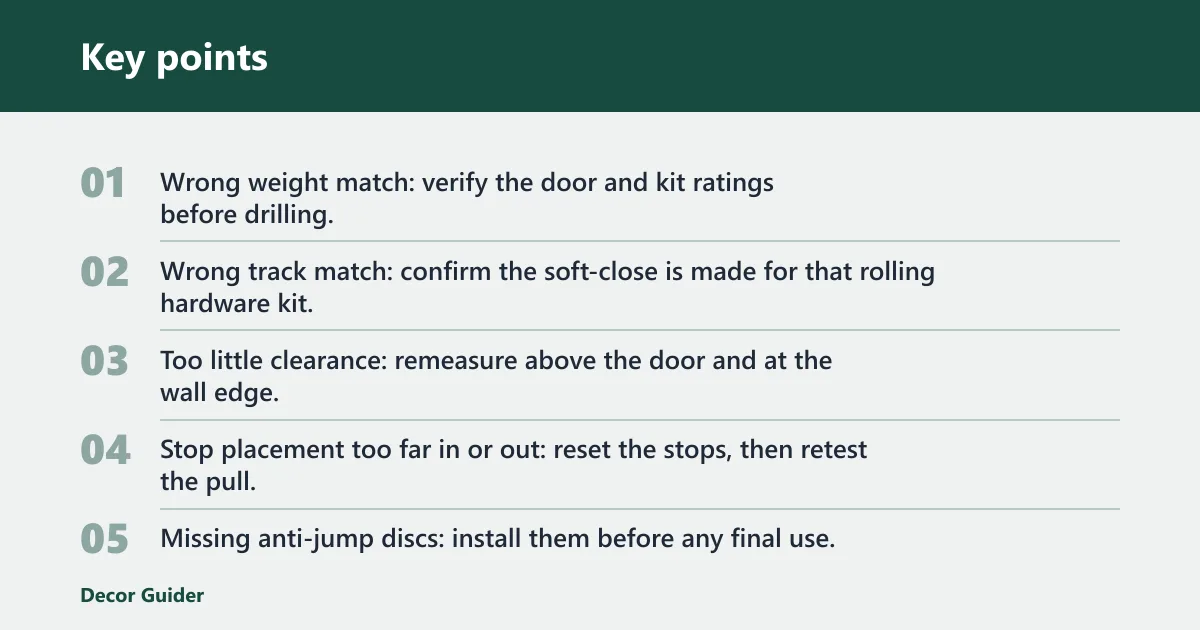
- Wrong weight match: verify the door and kit ratings before drilling.
- Wrong track match: confirm the soft-close is made for that rolling hardware kit.
- Too little clearance: remeasure above the door and at the wall edge.
- Stop placement too far in or out: reset the stops, then retest the pull.
- Missing anti-jump discs: install them before any final use.
If that did not work, inspect the hanger height, rail level, and door overlap. A door that rides high or low can miss the soft-close catch point, and a rail that is out of level can make one side close faster than the other. If the wall is weak or the door remains misaligned, move to a full hardware replacement rather than forcing the retrofit.
Should you use another hardware fix instead?
Use a simpler fix when you only need softer impact, not full controlled closing. Door dampers help with light-duty noise control. Simple bumper stops can reduce impact at the open and closed ends. If the track is undersized, the door is too heavy, or the wall support is weak, replacement hardware is usually the better move.
Cost comparison
Adding soft-close is often cheaper than replacing the whole track, but only when the existing hardware is compatible. A retrofit usually means the cost of the kit plus labor if the door is already mounted. A full replacement adds new rollers, stoppers, anti-jump discs, and mounting parts, but it can solve clearance or rating problems that a retrofit cannot.
Labor is the swing factor. A straightforward retrofit may be less expensive than a new kit with fresh track and header work, but once the wall needs support, the gap narrows fast. If the setup needs structural changes anyway, buying the correct kit the first time is usually the cleaner choice.
Frequently asked questions
How to install a soft close on a barn door
Remove the door, verify the header or stud support, install the damper, set the open and closed stops, then rehang and test. Use the maker’s hole locations and confirm that anti-jump discs are installed before the final check.
Can I use any door for a barn door?
No. The door needs the right weight, thickness, edge clearance, and hardware match for the track. A solid-core door may work, but the final answer depends on the door’s mass, the hanger profile, and whether the wall can support the load.
What can I use instead of a barn door?
Use a pocket door, hinged door, or bypass sliding door when the wall lacks support, the opening needs a tighter seal, or the room cannot spare the wall space for barn-door travel. Those options can solve clearance problems that a retrofit cannot.
How much clearance do I need for barn door soft close?
Plan on a minimum of 6-1/2 inches above the door, plus room for the hangers and damper body. Also leave enough wall clearance for the door thickness and trim so the final slowed movement does not scrape the wall.
Does soft close work on double barn doors?
Yes, but only with a kit meant for double-door layouts and enough room for both leaves to close cleanly. Each door still needs its own weight check, stop position, and travel space. If one side closes early, the center seam will not meet correctly.
Products related to this article
Sponsored / affiliate links. As an Amazon Associate I earn from qualifying purchases. I may earn additional commission from eligible campaigns.