How to Stop Door Slamming Noise
To stop a door from slamming, first correct the cause: seal drafts with weatherstripping or a door sweep, tighten loose hinge hardware, and adjust or replace a closer that shuts too fast. Left alone, it can damage frames, wake people, and wear out hinges and latches. This guide shows how to identify the cause, choose the cheapest fix first, and rank each option by permanence and renter-friendliness.
Why does a door slam shut?


A door usually slams for one of three reasons: airflow pushes it, hinge or frame problems let it swing crooked, or hardware makes it close too fast. The right fix depends on the pattern. A bedroom door that drifts shut points to air movement; a heavy exterior door with a closer points to adjustment.
Cause buckets to check first
- Drafts or air pressure: windows, fans, or HVAC can push a door closed.
- Loose or misaligned hinges: worn screws or a shifted frame can change the swing path.
- Closers and springs: a hydraulic or air-based closer can pull a door shut too quickly.
What you’ll need
- Screwdriver or wrench for hinge screws and closer screws
- Measuring tape and utility knife for weatherstripping
- Self-adhesive felt bumper pads
- Weatherstripping kit for the frame or jamb
- Rubber or wood door stop or wedge
- Optional pinch guard for a no-drill hold-open gap
Door slamming decision table
| Symptom pattern | Most likely cause | Best first fix |
|---|---|---|
| Door drifts shut when a window is open | Air pressure differential or airflow | Close the window, then add a door stop or wedge |
| Door bangs, but latch does not catch cleanly | Loose hinge hardware or frame misalignment | Tighten hinge screws and check alignment |
| Door closes fast from any open position | Too-quick closer or heavy swing | Adjust the closer if present |
| Door hits hard at the frame, then rebounds | Impact against the stop | Add felt pads or weatherstripping at the stop |
| Door slams only in one room with HVAC running | Draft and pressure change | Use weatherstripping and test airflow first |
Which fix should you try first?
Use the least invasive fix that matches the symptom. If the door moves because of air, use a stop or weatherstripping. If it closes too fast, adjust the closer. If it bangs at the latch or stop, check the hardware and add cushioning where the door actually hits.
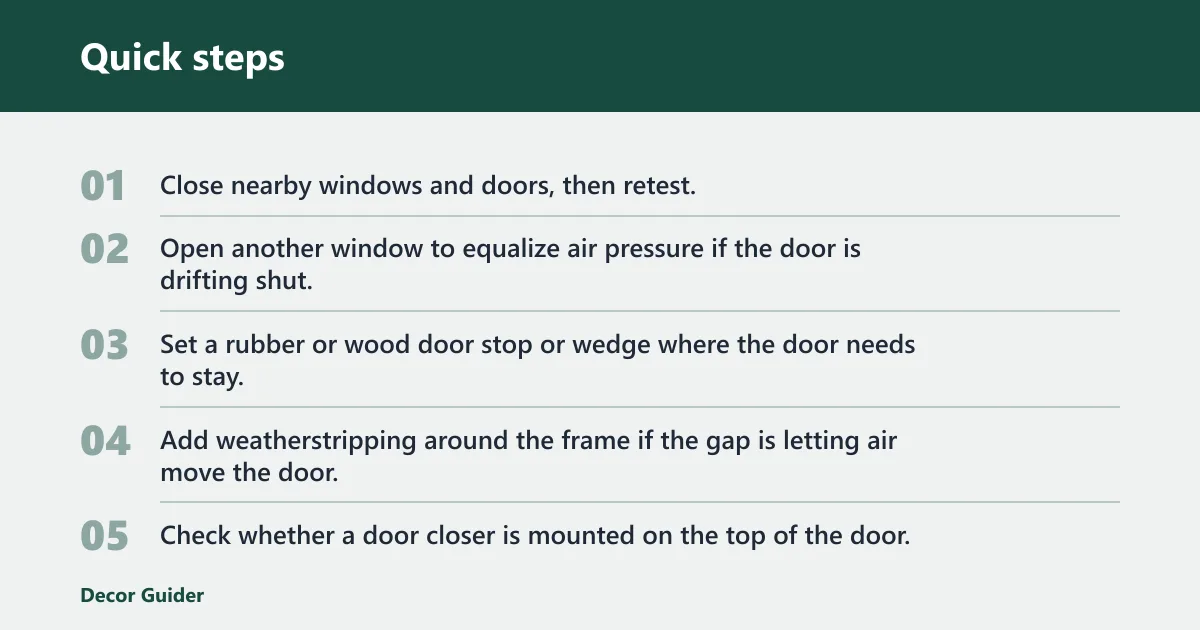
If the door slams from airflow
- Close nearby windows and doors, then retest.
- Open another window to equalize air pressure if the door is drifting shut.
- Set a rubber or wood door stop or wedge where the door needs to stay.
- Add weatherstripping around the frame if the gap is letting air move the door.
Say your hallway door swings shut only when the bathroom fan runs. That points to airflow, not a hinge problem. In that case, a wedge may solve it fast, while frame sealing helps if the same draft keeps returning.
If the door closes because it moves too fast
- Check whether a door closer is mounted on the top of the door.
- Turn the sweep speed screw a quarter turn clockwise, then test the door.
- Adjust the latching speed screw a quarter turn at a time so the last part of the close slows down too.
- Retest until the door takes 2 to 3 seconds in the final 10 degrees.
A common first-timer mistake is turning the screw several turns at once. That often makes the close worse, especially on exterior or commercial doors with hydraulic closer valves that respond to small changes.
If the door bangs at the latch or stop
- Tighten hinge screws with a screwdriver or wrench.
- Replace worn or damaged hinges if the leaf is loose or bent.
- Add self-adhesive felt bumper pads at the top, middle, or bottom of the stop.
- Use a pinch guard if you want a no-drill spacer that prevents full closure.
Felt bumper pads are a low-cost fix, and they are often about 1/8 inch thick. If they are too thick, the latch may not engage. That is the main failure case to watch for after the door stops slamming.
Use the fix that matches the door type, because interior bedroom doors and exterior or commercial doors do not need the same remedy. Interior doors usually respond best to pads, weatherstripping, or a pinch guard. Exterior and commercial doors may need closer adjustment or professional installation if the hardware is heavy.
Interior door fixes
- Felt bumper pads: self-adhesive, low-cost, and easy to place on the jamb.
- Weatherstripping: foam, felt, rubber, or vinyl options mounted around the frame.
- Pinch guard: C-shaped foam that clips over the hinge side or top edge and creates about 1 inch of separation.
Exterior and commercial door fixes
- Door closer: adjustable closing speed, used on the top of the door, and suited to heavier doors.
- Hydraulic door closer valve: adjust the sweep speed screw and latching speed screw in small increments.
- Professional installation: sometimes needed when the door is heavy or the closer body is not sized right.
Remedy comparison
| Remedy | Estimated cost | Difficulty | Tools required | Latch risk | Renter safety |
|---|---|---|---|---|---|
| Felt bumper pads | Low | Very easy | None or scissors | Medium if pads are too thick | High |
| Weatherstripping | Low to moderate | Easy | Measuring tape, utility knife | Low to medium if the seal is too bulky | High |
| Pinch guard | Low to moderate | Very easy | None | High, because it prevents full closure | High |
| Hinge hardware tightening | Very low | Easy | Screwdriver or wrench | Low if the door still closes squarely | High |
| Door closer adjustment or replacement | Moderate to higher | Moderate | Screwdriver; sometimes replacement kit | Low if adjusted correctly | Medium |
When should you use a door closer?

Use a door closer when the door is meant to shut itself and the problem is speed, not draft. It is the right tool for many exterior or commercial doors, and it can also help a heavy interior door. On light bedroom doors, it can be the wrong fix if the real issue is airflow.
Top-of-door installation
- Confirm the closer is mounted at the top of the door.
- Check the adjustment screws for sweep speed and latching speed.
- Turn each screw a quarter turn, then test the close again.
When professional installation makes sense
- Choose pro installation if the door is heavy and the closer fights the swing.
- Choose pro installation if the closer body leaks, binds, or will not hold adjustment.
- Replace the unit if the closer is worn or the door still slams after adjustment.
Door closer installation kits may cost about $33 to $80, and installation can take about 30 minutes. That makes sense for a door that truly needs a closer, but not for a simple interior door that only needs padding or draft control.
Common mistakes
- Using pads that are too thick: the door may stop slamming but refuse to latch.
- Choosing the wrong fix for a draft-driven slam: felt pads will not stop airflow from moving the door.
- Over-tightening or over-adjusting hardware: that can make the door bind, drag, or close unevenly.
- Skipping hinge checks: loose screws and worn hinges can keep the problem going.
- Using a closer on the wrong door: a light interior door may need only cushioning, not a closer.
Suppose a bedroom door slams only when the HVAC kicks on, but a thick pad leaves the latch half-miss. The better next step is thinner cushioning or weatherstripping, not another thicker pad.
Frequently asked questions
How do I stop a door from slamming noise?
Match the fix to the cause: use weatherstripping for draft movement, tighten hinge screws for loose hardware, and adjust a closer if the door shuts too fast. For a quick renter-safe option, start with self-adhesive felt pads or a rubber wedge, then test whether the latch still catches.
What is the cheapest way to stop a door from slamming?
Loose hinge screws are often the lowest-cost fix if the hardware is the issue, since the repair may only require a screwdriver or wrench. If the door is draft-driven, a rubber door stop is also cheap. Felt bumper pads are another low-cost option, but too much thickness can block latching.
Do felt pads stop door slamming?
They can, especially on interior doors where the door only needs a soft landing at the jamb. Place them at the top, middle, or bottom of the stop. If the pads are too thick, the latch may not engage, so test the close after each pad is added.
Should I adjust a door closer to stop slamming?
Yes, if the door has a closer and it is shutting too fast. Turn the sweep speed screw and latching speed screw a quarter turn at a time, then test again. If the door is heavy or the closer leaks, replacement or professional installation may be the better route.
Why does my door slam shut by itself?
Air pressure differential is a common reason, especially when windows are open or fans are running. Loose hinges or a misaligned frame can also change how the door swings. If the close speed is the problem, a closer or spring may be set too aggressively.
How can I stop a door from slamming?
Start with the quickest fix that fits the symptom: close the source of airflow, add a door stop or wedge, tighten hinge hardware, or install felt pads. If the door has a closer, adjust it in small increments. That order usually gives the best mix of cost, speed, and renter safety.
Products related to this article
Sponsored / affiliate links. As an Amazon Associate I earn from qualifying purchases. I may earn additional commission from eligible campaigns.