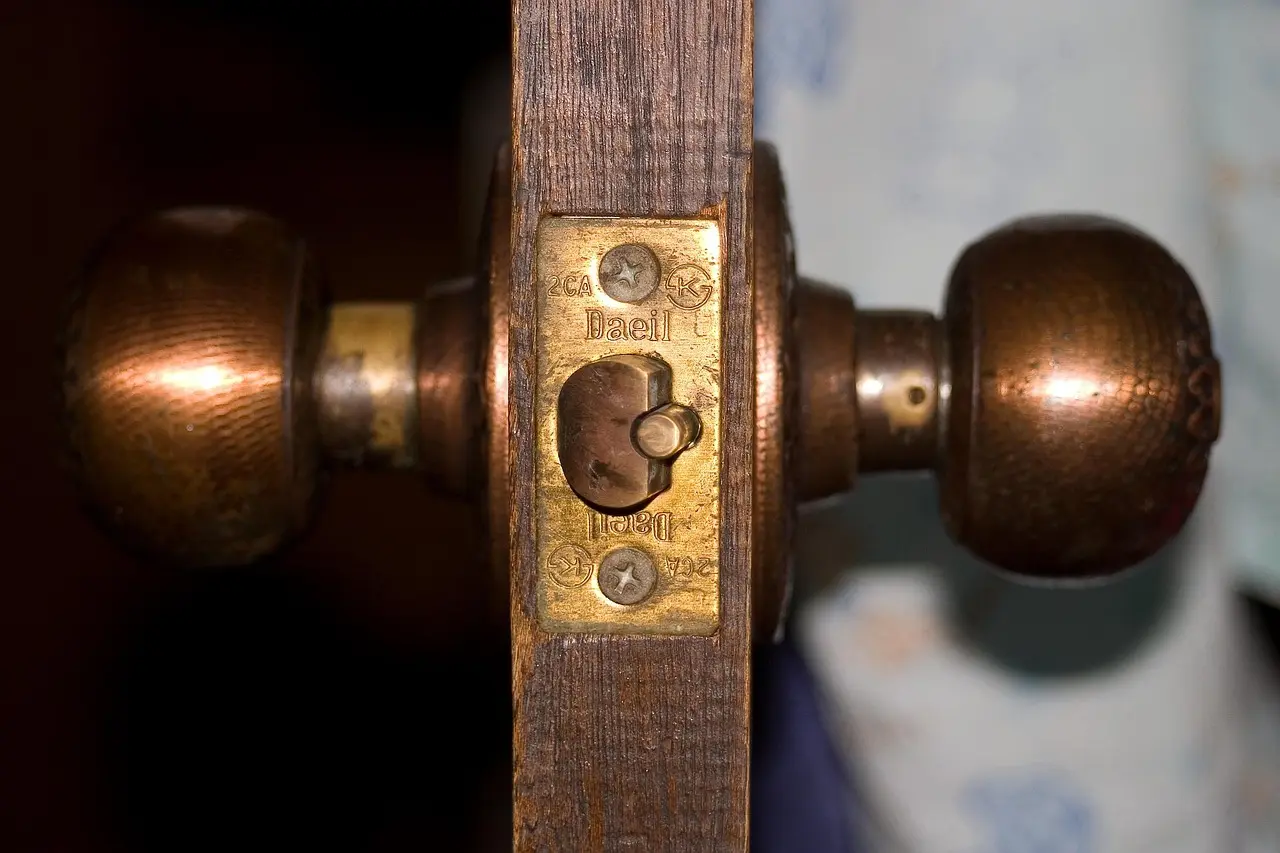
Passage, Privacy, and Dummy Door Knobs: Key Differences?
Passage knobs turn freely and do not lock, privacy knobs are commonly used for bedrooms and bathrooms because they lock from one side, and dummy knobs are fixed pulls for doors that do not need a latch or active turning. Pick the wrong type and the door may not close, may not lock, or may need extra drilling and replacement hardware. This guide shows a door-by-door decision matrix based on how the door closes, whether it needs privacy, and whether the hardware prep already includes a latch or catch.
How passage, privacy, and dummy hardware function
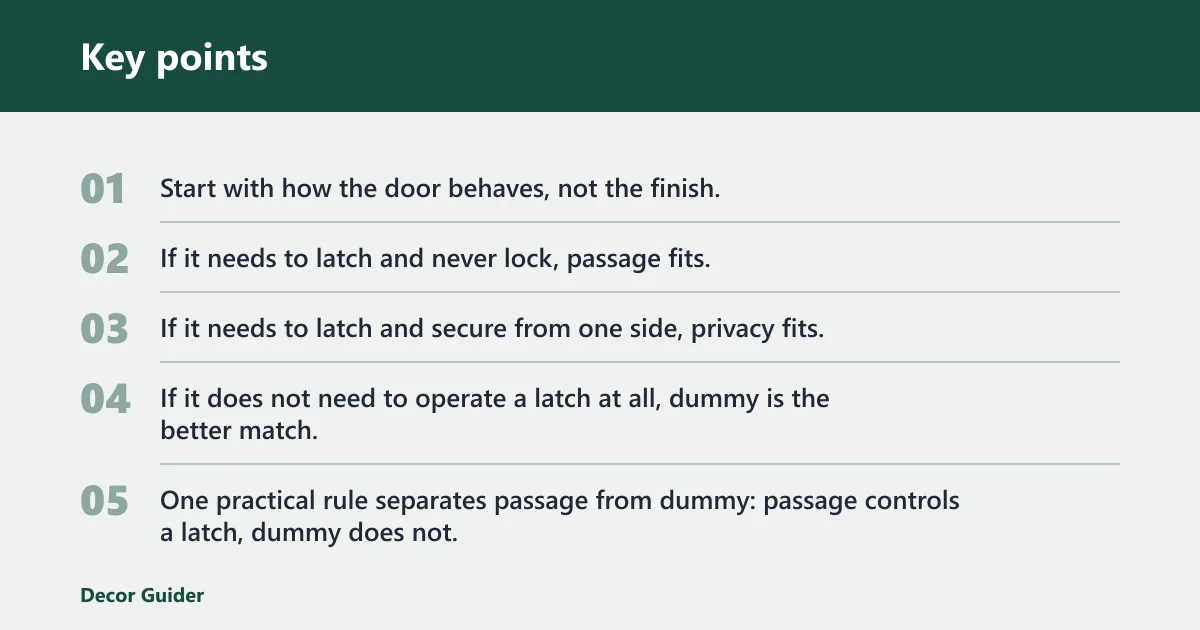


Start with how the door behaves, not the finish. If it needs to latch and never lock, passage fits. If it needs to latch and secure from one side, privacy fits. If it does not need to operate a latch at all, dummy is the better match.
| Function | How it works | Typical rooms | Locking? | Best fit when | Main risk if chosen wrong |
|---|---|---|---|---|---|
| Passage | Latches but does not lock | Hallways, closets, kitchens, living spaces, pantries, laundry rooms | No | The door should close and stay shut, but privacy is not needed | The door may be inconvenient if you expected a lock |
| Privacy | Latches and includes a lock | Bedrooms, bathrooms, powder rooms | Yes | One person needs temporary privacy from the inside | A non-locking door may be replaced with hardware that should not be locked |
| Dummy | Non-operable, non-turning pull | Closets, pantries, decorative double doors, bi-folds | No | The door does not need to latch or operate a latch | A door that should latch may never stay closed |
One practical rule separates passage from dummy: passage controls a latch, dummy does not. That matters on interior doors that need to stay shut. A dummy on a door that should latch leaves you with a pull, not a working closure.
Choose the right door knob in 30 seconds

Check the door type first, then check whether it needs locking, then verify the prep. This order avoids the most common mistake: buying a stylish set that does not match the bore, latch pocket, or edge hardware already in the door.
| Door type | How it closes | Whether it needs locking | Recommended function | Common mistakes | Compatibility notes for tubular or mortise prep |
|---|---|---|---|---|---|
| Bedroom door | Latches shut and should stay closed | Yes | Privacy | Choosing passage and losing the lock, or choosing dummy and losing the latch function | Check whether the door is pre-bored for tubular hardware or cut for a mortise lockset |
| Bathroom or powder room | Latches shut | Yes | Privacy | Choosing a non-locking set where temporary privacy is needed | Privacy trim must match the existing bore, backset, and edge prep |
| Hallway door | Latches shut | No | Passage | Adding a lock where no lock is needed | Most modern interior doors use tubular prep, but verify the bore and backset before buying |
| Closet door with a working latch | Latches shut | No | Passage | Picking dummy because it sounds simpler, even though the door needs to latch | If the door already has a standard bored latch, tubular passage trim is the usual fit |
| Closet or pantry door with no latch | Does not need to latch | No | Dummy | Buying passage hardware for a door that has no latch mechanism to operate | Dummy trim can work on a surface mount or on existing prep if the door only needs a pull |
| Decorative double door | One leaf is active, the other is passive | Usually no on the passive leaf | Dummy on the inactive leaf | Installing an operable set on the inactive panel | Active-passive layouts often pair a working lockset on one leaf with a dummy handle or pull on the other |
Say your laundry room door has a latch and you want it to stay closed, but you never need to lock it. Passage is the clean fit. If you buy dummy hardware instead, the door may look finished yet never catch properly.
Which knob should you use on a bedroom or bathroom door?
Use privacy hardware on bedroom, bathroom, and powder room doors. These doors need a latch plus a lock that can be engaged from inside. Privacy sets are built for that job, and they include emergency access from the outside if someone is stuck or a child locks the room accidentally.
How the outside emergency release works
Privacy locks include an outside release that can be opened in an emergency with a coin, screwdriver, or paper clip. The point is simple: the room locks for everyday use, but it can still be opened from outside without forcing the door or damaging the trim.
When privacy is the wrong choice
Privacy is a poor fit for doors that should never lock, such as many closets, pantry doors, and laundry rooms. It is also the wrong choice if the door does not need a thumbturn at all. In those cases, you may want passage or dummy hardware instead.
When does a passage knob make sense?
Use passage hardware when the door should latch but does not need a lock. That makes it a strong fit for hallways, closets, kitchens, living spaces, pantries, and laundry rooms. The knob turns the latch, yet it leaves privacy control out of the equation.
Closets, kitchens, and laundry rooms
Passage sets are commonly used on pantry, closet, and laundry room doors. Those spaces usually need the door to stay closed, but they do not need a locking function. That is the main difference between a passage set and a privacy set.
Doors that need a latch but no lock
If the door should close positively and stay shut, passage is the default choice. This is where many homeowners go wrong: they buy dummy hardware because the door is “just interior,” then discover the door no longer catches. If the door has a working latch, passage keeps that function intact.
When is a dummy knob the better choice?
Choose dummy hardware when the door does not need to latch or turn at all. A dummy handle has no locking function and does not operate a latch. It is commonly used on closets, pantries, decorative double doors, and bi-folds where the hardware is there mainly for grip or appearance.
Decorative doors and bi-folds
Dummy hardware works well on decorative doors that need a matching pull but no active latch. It is also common on bi-folds and some closet fronts. In those cases, the hardware is there to look complete and provide a handhold, not to run a latch mechanism.
Surface-mounted dummy handle setups
Surface-mounted dummy handles are single-face installations, and the screws are driven through from the opposite side. That makes them useful where the visible side needs a decorative pull and the other side does not need a turning mechanism. The key is that the setup is built for a fixed pull, not a working knob.
Suppose a pair of decorative double doors leads to a dining room and only one leaf opens. The active leaf can carry the working hardware, while the passive leaf can use a dummy handle and a flush bolt or striker. That keeps the look matched without pretending both panels need the same function.
Tubular vs mortise hardware
Compatibility matters as much as function. A knob can be the right type and still be wrong for the door if the prep is different. The fastest check is to look at the door edge and the trim side before you order anything.
How to spot tubular prep fast
Tubular hardware uses a standard 2-1/8 inch bore hole and a 2-3/8 inch backset. It is common in modern homes and fits 1-3/8 inch doors. From the trim side, you usually see a round bored opening rather than a rectangular pocket in the edge.
How to spot mortise prep fast
Mortise hardware uses a rectangular pocket cut into the edge of the door. It is often used on 1-3/4 inch doors, commonly uses a 2-1/2 inch backset, and typically needs a minimum stile width of about 4 inches. If the edge has a deep rectangular cutout, you are likely dealing with mortise prep, not a simple bored hole.
What to check before you buy
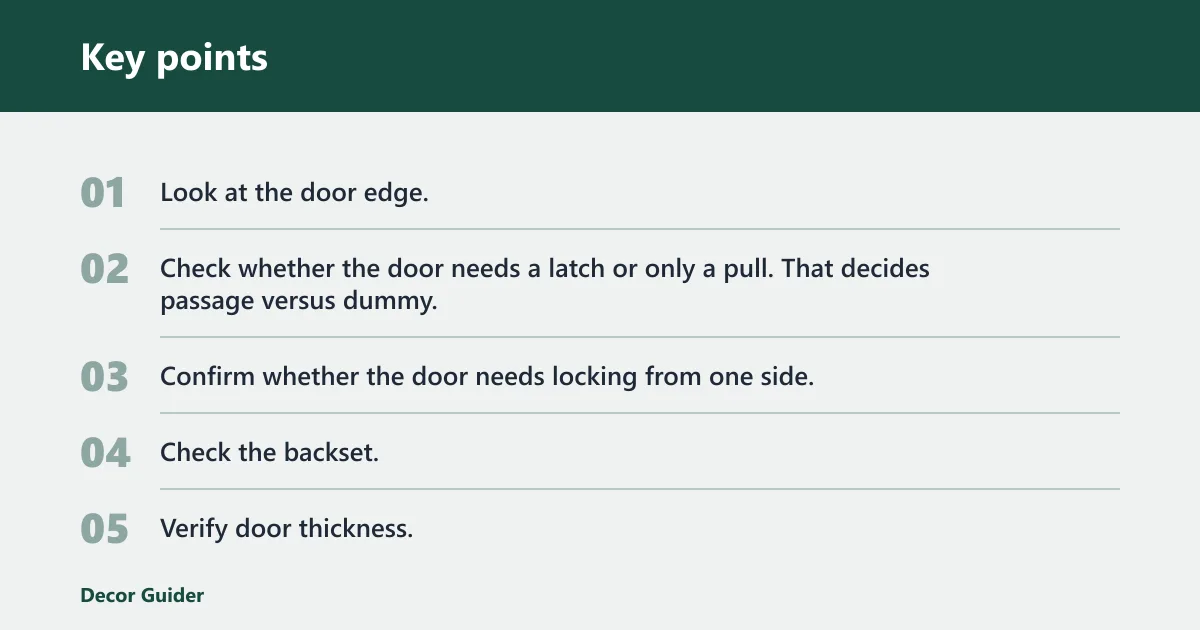
- Look at the door edge. A round bored opening points to tubular prep; a rectangular pocket points to mortise prep.
- Check whether the door needs a latch or only a pull. That decides passage versus dummy.
- Confirm whether the door needs locking from one side. That decides privacy versus a non-locking function.
- Check the backset. Tubular hardware commonly uses 2-3/8 inch, while mortise hardware uses 2-1/2 inch.
- Verify door thickness. Tubular hardware is commonly used on 1-3/8 inch interior doors, while mortise sets are standard for 1-3/4 inch doors.
- On mortise doors, confirm stile width. A minimum stile width of 4 inches is the practical threshold called out for mortise hardware.
Choose passage, privacy, or dummy
Use passage if the door latches but never needs a lock. Use privacy if the door latches and needs temporary locking from one side. Use dummy if the door does not need to latch or turn at all. If the prep is wrong, even the correct function can become a poor fit.
Choose passage if…
Choose passage if the door is a hallway, closet, kitchen, living space, pantry, or laundry room door that should close but not lock. It also fits many interior doors that need a normal latch without any privacy hardware. If the door already has a standard latch prep, passage is usually the cleanest match.
Choose privacy if…
Choose privacy if the door is a bedroom, bathroom, or powder room door. These spaces call for a latch plus a lock, and privacy hardware adds that function without changing the basic interior look. If the door should never lock, privacy is the wrong pick.
Choose dummy if…
Choose dummy if the door does not need to latch or operate normally, including decorative double doors, bi-folds, and some closet fronts. It is also the better choice when you want a pull only. If the door needs a working latch, dummy is not enough.
Frequently asked questions
What is the difference between passage, privacy, and dummy door knobs?
Passage knobs latch but do not lock, privacy knobs latch and lock from one side, and dummy knobs do not operate a latch at all. That means passage is for non-locking interior doors, privacy is for bedrooms and bathrooms, and dummy is for decorative or non-operable doors.
Which door knob type should I use for a bedroom door?
Use a privacy knob on a bedroom door. Bedrooms usually need a latch plus a lock that can be set from inside, and privacy hardware is made for that purpose. It also includes outside emergency release access, which matters if someone is locked in accidentally.
Can a dummy door knob be used on a closet door?
Yes, but only if the closet door does not need to latch. Dummy handles are typically installed on closet doors when the door is decorative or only needs a pull. If the closet door must stay shut with a latch, passage is usually the better choice.
Do passage door knobs lock at all?
No. Passage hardware latches the door but does not lock it. That is why it is common on pantry, closet, and laundry room doors, plus hallways and living spaces where closure matters more than privacy.
How do I know if my door needs tubular or mortise hardware?
Check the door edge and trim side. A round 2-1/8 inch bore with a 2-3/8 inch backset is commonly associated with tubular hardware. A rectangular pocket cut into the edge points to mortise hardware, which is standard for 1-3/4 inch doors and uses a 2-1/2 inch backset.
Which door hardware type is best for a pantry or laundry room?
Passage is usually best for a pantry or laundry room because those doors often need to latch but do not need to lock. If the door is decorative or does not latch at all, a dummy handle may fit better. Privacy is usually unnecessary in those rooms.
Can a dummy handle be installed on a door that already has a latch?
It can be, but it usually should not be if the door still needs to function normally. Dummy hardware does not operate a latch, so replacing a working passage set with dummy would remove the closing action. Use dummy only if the latch is no longer needed or the door is non-operable.
Door Handles – Residence Supply — What is the difference between solid brass and zinc alloy interior door handles, and which should I buy?
Function should come first, then material. Solid brass is generally chosen when you want a heavier metal feel and long-term durability, while zinc alloy is commonly used for lower-cost interior hardware. Buy the material that fits your budget and finish needs after you confirm passage, privacy, or dummy, plus the correct prep.
Products related to this article
Sponsored / affiliate links. As an Amazon Associate I earn from qualifying purchases. I may earn additional commission from eligible campaigns.