How to Install a Magnetic Door Catch
Install a magnetic door catch by matching the mount style to your door and frame, then line up the magnet and strike plate so they meet squarely at the closed position. Poor placement leaves doors hanging open, slamming shut, or rubbing the frame, which can wear hardware and damage paint. This guide shows how to choose the right catch, mark exact mounting points, and install it so the door closes cleanly on the first try.
Magnetic hardware components and placement


A magnetic door catch uses a magnet and a metal strike plate, or catch plate, to hold a door in position or help it close more smoothly. It is a small device that can mount on the wall, ceiling, or floor depending on the product design, and it is used on cabinet doors, closets, pantry doors, French doors, and other small interior doors.
It is different from a magnetic lock, which needs drilling, wiring, and a permanent power source. It is also different from a magnetic door stop, which helps prevent slamming and paint damage, and from a magnetic door latch, which is meant to keep a door closed rather than only held in place. Choose the hardware for the job you need done.
Magnet, strike plate, and hold point
The magnetic side mounts to one surface, and the metal plate mounts to the other surface so both parts meet at the closed or open position. In most interior-door installs, the plate goes on the door and the magnet goes on the frame, though some products reverse that layout. The hold point is the exact spot where the two parts make full contact.
Where this hardware fits on interior doors
Use a catch on cabinet doors, closet doors, pantry doors, and light interior doors where you want a controlled hold rather than a lock. For larger or heavier swinging doors, check the product rating before you buy. A catch that is too weak or too small may line up, then let go under load.
What you’ll need
- Magnetic door catch kit with magnet, strike plate, and mounting screws if included
- Drill and driver
- Pilot bits sized to the included screws
- Small countersink bit if the screw heads must sit flush
- Tape measure
- Pencil or marking awl
- Level or straightedge
- Painter’s tape for marking and temporary positioning
- Adhesive cleaner or isopropyl alcohol for retrofit installs
- Adhesive-backed pads only if the catch is designed for adhesive mounting
Which catch should you buy for your door?
Start with the door material, then match the holding force to the door’s weight and use. Solid wood takes screws well. Hollow core doors usually need shorter screws, backers, or anchors. Cabinet and closet doors often work with lighter hardware. Adhesive-only retrofit kits fit best when the surface is clean, smooth, and lightly loaded.
Solid wood door
Pick a screw-mounted catch with hardware sized for wood, and use pilot holes to avoid splitting. A wood door usually gives the strongest screw bite, so this is the easiest material for a first install. If the kit includes long screws, check that they will not break through the face of the door.
Hollow core door
Use a light-duty catch, shorter screws, or a reinforcement method approved by the hardware maker. Hollow core construction does not hold fasteners the same way solid wood does. If the catch is meant to take repeated force, adhesive alone is usually a poor choice for this door type.
Cabinet or closet door
Choose a compact magnetic door closer or holder made for small doors. These are common on pantry and closet doors because they need enough holding power to keep the door in place, but not so much that the door feels hard to open. Small parts also make alignment easier.
Adhesive-only retrofit
Use adhesive only on smooth, clean, low-load surfaces and only if the product is made for it. This option is useful when you cannot drill, but it is less forgiving of dust, texture, or misalignment. If the door has high traffic or heavy pull, screws are the safer choice.
Where should the catch and plate go?
Place the magnet and strike plate on the same line so they meet squarely when the door closes. Start with the door edge, the latch line, and the actual gap between the moving and fixed parts. If the gap is wrong, the catch may miss, chatter, or hold weakly even if the screws are tight.
Find the latch line and door edge reference
Mark the point where the door naturally stops in the closed position. Measure from the hinge side to the centerline of the catch location, then repeat that mark on the frame or mating surface. Keep the plate centered on the magnet’s path, not just near it.
Set the magnet and strike plate at the same height
Hold the magnet and plate together with painter’s tape and close the door slowly. Adjust until both faces meet flat. If one part sits higher than the other, the door may catch on an edge first, which weakens hold and can twist the hardware.
Check the gap before you drill
Look at the distance between the door and frame, then compare it with the hardware thickness. Say your cabinet door has a 2 mm reveal and the plate sits proud of the surface; the catch may need a shim or a different mount position. Make one change at a time so the fit stays predictable.
Install the catch and strike plate
Most installs are simple. The usual sequence is mark, drill, fasten, then test. Mount the metal plate to the door and the magnetic part to the frame, or reverse that layout if your kit is built that way. Keep the parts square or the hold point will wander.
- Hold the catch in the chosen position and mark every screw hole.
- Check the marks against the closed door line before you drill.
- Drill pilot holes sized to the included screws, especially in wood.
- Add a light countersink if the screw heads must sit flush.
- Fasten the magnet side first, then the strike plate side.
- Snug the screws without crushing the housing or distorting the plate.
- Close the door and test the hold before you clean up the marks.
How to install a magnetic door stop on wall
A wall-mounted magnetic door stop installs at the point where the door should stop before it hits trim or paint. Set the stop at the same path as the door swing, then fasten it into solid backing whenever possible. A floor or ceiling version works the same way, but the mount surface changes.
How to install a magnetic door latch
A magnetic door latch follows the same layout process as a catch, but the hold is meant to keep the door shut rather than simply parked. Align the latch body and keeper so the door closes fully before the magnet engages. If the door sits proud, shift the strike plate before tightening.
Match your hardware to the door material
Door material decides how aggressive your fastening method can be. Solid wood generally accepts a wider range of screw lengths. Hollow core doors need gentler fastening and careful placement. Cabinet and closet doors usually benefit from smaller hardware and closer alignment. Adhesive is acceptable only when the surface and load fit the product.
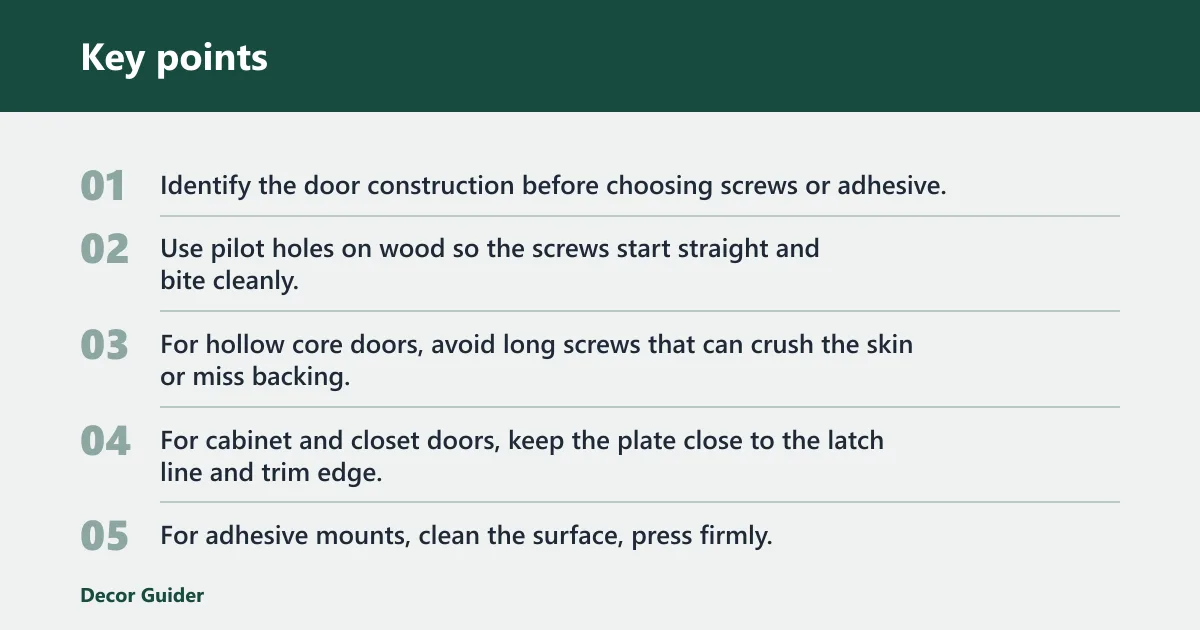
- Identify the door construction before choosing screws or adhesive.
- Use pilot holes on wood so the screws start straight and bite cleanly.
- For hollow core doors, avoid long screws that can crush the skin or miss backing.
- For cabinet and closet doors, keep the plate close to the latch line and trim edge.
- For adhesive mounts, clean the surface, press firmly, and let the adhesive cure before loading it.
Solid wood screw fit
Use the hardware included in the kit if the screw length matches the door thickness and part depth. If not, choose screws that are short enough to stay inside the material but long enough to hold. Pre-drill pilot holes to reduce splitting, especially near the edge.
Hollow core anchor choices
Use anchors or reinforcement only if the product instructions allow them. A hollow core door can strip out if screws are too long or over-tightened. If the magnet keeps slipping after a few cycles, the fix is usually better support, not more torque on the screw heads.
Light-duty cabinet and closet doors
Smaller doors often need only basic tools and short screws. Mount the plate on a flat section of the door, not on a narrow edge where the fasteners can pull out. Picture a pantry door that springs open 3 mm at the corner; moving the plate inward often fixes the gap.
When adhesive is acceptable
Adhesive works best on smooth, clean surfaces with low pull force. Wipe away dust and grease, let the surface dry, and press the hardware squarely in place. If the door is heavy, textured, or frequently slammed, adhesive alone is the wrong choice.
Common mistakes
Most failures come from placement, not from the magnet itself. If the catch is lined up poorly, the door may still miss the contact point. If the fastener is wrong for the door material, the hardware loosens. If the surface prep is poor, adhesive lifts early. Fix the cause, not only the symptom.
Misaligned magnet and plate
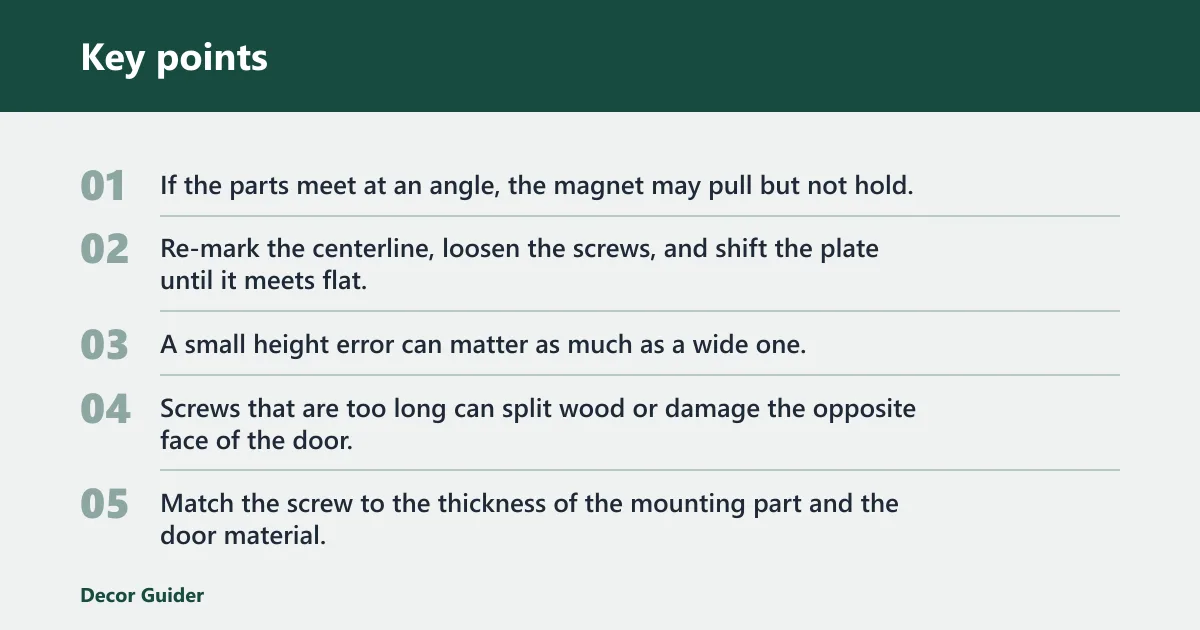
If the parts meet at an angle, the magnet may pull but not hold. Re-mark the centerline, loosen the screws, and shift the plate until it meets flat. A small height error can matter as much as a wide one.
Wrong fastener length
Screws that are too short pull loose. Screws that are too long can split wood or damage the opposite face of the door. Match the screw to the thickness of the mounting part and the door material, not just to the hole size.
Weak hold from poor placement
Weak hold often means the gap is too large or the catch is off the travel line. Move the strike plate closer to the magnet path in small increments, then retest after each adjustment. Change about 1 mm at a time so it is easier to see which direction improves the hold.
Adhesive on an unsuitable surface
Adhesive can fail quickly on dusty paint, textured finishes, or oily surfaces. Remove the hardware, clean the area, and reinstall only if the surface is smooth enough for full contact. If the door sees frequent use, switch to screws instead of trying a second adhesive layer.
Stripped holes or loose screws
If a screw spins without tightening, stop and reset the hole before the hardware gets crooked. On wood, use a larger pilot only if the screw is splitting the edge; on stripped holes, a suitable filler or anchor may be needed. Tighten only until the part sits flat.
Decision table for common installs
| Door type | Best fastener type | Tool list | Placement check | Likely failure mode | Screws? | Adhesive? |
|---|---|---|---|---|---|---|
| Solid wood door | Wood screws with pilot holes | Drill, driver, tape measure, pencil, level, pilot bit | Center plate on the door edge line and close the door to confirm flat contact | Split wood or loose screws if holes are not predrilled | Yes | No |
| Hollow core door | Short screws with approved anchors or reinforcement | Drill, driver, bit set, level, marking tape | Check that the plate lands on a supported area, not a weak panel edge | Fastener pull-out or crushed skin from over-tightening | Yes | No |
| Cabinet/closet door | Small wood screws or light-duty kit screws | Driver, pencil, ruler, pilot bit, optional countersink | Match the magnet to the closed position before final tightening | Weak hold from poor height alignment | Yes | Sometimes |
| Adhesive-only retrofit | Factory adhesive pad or adhesive-backed catch | Cleaner, cloth, ruler, tape, pressure tool | Dry-fit first, then press squarely onto a clean, smooth surface | Lift-off from dust, texture, or repeated force | No | Yes |
Frequently asked questions
What is a magnetic door catch?
It is a small magnet-based holder that keeps a door in place or helps it close more smoothly. The usual setup pairs a magnet with a metal strike plate, and the parts mount on the door and frame, or the reverse, depending on the kit design.
How does a magnetic door catch work?
The magnet pulls on the metal plate when the door reaches the set position. For best hold, the parts must meet squarely with the correct gap between them. If the door floats or bounces open, shift the plate closer to the magnet path and retest.
How to install a hyper tough magnetic door catch
Start with the parts in the kit, then measure the closed position before drilling any holes. If the included screws are too long for your door material, choose shorter ones of the same type. The key is the same: line up the magnet and plate before tightening.
Products related to this article
Sponsored / affiliate links. As an Amazon Associate I earn from qualifying purchases. I may earn additional commission from eligible campaigns.