How to Adjust Bifold Closet Doors
Adjust bifold closet doors by finding the fault first, then making the smallest fix: realign the top pivot and guide, reset the bottom pivot in its bracket, or retighten the hardware before touching the track. Using the wrong adjustment wastes time and can make the doors rub, jump out of the track, or leave an uneven gap. This guide shows how to diagnose the problem, choose the right adjustment, and check the door so it closes squarely.
Quick diagnosis
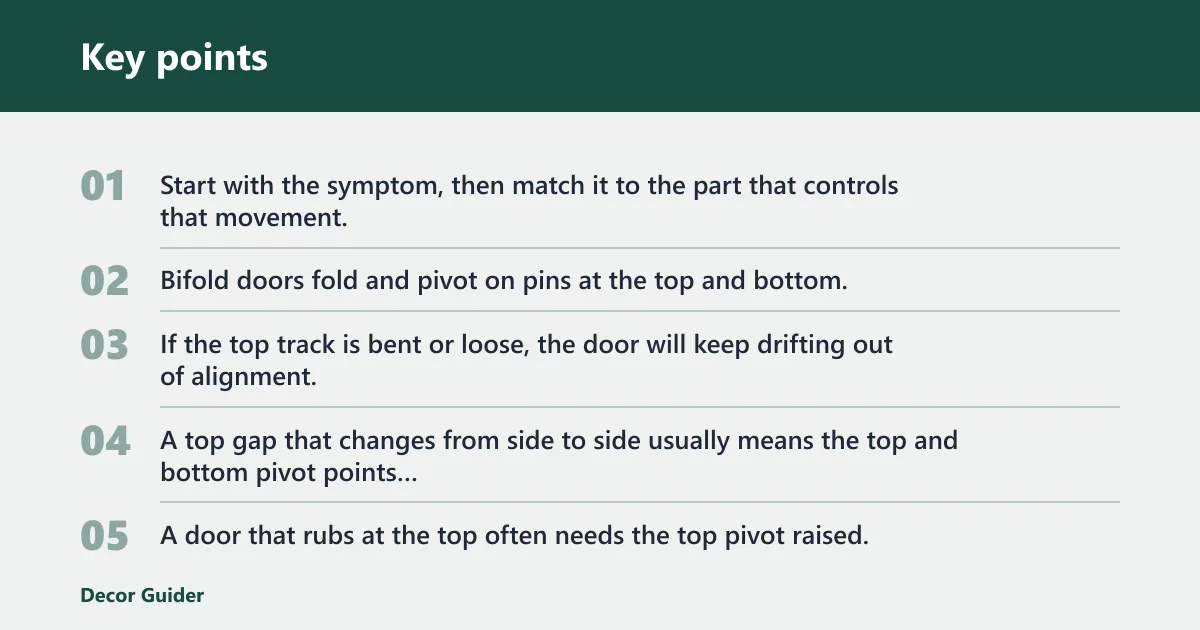


Start with the symptom, then match it to the part that controls that movement. Bifold doors fold and pivot on pins at the top and bottom, so a top gap problem usually points to the pivot set, while track jumping points to the guide pin or roller. If the top track is bent or loose, the door will keep drifting out of alignment.
Match the symptom to the likely cause
A top gap that changes from side to side usually means the top and bottom pivot points are no longer lined up. A door that rubs at the top often needs the top pivot raised, or the track checked for sag. A door that drags on the floor usually needs the bottom pivot reset, not a full rehung system.
Decide whether the fix is track, pivot, or pin related
The top track usually carries most of the operating load, so inspect it first if the door feels unstable or keeps slipping. A loose or bent track, a shifted bottom pivot bracket, or a worn top pivot pin can each create the same bad reveal. Fix the part that moves the door, not the panel itself, unless the panel is damaged.
Check for damage that needs replacement instead of adjustment
Stop adjusting if the track is bent, the bracket holes are stripped, the pivot pin is worn flat, or the panel is cracked. A weak, uneven, or damaged header can also make a new door hard to align. Replacement pivot hardware is inexpensive, around $3 to $5 per set, so worn pins are often worth replacing.
What you’ll need
- Tape measure
- Level
- Screwdriver
- Drill with the correct bit
- Replacement pivot pins
- Guide hardware
- Screws that match the existing hardware
- Shims or washers, if the hardware system allows them
Measure the opening first
Measure before you touch the brackets. Use the smallest width, because the opening often varies across the top, middle, and bottom. Measure height at both sides and in the center, and use the finished floor, not carpet padding or unfinished subfloor, for your height reference.
- Measure the opening width at the top, middle, and bottom, then keep the smallest number.
- Measure the height at both sides and in the center.
- Check the finished floor line and the finished header line.
- Look for a header that bows, sags, or has loose fasteners.
Say the opening is about 36 inches wide at the top, about 35 7/8 inches in the middle, and about 35 3/4 inches at the bottom. The smallest width is the number that matters when you judge fit, because that is the tightest point the door has to clear.
How do you adjust bifold closet doors?
Adjust bifold closet doors by working from the top down: tighten the track, match the top and bottom pivot positions, then reseat the guide pin or roller in the top channel. Make one change at a time and test the swing after each change. That keeps you from chasing the wrong problem.
- Snug loose top track screws into solid framing or the header.
- Check that the track is straight and level before adjusting any pivot.
- Move the top pivot bracket only if that system allows up or down adjustment.
- Reset the bottom pivot bracket so it matches the top pivot position.
- Lift the door slightly and reseat the top guide if it slipped out of the track.
- Open and close the door about three times, then recheck the reveal.
If the door came off track, lift the door slightly and reseat the top guide. That is the fastest fix when the roller or guide pin has slipped out of the rail. Suppose a mirrored pair catches near the top corner after a bump; reseating the guide often fixes that without changing the panel height.
How do you adjust bifold closet door height?
Height changes come from the pivot positions, not the panel itself. Raise or lower the top pivot bracket if the hardware allows it, then loosen the bottom pivot bracket only enough to reset alignment. Recheck the head gap and floor clearance after every move, because both ends of the door interact.
- Loosen the top pivot bracket fastener just enough to move the bracket.
- Raise the door if it rubs the floor, or lower it if the top gap is too tight.
- Loosen the bottom pivot bracket, slide it as needed, and retighten it.
- Keep the top and bottom pivot pins fully seated in their brackets.
- Check the reveal at the head and the floor after each adjustment.
Small changes matter here. A reset of about 1/8 inch is often enough to stop rubbing, but recheck after each move instead of stacking several changes at once. A worn or broken top pivot pin can make the door sag, so a height problem that returns after adjustment usually means the pin set needs replacement.
Bifold closet doors table
| Problem symptom | Likely cause | Exact adjustment to try first | When to replace hardware |
|---|---|---|---|
| Top gap uneven | Top and bottom pivots are not aligned; bottom bracket may have shifted | Reset the bottom pivot bracket, then match the top pivot position | If the pivot pin is worn, the bracket holes are stripped, or the gap returns after reset |
| Door rubs at the top | Top pivot set is too low, or the track is out of level | Raise the top pivot bracket if the hardware allows it, then check the track | If the track is bent, loose, or the header is damaged |
| Door drags on the floor | Door sits too low, or the bottom pivot bracket has shifted | Loosen, slide, and retighten the bottom pivot bracket | If the pivot pin is worn or the floor level changes sharply across the opening |
| Door jumps track | Guide pin or roller slipped out, bent, cracked, or worn | Lift the door slightly and reseat the top guide in the track | If the guide hardware is cracked, bent, or will not stay seated |
| Door will not close flush | Top and bottom pivots do not match, or the opening is out of square | Check track level, then realign both pivot points before tightening | If the panel is warped, the track is bent, or the opening itself is not square |
How do you adjust bifold closet doors with metal frame?
Metal-frame bifold doors can use different pivot hardware than wood or composite doors, so check the bracket shape before forcing any part. Adjust the same three points in order: track, top pivot, then bottom pivot. If the frame is mirrored or glass, handle it carefully and replace worn hardware before loading it with extra force.
- Confirm the frame uses the same pivot and guide style as the replacement parts.
- Check whether the top pivot bracket is spring-loaded or adjustable.
- Reseat the guide hardware before turning to the frame itself.
- Replace worn pins or cracked rollers before making larger changes.
Interior bifold doors can be made from wood, aluminum, fiberglass, or composite, and some use mirrored panels, six-panel designs, or louvered styles. Heavier panels need dependable hardware, so a light-duty pivot set may not hold alignment for long on a heavier mirrored door.
Common mistakes
Most repeat problems come from changing the wrong part or forcing a worn one back into place. A door that is already misaligned often needs one bracket reset, not a full reinstall. If the track is secure and the opening is square enough, you usually do not need to remove the whole system.
- Overtightening screws in weak wood and stripping the holes.
- Adjusting one pivot without checking the other pivot.
- Ignoring a bent track or cracked bracket.
- Forcing a misseated pin into place instead of reseating it.
- Replacing panels before checking the guide pin, pivot pin, and bracket position.
Common first-timer mistake: a door that drags at the floor gets lifted at the top only, while the bottom pivot stays low. That can make the top gap look better for a moment, but the door still closes out of square. Reset both pivot points together.
Frequently asked questions
Can you adjust bifold doors?
Yes. Most adjustments come from the top pivot bracket, bottom pivot bracket, and guide hardware. Start with the track, then move the pivots in small steps and test the swing each time. If the door still will not stay aligned after that, the pin set or track may need replacement.
How do you align bifold closet doors?
Align them by matching the top and bottom pivot positions and making sure the top guide stays centered in the track. Use the smallest opening width as your fit reference, then check the head and floor reveals after every change. If the opening is out of square, alignment will be limited.
How do you fit bifold closet doors?
Fit starts with measuring the opening at the top, middle, and bottom, then measuring height at both sides and in the center. The smallest width controls the fit. If you are replacing doors, many kits include the panels, track, hardware, and pulls or knobs, but the parts must match the door weight and size.
How do you adjust old bifold closet doors?
Old bifold systems often need fresh pivot hardware before anything else. If the pins are worn, the door sags and no adjustment will hold for long. Replace the pivot set first, then reset the bottom bracket and guide hardware. Older tracks also deserve a close look for bends or loose screws.
How do you set bifold closet doors?
Set them by centering the guide in the top track, lining up the pivot pins, and tightening the track only after the door swings freely. Use the finished floor and finished header as your reference points. If the door jumps the rail or rubs, reset the pivots before touching the panel.
Products related to this article
Sponsored / affiliate links. As an Amazon Associate I earn from qualifying purchases. I may earn additional commission from eligible campaigns.