How to Close the Gap at the Bottom of a Door
Close the gap at the bottom of a door by matching the fix to the cause: tighten hinges first, then add a sweep for small, even openings, or use a threshold when the floor contact point needs to rise. Clearance needs vary by flooring, ventilation, privacy, and any code or manufacturer requirements, so the right answer is not one fixed number for every interior door. Interior doors commonly need enough undercut to clear the floor after installation, but oversized gaps usually mean the door, hinges, or frame need correction instead of a thicker seal.
Why is there a gap at the bottom of the door?



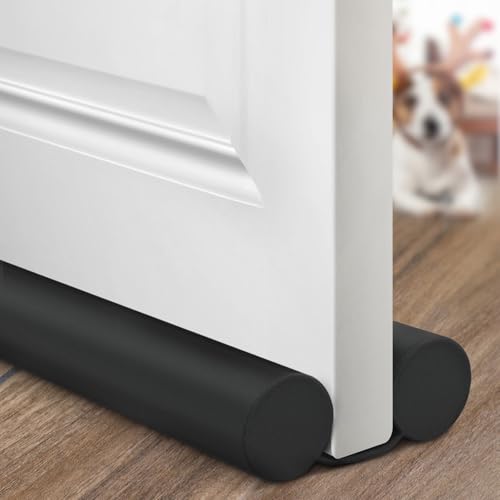
Most bottom gaps come from four causes: the door sits too high, the floor is uneven, the slab is sagging or rubbing, or the gap changed after new flooring went in. Check where the opening appears first, because a bottom seal will not fix a door that is out of alignment. The best first step is diagnosis, not product selection.
Symptom → likely cause → first check
| Symptom | Likely cause | First check |
|---|---|---|
| Gap is even across the bottom | Door is simply set high or floor clearance is generous | Measure left, center, and right before choosing a sweep |
| Door rubs on one corner | Hinge sag or frame misalignment | Open and close the door and look for contact at the latch side |
| Gap is wider on one side | Uneven floor or a twisted slab | Compare the left, center, and right openings |
| Gap changed after new flooring | Floor height changed under the door | Remeasure after the floor installation is complete |
| Noise, drafts, or light still pass through after sealing | Bottom seal is the wrong style or the jamb seals are worn | Check top and side weatherstripping too |
Check where the opening
Look at the bottom, then the top and sides. If the door rubs on one corner, or a side gap widens as the door swings, the issue may be alignment rather than seal choice.
Note changes after flooring work
If the gap appeared after tile, vinyl, laminate, or carpet changes, the floor height may be different from before. Hardwood, tile, and low-pile carpet each change the clearance need differently. That can shift the contact point and make a previous sweep too short or too long.
Think in floor contact, not just “gap”
For interior doors, acceptable clearance depends on flooring, door location, and airflow needs. A hallway door with carpet under it may need different clearance than a bedroom door over hard flooring or a return-air opening. Industry guidance for interior door undercuts and fire/return-air openings can differ from a basic draft seal target, so confirm any project-specific requirement before trimming or adding hardware.
What you’ll need
- Measuring tape
- Cleaning cloth or vacuum
- Replacement sweep, threshold part, or weatherstripping
- Screwdriver or drill, if the part uses screws
- Pen and paper for left, center, and right measurements
Bottom door gap fix selector
| Gap size | Floor condition | Door condition | Recommended fix | Difficulty | Tools needed | When to stop and call a pro |
|---|---|---|---|---|---|---|
| Tight, around 1/4 inch | Flat and even | Door opens and closes cleanly | Simple sweep | Low | Measuring tape, screwdriver if needed | If the sweep drags after fitting |
| Moderate, up to 1/2 inch | Mostly even | Door is sound and square | Standard rubber sweep | Low to moderate | Measuring tape, screwdriver or drill | If the gap varies a lot from side to side |
| Moderate to 1 inch | Uneven at left, center, and right | Door is not sagging | Brush sweep or threshold check | Moderate | Measuring tape, screwdriver | If the floor slope is severe or the door still rubs |
| Gap changed after new flooring | Higher or lower than before | Door still swings normally | Remeasure, then choose sweep or threshold based on the new contact point | Moderate | Measuring tape, cleaning cloth, replacement part | If the new floor leaves too little room for a safe seal |
| Any size, with sagging or rubbing | Any | Door is out of alignment | Fix alignment before adding a thicker seal | Moderate to high | Measuring tape, screwdriver, drill if needed | If hinge repair or planing is outside basic adjustment |
| Over 1 inch | Any | Door or opening may be wrong for the frame | Replace the threshold or add wood to the door bottom | High | Measuring tape, drill, replacement material | If the gap remains oversized after the first correction |
Measure the gap
Measure the door width and the gap before buying anything. Then check the bottom at left, center, and right. That three-point read shows whether floor unevenness is changing the seal contact along the bottom edge. Separate the product fit range from the clearance you actually want to preserve for flooring, airflow, and privacy.
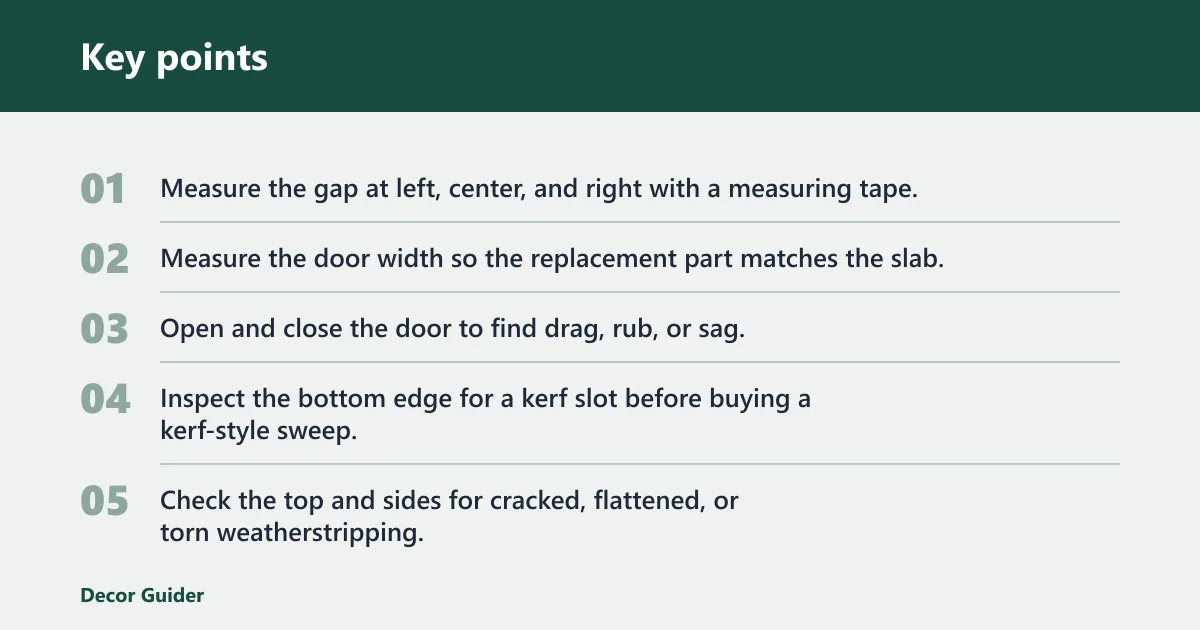
- Measure the gap at left, center, and right with a measuring tape.
- Measure the door width so the replacement part matches the slab.
- Open and close the door to find drag, rub, or sag.
- Inspect the bottom edge for a kerf slot before buying a kerf-style sweep.
- Check the top and sides for cracked, flattened, or torn weatherstripping.
Common product fit ranges versus recommended clearance
Product fit ranges describe what a sweep or threshold can physically cover; they are not the same as the recommended clearance for every interior door. A door over hardwood may need a different undercut than one over tile or carpet. Return-air doors, privacy-sensitive rooms, and manufacturer instructions may call for more or less clearance than the seal alone would suggest.
Why the kerf slot matters
A kerf slot is a narrow groove in the bottom of the door. It is required for kerf-in sweeps. Do not buy that style unless the groove is already present.
What weatherstripping can and cannot do
Weatherstripping belongs at the top and sides where the door meets the jamb. Replace it if it is cracked, flattened, or torn. It does not solve a floor gap by itself, and it will not correct an oversized opening caused by frame or hinge movement.
Choose sweep vs threshold
Use a door sweep when the gap is under the moving door edge and the slab closes normally. Use a threshold when the floor or sill needs a higher contact point. If there is already an adjustable threshold with screws, check that option before replacing the whole unit. Oversized gaps that stay wide after normal sealing often point to a door, hinge, or frame issue rather than a seal problem.
Choose the least invasive fix first
Start with the part that changes the least. A door sweep mounts to the moving door and should not drag while the door opens or closes. A threshold stays on the floor and works when the contact point must rise to meet the door.
Match the part to the gap and floor
A standard rubber sweep works best for many small, even gaps. A brush sweep is better for uneven floors and rougher contact lines. Carpet, tile, and hardwood each change how much compression you need, so the best part depends on both the measured opening and the floor surface.
Keep the threshold safe to walk over
Do not create a trip hazard with a raised threshold. If the threshold already exists, an adjustable model may raise the floor contact point by up to 3/8 inch on many products, while some adjustable thresholds can raise the contact point by up to 1 inch. Check the manufacturer range and any code limit before setting the height.
Install
After you find the cause, install the lightest fix that fits it. Start with a sweep for a small, even gap. Move to a threshold only when the floor contact point needs to change. Stop and correct alignment first if the door is sagging or rubbing. For a bedroom door, keep the seal quiet and low-friction so it does not bind with daily use.
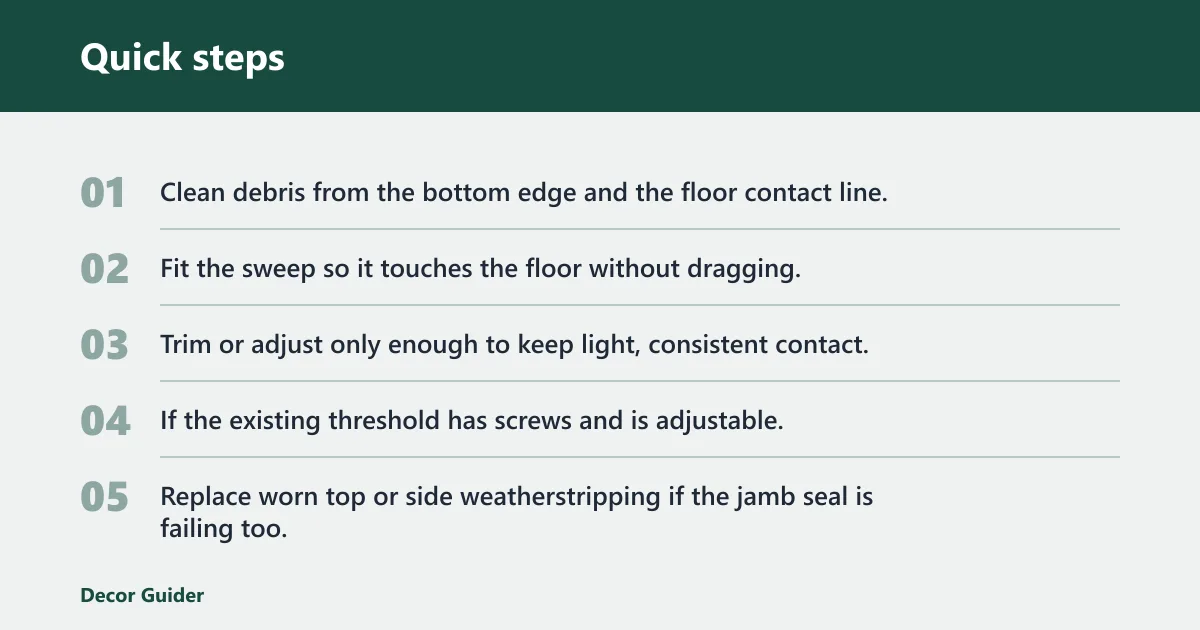
- Clean debris from the bottom edge and the floor contact line.
- Fit the sweep so it touches the floor without dragging.
- Trim or adjust only enough to keep light, consistent contact.
- If the existing threshold has screws and is adjustable, raise or lower it and recheck the door.
- Replace worn top or side weatherstripping if the jamb seal is failing too.
- Open and close the door again to confirm smooth movement.
For renters or non-destructive fixes
Start with a removable sweep or a reversible threshold adjustment if the existing hardware allows it. Avoid planing the door or adding permanent wood unless you own the unit or have permission. A common first-timer mistake is forcing a thick seal onto a door that still needs alignment correction from the door bottom up.
For permanent repairs
If the gap is over 1 inch, or the door still leaves a wide opening after the first fix, the slab or threshold may need a more permanent repair. That can mean replacing the threshold or adding wood to the door bottom, depending on the frame and floor. In those cases, the issue may be better treated as a door/frame correction than as a sealing problem.
Mistakes
Most problems come from choosing hardware before checking the door. A quick inspection avoids wasted parts and a door that binds.
- Buying a kerf-in sweep without confirming a kerf slot
- Trying to seal a sagging door before fixing alignment
- Using a sweep on a floor that slopes enough to need a brush style or threshold check
- Setting a threshold so high that it becomes a trip hazard
- Ignoring top and side weatherstripping when those seals are cracked or flattened
Say your bedroom door has a 1/4-inch gap at the center but nearly closes at both corners. A simple sweep is the likely first fix, but only after the door still swings cleanly and the floor is even enough for the sweep to contact without dragging.
Suppose a hallway door started leaking noise after new vinyl flooring went in. Remeasure the bottom at left, center, and right before buying parts, because the new floor height may have changed the contact point and shifted the best fix from a sweep to a threshold check.
Frequently asked questions
How do you fill the gap at the bottom of a door?
Measure the gap first, then choose the least invasive fix that matches it. A small, even gap usually takes a sweep, while a larger or uneven opening may need a brush sweep or adjustable threshold. If the door sagged or rubbed, fix alignment before sealing so the new part does not fail.
How to fill the gap at the bottom of a door
Start with a measuring tape and check the gap at left, center, and right. Then inspect the floor, the door edge, and the jamb weatherstripping. Pick a sweep for a moving-door seal, or a threshold if the floor contact point has to rise. Floor type and door condition should drive the choice.
What is the gap at the bottom of a door called?
It is usually called the bottom door gap or under-door gap. In repair terms, people also talk about the floor contact point, since that is what a sweep or threshold needs to meet. The exact fix depends on the opening size and the floor condition.
What should the gap at the bottom of a door?
There is no single number for every interior door. Acceptable clearance depends on the flooring, the door location, privacy needs, and airflow requirements. Measure before buying parts, then judge whether the opening is small enough for a sweep or large enough to need a threshold check or alignment correction.
How big can the gap under a door be before it needs fixing?
A small, even gap may only need a sweep. A wider or uneven gap may need a brush sweep or adjustable threshold, and a gap over 1 inch may require adding wood to the door bottom or replacing the threshold. If the door is sagging, fix that first instead of sealing over the problem.
Do I need a door sweep or a threshold for the gap under my door?
Choose a sweep when the door moves cleanly and the seal just needs to meet the floor. Choose a threshold when the floor or sill needs a raised contact point. If an adjustable threshold already exists, check whether it can be altered before replacing it. The best choice is the one that solves the cause with the least change.
How do I fix a gap under a door after new flooring?
Remeasure the gap after the floor change, because the contact point may have moved. If the door still swings smoothly, choose a sweep or threshold based on the new height. If the door now rubs, correct alignment before installing anything thicker. New flooring can turn a clearance problem into a fit problem.
Why is there a gap at the bottom of my interior door?
Common causes are sagging hinges, a warped slab, uneven flooring, or a floor height change after remodeling. Check the bottom, top, and sides, then open and close the door to see whether the problem is really alignment instead of seal wear. If the gap is oversized, the frame or slab may need correction rather than just sealing.
Sources
Door clearance, undercut, and fire/return-air requirements are commonly addressed in building-code and manufacturer guidance. For project-specific limits, confirm the applicable local code and the hardware manufacturer’s installation instructions before trimming, planing, or raising the seal.
Products related to this article
Sponsored / affiliate links. As an Amazon Associate I earn from qualifying purchases. I may earn additional commission from eligible campaigns.