How to Fix a Door That Is Out of Square
If a door is out of square, check the reveal first: if gaps vary by more than about 1/8 inch, fix the hinge, strike plate, or frame part that is actually off instead of trimming the slab. Using the wrong fix can leave the door still failing to latch and can wear hardware faster. This guide shows how to tell hinge sag, strike misalignment, and true frame distortion apart, then correct each one.
What you’ll need


- Phillips screwdriver
- Flathead screwdriver
- Metal file
- Chisel
- Cordless drill
- Masking tape
- Lipstick or paint for transfer marking
- Replacement screws, including 3-inch screws for hinge correction if needed
- Shims for hinge adjustment
How do I tell if my door frame is out of square?
Read the gaps before you touch hardware. A square frame gives you an even reveal around the perimeter. An out-of-square frame usually shows a wedge-shaped gap, a top-corner rub, or a corner gap that changes as you close the door. If the door latches only when lifted or pushed, hinge sag is more likely than a bad opening.
Read the gap pattern
Check the top, both sides, and the bottom. A gap that widens toward one corner points to racking or a twisted jamb, while a door that sits tight at the latch edge but gapes at the top often points to hinge-side movement. Exterior doors can also show weatherstripping compression that hides a small reveal problem, so inspect with the door partly open too.
Separate slab sag from frame distortion
Close the door and look at the latch-side gap from top to bottom. If the top hinge side looks fine but the latch-side top corner rubs, the slab is often sagging or racked. If both the hinge side and latch side look uneven, the opening itself may be out of square. Hollow-core slabs bend differently from solid-core slabs, so edge work is riskier on hollow core doors.
Door square diagnosis matrix
| Symptom | Likely problem | Quick test | Best fix | When to stop DIY and call a pro |
|---|---|---|---|---|
| Top-corner rub on latch side | Sagging door or loose top hinge | Lift the handle side; if the rub improves, the hinge is pulling loose | Tighten hinges, then use 3-inch screws in the top hinge if needed | If the jamb is cracked or the hinge leaf will not hold screws |
| Even rubbing along the latch edge | Door slab is racked or edge is oversized | Check whether the reveal changes by more than about 1/8 inch corner to corner | Plane or trim the edge only after hinge alignment is verified | If it is a hollow-core slab and the edge would expose the core |
| Latch hits the strike plate | Strike plate is misaligned | Mark the latch with lipstick or paint, then close the door slowly | File the plate for a miss of 1/8 inch or less; move it if the miss is larger | If the wood pocket is split or the latch bore is off center |
| Door closes but will not latch unless pushed hard | Hinge pull or frame opening out of square | Open and close while watching the reveal at the top and latch side | Reset hinge depth, then address the frame only if the opening is truly distorted | If the frame is metal, twisted, or part of an exterior assembly |
| Latch sticks or feels sticky | Debris, paint, or lockset interaction | Remove the latch bolt and check for dirt or drag in the mechanism | Clean the bolt, clear the bore, and test the lockset action | If the internal spring-loaded latch bolt will not return cleanly after cleaning |
Fix the misalignment in order
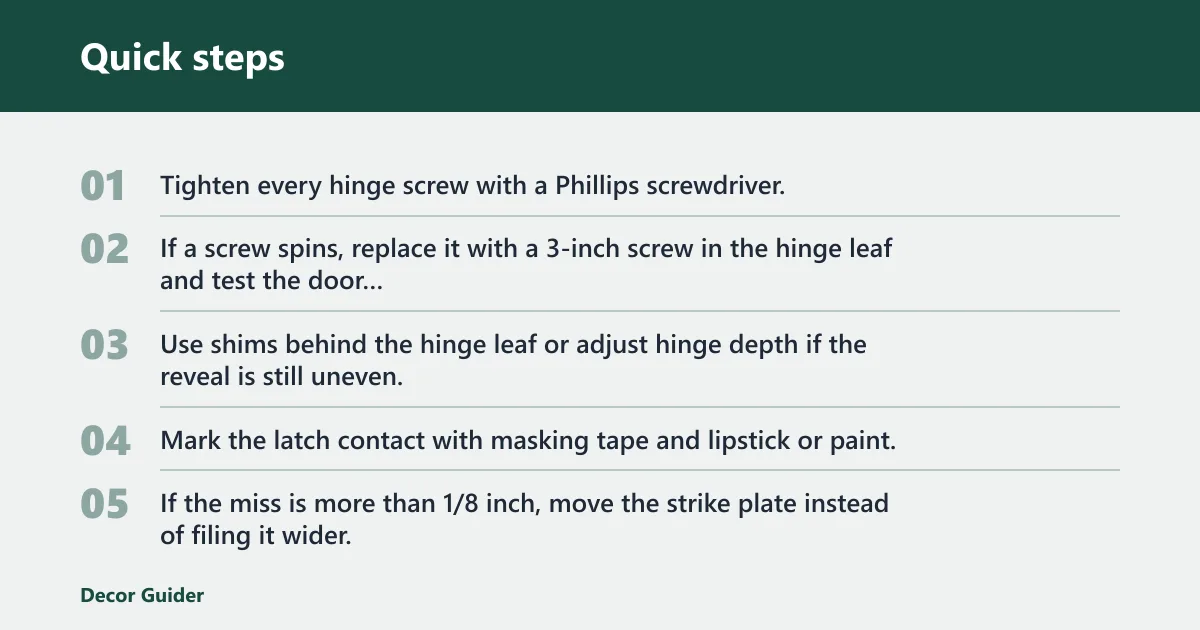
- Tighten every hinge screw with a Phillips screwdriver. Start with the top hinge, because a loose top hinge often lets the door drop and rub on the opposite side.
- If a screw spins, replace it with a 3-inch screw in the hinge leaf and test the door again. Use the long screw to pull the jamb back toward the framing only when the hinge hole still has wood to grip.
- Use shims behind the hinge leaf or adjust hinge depth if the reveal is still uneven. Remove the hinge, add or reduce shim material, then re-seat it so the hinge leaf sits flush.
- Mark the latch contact with masking tape and lipstick or paint, then close the door slowly. If the mark lands high, low, or too far inboard, file the strike plate for a miss of 1/8 inch or less.
- If the miss is more than 1/8 inch, move the strike plate instead of filing it wider. Re-cut the wood pocket with a chisel only after the new plate position is marked and checked.
- Trim or plane the door edge only when the slab itself is the problem and the frame is sound. Take off about 1/16 inch, then recheck the reveal and latch before removing more material.
- Address the frame only when the opening is actually out of square. On an exterior unit, a twisted jamb, damaged sill, or metal frame distortion often needs rework that goes beyond hinge or strike changes.
Say your interior bedroom door shows a 3/16-inch gap at the top latch corner but nearly touches at the bottom latch corner. Tightening the top hinge and adding a 3-inch screw may pull the slab back into alignment without touching the strike plate at all.
Suppose a storm door closes cleanly until the latch reaches the keeper, then rebounds. That often points to the strike location or weatherstripping compression, not the slab edge, so check the latch mark before trimming any material from the door.
Should you plane the door or move the strike plate?
Move the strike plate when the latch nearly meets the hole and the miss is minor. Plane or trim the slab only when hinge alignment is correct and the door still rubs along its edge. If the latch bolt is spring-loaded but sticks, clean it first; a dirty latch can mimic a geometry problem.
When a file is enough
If the latch mark shows a miss of 1/8 inch or less, a metal file can enlarge the strike opening enough for clean entry. Work slowly and stop as soon as the latch enters without drag. Recheck with the door closed and locked, especially on interior locksets that add extra resistance.
When to re-cut the pocket
If the strike plate must move more than 1/8 inch, mark a new location, remove the plate, and chisel the pocket to fit the new position. This matters more on exterior doors, where weatherstripping and deadbolt alignment can make a shallow fix fail fast.
When trimming the slab is the wrong move
Do not plane a hollow-core door before checking the hinges and strike. Too much edge removal can expose the core and weaken the door. On solid-core slabs, edge trimming is safer, but it still should come after hinge correction and a contact test, not before.
Common mistakes
The fastest way to chase the wrong fix is to treat every latch failure as a strike-plate issue. A door that won’t latch usually signals hinge or alignment issues, and a sagging door can show uneven gap sizes around the frame. The order matters.
- Filing the strike plate too far instead of moving it when the miss is larger than 1/8 inch.
- Fixing the latch before tightening loose hinges.
- Trimming a hollow-core door without checking the core location.
- Ignoring a twisted jamb or racked frame because the latch seems to be the only problem.
- Stopping after one hinge screw when the top hinge and bottom hinge are pulling the slab differently.
A common first-timer mistake is to chase the strike plate while the top hinge is still loose. That can leave the door rubbing on the opposite side, even after the latch finally clicks.
How to fix a door frame that is out of square
If the opening itself is out of square, the frame has to be corrected, not the slab. Start by confirming the reveal is uneven at more than one corner, then check whether the jamb is out of plumb or the opening is racked. Interior frames often need hinge and jamb reset work; exterior frames may also involve weatherstripping, sill, or metal frame issues.
Check the opening before you reset anything
Measure the top, latch side, and hinge side gaps by eye against the existing reveal. A corner gap indicates racking, while a uniform out-of-plumb condition usually shows as a lean with otherwise even spacing. If the door is square at the hinges but the opening is not, the frame is the problem.
Reset only the part that is wrong
Use a cordless drill to remove hinge screws, then adjust the hinge location or shim as needed. Reinstall the hinge so the leaf sits flush in its mortise. If the jamb itself is twisted or bowed, stop before planing the slab again; the opening needs correction first.
Interior, exterior, and storm door differences
Interior doors usually forgive slight hinge corrections and modest strike adjustments. Exterior doors are less forgiving because weatherstripping, locks, and thresholds can all affect the fit. Storm doors often need latch and keeper alignment more than slab trimming, and the frame can be aluminum or steel, which changes how much rework is practical.
Frequently asked questions
What is the easiest fix when a door is out of square?
Start with hinge screws. Tighten them, then replace weak screws with 3-inch screws in the top hinge if the door has sagged. That is the least invasive correction and it often restores latch alignment without touching the strike plate or slab.
How to fix a door that is not square in the frame
A common sequence is hinge first, strike second, edge work third, frame last. Mark the latch contact with lipstick or paint, then decide whether the strike needs filing or relocation. If the reveal still changes corner to corner after hinge correction, the frame or slab needs adjustment.
How to fix an interior door frame that is out of square
For an interior frame, confirm whether the jamb is actually twisted or the slab is just sagging. Tighten hinges, use a flathead screwdriver to lift a seated leaf if needed, then correct the strike. If the frame opening itself is distorted, reset the jamb before trimming the door.
How to fix a storm door that is out of square
On a storm door, begin with hinge alignment and keeper location before trimming anything. The closer, latch bolt, and frame often have to work together, so a small keeper shift can solve a problem that looks like a warped slab. If the frame is bent, replacement parts may be the better path.
Products related to this article
Sponsored / affiliate links. As an Amazon Associate I earn from qualifying purchases. I may earn additional commission from eligible campaigns.