How to Fix a Door Frame That Is Cracked Around the Strike Plate
Stabilize the crack with glue and fasteners first, then reinstall the strike plate with longer screws into solid wood so latch pressure stops splitting the jamb. Skip the repair, or reset the plate into damaged wood, and the crack usually widens while the door stops latching cleanly. This guide covers diagnosis, reinforcement, filler choices, strike-plate reset, and a final fit check.
What should you check first?


Start with the hinges, then the crack, then the latch contact. A problem at the top hinge can push the latch-side top corner into the frame, so a cracked strike-plate area may be a symptom, not the source. If the door only sticks in summer or after rain, wood swelling from humidity is a common clue.
- Screwdriver
- Wood screws
- Drill and bits
- Wood filler
- Waterproof wood glue
- Toothpicks or hardwood sticks
- Wood dowels
- Chisel
- Sandpaper
- File
- Self-tapping screws for metal frames
Crack around strike plate: Fix selector
| Crack type | Likely cause | Best repair method | Tools needed | Cure time | Replace-vs-repair threshold |
|---|---|---|---|---|---|
| Hairline split | Latch pressure, mild hinge sag, or minor settling | Glue the split, clamp if needed, then reinstall the plate with longer screws | Wood glue, screwdriver, drill, #10 x 3" screws | About 24 hours for glue | Repair if wood is firm and the split stays closed |
| Stripped screw hole | Screw spun without biting | Toothpicks or hardwood sticks for small holes; dowels for larger holes | Glue, sticks or dowels, drill, screwdriver | 24 hours | Repair if the jamb is still solid around the hole |
| Crushed wood | Repeated latch impact | Rebuild with dowel reinforcement, then re-drill the pilot hole | Glue, dowels, chisel, drill, sandpaper | 24 hours | Repair if the damage is local and the surrounding wood is firm |
| Soft or rotted jamb | Moisture damage or long-term failure | Replace the damaged jamb section or the frame | Inspection tools, replacement lumber or frame parts | Not a patch repair | Replace if wood crumbles, feels soft, or keeps reopening |
| Metal frame | Stripped metal hole or commercial-style frame wear | Use self-tapping screws that match the existing size and thread pattern | Screwdriver, drill, self-tapping screws | No glue cure | Repair if the metal is intact and not torn out |
How do I fix a cracked door frame around the strike plate?
Fix the crack first, then reset the strike plate. That order keeps the latch bolt from forcing the split open again. If the screw holes are only stripped and the jamb is still firm, a fastener upgrade can often solve the problem in about 10 minutes. If the wood is split or crushed, plan on a glue-and-cure repair first.
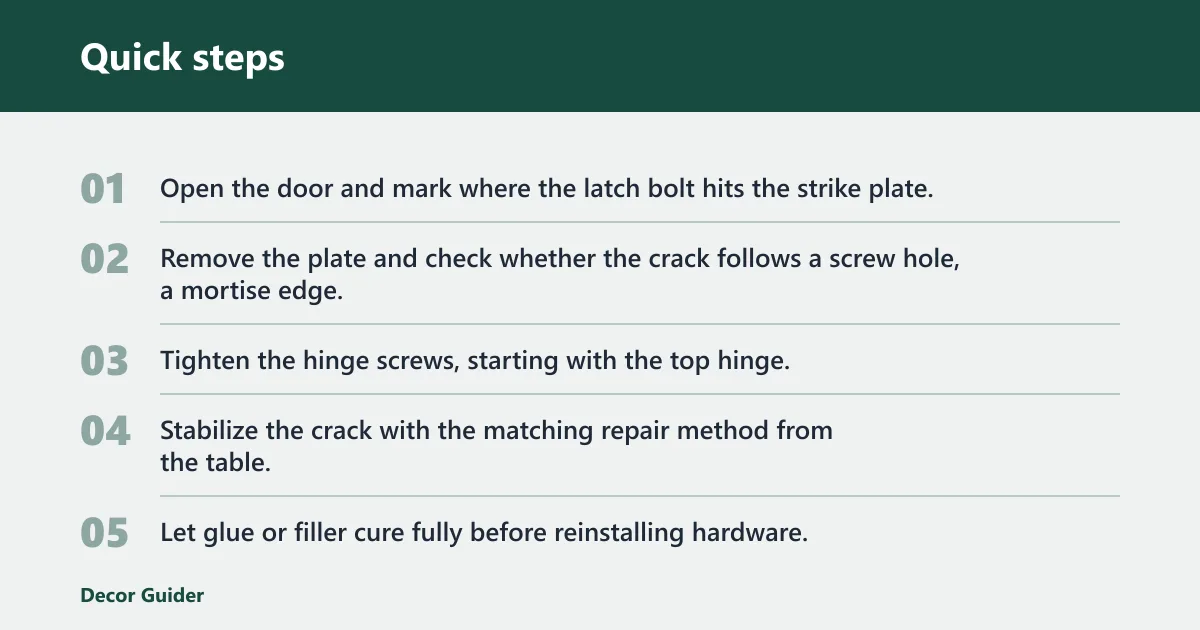
- Open the door and mark where the latch bolt hits the strike plate.
- Remove the plate and check whether the crack follows a screw hole, a mortise edge, or a crushed corner.
- Tighten the hinge screws, starting with the top hinge, using #9 x 2.5" or 3" wood screws if the originals spin.
- Stabilize the crack with the matching repair method from the table.
- Let glue or filler cure fully before reinstalling hardware.
- Reinstall the strike plate with #10 x 3" screws, then test the latch.
If the screw hole near the upper strike-plate screw spins freely but the wood around it is still hard, a repair may hold if the hole is filled with toothpicks and glue. A toothpick-and-glue repair can hold the screw again. If the same area feels spongy, the fix needs a dowel or a replacement jamb section instead.
How do you stabilize the crack first?
Use glue and reinforcement before any plate adjustment. Wood filler works for small to medium holes, but it is not structural on its own. Toothpicks or hardwood sticks suit quick, low-cost repairs for small stripped holes, while wooden dowel reinforcement is the strongest large-hole repair. For all three, full cure time matters.
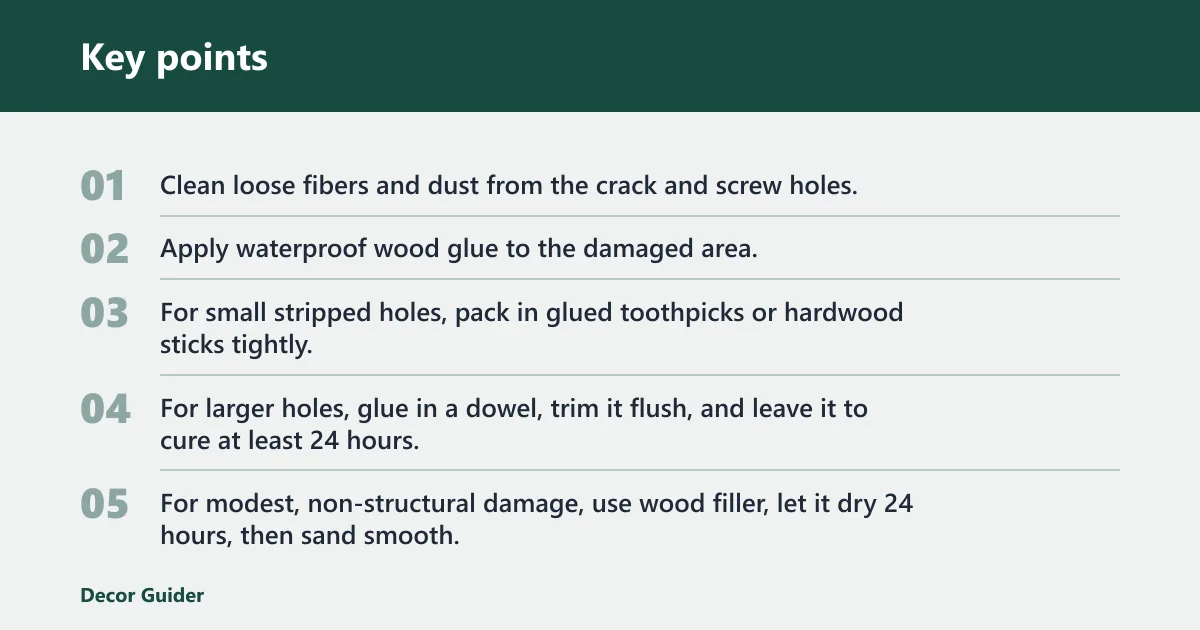
- Clean loose fibers and dust from the crack and screw holes.
- Apply waterproof wood glue to the damaged area.
- For small stripped holes, pack in glued toothpicks or hardwood sticks tightly.
- For larger holes, glue in a dowel, trim it flush, and leave it to cure at least 24 hours.
- For modest, non-structural damage, use wood filler, let it dry 24 hours, then sand smooth.
- Drill a fresh pilot hole after curing before reinstalling the screw.
How should you reset the strike plate?
Reinstall the strike plate only after the jamb is stable. If the latch rubs, file the opening a little at a time, then test again. If the plate sits too low or too high, reposition it so the latch enters smoothly. Longer screws help only when they reach sound framing behind the jamb.
- Place the plate where the latch bolt marks the metal, then check alignment.
- File the opening only enough for the latch to pass cleanly.
- Move the plate slightly if the latch is hitting the edge of the mortise.
- Drive #10 x 3" screws through the plate and into solid framing.
- Close the door and confirm the latch enters without scraping or rebound.
How do I tell if the crack is from loose hinges or a shifting frame?
Loose hinges usually show up as sag, top-corner rub, or a latch that misses higher or lower than before. A shifted frame shows a more persistent fit problem, especially if the door gap is no longer close to slightly more than 1/16 inch but no wider than 1/8 inch. If the issue changes with humidity, swelling is likely part of it.
- Inspect the top hinge first and tighten its screws.
- Close the door and watch whether the latch-side top corner scrapes the jamb.
- Check the gap against the thickness of a playing card.
- Mark the strike plate where the latch bolt contacts it.
- If the contact point shifts after tightening hinges, adjust the hinges before touching the plate.
What should you do for stripped or crushed screw holes?
Use toothpicks or hardwood sticks for a quick small-hole fix, then move to dowels if the hole is larger or the wood is crushed. Wood filler is fine for modest damage, but it needs a full 24 hours and works best when the area is not carrying major latch force. Re-drill only after the repair hardens.
- Remove the screw and inspect the hole diameter.
- Pack small holes with glued toothpicks or hardwood sticks.
- Use a glued dowel for larger holes, then trim it flush.
- Let the repair cure for 24 hours.
- Sand smooth, drill a new pilot hole, and reinstall the screw.
- If the frame is metal, switch to a self-tapping screw that matches the existing size and thread pattern.
A common first-timer mistake is forcing the original screw back into a hole that has already failed. The screw may bite for a moment, then spin again. If that happens twice, stop and rebuild the hole rather than tightening harder.
When should I use longer screws in a strike plate repair?
Use longer screws when the plate is sound but the fastener is not reaching strong material behind the jamb. For most residential hinge screws, #9 x 2.5" or 3" wood screws are common, and strike plate screws are often #10 x 3". Longer screws are a fastening fix, not a cure for soft or rotten wood.
- Confirm the jamb wood is firm around the mortise.
- Choose longer screws only after the crack is stabilized.
- Drive them straight so they bite into framing, not just the jamb face.
- Test the latch after each screw, then stop if the wood begins to split again.
- If the jamb keeps cracking, move to reinforcement or replacement.
Common mistakes
Do not drive the strike plate back into cracked wood without reinforcement. Do not rely on filler alone for large holes or a soft jamb. Do not ignore hinge sag, because the top hinge often drives the misalignment. Do not keep resetting the plate if the frame is shifting or rotted.
- Reattaching too soon: Wait for the glue or filler to cure, typically about 24 hours before reinstalling hardware.
- Using the wrong repair: Toothpicks suit small stripped holes; dowels suit larger damage.
- Skipping hinge checks: A loose top hinge can make the latch-side corner drive into the frame.
- Ignoring soft wood: If the jamb feels weak, cracked repairs will fail again.
- Overfiling the plate: Remove only enough metal for smooth latch entry.
How do I know if the frame is too damaged to repair?
Replace the damaged section if the jamb is soft, rotten, badly shifted, or keeps re-cracking after a proper repair. Crumbled fibers, oversized mortises, and screws that will not hold are strong signs that patching will not last. Metal frames are different: if the hole is stripped but the frame is intact, self-tapping screws may still solve it.
- Press a screwdriver tip into the damaged wood to check firmness.
- Look for repeated splits around the same screw hole.
- Check whether the strike plate sits far from the latch path.
- If the jamb is soft or badly distorted, stop repairing and plan replacement.
Frequently asked questions
Can I repair a split strike plate area without replacing the frame?
Yes, if the wood is firm and the split is local. Glue-and-clamp repair, toothpick packing, or dowel reinforcement can hold well once cured. If the jamb is soft, rotten, or badly shifted, replacement is the safer call because the latch load will reopen the split.
What should I use to fill stripped screw holes in a door jamb?
Use glued toothpicks or hardwood sticks for small stripped holes, and a glued dowel for larger ones. Wood filler works for modest, non-structural damage, but it needs 24 hours to dry and should be sanded smooth before re-drilling. For metal frames, use self-tapping screws instead.
How far should strike plate screws go into the framing?
They should pass through the jamb and bite into solid framing behind it. For residential repairs, #10 x 3" strike-plate screws are commonly used for that reach. If the screws only grab the damaged jamb skin, the plate can loosen again and the crack may reopen.
Products related to this article
Sponsored / affiliate links. As an Amazon Associate I earn from qualifying purchases. I may earn additional commission from eligible campaigns.