How to Fix French Doors That Don’t Latch
If French doors will not latch, check the inactive leaf first, then the astragal, hinges, and threshold. Most problems come from alignment or strike-plate adjustment, not latch replacement. Leaving it alone can cause air leaks, hardware rub, and lock failure. This guide shows how to find the fault and fix the right part first.
Tools you need


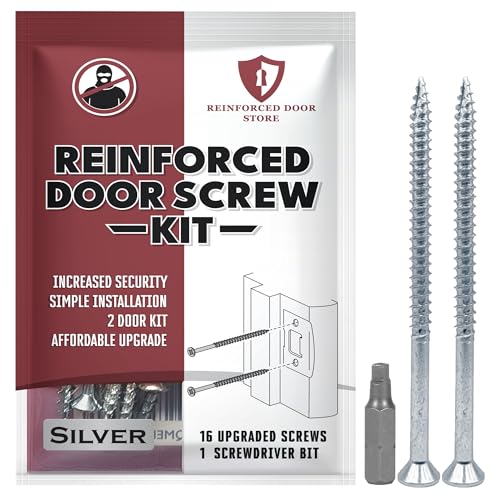
Keep the basics on hand before you start: drill, chisel, file, screwdriver, tape or marking compound, level, and 3-inch screws. A tape measure is also useful for checking reveal and strike alignment, and a straightedge can help confirm whether the jamb or leaf is out of line.
Before any repair, measure the reveal at the top, middle, and bottom of both leaves. Compare the active leaf to the inactive leaf and note whether the gap changes as you move down the jamb. Then close the door slowly and watch the latch hit: does it land above, below, or sideways from the strike opening? Finally, try lifting slightly at the handle as you close the door. If the latch catches only when lifted, the problem is usually sag, drag, or height—not a broken latch.
Use this quick rule to separate a small miss from a large one. A small misalignment is usually a latch miss of about 1/8 inch or less at the strike, where filing or minor plate adjustment may work. A large misalignment is anything bigger, or any situation where the reveal changes noticeably from top to bottom, the door must be forced shut, or the inactive leaf will not stay seated. Large misses usually require hinge correction, strike relocation, or frame adjustment before hardware replacement. For alignment principles and adjustment basics, see How to Fix a Sticky Door and the American National Standards for builders’ hardware at ANSI/BHMA Standards.
French door latch troubleshooting matrix

| Symptom | Likely cause | Quick test | Fix |
|---|---|---|---|
| Top latch misalignment | Door is sagging, too high, or the frame is out of plumb | Mark the latch with painter’s tape, lipstick, fingernail polish, or marking compound and close the door to see whether the latch hits above, below, or beside the strike opening | Tighten hinge screws, then use 3-inch screws. If the miss is 1/8 inch or less, file the strike plate. If it is larger, move the strike plate or adjust the hinges |
| Inactive leaf won’t stay closed | Flush bolts are loose, the astragal is bent, or the inactive leaf is not seated fully in the frame | Close and lock the inactive leaf first, then see whether the active leaf still meets the center cleanly | Reset or replace the flush bolts, straighten or replace the astragal, and check that the inactive leaf sits flush at top and bottom |
| Doors meet unevenly | Hinge sag, twisted jamb, or inconsistent door height relative to the strike plate | Check the gap all the way around both leaves and compare the center reveal from top to bottom | Correct hinge sag first, then verify that the hinge-side jamb is plumb before moving the strike plate |
| Latch only catches when pushed hard | Strike opening is slightly off, or the door is dragging at the threshold or weatherstrip | Watch where the latch mark lands on the strike opening, then try closing the door while lifting slightly at the handle | For a small miss, file the strike plate. For a larger offset, move the strike plate or correct sag, bottom drag, or threshold height |
| Drafty center seam | Astragal misalignment, worn weatherstrip, or a gap between the two doors | Feel for air at the meeting stile and inspect the seal condition around the threshold and center seam | Adjust the astragal, replace torn weatherstrip, and confirm the center gap closes evenly when both leaves are latched |
| Replace hardware | Worn latch parts, stripped screw holes, bent astragal, damaged hinge leaves, or repeated misalignment after adjustment | If the door still misses after hinge and strike adjustments, or the hardware is loose, cracked, or visibly bent, repair time is probably over | Replace the latch set, damaged hinges, or the astragal assembly as needed |
Why is your French door not latching?
Start at the strike opening, but do not stop there. If the latch mark lands above, below, or beside the opening, the problem is usually sag, height, or frame alignment. French doors add a second variable: the inactive leaf must also sit correctly and lock in place.
Check the latch mark first
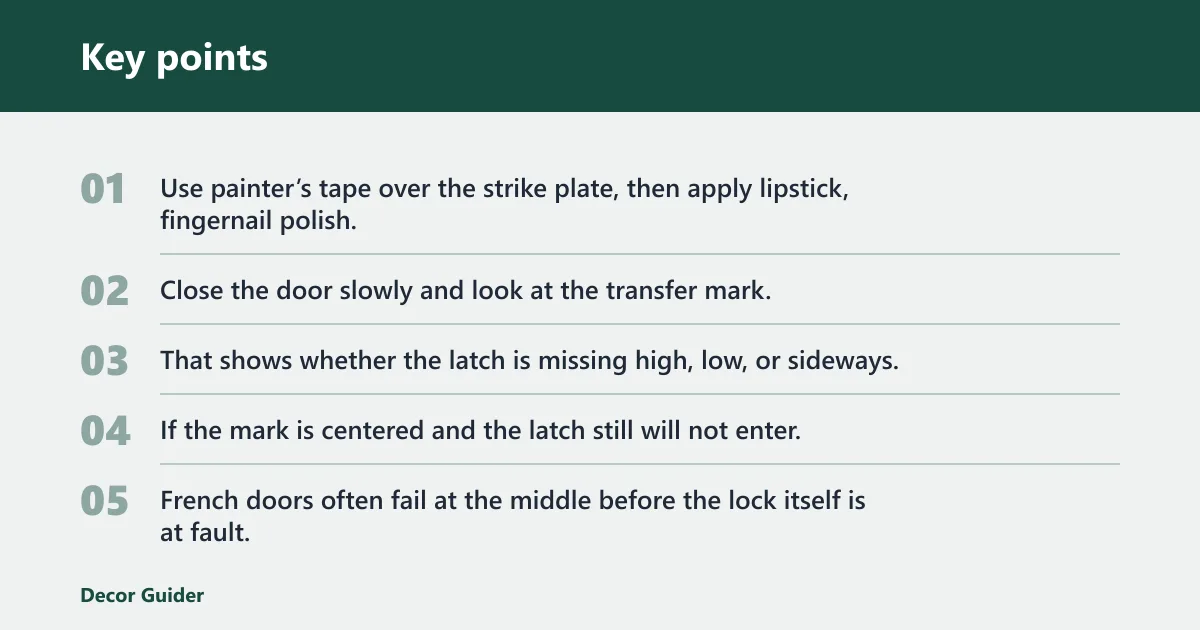
Use painter’s tape over the strike plate, then apply lipstick, fingernail polish, or marking compound to the latch bolt. Close the door slowly and look at the transfer mark. That shows whether the latch is missing high, low, or sideways, which is the fastest clue for the right fix.
If the mark is centered and the latch still will not enter, inspect the inactive leaf and center meeting point next. French doors often fail at the middle before the lock itself is at fault.
Decide whether the door is sagging or too high
A latch that hits low often points to sag at the top hinge or hinge-side movement at the bottom. A latch that hits high suggests the leaf sits too low or the frame is out of square. The hinge-side plumb is the reference point that matters most.
Say your active leaf must be lifted with a hand at the knob before the latch catches. That usually means the door is sagging or the threshold is forcing the leaf out of line, not that the latch is broken.
Use code-compliant hardware and weather sealing where needed
When replacement parts are needed, choose hardware that matches the door’s existing bore, backset, and handing, and look for products made to recognized builders’ hardware standards such as ANSI/BHMA. For weatherstripping and air-leak control, the U.S. Department of Energy recommends sealing gaps around moving components and using durable compression seals where appropriate; see Air Sealing Your Home and Insulation and Air Sealing. The ENERGY STAR guidance on sealing leaks around doors also helps when the center seam or threshold is drafty; see Door Sealing.
How do you tell if the problem is the hinge or the strike plate?
Start with the hinges, then move to the strike plate. Tighten loose screws first, because a simple pull on the jamb can restore alignment. If the latch miss is 1/8 inch or less, filing the strike plate may be enough. If the offset is larger, move the strike plate or correct the hinge position.
Tighten hinge screws before changing hardware
Loose screws let the leaf drop or twist. Tighten them all, especially at the top hinge and bottom hinge, because those two points control sagging and door height. If a screw spins, replace it with a 3-inch screw so it bites deeper into framing behind the jamb.
Longer screws are often the smallest useful fix. They can pull the hinge side tighter without changing the look of the door or cutting wood.
Adjust the mortise only when screw tension is not enough
If the hinge leaves sit proud or too deep in the mortise, the door can shift enough to miss the strike. A shallow mortise may need a chisel touch-up, while a hinge set too deep may need a thin shim. Keep the hinge leaf seated evenly so the door does not bind.
For heavier French doors, a same-size swap to heavy-duty ball bearing hinges is a sound upgrade. A 4 inch by 4 inch example is common on full-size units, and the higher load rating helps when the existing hinges are worn or the leaves are heavy.
Use the strike plate only after the hinge side is sound
For very small misalignment, filing the strike plate can be enough. If the latch is missing by 1/8 inch or less, remove a small amount from the strike opening and retest. If the miss is more than 1/8 inch, move the strike plate instead of forcing the latch.
A common first-timer mistake is filing the plate before checking sag. That can hide the real issue for a while, but the doors will still rub or drift out of line.
French door hinges and sagging
Hinge wear changes more than latch alignment. It changes door height, center reveal, and how the active leaf meets the inactive leaf. If the top corner rubs or the bottom corner drags, the top hinge and bottom hinge are usually part of the problem.
Read the gap pattern before you adjust
Check gaps all the way around both leaves. If the reveal is narrow at the top and wide at the bottom, the leaf is likely sagging. If one side looks even but the latch still misses, the frame may be twisted or the leaf may be sitting too high relative to the strike plate.
Hinge-side plumb is the critical reference. If that side is not plumb, any strike adjustment is temporary.
Know when to replace hinges
Heavy wear, loose hinge pins, cracked leaves, or stripped screw holes point toward replacement rather than more adjustment. Heavy-duty ball bearing hinges are a strong choice when the door is heavy or the hinges are repeatedly loosening. Same-size swaps reduce the amount of wood work needed.
If a hinge mortise has already been opened up, check that the new hinge sits flat and does not leave the door leaf proud of the jamb.
Inactive leaf and astragal alignment
French doors commonly depend on the inactive leaf as much as the active one. The inactive leaf must stay closed with flush bolts, the astragal must sit straight at the center meeting point, and the gap between the two doors must stay even so the latch and lock can work together.
Check the flush bolts first
If the inactive leaf shifts, the active leaf will never latch cleanly. Open and close the inactive leaf, then confirm that the top and bottom flush bolts appear to fully seat. A loose bolt can let the leaf drift, which changes the center gap and makes the active latch miss the strike opening.
Inspect the astragal and center seam
The astragal bridges the meeting stile and helps control both closure and draft control. If it is bent, loose, or set off center, the active leaf may hit it before the latch reaches the strike. That can also leave a drafty center seam even when the lock seems close to working.
Suppose the doors meet with a 1/2 inch gap at the center. That is too much for normal latch correction alone. The issue is likely at the inactive leaf, astragal, or hinge alignment, not just at the strike plate.
Frame, threshold, and weatherstrip checks
Not every latch failure starts at the latch. A twisted jamb, a threshold set too high, torn weatherstrip, or rot at the door bottom can stop the leaf from closing fully. Those problems can look like bad hardware even when the latch parts are fine.
Check for an out-of-square or twisted jamb
Look at the hinge side first and compare the gap from top to bottom. If the frame is out of square or twisted, the active leaf may close well at one point and miss at another. The hinge side should sit perfectly plumb before you trust any strike setting.
Measure the door leaf height relative to the strike plate, then compare it at the top and bottom. A change there points to frame movement, not just latch wear.
Inspect the threshold and seal condition
A mis-set threshold can block the bottom of the door before the latch engages. Torn weatherstrip can also make the door feel as if it is binding, especially if the seal is compressed unevenly or damaged near the bottom edge. Rot or damage at the door bottom often shows up as drag, gaps, or soft spots.
Repair the seal and bottom damage before you judge the latch. Otherwise, you may end up moving the strike plate to compensate for a closure problem that belongs at the threshold.
When to replace parts on French doors
Replace individual parts first when the damage is localized. If the flush bolts no longer hold the inactive leaf, replace the flush bolts. If the astragal is bent, warped, or split, replace the astragal assembly. If the strike opening is worn or the latch does not engage even after alignment work, replace the strike plate or the latch set. If the hinges are loose, cracked, or repeatedly pulling out, replace the hinges with same-size hardware so the door does not need a full remortise.
Same-size replacement hinges are the safest hinge upgrade when the current leaf size and screw pattern are still usable. That keeps the door geometry close to its original layout and reduces the chance of creating a new alignment problem. If the hinge screw holes are stripped but the hinge leaf is otherwise sound, longer screws may solve the problem without changing the hinge itself.
Replace the full French door set when the leaves are warped beyond correction, the frame is damaged or out of square enough that adjustments do not hold, the jamb or threshold is rotten, or multiple parts keep failing after proper repairs. Full replacement also makes sense when the doors no longer meet evenly even after hinge, strike, astragal, and flush-bolt corrections. In those cases, part-by-part repair can cost more time than a clean replacement.
- Close the inactive leaf and lock the flush bolts.
- Mark the latch contact point with tape or transfer compound.
- Check whether the miss is above, below, or beside the strike opening.
- Tighten hinge screws on both the active leaf and the inactive leaf.
- Replace stripped screws with 3-inch screws if needed.
- Compare the latch miss to the 1/8 inch filing threshold.
- File the strike plate for a very small miss, or move it for a larger one.
- Inspect the astragal, threshold, weatherstrip, and bottom edge.
- Retest both leaves for even reveal and smooth latch throw.
Products related to this article
Sponsored / affiliate links. As an Amazon Associate I earn from qualifying purchases. I may earn additional commission from eligible campaigns.