How to Stop a Barn Door From Swinging Out
Stop a barn door from swinging out by checking the guide first, then the track stops, then wall and hanger alignment. If the door drifts, add or adjust a floor guide. If it swings at travel ends, set proper stops. Left unchecked, the door can hit trim, jump the track, or wear rollers and hardware fast. This guide shows the right order to diagnose swing, side play, and travel limits, then fix each one.
Why your barn door moves
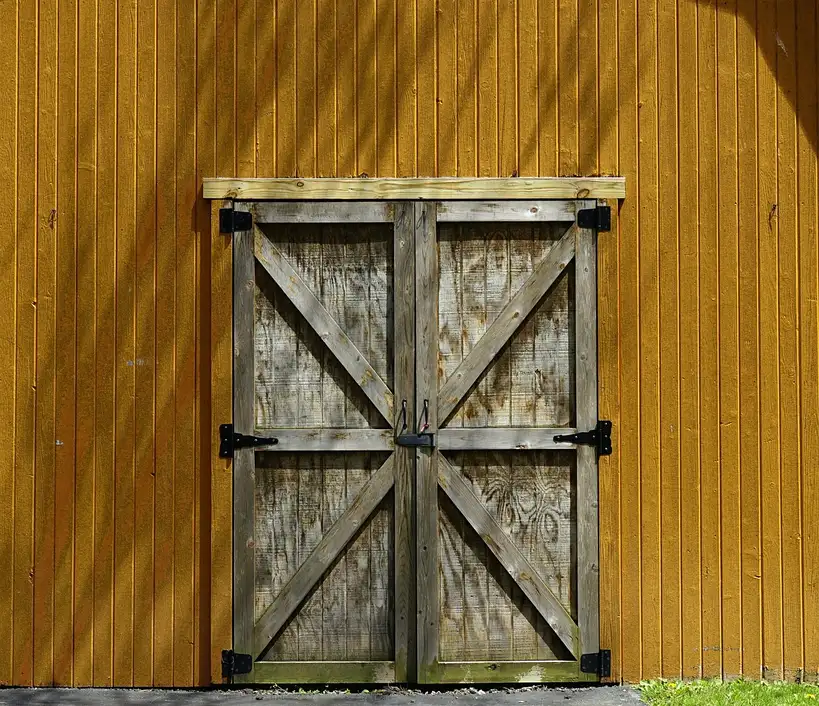


The cause depends on how it moves. A sliding barn door that drifts open points to wall plumb, track alignment, or stop hardware. Side-to-side sway usually points to guide size, hanger spacing, or clearance. A swing-style door uses hinges, so the fix path is different.
A standard single-track sliding barn door hangs above the opening. If the track, hangers, or floor guide do not match the door thickness and weight, the door can wander. Out-of-plumb walls can also let the panel roll or slide to one side until it rests against the stop or trim. For plumb and alignment guidance, see the manufacturer instructions from Häfele and Knape & Vogt.
Track, guide, and wall causes
Track hardware, hanger geometry, and the floor guide work as one system. Anti-jump devices keep the door from lifting off the track, but they do not control drift by themselves. A floor guide reduces swinging and side-to-side movement at the bottom, while soft-close or stop hardware limits travel at the open and closed ends. Manufacturer guidance from Richelieu and Johnson Hardware also ties safe operation to proper alignment and compatible load ratings.
What you’ll need
- Level for checking wall plumb
- Tape measure for door thickness and bottom clearance
- Shim scraps for temporary correction
- Hammer for hinge-pin adjustment on swing doors
- Large nail for driving out a hinge pin
- Replacement floor guide sized to the door thickness
- Stop or soft-close hardware rated for the door weight
- Track-compatible anti-jump device
- Hardware rated for the door weight and thickness
Measure two things first: door thickness and door weight. Those values decide whether the guide fits, whether the track and hangers are rated correctly, and whether stop hardware can handle the load safely. Check the product load rating before buying replacement hardware; for example, major makers such as Liberty Hardware and Horton Brasses publish capacity and fit limits for their systems.
Which barn door fix you need?
The symptom tells you which part to change first. Start with the weakest link: guide fit, track alignment, or travel control. A swing-style door uses a different fix path than a sliding barn door, so do not apply hinge-pin tweaks to track hardware.
Which barn door fix you need?
| Symptom | Likely cause | Tool/hardware needed | Applies to |
|---|---|---|---|
| Door drifts open by itself | Wall not plumb or stop position off | Level, shim, stop or soft-close hardware | Sliding barn door, bypass door |
| Bottom of door swings side to side | Guide too loose or wrong clearance | Floor guide matched to thickness | Sliding barn door, bypass door |
| Door lifts or rattles near the track | Anti-jump device not set for hanger geometry | Anti-jump device, wrench or driver | Sliding barn door, bypass door |
| Door hits the end hard | No stop or stop not rated for weight | Soft-close or stop hardware rated for load | Sliding barn door, bypass door |
| Hinged door leans or swings open | Out-of-plumb frame or hinge issue | Level, shim, large nail, hammer | Swing-style door |
| Bypass leaf rubs or overlaps incorrectly | Leaf interference, wrong guide path, or stop placement | Guide matched to bypass path, stop hardware | Bypass door |
| Guide slot feels loose on the panel | Oversized guide slot or mismatched thickness | Guide sized to the door thickness | Sliding barn door, bypass door |
| Anti-jump tab loosens or shifts | Hardware not tightened or mismatched to the track lip | Driver or wrench, replacement anti-jump part | Sliding barn door, bypass door |
| Soft-close feels weak on a heavy door | Underrated soft-close or stop hardware | Load-rated soft-close or stop kit | Sliding barn door, bypass door |
| Door opens or closes unevenly after adjustment | Warped slab or out-of-plumb wall | Level, shim, replacement door if needed | Sliding barn door, bypass door, swing-style door |
How do you check the door and wall first?
Check wall plumb and door size before changing hardware. A door frame that is not plumb can let the door drift open, and a guide or stop that does not match door thickness or weight will keep causing the same problem after adjustment.
Measure the wall and hardware fit
- Place a level on the jamb and the wall edge.
- Look for lean at the top, middle, and bottom.
- Measure the door thickness in inches.
- Confirm the door weight against the track, guide, and stop rating.
- Check bottom clearance against the floor guide opening.
Use the level to separate wall plumb from track level. If the wall leans but the track is level, the door may still drift because the opening is out of square. Shim behind the track header board when the wall or header is out of plane; do not force the track itself into a bend, because that can create bind and roller wear. If the track is level but the door still rides to one side, the guide or hanger spacing is the more likely fault.
Say a 1 3/8-inch door keeps drifting because the guide slot is made for a thicker panel. The door will still wander after you adjust the track, because the guide never grips the panel correctly. Guide-sizing charts from makers such as Hager Companies and Häfele show that slot width and panel thickness must match closely for stable travel.
How do you stop a sliding barn door from drifting open?

Start with travel control, then the track, then the wall. A sliding door that moves on its own usually needs a stop or soft-close setting, plus a plumb check. If the hanger spacing is off, the panel can load the track unevenly and drift back to one side.
Set the stop and check alignment
- Inspect the open and closed stops on the track.
- Set stop hardware so the door rests where you want it.
- Shim the track only where the level shows a lean.
- Recheck hanger spacing and roller contact after each change.
- If the door still drifts, replace worn hangers or misfit stops.
Move the stop about 1/8 inch at a time and test after each change. That small shift is often enough to change the resting point without creating a new bind. If the door is heavy, make sure the stop or soft-close kit is rated for the actual load; under-rated hardware can let the panel slam or rebound instead of settling cleanly.
Add or replace the floor guide
A floor guide keeps the bottom of the door aligned and reduces swinging and side-to-side movement. It must match the door thickness and the bottom clearance. An undersized guide lets the panel twist; an oversized one can bind and drag. Follow the door-thickness sizing guidance in the manufacturer guides from Knape & Vogt and Richelieu.
- Center the guide under the door path.
- Confirm the slot matches the door thickness.
- Adjust height so the door clears the floor by the guide’s spec.
- Test full travel before tightening the final fasteners.
How do you fix side-to-side movement?
Side play is usually a guidance problem, not a travel-stop problem. Check the floor guide first, then the anti-jump device, then the hanger geometry at the track. If the door can rock in the guide, it will feel unstable even when the stops are correct.
Check the anti-jump device and hanger spacing
- Inspect the anti-jump device against the track lip.
- Confirm it matches the hanger geometry and track clearance.
- Measure hanger spacing across the door face.
- Adjust only to the hardware maker’s spacing range.
- Replace bent or worn rollers if the play remains.
Anti-jump hardware helps keep the door from lifting off the track. It does not fix a loose guide or a warped panel, and it does not correct lateral sway on its own. If the panel still sways after the guide is corrected, the door itself may be warped or the track may be out of line. Manufacturer instructions from Liberty Hardware and Horton Brasses also emphasize matching the anti-jump setting to the hanger and track profile.
How do you stop a barn door from swinging out?
Stop swing-out by matching the fix to the movement. A sliding barn door that swings at the bottom usually needs a better floor guide or a straighter track. A swing-style door that opens by itself needs hinge correction, and the upper hinge pin is usually the first one to adjust.
Use the right correction for the door type
- Identify whether the door slides or swings on hinges.
- Use a level to confirm whether the wall is out of plumb.
- For a swing door, remove the upper hinge pin with a large nail and hammer.
- Bend the pin slightly, then reinstall it.
- If needed, repeat on the lower hinge.
On a swing-style door, the hinge-pin tweak changes the resting angle and can stop drift. It does not solve track drift on a standard barn door. A sliding panel needs guide and track correction instead.
If that didn’t work, try this next
If the first adjustment fails, move to the next most likely fault. Repeat swing-out often means more than one issue: a guide that is too loose, a wall that is out of plumb, or hardware that no longer matches the door weight.
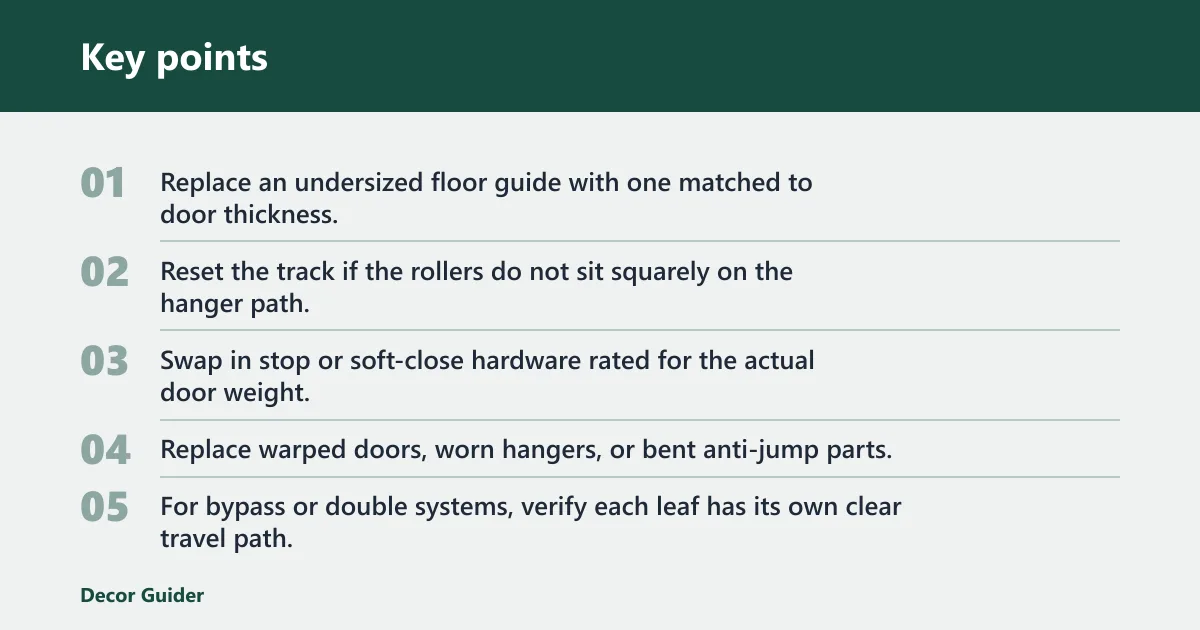
Escalation ladder
- Replace an undersized floor guide with one matched to door thickness.
- Reset the track if the rollers do not sit squarely on the hanger path.
- Swap in stop or soft-close hardware rated for the actual door weight.
- Replace warped doors, worn hangers, or bent anti-jump parts.
- For bypass or double systems, verify each leaf has its own clear travel path.
Picture a roughly 90-pound bypass door with two panels and a guide sized for a single leaf. The outer panel may still drift even after the stop is adjusted, because the guide and clearance are wrong for the system layout.
Common mistakes
Most repeat failures come from using the wrong hardware size or correcting the wrong symptom. A floor guide will not fix an out-of-plumb wall by itself, and a hinge-pin tweak will not fix a sliding barn door. Warped doors and worn rollers can also bring the problem back.
- Using a guide that does not match door thickness
- Ignoring door weight when choosing stop or track hardware
- Assuming a swing-style fix works on sliding hardware
- Skipping the wall plumb check
- Leaving worn hangers, rollers, or anti-jump parts in place
- Failing to account for low-clearance bypass or double systems
Prevention
Before installing or replacing hardware, confirm door thickness, door weight, bottom clearance, and wall plumb. That quick check prevents most recurring drift, sway, and overswing problems. It also helps ensure the soft-close or stop kit is sized for the door load, which is especially important on heavier slab doors.
Frequently asked questions
Why does my barn door swing open by itself?
Out-of-plumb walls are a common cause, especially when the opening leans enough to let the panel roll to one side. Weak stops, a loose guide, or worn rollers can add to the problem. Check plumb before replacing hardware, because the wrong part may not be the real cause.
Can I adjust barn door hardware so it stays closed?
Yes, if the hardware is the issue. Adjust the stop position, verify the floor guide fit, and confirm the track and hangers match the door weight. If the door still will not stay put, replace the worn part instead of forcing more adjustment into a mismatched setup.
What if the guide fits, but the door still wanders?
Look at hanger spacing, track alignment, and wall plumb next. A guide can be correct and still fail if the track is out of line or the door panel is warped. Bypass and double systems need their own clearance checks because one leaf can influence the path of the other.
Products related to this article
Sponsored / affiliate links. As an Amazon Associate I earn from qualifying purchases. I may earn additional commission from eligible campaigns.