How to Fix a Sliding Closet Door That Keeps Coming Off the Track
Start with the failure pattern, not the symptom. A door that lifts out at the front usually points to roller height, stop placement, or a loose top-hung hanger. A door that jumps at the rear often points to a bent track, a misaligned floor guide, or a twisted frame that shifts the roller path.
Identify the door type before adjusting anything. Top-hung sliding doors ride on upper rollers, while bottom-guided systems use a lower guide channel to keep the panel centered. Bypass doors overlap on separate tracks, and bifold doors use pivots and hinges instead of a sliding roller path, so each fails differently.
Safety checks before rehanging the door


Safety note: use a step ladder for overhead hardware, not unstable furniture, and follow the manufacturer’s instructions for your model. If the track, hanger bracket, or frame is bent, stop and replace the damaged part instead of forcing the door back into place.
What you’ll need
- Phillips screwdriver for retaining screws and access hardware
- Step ladder for top-mounted rollers and stops
- Replacement roller or guide parts that match your model
- Vacuum or brush for debris in the track
- Soft cloth for wiping the track and guide channel
- Flashlight for checking bends, cracks, and missing fasteners
How do I diagnose the exact derailment?
Begin by watching where the panel leaves the track, then compare that spot with the hardware. A lift at the front usually means roller height or a stop issue, while a jump near one side often points to a bent rail or twisted opening. The goal is to match the fault before you adjust anything.
- Open and close the door slowly while watching the top rollers and bottom guide.
- Note whether the panel lifts, rubs, or jumps at the front, center, or rear.
- Check whether the same spot fails every time or only under load.
- Inspect the guide, stops, and track for looseness or missing fasteners.
- Compare the symptom to the door type: top-hung, bottom-guided, bypass, or bifold.
If the panel only derails when it is halfway open, that usually points to a localized roller, guide, or track problem rather than a door that is loose everywhere. A consistent failure point is the best clue that the track path is bent, the frame is twisted, or the guide is set too tight.
How do I get it back on track?
Lift the panel into the track, then check that both rollers sit squarely before you let go. If the door has a bottom guide channel, confirm the guide is not blocking the panel or pinching a wheel. If the panel only dropped because it was bumped loose, reseating may be enough.
- Open the door far enough to see both roller points.
- Lift with both hands and set the top rollers back into the track.
- Lower the door slowly and watch whether it stays centered.
- Check the floor guide or bottom channel for obstruction.
- Test the door through the full travel before you reinstall any cover parts.
If the door derails at one repeatable spot, do not keep forcing it back into place. That pattern usually means the track or guide is out of line, and repeated reseating can chip the door edge or deepen a bend in the rail.
How do I inspect rollers, stops, and guides?
Worn rollers are a common failure point, especially when the wheel has flat spots, chips, or a cracked bracket. The same goes for a floor guide that is cracked or loose; it keeps the door aligned, and once it breaks, the panel can wander off line. Closet doors rely on rollers, stops, guides, and catches working together.
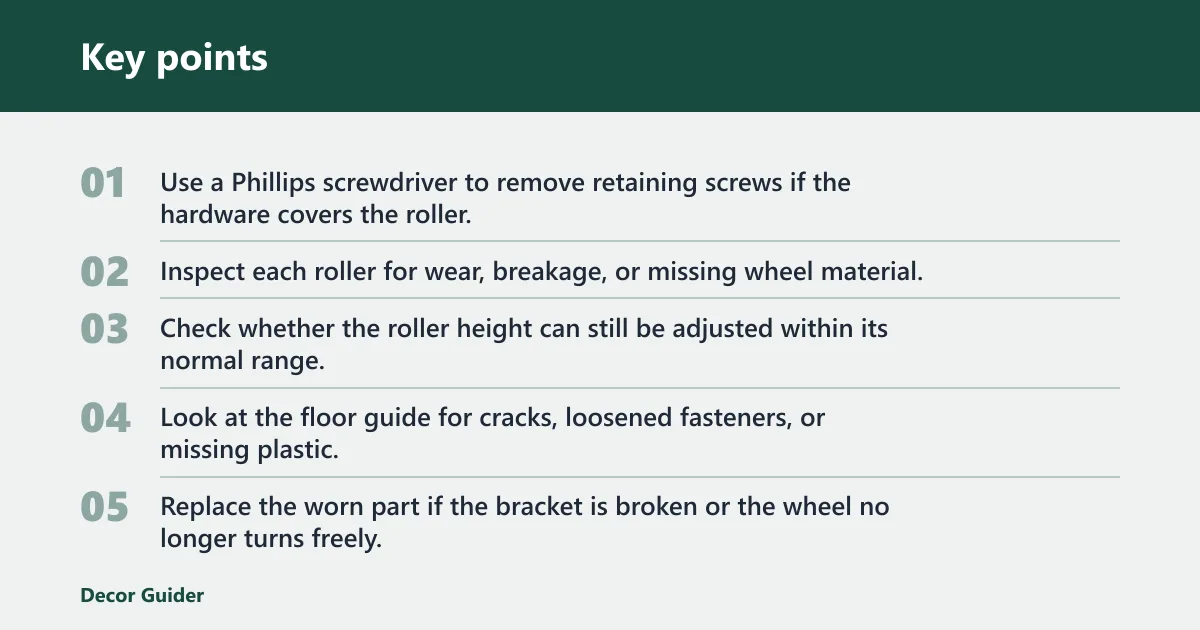
- Use a Phillips screwdriver to remove retaining screws if the hardware covers the roller.
- Inspect each roller for wear, breakage, or missing wheel material.
- Check whether the roller height can still be adjusted within its normal range.
- Look at the floor guide for cracks, loosened fasteners, or missing plastic.
- Replace the worn part if the bracket is broken or the wheel no longer turns freely.
Look closely at the anti-jump or retainer hardware on top-hung systems. If a clip is missing, loose, or bent away from the track, the roller can lift out under load even when the door otherwise slides smoothly. A door stop that is shifted too far back can create the same symptom by letting the panel travel farther than the hardware can hold.
How do I clean a sliding closet door track?
Clean the track only after you have checked for bends or damage, because dirt is not the only reason a door derails. If the track is sound, remove dust, hair, and grit from the top track and any bottom guide channel, then test the door dry before adding lubricant. Lubricant should not be the first fix when the hardware is bent or broken.
- Vacuum the track and guide channel.
- Brush out hair, grit, and packed debris.
- Wipe the running surface with a soft cloth.
- Inspect for dents, lifted edges, or corrosion.
- Apply lubricant only if the hardware is sound and the manufacturer allows it.
Humidity can swell wood components and corrode metal tracks, which can make the door jump off even after a thorough cleaning. If the door still binds in the same spot after cleaning, suspect a bent section rather than more debris.
When is a bent track the real problem?
A bent track is the likely fault when the door derails at the same point every time, scrapes in one section, or leaves the track with a visible hitch. Lubrication will not straighten metal. If the track rail or hanger bracket is distorted, replacement is usually the better move than repeated adjustment.
- Roll the door slowly and mark the spot where it binds.
- Look for a kink, dent, or bowed section at that spot.
- Check whether the rollers sit level before the bend.
- Replace the damaged track section if the panel still jumps after a clean, dry test.
- Call a pro if the frame or hanger bracket is distorted.
If the door is smooth on one side but jumps on the other near the closet opening, that pattern points to a localized track problem, not a full-door cleaning issue. A bent rail and a twisted frame can look similar, so check whether the opening itself is square before replacing hardware.
Should I replace the rollers on an off-track closet door?
Replace the rollers when the wheel is broken, the bracket is cracked, or the door keeps dropping even after a correct reseat. Re-seating works when the roller is intact and only slipped out. Replacement is better when the hardware is worn enough that it cannot hold height under the door’s weight, especially with mirrored panels.
- Remove the door far enough to reach the roller assembly.
- Compare the damaged roller with the replacement part before installing it.
- Install matching rollers in pairs when the hardware wears unevenly.
- Reinstall the door and adjust only as much as the model allows.
- Test the door through full travel with no load on the panel edge.
Before you replace anything, check the roller height adjustment range. If one side sits lower than the other, the door can ride up against the stop or climb out of the track even when the wheel itself is still intact. Proper adjustment often matters as much as the part condition.
What causes a closet door to keep coming off track?
The usual causes are worn rollers, a cracked floor guide, debris in the track, or a bent section that changes the roller path. Recent flooring changes can also matter. New carpet, thicker flooring, or humidity-driven swelling can change clearance and make a previously stable door derail.
- Check whether the derailment started after flooring work or seasonal swelling.
- Measure whether the bottom guide still centers the panel after the change.
- Inspect roller height and wheel wear on both sides.
- Clean the track, then retest before swapping parts.
- Replace the matching failed part instead of adjusting everything at once.
Top-hung sliding doors and bottom-guided systems fail differently. A top-hung door usually shows roller or stop trouble at the top, while a bottom-guided system may derail because the guide channel no longer holds the panel centered. Bypass doors add another layer because one panel can push the other out of alignment.
Derailment troubleshooting matrix
Use this matrix to match the symptom to the likely fault before you start replacing parts. A quick diagnosis saves time and keeps you from blaming the wrong component.
| Symptom | Likely cause | Quick check | DIY fix | Replace or call a pro |
|---|---|---|---|---|
| Door pops off at the same front corner | Roller height out of range | See whether one side sits lower | Adjust the roller and retest | DIY if the hardware is intact |
| Door jumps off halfway across the opening | Bent track section | Look for a kink or dent at that point | Replace the damaged section | Call a pro if the frame is distorted |
| Door derails after being slammed | Stop or roller shock damage | Inspect the stop and roller bracket | Re-seat and replace worn hardware | DIY if only hardware is bent |
| Door derails only after cleaning | Track damage exposed by the clean test | Roll the door slowly in the same spot | Fix the bend, not the dust | Call a pro if the rail is warped |
| Door rubs after carpet replacement | Clearance changed | Check the guide and bottom gap | Re-center or swap the guide | DIY if the door still hangs square |
| Door wobbles and falls out with weight | Worn rollers or cracked bracket | Look for flat spots or loose wheels | Install matching replacement rollers | DIY if the hanger bracket is sound |
| Door slides but will not stay aligned | Cracked floor guide | Check for broken plastic | Replace the guide | DIY; fast fix if parts match |
| Door still derails after new rollers | Track or frame distortion | Inspect the rail and opening for twist | Stop forcing it | Call a pro |
What mistakes make the problem worse?
Do not spray lubricant first and call the job done. If the track is bent, lubrication only hides the symptom for a short time. Do not force the panel back onto the track if the roller is cracked, because that can chip the door edge or damage the rail.
Do not confuse sliding hardware with bifold door hardware. Bifold doors use pivot brackets and bottom pivot pins, so the repair path is different. A sliding-door fix that targets rollers and guides will not solve a bifold alignment issue.
Do not use a stable-looking chair as a substitute for a step ladder. Top-mounted hardware needs safe access, and a slip at the top of a closet can cause more damage than the original derailment.
How do I stop a sliding closet door from coming off again?
Prevent repeat derailment by keeping the track clean, replacing worn rollers before they crack, and checking the guide after any flooring change or humidity swing. If the door starts to bind after a remodel, recheck clearance instead of assuming the same adjustment will still work.
- Vacuum the track and guide channel during regular cleaning.
- Inspect rollers for wear before they fail.
- Check the guide after carpet, tile, or floor height changes.
- Confirm that stops and retaining screws stay tight.
- Replace damaged hardware before the door starts riding crooked.
Track repair or roller replacement is usually straightforward when the frame is square and the hardware still matches. Once the rail or hanger bracket is distorted, recurring derailment usually means the repair has moved beyond a simple adjustment. If the opening is out of square, a repeated adjustment will not hold for long.
Frequently asked questions
Why does my sliding closet door keep falling off?
Most repeat derailments come from worn rollers, a cracked guide, debris in the track, or a bent rail. Match the fix to the symptom. If the door drops in one spot, inspect the track there first; if it wobbles everywhere, inspect the rollers and guide.
How do I fix a sliding closet door that fell off?
Lift the panel back into the track, then test for smooth travel before tightening hardware. If the door falls off again, replace the worn roller or cracked guide rather than repeating the reseat. Use a Phillips screwdriver for the retaining screws if your model uses them.
How do I get a sliding closet door back on the track?
Set both rollers into the track, lower the door slowly, and check that the guide channel does not block movement. If the panel will not stay centered, remove the door again and inspect the rollers for flat spots or broken brackets.
Should I repair or replace the door hardware?
Choose repair when the problem is limited to worn rollers, loose stops, or a cracked guide and the frame is still square. Choose replacement when the rail is bent, the hanger bracket is distorted, or the door keeps derailing after correct adjustment. The right choice depends on whether the structure is still true.
| Problem | Usually worth repairing | Usually worth replacing |
|---|---|---|
| Loose stop, dirty track, or loose guide | Yes | No |
| Worn roller or cracked wheel | Yes | No |
| Anti-jump clip missing or bent | Yes | No |
| Bent track or warped rail | Sometimes, if a short section can be replaced | Usually yes |
| Twisted frame or distorted hanger bracket | No | Usually yes |
| Door still derails after correct roller adjustment | Sometimes, if another part is clearly damaged | Often yes if the opening is out of square |
Products related to this article
Sponsored / affiliate links. As an Amazon Associate I earn from qualifying purchases. I may earn additional commission from eligible campaigns.