How to Fix a Barn Door That Jumps Off the Track
Fix a barn door that jumps off the track by finding the cause first: level the track, tighten lag bolts, confirm wheel alignment, and keep about 1/8 to 1/4 inch of guide clearance. If you only rehang it, the door will derail again and can damage the track, rollers, or wall. This guide shows how to diagnose alignment, support, rollers, and guides, then reseat the door safely.
What you’ll need


- Spirit level at least 24 inches long
- Tape measure
- Socket wrench or ratchet for lag bolts
- Phillips and flathead screwdrivers
- Hex keys or Allen wrenches for hanger bolts
- Clamp or locking pliers to hold the door if needed
- Flashlight or inspection light
- Replacement rollers, hangers, or track section if wear is visible
- Replacement floor guide parts: C-guide or T-guide, as matched to the door
- Wood shims for minor leveling corrections
- Mounting board or header board materials if the support has failed
- Safety glasses and work gloves
Derailment diagnostic table
Read the table from symptom to fix priority. Start with the highest-risk problem first: a loose support, a bent track, or a damaged roller can keep defeating every rehang attempt.
| Symptom | Likely cause | Check to perform | Fix priority |
|---|---|---|---|
| One-sided drop | One hanger is loose, worn, or out of square | Measure hanger height from floor on both sides; compare the roller position to the track centerline | Tighten or replace hangers first |
| Grinding | Wheel wear, flat spots, or debris in the track | Spin each roller by hand and inspect for flats, rough spots, or metal shavings | Clean, then replace rollers if noise remains |
| Roller chatter | Axle or hanger bolt is loose | Check for play at the axle and hanger fasteners | Tighten hardware before rehang |
| Track gap | Track is not level or mounting board is flexing | Level the full track length and look for spacing between track and wall | Rebuild support before using the door again |
| Door sway | Bottom guide is missing, loose, or the wrong type | Check whether the door can swing away from the wall at the floor | Install or replace the guide |
| End-of-track impact | No stop, weak stop, or stop placed too close to the edge | Confirm the stop sits where the hanger cannot run off the end | Add or reposition track stops |
| Repeat derailment after rehang | Track, rollers, or hinge alignment is still out of spec | Measure alignment again with the door fully closed and fully open | Replace the failed part, not just the door position |
| Door jumps near one end only | Bent track section or damaged stop zone | Roll the hangers through the problem area and watch for binding | Straighten or replace the track |
| Door rubs the floor | Uneven floor or guide set too tight | Check floor height at both ends of the opening | Reset guide height and clearances |
| Door pulls away from the wall | Insufficient overlap or wrong door-to-opening sizing | Measure overlap at both sides of the opening | Adjust door sizing or hardware placement |
| Hardware loosens again | Soft drywall anchoring or fastener pullout | Inspect screw holes for elongation, crush, or pullout | Rebuild the mounting support |
If a roughly 84-inch opening has a door that tracks well in the middle but pops near one end, that suggests a localized track, stop, or roller issue. That points more to a bent track section, missing stop, or roller defect on that side than to a general rehang problem.
Suppose the door came off after a year of use and now rattles at the hanger. That is a wear problem until proven otherwise, especially if the wheel shows flats or the axle nut will not stay tight.
Why does a barn door jump off the track?
A barn door jumps when the track, roller, or hinge alignment drifts out of spec. The failure can start with one loose hanger, a bent section of track, a weak mounting board, or a floor guide that no longer keeps the door centered.
What derailment usually looks like
You may see the door lean to one side, scrape at one point, or lift as it rolls. Grinding, chatter, and a door that swings away from the wall at the bottom are early warnings. A stop that lets the hanger hit the end of the track is another common sign.
When the problem is the door, not the track
If the track is level and the mount is solid but one hanger keeps dropping, the door itself may be the issue. Check wheel material, flat spots, bearing wear, and hanger compatibility with the track profile. Some replacement rollers fit poorly even when they look close.
- Stop moving the door and leave it where it is.
- Clamp or lock the door if it can swing free.
- Check the full track for bends, open joints, and loose lag screws.
- Check both rollers for flats, wobble, and tightness.
- Confirm the bottom guide still holds the door centered.
How do you put a barn door back on the track?
Put the door back only after you have checked the support, rollers, and stops. Lift the hangers onto the track by hand, one side at a time, and do not pry the door into place with the handle or push hard against the edge. Then test the full travel slowly. If it derails again in the same spot, the damaged part is still in place.
- Clear the opening and remove obstacles near the floor.
- Support the door with a helper, clamp, or locking pliers if needed.
- Lift the hangers onto the track one side at a time.
- Center the rollers on the track and confirm the wheels sit flat.
- Move the door by hand from end to end.
- Reset the stops so the rollers cannot run off the ends.
- Set the floor guide gap back to 1/8 to 1/4 inch before full use.
Use the rehang as a test, not a cure. If the door still rides high on one side or catches near the stop, stop there and return to the diagnostic table.
Can you mount the track directly to drywall?
Barn door track generally needs solid backing, such as a mounting board or header board fastened into studs or solid blocking. Drywall alone can crush, flex, or pull out under the moving load, which is how a door can begin to sway, drop, and derail again.
Header board thickness and stud spacing
Use solid wood blocking or a ledger/header board, not thin trim. Fasteners should hit framing at regular stud spacing, often around 16 inches on center in many homes, but confirm your wall layout before drilling. The board must stay flat across the full track length.
Fastener type and length to check
Use lag screws or structural screws long enough to pass through the board and bite well into framing. For a loose wall, remove the hardware and rebuild the support rather than adding more screws into weakened holes. Fastener pullout is a support failure, not a cosmetic issue.
- Locate studs with a stud finder and mark each one.
- Inspect the board for flex, split wood, or elongated holes.
- Replace undersized fasteners with structural screws or lag screws.
- Re-seat the board against solid framing before rehanging the track.
How do you stop it from jumping again?
Stop repeat derailment by matching the guide, track, and door size to the opening. A guide keeps the door from swinging, but it cannot fix bent metal or weak mounting. Track length, overlap, clearance, and stop placement all have to work together.
Choose the right floor guide
RealCraft says the C-guide cups the bottom of the door, while the T-guide requires a slot cut into the bottom edge of the door. Use the style that matches the door profile and installation plan. Set guide clearance in the 1/8 to 1/4 inch range so the door can move without dragging.
Check track length, clearance, and overlap
This Old House recommends a hardware track twice the width of the opening. The same source recommends at least 1 inch of door-to-frame overlap per side for doors up to 54 inches, and 2 inches per side for larger doors. Some classic hangers need 6 inches of ceiling clearance, and Aero Hangers need 5 1/2 inches.
Replace worn rollers, bent track, or weak stops
Track stops belong at the ends of travel, where they prevent runaway rollers. If the track has a kink, replace that section. If the wheel has a flat spot or the axle will not stay tight, replace the hanger set with compatible parts from the same hardware family.
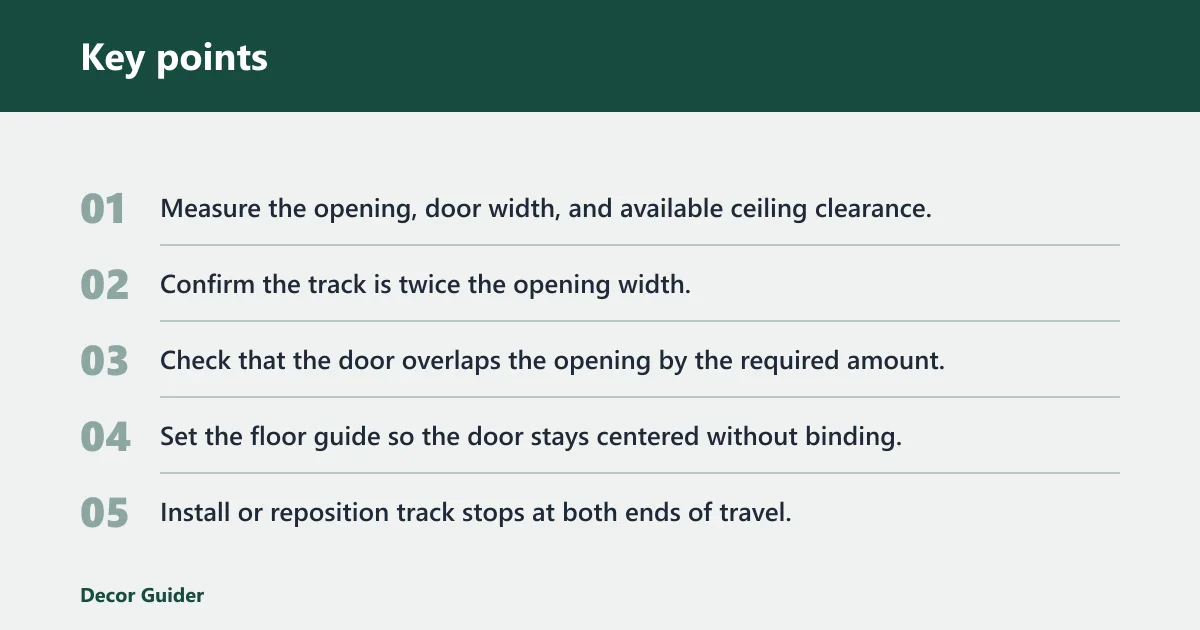
- Measure the opening, door width, and available ceiling clearance.
- Confirm the track is twice the opening width.
- Check that the door overlaps the opening by the required amount.
- Set the floor guide so the door stays centered without binding.
- Install or reposition track stops at both ends of travel.
- Replace any wheel, hanger, or track section that shows wear.
What parts wear out first? Usually the rollers, then the hanger bolts, then the stop hardware. A soft mounting board can fail early too, especially if the wall was only tied to drywall.
Common mistakes
The fastest way to repeat the failure is to force the door after it derails. That can bend the track, damage the hangers, or widen a weak fastener hole.
- Forcing the door instead of stopping and inspecting first
- Cleaning debris but ignoring a bent track or loose support
- Using the wrong floor guide for the door bottom
- Mixing rollers from a different hardware kit
- Skipping the stop hardware at the track ends
- Mounting into drywall with no solid backing
- Ignoring repeat chatter after a rehang
If the door still sways after a clean rehang, the guide or mounting support is still wrong. If it only fails at one end, suspect the stop zone or a bent section near that end.
Frequently asked questions
Why does my barn door jump off the track?
It usually means alignment, support, rollers, or guidance has drifted enough for the hanger to climb, bind, or drop. Check the track for level, the rollers for wear or flats, and the mounting board for flex before trying another rehang.
What should I check first if a barn door came off the track?
Stop operating it and leave it where it is. Then inspect for a loose hanger, a bent rail, a missing stop, or a guide that no longer keeps the door centered. That order finds the failure before you add new damage.
How much clearance does a barn door need above the opening?
Clearance depends on the hanger style. The same source says some classic hangers need 6 inches between the door and ceiling, while Aero Hangers need 5 1/2 inches. Measure before you buy hardware so the rollers and track can fit without rubbing overhead.
What bottom guide should I use for a barn door?
Use a C-guide if you want the door bottom cupped, or a T-guide if the door has, or can accept, a slot cut into the bottom edge. Keep enough clearance for smooth travel, and anchor the guide so it actually stops swing.
Can I mount barn door track directly to drywall?
No. Use solid wood blocking, a ledger, or a header board fastened into studs or other solid framing. Drywall alone can compress and pull out under movement, which invites repeat derailment and hardware loosening.
How long should a barn door track be for my opening?
A common rule is a track that is twice the width of the opening. That lets the door clear the opening fully when it slides aside. Also confirm the door itself has enough overlap on each side to cover the opening properly.
Products related to this article
Sponsored / affiliate links. As an Amazon Associate I earn from qualifying purchases. I may earn additional commission from eligible campaigns.