How to Adjust a Door Threshold Height
Adjust a door threshold height only if the threshold has accessible screws and moving it changes the gap. If the door still drags, or the threshold is warped, replace the sweep, shim the sill, or replace the threshold instead. A poor fix leaves drafts, light leaks, water intrusion, and a rubbing door. This guide shows how to diagnose the problem and choose the right repair before you turn any screws.
Door threshold basics
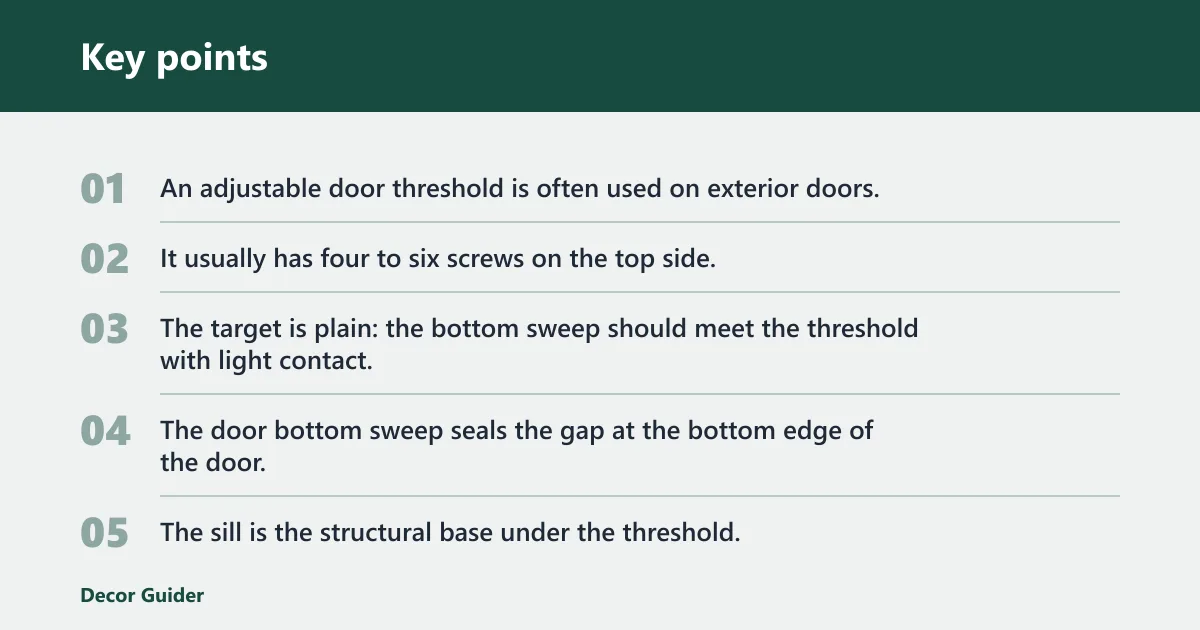


An adjustable door threshold is often used on exterior doors. It usually has four to six screws on the top side, and those screws move the threshold up or down. The target is plain: the bottom sweep should meet the threshold with light contact, not hard pressure.
The threshold works with three other parts. The door bottom sweep seals the gap at the bottom edge of the door. The sill is the structural base under the threshold. The subfloor beneath the sill must stay flat and sound, or the threshold can never sit correctly.
How the threshold, sweep, and sill interact
If the threshold is too low, you may see light, drafts, or a visible gap under the closed door. If it is too high, the door may scrape when you open it. If the sweep is worn, the symptoms can look the same as a bad threshold even when the threshold setting is fine.
That is why threshold height is a diagnosis step first. Adjusting screws helps only when the hardware can still move and the structure under it is sound.
📊 This Old House recommends a 3/4-inch-thick oak threshold for a retrofit. Source: How to Make an Exterior Door Threshold.
Threshold symptom decision table
Use the symptom first, then test the cause before adjusting anything. The right fix depends on whether the issue is the threshold, the sweep, the sill, or the floor under the opening.
| Symptom | Likely cause | Quick test | Correct action | When to replace |
|---|---|---|---|---|
| Light under door | Threshold too low or sweep worn | Close the door in a dark room and check for a visible gap | Raise the threshold evenly or replace the sweep if the rubber is worn | Replace if the screws strip, bottom out, or the threshold is warped |
| Dragging on opening | Threshold too high or door bottom too low | Open the door slowly and listen or feel for rubbing at the threshold | Lower the threshold evenly, then confirm the sweep still makes light contact | Replace if lowering does not stop the drag or the threshold surface is damaged |
| One-corner gap | Uneven threshold, sagging door, or uneven sill | Check whether the gap changes from latch side to hinge side | Check hinge sag, then inspect the sill and subfloor for flatness | Replace if the sill is rotted or the threshold cannot sit level |
| Water intrusion | Poor exterior seal, damaged threshold, or rotted sill | Look for staining, soft wood, or failed caulk at the exterior edge | Seal the exterior edge with 100% silicone or polyurethane and inspect the sill | Replace if rot is present or water keeps entering after sealing |
| Stripped adjustment screws | Worn fasteners or seized hardware | Turn a screw gently and see whether it slips or will not move | Stop forcing it; repair or replace the fastener set and check the threshold body | Replace if multiple screws are stripped or the threshold will not hold position |
Can you adjust a door threshold?
Yes, if it is an adjustable exterior threshold with accessible screws and the structure under it is sound. The screws can raise or lower the threshold, but they cannot fix a sagging door, a warped bottom edge, a rotten sill, or an uneven subfloor. Those problems need a different repair.
What the screws can and cannot fix
Threshold adjustment changes the seal line at the bottom of the door. It does not correct hinge sag, frame twist, or a door that is out of square. If the door closes with an obvious lean, the threshold may be only one part of the problem.
Say your exterior door shows a bright line of light at the latch side but scrapes near the hinge side when opening. That pattern points away from a simple threshold issue and toward door sag or an uneven opening.
When the problem is a worn sweep
A worn or missing door bottom sweep can mimic a low threshold. If the sweep is cracked, compressed flat, or missing sections, the threshold may already be high enough. Replace the sweep before you chase the screws farther upward.
When the threshold should be replaced instead
Replace the threshold when the adjustment screws strip, seize, or bottom out without changing the fit. Replace it also when the aluminum or wood body is warped, cracked, or water-damaged. A threshold that no longer sits flat will not seal consistently.
Find the top-side adjustment screws first. Most modern exterior thresholds use four to six screws across the width. Turn the screws clockwise to raise the threshold and counterclockwise to lower it. Make changes evenly across the width so one end does not climb higher than the other.
- Close the door and note where the gap or drag appears.
- Locate the adjustment screws on top of the threshold.
- Turn each screw in small, equal increments across the width.
- Check the door after each round of adjustments.
- Stop when the sweep makes slight, even contact and the door closes with slight resistance.
How to turn the screws evenly
Move the screws in the same direction and by the same amount. A threshold raised more on one side than the other can create a one-corner gap or a new drag point. Keep the changes small so you can stop before the door binds.
The correct setting leaves only slight resistance when the door closes. The sweep should touch the threshold, but the door should not need force to open or latch.
How do you know the threshold is too high or too low?
A threshold that is too low leaves an open gap beneath the closed door. A threshold that is too high causes drag when you open the door or can make the door feel tight at the bottom edge. The target is light, even sweep contact without binding.
Signs of a threshold set too low
If you can see light under the closed door, the threshold is likely too low or the sweep is worn. Drafts, pests, and noise can pass through that opening. Water can also blow in under the threshold on an exterior door.
Signs of a threshold set too high
If the door rubs when opening, the threshold is likely too high. You may also hear the sweep scrape hard across the top of the threshold. That is too much compression.
What acceptable compression looks like
A common rule of thumb is light contact across the width of the threshold. The sweep should flex just enough to close the gap and stop visible light. If the door has to be pushed hard to close, the threshold is too high.
A common first-timer mistake is adjusting the threshold only enough to stop a light draft, even though the door still drags on the jamb when it closes. That can create drag on one side and leave the other side loose.
Door threshold fix table
Use this table when the symptom stays after a basic adjustment. It separates threshold height issues from sweep wear, sill damage, and replacement sizing.
| Problem | What to check | What to do | Replacement notes |
|---|---|---|---|
| Light under the door | Sweep wear, threshold height, and evenness across the opening | Raise the threshold slightly or replace the sweep if the seal is worn | Replace the threshold if the screws no longer move it or the body is damaged |
| Dragging or binding | Threshold height and the door bottom edge | Lower the threshold evenly until the drag stops | If lowering does not help, inspect the door edge and hinge side for sag |
| Rotten sill or uneven subfloor | Soft wood, movement, or a slope under the threshold | Remove the threshold and repair or replace the sill or subfloor first | Seal after repair, then reinstall or replace the threshold |
| Replacement threshold sizing and sealing | Door opening width and exterior edge condition | Measure the opening between the jambs or stops and cut the replacement to fit snugly | Use exterior-grade sealant at the outside edge to reduce water intrusion |
When the sill or subfloor needs attention
Inspect the door sill if the threshold will not hold position, rocks when pressed, or shows staining and soft spots. Inspect the subfloor beneath it if the opening seems uneven from one side to the other. A threshold cannot compensate for rot or a soft base.
If the sill is damaged, seal or replace it before fine-tuning the threshold. If the subfloor is uneven, shimming or repair may be necessary so the new setting holds.
When replacement becomes the better fix
Replacement is the right step when adjustment no longer changes the fit or the threshold no longer seals in a stable way. For a retrofit, an oak replacement threshold is commonly 3/4-inch thick. It should be sealed and finished, and the replacement should match the measured door opening width so it fits snugly.
For exterior work, seal the bottom or outside edge with 100% silicone or polyurethane. That helps reduce water intrusion and the rot that follows it.
Should you adjust the threshold or replace the sweep?
Start with the sweep if the threshold is already near a good setting and the seal still fails. Start with the threshold if the sweep is sound but the gap is too large or the door drags only because the threshold sits too high. If the sill or subfloor is damaged, neither part will solve the problem alone.
How to inspect the sweep
Check whether the sweep is cracked, curled, uneven, or missing material. It should make slight, even contact with the threshold. If it barely touches in one area and leaves light in another, the sweep may be worn even if the threshold is set correctly.
How to check the sill and subfloor
Look for softness, swelling, dark staining, and movement under the threshold. Press along the base with a tool handle or fingertip. Any flexing or mushy feel points to structural damage, not a screw adjustment problem.
When to seal, shim, or replace
Seal the exterior edge when the threshold is sound but water can still work in from outside. Shim when the base is slightly uneven and the threshold needs support. Replace when the damage is beyond correction or the adjustment hardware has failed.
Picture a front entry where the door closes, but a sliver of daylight remains at the latch side. If the sweep is intact, a small clockwise adjustment across the threshold may solve it. If the light stays after the screws bottom out, the issue is likely the sill or the door itself.
Frequently asked questions
Can you adjust a door threshold: yes, on many exterior doors?
Yes, on many exterior doors with an adjustable threshold. Most modern versions use four to six screws on top. If the threshold is warped, stripped, or fixed in place, adjustment will not help and replacement may be the better repair.
How do I know if my threshold is too high or too low?
A visible gap under the closed door points to a threshold that is too low. Dragging when opening points to one that is too high. The target is slight, even sweep contact with no hard binding and no visible light at the bottom edge.
Should I adjust the threshold or replace the door sweep?
Replace the sweep if it is worn, cracked, or missing material. Adjust the threshold if the sweep is still sound and the gap changes with screw movement. If the seal still fails after both checks, inspect the sill and the subfloor.
What if the threshold is rotted or uneven?
Do not keep adjusting it. Rotten wood or an uneven base prevents a good seal and can cause repeated failure. Inspect the sill and subfloor first, then repair or replace the damaged parts before fitting a new threshold and sealing the exterior edge.
Products related to this article
Sponsored / affiliate links. As an Amazon Associate I earn from qualifying purchases. I may earn additional commission from eligible campaigns.