How to Fix a Door Threshold That Is Loose
Tighten or replace the fasteners first. If the threshold still moves, repair the substrate, replace a worn insert, or fix door alignment before you reinstall it. A loose threshold can let in water and air, create a trip hazard, and damage the floor below. This guide shows how to diagnose the failure mode and apply the right repair for an interior or exterior door.
What you’ll need


- Phillips and flathead screwdrivers
- Drill/driver with bits for pilot holes
- Replacement screws, preferably longer than the stripped originals
- Shims for leveling a loose threshold
- Utility knife
- Putty knife or thin pry bar
- Vacuum and stiff brush
- Exterior-grade silicone or polyurethane sealant
- Caulk gun
- Replacement threshold seal insert, if the rubber or vinyl strip is worn
- Use long hinge screws, about 3-inch, if the door is sagging.
- Hacksaw or circular saw for cutting a replacement threshold to length
- Safety glasses and gloves
Is the threshold loose or just misaligned?
Start by checking whether the threshold itself is moving, or whether the door is out of position and making the gap look wrong. A threshold can rock, lift at one edge, or stay firm while the door sweep misses it because the door sagged or the insert wore out.
Check for rocking, lifted edges, and loose fasteners
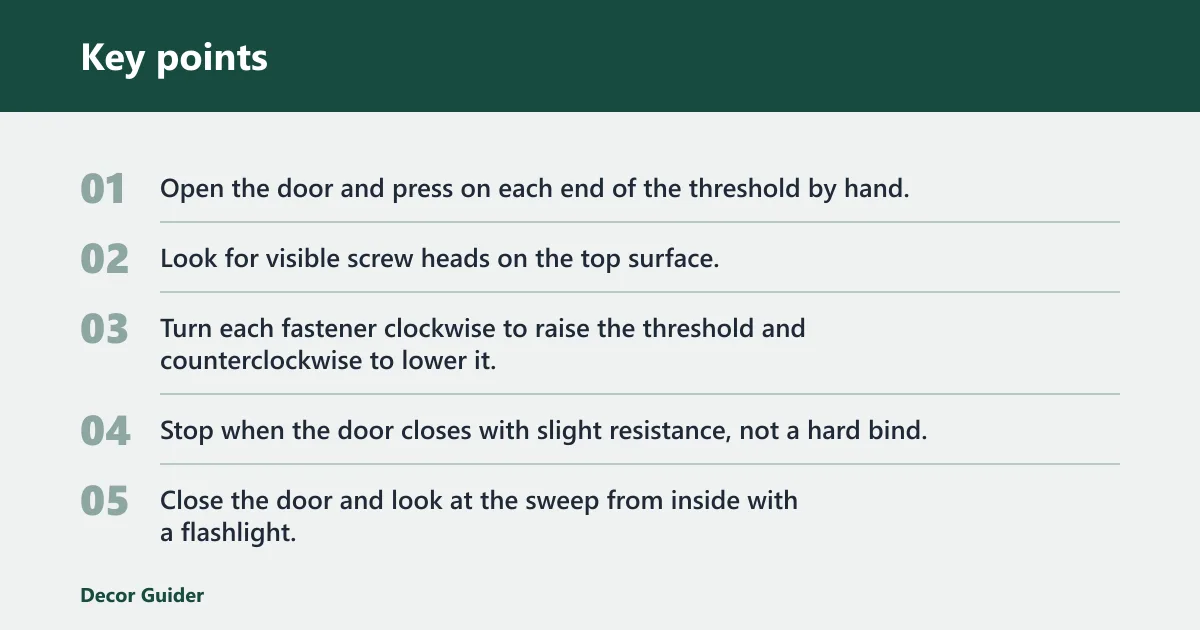
- Open the door and press on each end of the threshold by hand.
- Look for visible screw heads on the top surface; adjustable exterior thresholds often use four to six screws.
- Turn each fastener clockwise to raise the threshold and counterclockwise to lower it.
- Stop when the door closes with slight resistance, not a hard bind.
Say your aluminum threshold rocks at the latch side but the center stays flat. That usually points to one loose fastener or a stripped hole, not a failed door sweep. If the whole piece still moves, check the substrate before tightening anything further.
Confirm whether the door sweep is actually the problem
- Close the door and look at the sweep from inside with a flashlight.
- Inspect the bottom edge of the door for a missing, cracked, or curled sweep.
- Slide a sheet of paper under the door; if it moves easily where the sweep should touch, the sweep may be worn.
- Replace the sweep before replacing the threshold if the threshold itself is stable.
Look for signs of a damaged sill or subfloor
- Remove one threshold screw and probe the hole with a screwdriver.
- Press the surrounding wood or subfloor with a stiff tool.
- If the material feels soft, punky, or uneven, stop and repair the substrate first.
- For exterior doors, check the sill area for staining or rot before reinstalling the threshold.
Threshold and sill are related but not identical terms. The threshold is the transition piece across the opening; the sill is the lower structural part beneath it on many exterior doors. That distinction matters because a loose threshold fastens to something, and that something may be failing.
Fasten the threshold again only after you know the substrate is sound. If the wood below is solid, tightening, shimming, or re-anchoring usually solves the movement. If holes are stripped or the floor under it is uneven, a simple screw tighten will fail again.
Tighten visible screws and test for movement
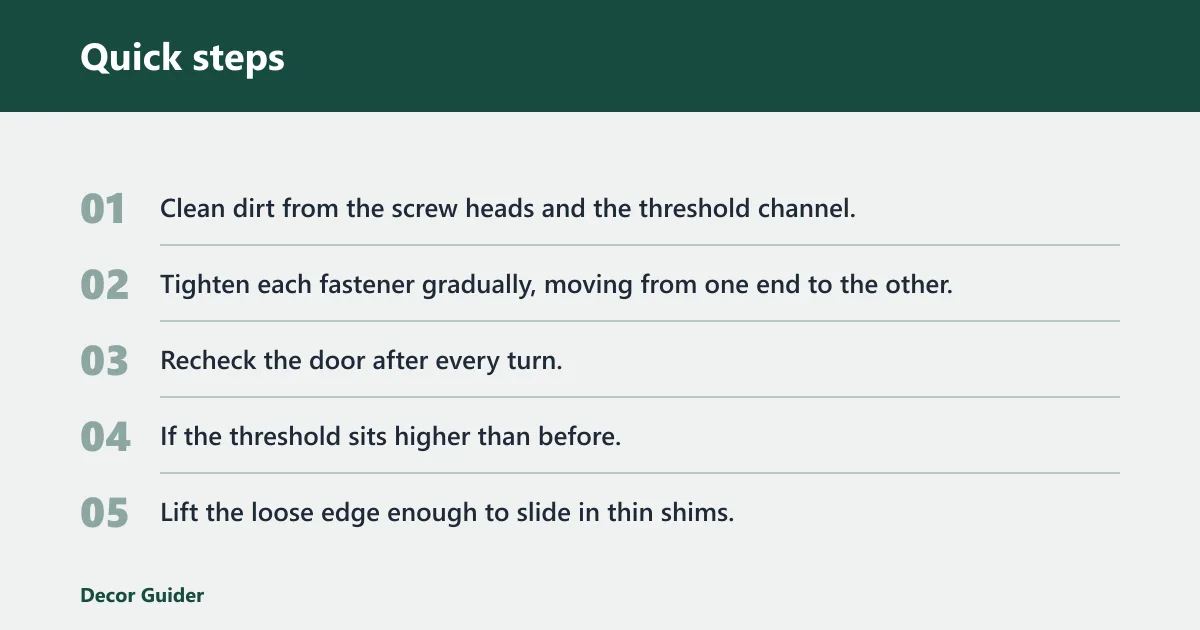
- Clean dirt from the screw heads and the threshold channel.
- Tighten each fastener gradually, moving from one end to the other.
- Recheck the door after every turn.
- If the threshold sits higher than before, back the screws off counterclockwise until the sweep just compresses.
Shim and re-anchor if the substrate is uneven
- Lift the loose edge enough to slide in thin shims.
- Place shims only where the gap exists, not across the full length unless needed.
- Pre-drill new holes into sound wood or the sill substrate.
- Reinstall screws so the threshold sits flat and does not spring back.
Suppose a wood threshold is loose at the center because the tile transition next to it shifted. Use shims to support the hollow spot, then re-anchor into solid material. If the threshold still rocks after that, the base beneath it is too damaged to hold fasteners.
Replace stripped fasteners or damaged anchors
- Remove the loose screw and inspect the hole.
- Choose a longer replacement screw if the base wood is sound deeper down.
- Fill badly stripped holes with a repair plug or move the fastener to fresh material.
- Retighten until the threshold stays fixed without cracking the surrounding material.
Longer hinge screws can solve a different problem: door sag. If the gap under the door appeared after the door dropped on its hinges, 3-inch screws in the top hinge can pull the door back into alignment and reduce false threshold wear.
How do you stop drafts or water?
Drafts and water entry need different fixes, even when they show up at the same opening. A worn insert or poor threshold adjustment usually causes air leakage. Water at the outside edge points to sealing failure, while a missing sweep or compressed weatherstripping can mimic a bad threshold.
Adjust an adjustable threshold for better sweep contact
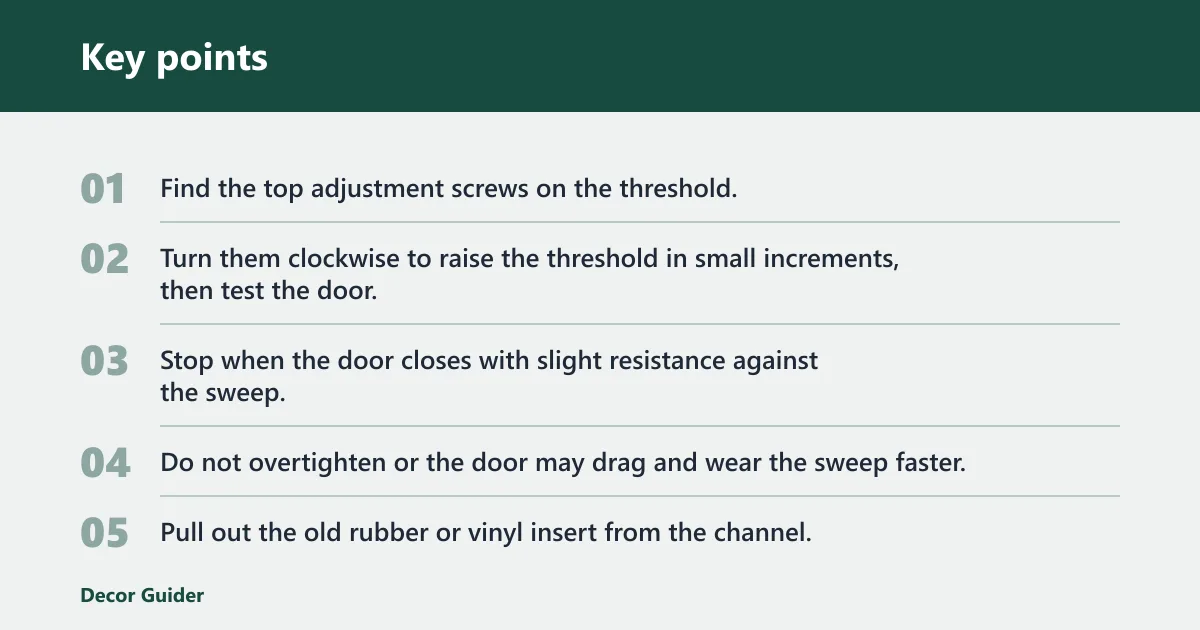
- Find the top adjustment screws on the threshold.
- Turn them clockwise to raise the threshold in small increments, then test the door.
- Stop when the door closes with slight resistance against the sweep.
- Do not overtighten or the door may drag and wear the sweep faster.
Replace a worn threshold seal insert
- Pull out the old rubber or vinyl insert from the channel.
- Match the replacement to the slot size; common styles use 3/8 or 1/2 inch T-slots.
- Press or slide the new insert fully into place.
- Trim the ends flush so they do not catch on footwear.
Threshold seal insert replacement is often the most common repair. If the aluminum body is sound but the insert has flattened, a new insert can fix the draft without replacing the whole threshold.
Seal the exterior edge with exterior-grade caulk
- Clean and dry the outside edge where the threshold meets the floor or slab.
- Apply silicone or polyurethane sealant only at the exterior edge, not across drainage paths.
- Smooth the bead so water sheds away from the opening.
- Allow the sealant to cure before foot traffic; a common rule of thumb is about 24 hours for some products.
Should you caulk under a door threshold? Use exterior-grade silicone or polyurethane at the outside edge when water is entering. Do not trap water on the interior side, and do not seal over a problem that still needs rot repair or re-fastening.
Threshold troubleshooting matrix
| Symptom | Likely cause | Confirmation test | Exact fix |
|---|---|---|---|
| Loose screws | Stripped fastener holes or a loosened adjustable threshold | Screw turns without pulling the threshold down | Replace the screw with a longer one, or move it into solid substrate |
| Lifted edge | Uneven substrate or failed fastener at one end | One end rocks when pressed by hand | Shim the gap, pre-drill, and re-anchor to sound material |
| Drafts only | Worn threshold insert, missing sweep, or compressed weatherstripping | Paper slides freely under the door, but the threshold does not move | Replace the insert, then inspect the sweep and jamb weatherstripping |
| Water intrusion | Outside edge not sealed or threshold pitched wrong | Staining or wetness appears at the exterior side after rain | Re-seal the outside edge with exterior-grade silicone or polyurethane |
| Trip hazard | Lifted threshold, warped material, or poor transition height | Toe catches on the edge or the piece sits above adjacent flooring | Re-anchor, level, or replace; keep transition height within 0.5 inches for accessible replacements |
| Threshold rocks when stepped on | Loose fasteners, bad substrate, or a cracked threshold body | Movement continues after screw tightening | Remove the threshold, inspect for rot, and replace damaged parts before reinstalling |
Repair or replace based on movement, material condition, and substrate health. If the threshold is sound and only the fasteners or insert failed, repair it. If the wood is rotten, the aluminum is bent, or the piece will not stay fastened, replacement is the better call.
When should you replace the threshold?
Replace the threshold when the body is cracked, warped, or too damaged to hold fasteners. Also replace it if the substrate beneath it is soft, the opening is badly uneven, or the threshold has become a repeated trip hazard. Full replacement starts with removing the screws and checking for rot below.
Check for rot, cracking, or warped material
- Lift the threshold enough to inspect the underside and the opening beneath it.
- Probe wood for softness and look for discoloration or crumbling edges.
- Inspect aluminum for bends, splits, or stripped screw channels.
- Replace stone, concrete, or wood pieces that no longer sit flat or safe.
Match replacement length and material to the opening
- Measure the opening width before you buy the replacement.
- Cut the new threshold to length with a hacksaw for metal or a circular saw for wood.
- Choose a replacement that matches the door use: interior, exterior, or transition between floor heights.
- For upgraded transitions, keep the accessible height in mind; 0.5 inches is the maximum mentioned for a threshold.
Aluminum thresholds are a common exterior choice because they do not rot or warp. Wood works for some interior openings, while stone, concrete, and rubber or vinyl styles appear in specific transitions. Match the material to the environment, not just the look.
If that didn’t work, try this next
- Check the door sweep again and replace it if it no longer touches the threshold.
- Check the jamb weatherstripping and replace cracked or compressed strips.
- Use about 3-inch hinge screws if the door itself has sagged and shifted the gap.
- Revisit the sill or subfloor if the threshold still moves after a fresh install.
Common mistakes
One common mistake is fixing the threshold when the door is sagging. That wastes time and leaves the gap unchanged. Another is caulking the wrong edge and trapping moisture where it should drain. A third is ignoring a worn sweep or compressed weatherstripping.
A loose threshold can be an interior problem, too. Foot traffic, flooring transitions, and loose anchors can make an interior threshold rock even when no rain is involved. Do not assume every loose piece is an exterior sealing failure.
Frequently asked questions
How do I know if my door threshold needs repair?
Press on it. A threshold that rocks, lifts at one end, or has loose screws needs repair. If drafts continue but the piece does not move, look at the sweep, weatherstripping, or insert first. Water stains, trip hazards, and stripped fasteners are stronger signs than air leaks alone.
Products related to this article
Sponsored / affiliate links. As an Amazon Associate I earn from qualifying purchases. I may earn additional commission from eligible campaigns.