How to Make a Bedroom Door Soundproof
Start with the largest leak: add a door sweep or draft stopper at the bottom gap, then apply adhesive weatherstripping to the jamb. Add a solid-core door or acoustic panels only if noise still passes through. If you leave the air gaps open, most hallway sound will still get in. This guide ranks fixes by noise type, cost, and lease limits so you can pick the smallest change that works.
How bedroom doors leak sound
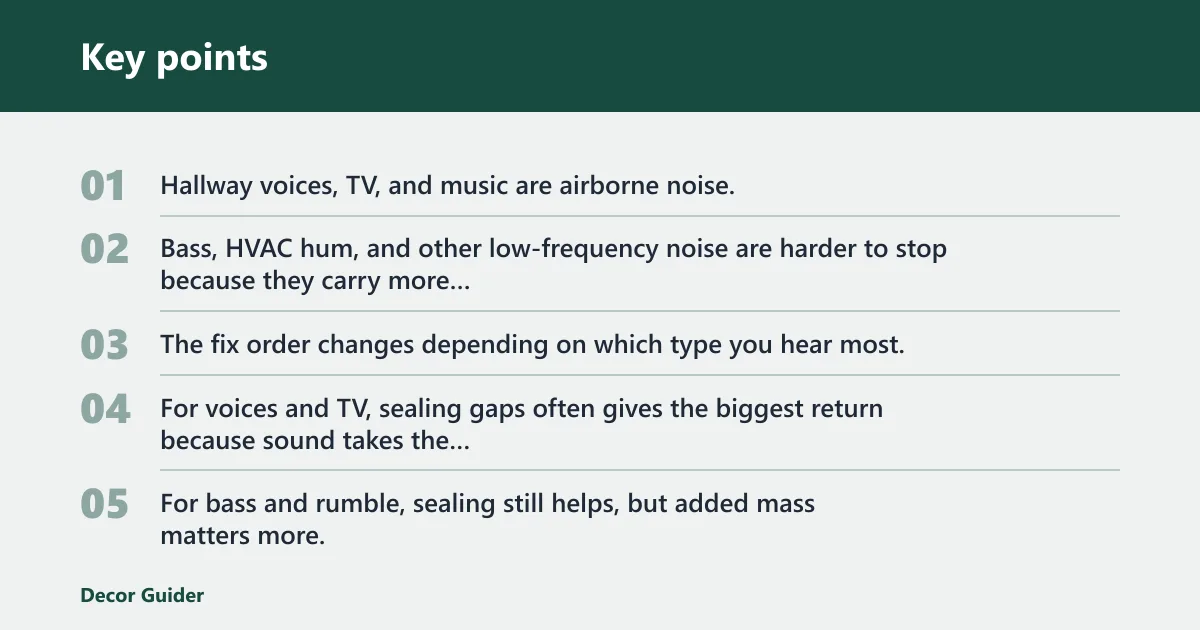


Hallway voices, TV, and music are airborne noise, so they move through gaps first and thin door construction second. Bass, HVAC hum, and other low-frequency noise are harder to stop because they carry more energy and can shake lighter doors. The fix order changes depending on which type you hear most.
Airborne noise versus low-frequency noise
For voices and TV, sealing gaps often gives the biggest return because sound takes the easiest path around the door slab. For bass and rumble, sealing still helps, but added mass matters more. Hush separates airborne noise from impact noise and notes that low-frequency noise is the hardest to stop.
Where leaks usually occur in the frame
Check the door frame and jamb at the top, hinge side, latch side, and bottom. Bob Vila identifies the door casing and threshold as leak points, and wikiHow includes a flashlight test for finding gaps. If you see light, sound has a path too.
📊 There are "2 primary strategies" for soundproofing a door. Source: Wikihow.
What you’ll need
- Adhesive or nailed weatherstripping in rubber or spring bronze
- A door sweep sized to the door width
- A snug threshold, if the bottom gap is still open
- Acoustic caulk for small cracks and frame penetrations
- Measuring tape and a pencil
- Utility knife or snips
- Screwdriver and drill/driver
- Optional mass-loaded vinyl for removable mass
- Optional replacement hardware for a worn latch or misfit sweep
Can you soundproof a bedroom door?
Yes, to a point. DIY fixes can cut hallway noise by sealing leaks, adding some mass, and improving the bottom edge, but they do not create full sound isolation. If the door is hollow-core or the noise is mostly bass, you may need a heavier replacement to get a noticeable change.
What DIY fixes can do
There are 2 primary strategies for soundproofing a door: seal leaks and add mass. wikiHow says most solutions require a few basic tools, and it recommends weather stripping around the doorframe plus an acoustic door sweep at the base of the door. Those changes attack the main sound paths first.
What they cannot do
DIY fixes rarely block low-frequency noise fully. Bass can still pass through the slab, the frame, and the wall around the frame. Acoustic panels may reduce echo inside the room, but they do not block hallway noise well because they treat reflections, not isolation.
When a full replacement makes sense
If the door is hollow-core, warped, or badly misfit, a solid-core door is usually the stronger upgrade. It is heavier, costs more, and blocks more sound than a hollow-core door. Use that route when sealing plus a sweep still leaves too much voice or TV bleed.
Seal the frame and jamb
Seal the perimeter first. That usually gives the best gain for the least money, especially for speech, TV, and music. Use weatherstripping around the full frame, then close any small gaps with acoustic caulk where the frame meets trim or where penetrations let sound through.
Install weatherstripping on the perimeter
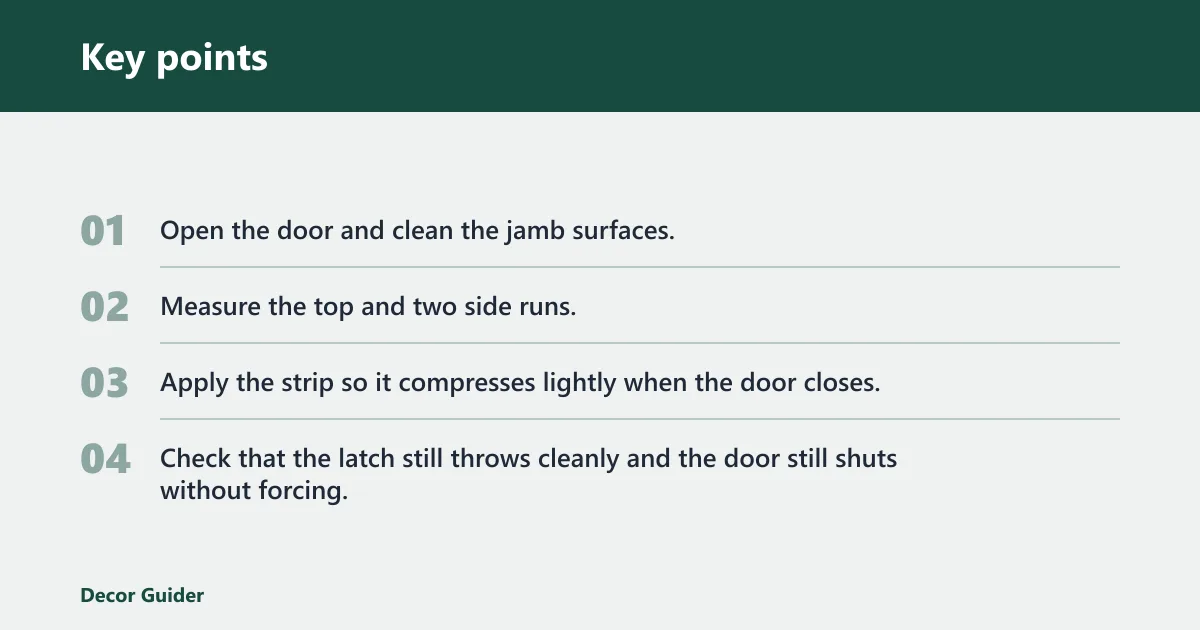
Choose rubber or spring bronze weatherstripping for the jamb and head stop. Spring bronze can last up to 30 years and is especially ideal for outside-facing doors. On interior bedroom doors, adhesive-backed strips are usually the easier renter-safe choice, while nailed strips are more permanent.
- Open the door and clean the jamb surfaces.
- Measure the top and two side runs.
- Apply the strip so it compresses lightly when the door closes.
- Check that the latch still throws cleanly and the door still shuts without forcing.
Seal small cracks with acoustic caulk
Use acoustic caulk for small cracks, trim gaps, and frame penetrations around the casing. It stays flexible, so it handles slight movement better than standard patching. Put it where the opening is narrow and stationary; do not use it where the door itself moves against the seal.
Check hinge, latch, and top gaps
Picture a 28-inch bedroom door in an apartment where voices from the hallway still sound sharp after weatherstripping. If the top corner near the latch still leaks, the problem is usually uneven contact, not missing caulk. Recheck the hinge side and latch side before buying a heavier fix.
Fix the bottom gap
The bottom gap is often the largest single leak. A door sweep blocks that opening, and a threshold helps it seal better. wikiHow recommends an acoustic door sweep at the base of the door, and Bob Vila notes the threshold as a common leak point.
Choose the right door sweep
Match the sweep to the door width so the seal covers the full opening. A sweep works best when it just brushes the floor or threshold. If it drags, it can stop the door from closing cleanly and can wear the bottom edge faster.
- Measure the door width before buying the sweep.
- Mount the sweep square to the bottom edge.
- Close the door and watch for drag or catching.
- Trim or reposition it if the latch no longer lines up.
Match the sweep to the threshold
A sweep works best with a snug threshold because the two parts close the floor gap together. If the threshold is missing or worn, a sweep alone may leave a sliver of space. That sliver matters for hallway voices and music.
Avoid drag and closing problems
Do not force a sweep so tight that the latch needs extra pressure. A misfit sweep can worsen latch alignment, scratch the floor, or make the door hard to shut. If the gap changes along the width, adjust the hinge side before trimming the sweep again.
Bedroom door decision table
| Scenario | Priority fix | Estimated cost band | Difficulty | Reversibility | Expected noise reduction |
|---|---|---|---|---|---|
| Renter | Adhesive weatherstripping plus a removable door sweep | Under $20 to about $60 | Low | High | Moderate for voices, limited for bass |
| Homeowner | Weatherstripping, sweep, acoustic caulk, then threshold tune-up | About $20 to about $120 | Low to medium | Medium | Moderate to strong for hallway speech |
| Hollow-core door | Seal first, then add mass or replace the slab | About $60 to several hundred dollars | Medium | Low to medium | Moderate if sealed; stronger with replacement |
| Solid-core door | Perimeter sealing and bottom-gap control first | About $20 to about $150 | Low | Medium | Good for voices; limited on deep bass |
Which door upgrade works best?
If sealing alone is not enough, add mass next. Mass-loaded vinyl is useful when you want a removable or reversible option, while a solid-core door is the better buy when you want the strongest lasting improvement. Choose based on door type and lease limits, not on price alone.
Add mass with removable materials
Mass-loaded vinyl adds weight to the door and helps with airborne noise after the leaks are controlled. It is most useful when you cannot replace the slab. Use it when the frame already seals well and the remaining problem is thin construction rather than a big gap.
When MLV is worth it
MLV makes sense for renters who want more reduction without replacing the door. It is also useful when the door is decent but still transmits speech. If the frame leaks badly, fix the perimeter first; extra mass on a leaky door wastes money.
When a solid-core door is the better buy
A solid-core door is the higher-cost, higher-performance upgrade. It outperforms a hollow-core door because the denser slab resists airborne noise better. Use it when you want a long-term fix and the lease or budget allows a permanent change.
Common mistakes
Acoustic panels are often bought too early. They can reduce echo in the bedroom, but they do little to stop hallway noise at the door. Another common problem is blocking the latch or sweep clearance, which turns a sound fix into a closing problem.
- Do not buy panels before sealing the perimeter.
- Do not over-tighten weatherstripping so the door rebounds open.
- Do not choose a sweep that drags across the floor.
- Do not expect bass or HVAC hum to vanish with seal-only fixes.
A common first-timer mistake is adding a heavy sweep to a door with a crooked strike plate. The door then sounds better at the edges but will not latch cleanly, so the gap returns every time the door sits ajar. Fix the alignment before adding more material.
If that didn’t work, try this next
If voices still carry after sealing, add mass to the slab. If bass or rumble still passes through, a solid-core replacement is the next meaningful step. If the room is still noisy after that, the sound may be traveling through the wall or ceiling around the door rather than through the door itself.
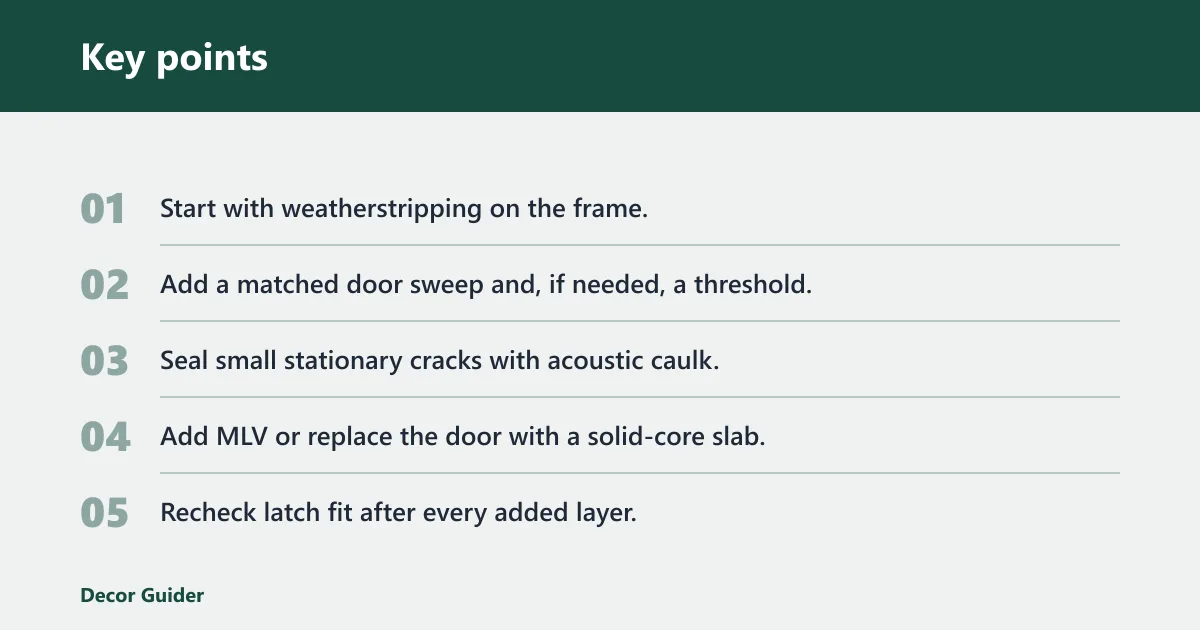
- Start with weatherstripping on the frame.
- Add a matched door sweep and, if needed, a threshold.
- Seal small stationary cracks with acoustic caulk.
- Add MLV or replace the door with a solid-core slab.
- Recheck latch fit after every added layer.
Suppose a hallway with one music-heavy neighbor keeps sending bass through a bedroom door. Sealing the frame may soften the top edge of the sound, but the remaining rumble usually points to the slab itself. That is the point where added mass or replacement matters most.
Keep the bottom seal clean and check it after seasonal shifts, because small warps and settlement can reopen the gap.
Frequently asked questions
How to make a bedroom door more sound proof
Focus on the frame, jamb, and bottom edge first. A sweep, matched threshold, and perimeter seal usually help more than room decor. If the door is hollow-core, added mass or a replacement slab will likely be needed for a stronger result.
Can you soundproof a door?
You can often reduce door noise a lot, but full sound isolation is not realistic with DIY alone. Sealing and mass can cut hallway voices and TV sound well, yet low-frequency noise often still gets through. The best outcome comes from combining gap control with a denser door.
Products related to this article
Sponsored / affiliate links. As an Amazon Associate I earn from qualifying purchases. I may earn additional commission from eligible campaigns.