How to Replace Sliding Closet Door Rollers
Replace sliding closet door rollers by first confirming the fault is in the wheel, hanger, or adjustment screw. If the wheel is cracked, flat-spotted, seized, or cannot be raised enough, remove the door and match the replacement to the original mount. If you miss the real cause, the door can keep dragging, jump the track, or bend the frame. This guide shows how to diagnose the problem, choose the right part, and swap the rollers safely.
What you’ll need


- Phillips head screwdriver
- Sturdy step stool or ladder for upper fasteners
- Second person if the panel is heavy, mirrored, or oversized
- Replacement roller assembly that matches door thickness, track style, and housing profile
- Cleaning cloth
- Vacuum or brush for dust, grit, and small debris in the track
- Cleaning lubricant only after the track is clean and only if the roller type calls for it
How to tell if the rollers are the problem
Start by separating a roller failure from a track, alignment, or adjustment problem. Top-hung sliding closet doors usually ride in the upper track, and the rollers hang from that track. If the door still binds after a height adjustment, inspect the track, guide, and mounting hardware before you order parts.
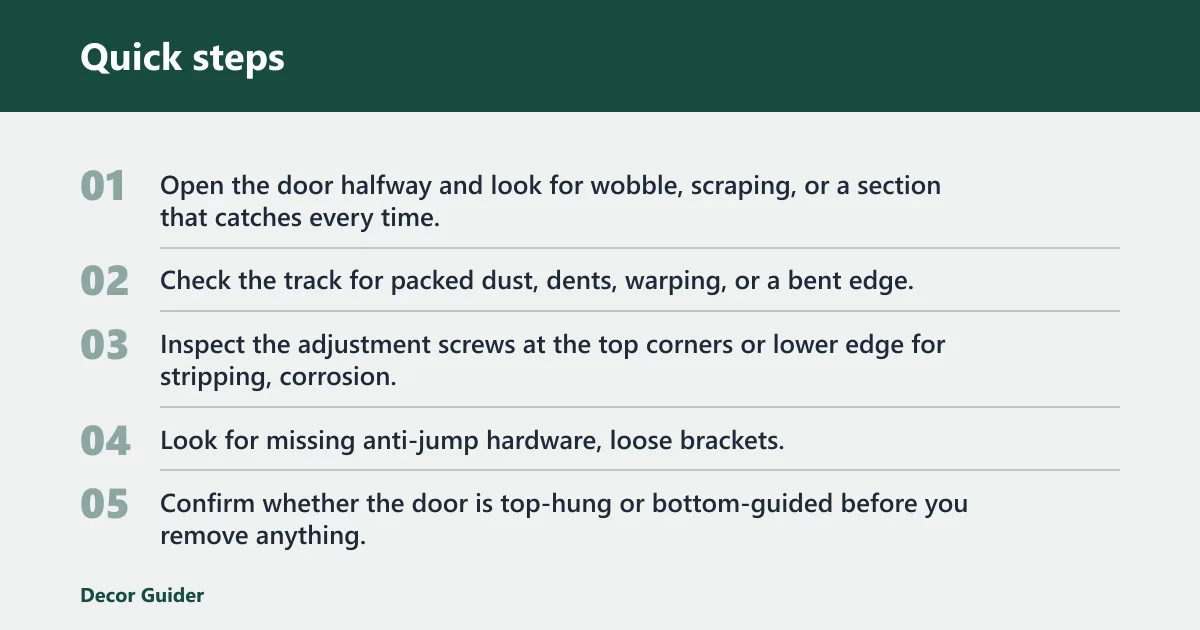
Use this diagnosis first
- Open the door halfway and look for wobble, scraping, or a section that catches every time.
- Check the track for packed dust, dents, warping, or a bent edge.
- Inspect the adjustment screws at the top corners or lower edge for stripping, corrosion, or a rounded head.
- Look for missing anti-jump hardware, loose brackets, or a wheel that sits crooked in the hanger.
- Confirm whether the door is top-hung or bottom-guided before you remove anything.
Say your mirrored panel slides fine for 2 feet, then sticks at the same spot every time. That usually points to track damage or debris at that location, not a bad wheel. If the problem moves after cleaning and height adjustment, the roller is more likely at fault.
Suppose the door drags only when it closes fully and the lower edge scuffs the floor guide. That often means the panel is out of alignment, not that both rollers failed. A stripped adjustment screw can create the same symptom, so inspect the screw head before ordering replacements.
Sliding closet door roller diagnosis and parts-match checklist
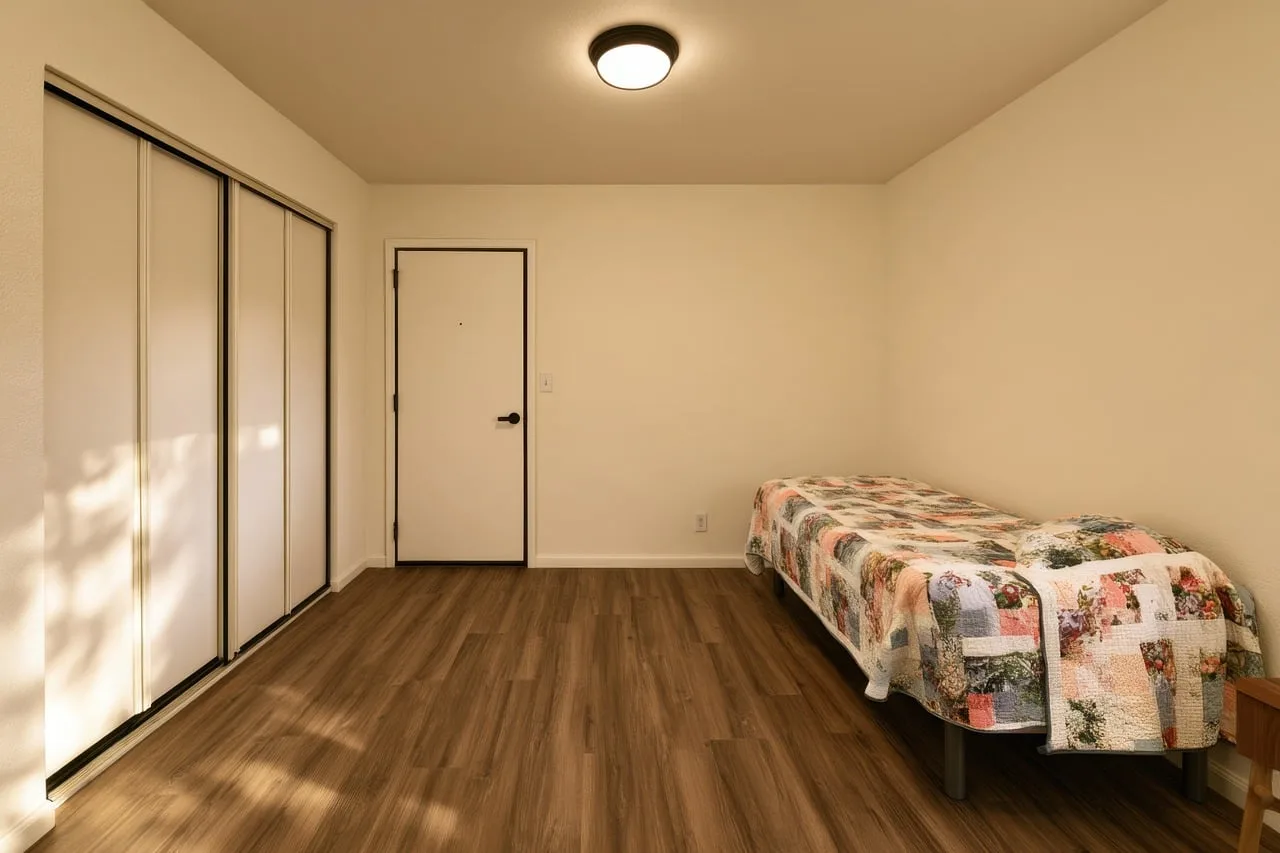
Use the symptom and the hardware shape together. A roller swap is worth doing when the wheel is cracked, seized, or bent, but a warped track or mismatched hanger can also cause a new roller to fail quickly. Match by stamp, housing profile, side orientation, and door thickness.
| Symptom | Likely cause | What to measure | Replacement part clues | Repair, adjust, or replace the track? |
|---|---|---|---|---|
| Door scrapes only at one spot | Dirt in the top track or bottom guide | Track opening and any dented section | Clean track first; no part change yet | Repair or clean |
| Door will not stay level | Adjustment screw issue or worn hanger | Screw travel, hanger slot position, door thickness | Top-corner mount, reversible or side-specific | Adjust first, replace roller if still off |
| Wheel rattles or binds | Seized, cracked, or flat-spotted wheel | Wheel diameter and housing profile | Match wheel type and bracket shape | Replace roller |
| Panel jumps the track | Missing anti-jump hardware or wrong roller | Mounting points and clip locations | Match side orientation and anti-jump style | Repair hardware or replace roller |
| Track is visibly bowed | Warped or damaged track | Straightness across the full run | Track replacement part, not just rollers | Replace track |
| Door hangs uneven after new rollers | Mismatch in thickness, mount, or side | Door thickness and stamp on old assembly | Brand stamp, housing profile, reversible or side-specific | Adjust or replace the roller assembly |
How do you remove the door safely?
Remove the panel only after you know whether it is top-hung or bottom-guided, because the sequence is different. Heavy or mirrored panels are commonly removed with a second person.
Removal steps
- Move the door to a clear section of the opening.
- Place a sturdy step stool or ladder where you can reach the upper fasteners safely.
- Loosen or remove the top-corner screws that retain the rollers or hangers.
- Lift the panel upward to clear the lower guide or runner, then angle it out of the opening.
- Set the panel on a padded, stable surface before touching the rollers.
For bottom-guided systems, do not force the panel upward as if it were top-hung. The lower guide or runner may hold the door in a different way, and forcing the wrong sequence can bend the frame or chip a mirrored edge. Check the manufacturer’s listing for your model if the hardware layout is not obvious.
How do you identify the correct replacement roller?
The correct roller is the one that matches the original mount, door thickness, track style, and housing profile as closely as possible. The roller assembly can include the wheel, bracket, and mounting hardware, and many versions are reversible or side-specific. Match the door thickness, track style, and housing profile before you buy.
What to look for on the old part
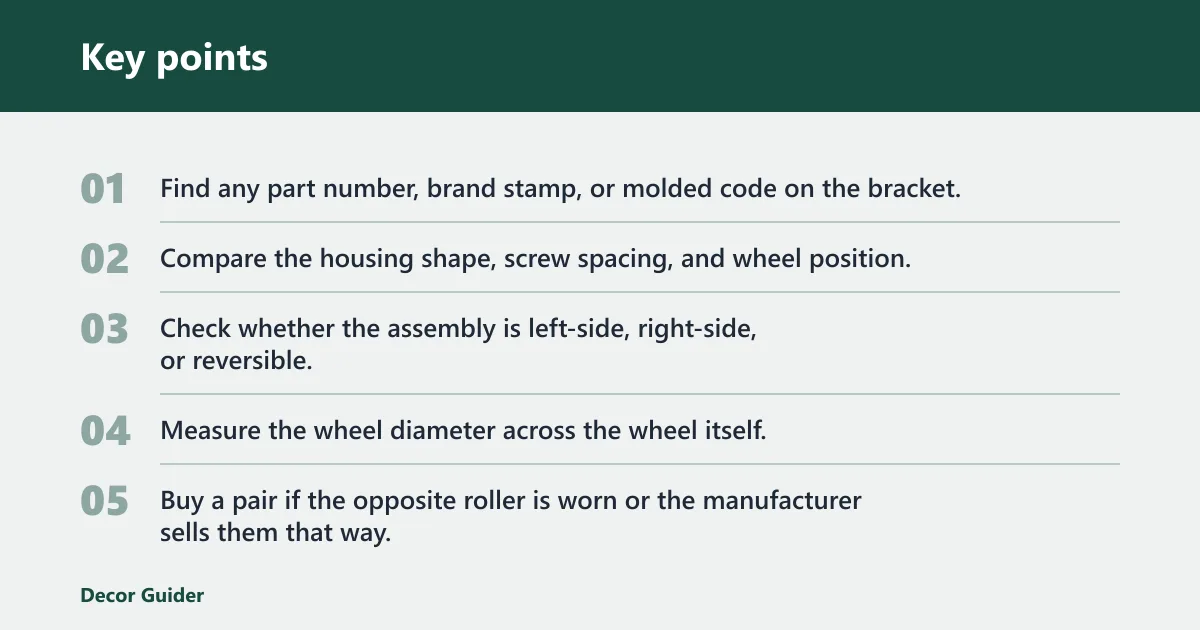
- Find any part number, brand stamp, or molded code on the bracket.
- Compare the housing shape, screw spacing, and wheel position.
- Check whether the assembly is left-side, right-side, or reversible.
- Measure the wheel diameter across the wheel itself, the bracket offset from the mounting face to the wheel centerline, and the screw spacing center to center.
- Buy a pair if the opposite roller is worn or the manufacturer sells them that way.
A common first-timer mistake is to order by wheel shape alone. Two assemblies can use the same-looking wheel and still fail to fit because the bracket offset, screw spacing, or door thickness may differ. If the listing does not match your stamp or housing profile, keep looking.
Replace the roller assembly
After removal and part matching, swap only the roller assembly that fits your door and track style. Do not mix a top-hung hanger with a bottom-guided part.
Installation steps
- Remove the old roller screws with a Phillips head screwdriver.
- Keep screws and brackets in order so you can compare the old and new pieces.
- Install the matched roller assembly without over-tightening soft or stripped screw holes.
- Confirm the bracket sits flat and the wheel turns freely.
- Repeat on the opposite side only if the hardware pair is worn or sold as a pair.
If a screw head is stripped, stop before the bracket twists. A damaged fastener can distort the mount and make the new roller sit at an angle. In that case, repair the fastener hole or replace the mounting hardware specified for your model.
Adjust the door and test the track
Clean the top track and bottom guide before rehanging the panel. Cleaning comes before lubrication, because dust and grit can turn a good roller into a sticky one.
Rehang and tune the alignment
- Hang the panel back in the top track or guide, following your door style.
- Turn the adjustment screws with a Phillips screwdriver to raise or lower the roller assembly.
- Adjust in small increments, then test the door after each change.
- Repeat until the door moves without rubbing the frame or guide.
- Apply lubricant only if the track and roller type call for it; nylon rollers and clean metal tracks usually work best dry or with silicone, while heavy oil can attract dirt.
If the door still drags after alignment and cleaning, the track may be bent or worn beyond a simple tune-up. That is the point where roller replacement stops helping. A warped upper track or damaged bottom runner should be replaced instead of masked with lubricant.
Common mistakes
Most bad repairs come from buying the wrong part or trying to fix worn hardware with lubricant alone. Track damage, missing anti-jump hardware, and stripped adjustment screws are common failure cases, and they need separate fixes.
Avoid these errors
- Buying a roller without checking side orientation or housing profile
- Using lubricant to hide a cracked wheel or bent track
- Skipping the track inspection after the new roller goes in
- Forcing a top-hung removal sequence on a bottom-guided door
- Ignoring mirrored or heavy panels that need a second person
How to replace sliding closet door track parts comes down to straightness and wear. If the existing track is bowed, gouged, or badly worn, a new roller will not solve the problem.
Frequently asked questions
How to fix sliding closet door top track without replacing it
If the top track is only dirty or slightly out of alignment, clean it thoroughly and check the hanger adjustment first. If the track is bowed, crushed, or cracked, a non-replacement fix will not last. At that point, replace the track section that no longer holds the rollers in line.
Products related to this article
Sponsored / affiliate links. As an Amazon Associate I earn from qualifying purchases. I may earn additional commission from eligible campaigns.