How to Add a Lock to an Interior Door Without Drilling
Choose a no-drill interior-door lock by matching three things: the door’s swing, the handle style, and the level of resistance you need. A privacy handle, add-on slide bolt, or wedge-style stop each solves a different problem. Pick the wrong type, and the door can still open, bind against the frame, or leave marks that need repair later. This guide shows how to choose the right temporary method for renters, students, and homeowners without drilling.
Choose the right no-drill lock


Start with door swing, then check the handle, then decide whether you need privacy or stronger resistance against entry. A simple wedge can often handle short-term privacy on an inward-opening door, but performance still depends on floor grip and latch geometry. For more force resistance, move to a portable lock, security bar, keyless reinforcement lock, or a door barricade that anchors to the floor. Consumer safety guidance from CPSC and building-code style egress rules also favors temporary devices that do not block a fast exit or interfere with fire-door operation.
Quick checklist before you choose
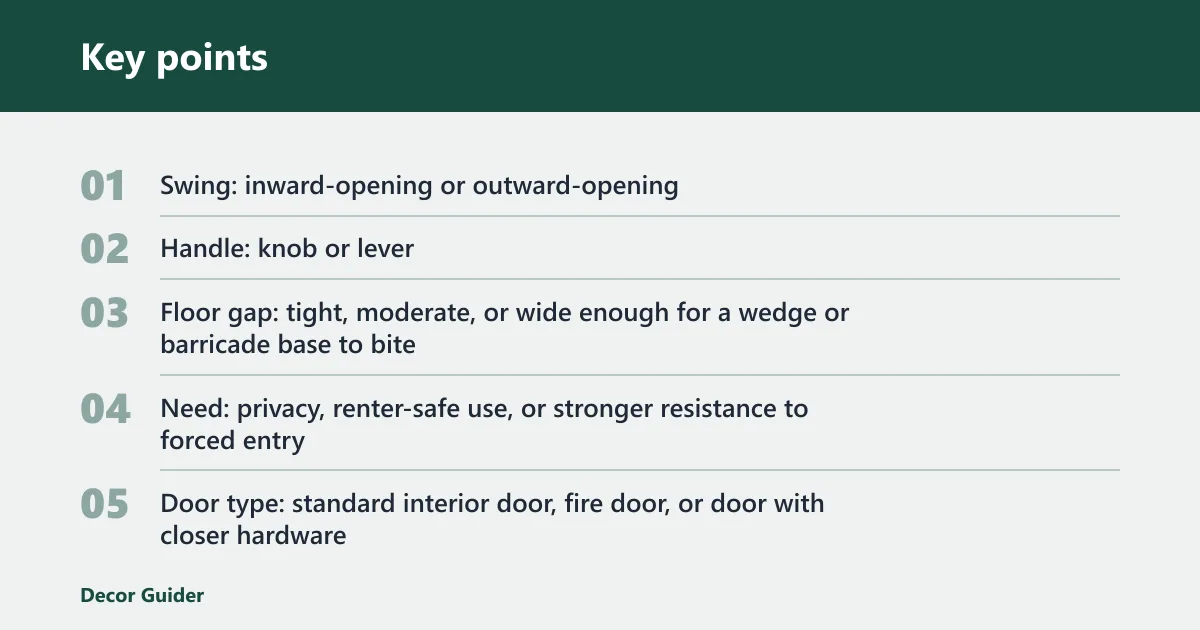
- Swing: inward-opening or outward-opening
- Handle: knob or lever
- Floor gap: tight, moderate, or wide enough for a wedge or barricade base to bite
- Need: privacy, renter-safe use, or stronger resistance to forced entry
- Door type: standard interior door, fire door, or door with closer hardware
Inward-opening doors
Most no-drill options are made for inward-opening doors. Portable door locks, security bars, wedges, keyless reinforcement locks, and many barricades fit this direction, although exact fit still depends on the latch shape and product design. That is why renters and travelers often start here. A wedge is the simplest and cost-effective choice, but it only works with inward opening doors and a floor surface that gives it traction.
Outward-opening doors
Out-swing doors are the weak point for most temporary products. Portable door locks are usually less effective on outward-opening doors, and security bars are generally not suited to that setup because they need the door to push into the device. For an outward swing, a belt or rope tether, or a stronger floor-anchored barricade, is usually the better temporary route if the hardware and surrounding structure allow it.
Knobs vs. levers
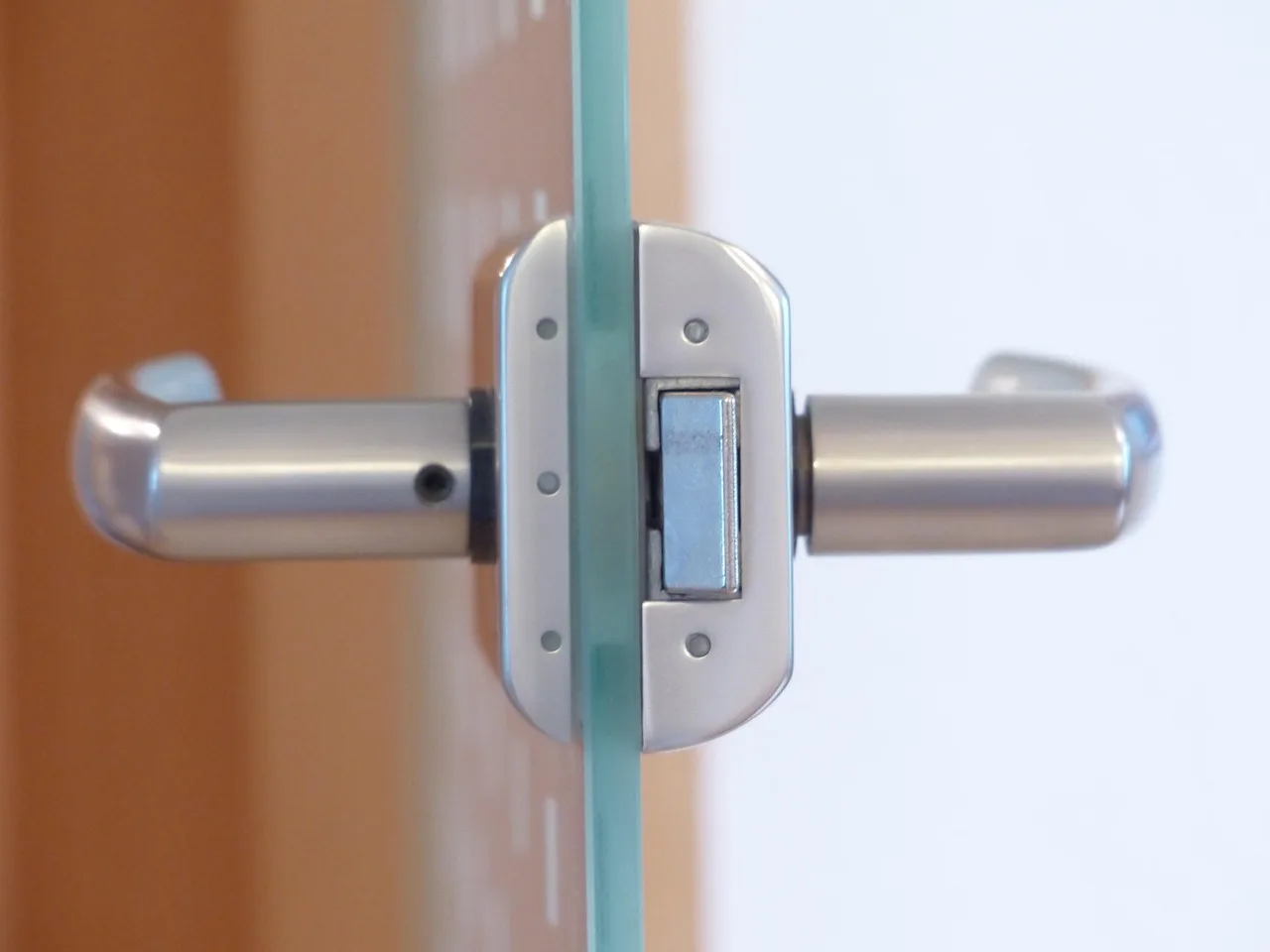
Handle style changes the fit. Portable door locks usually work best when they can fit over the bolt or latch on the existing door knob. Lever handles are often better for chair barricades and belt or rope tethers because the handle itself can be trapped or tied off. If the lever moves upward freely, a chair can fail, and if the handle is too loose or too high, the tether may not hold as intended.
Security vs. privacy needs
Privacy means blocking casual entry. Anti-entry means resisting a push, shoulder, or repeated force. A wedge or chair may be enough for privacy, but those choices are not the same as forced-entry resistance. A security bar, keyless reinforcement lock, or door barricade is better when you want added resistance against someone trying the door from the outside.
Interior door lock options table

This table compares the main no-drill choices by fit, speed, reuse, and where they fail. It also ranks them by common scenarios so you can choose a best fit before you buy or improvise anything.
| Ranked recommendation by scenario | Option | Best for | Door swing | Handle type | Install time | Reuse | Damage risk | Security strength | Do not use when | One-line winner for this door/handle combination |
|---|---|---|---|---|---|---|---|---|---|---|
| Best for inward knob privacy | Portable door lock | Renter-friendly inside privacy on a standard in-swing knob door | Inward only | Best with knob latch; often poor on lever setups | Very fast | High | Low | Good for privacy; moderate for entry resistance | Do not use on outward-opening doors or where the latch geometry does not seat cleanly | Best choice when an inward knob door needs fast, removable privacy with minimal setup. |
| Best for inward lever resistance | Door barricade | Stronger temporary resistance on an in-swing door with a lever or knob | Inward most commonly | Any handle type | Moderate | High | Low | Strongest temporary option here | Do not use where there is no stable floor space or the base plate cannot sit flat | Best choice when an inward lever door needs the strongest temporary resistance without drilling. |
| Best for outward-opening doors | Belt or rope tether | Temporary restraint when the door swing points outward and the handle can be captured | Better on outward doors; usable on inward doors too | Especially useful for lever handles | Fast | High | Low to moderate | Light to moderate | Do not use if the fixed anchor moves, the handle has too much travel, or the tether can slip off | Best choice when an outward-swing lever door needs a temporary hold and the anchor point is stable. |
| Best rental-safe pick | Doorstop wedge | Simple privacy on an in-swing door with a reliable floor surface | Inward only | Any handle type | Fastest | High | Low | Light | Do not use on smooth floors, wide floor gaps, or when you need meaningful forced-entry resistance | Best choice when you want the simplest renter-safe privacy fix and the door opens inward. |
| Runner-up for inward privacy | Door security bar | Added resistance on an inward-opening door | Inward only | Works with most handles | Fast | High | Low | Strong | Do not use on outward-opening doors or where the bar cannot brace against a stable surface | Best choice when an inward door needs stronger push-back than a wedge can provide. |
| Emergency-only backup | Chair barricade | Short-term blocking when you need something immediately and have a solid chair | Inward; can work on some outward doors only as a crude block | Best with lever handles; can work on knobs that open inward | Fast | High | Low | Light to moderate | Do not use as a long-term fix or when the handle can move upward and the chair can slip | Best choice only in a pinch when a lever door needs a fast block and no purpose-made device is available. |
| Emergency-only backup | Fork latch trick | Very temporary workaround at the latch area | Inward only | Any handle type; uses strike plate/latch area | Slower | Low | Moderate | Light | Do not use when the latch gap is tight, the fork bends too far, or you need dependable security | Best choice only when an emergency workaround is needed and the latch gap is compatible. |
| Best for added hardware-style resistance | Keyless reinforcement lock | Quick-install reinforcement on compatible in-swing doors | Inward only | Works on interior and exterior doors | Quick | High | Low | Strong | Do not assume it is universally no-drill or suited to out-swing doors; some models still require mounting | Best choice when you want a stronger add-on for an inward-opening door and the product matches the frame. |
What you’ll need
Gather the right items before you start. That keeps you from forcing the wrong method onto the wrong door.
- Portable door lock, if the door swings inward and you want a renter-friendly option
- Door security bar or door barricade, if you need stronger force resistance
- Doorstop wedge, if you only need temporary privacy
- Chair with a solid backrest, if you are using the chair barricade method
- Belt, rope, or similar strap, if you are tying off a lever or handle
- Fork, if you are attempting the fork latch trick as an emergency workaround
- Keyless reinforcement lock, if you want a quick-install add-on for an in-swing door
- Clean cloth, so you can wipe dust from the latch, frame, or floor contact points
How can I add a lock to an interior door without drilling?
Match the method to the swing first, then the handle, then the gap at the latch or floor. For an inward-opening bedroom door, the simplest path is a wedge or portable door lock. For an outward-opening door, skip inward-only tools and choose a tether or other temporary barrier that does not depend on the latch face. Temporary devices are most useful for short-term privacy, travel, rentals, or emergency hold situations, not as a substitute for a properly installed lockset.
Step-by-step fit check
- Check whether the door opens inward or outward.
- Measure the handle type by sight: knob or lever.
- Look for a wide floor gap or latch-side gap, because that affects wedges and fork tricks.
- Choose the lightest option that matches your need: privacy, renter-safe use, or stronger resistance.
- Install the method exactly as intended, then close and open the door once to confirm it catches.
- Add a top-up adjustment only where it helps, such as sliding a wedge in by about 1/2 inch at a time and rechecking the door after each move.
Suppose a student room has a knob and an inward-opening door with a narrow floor gap. A portable door lock or wedge is usually the cleanest choice. Suppose the same room has a lever handle and a wide bottom gap instead. A chair barricade or tether becomes the better fit, because the first setup may slip or fail to catch. If the door is a fire door or has a closer, temporary blocking should be treated cautiously because those doors need to close and latch reliably.
Which method is easiest for a bedroom door?
The fastest temporary choice is usually a wedge, because it takes almost no setup and works on inward-opening doors. If you want something still simple but more resistant, a portable door lock or security bar is a better fit. For renters, the key test is reversibility: it should come off cleanly and leave no damage, while still matching the door’s swing and latch design.
Fastest options for privacy
A wedge is the quickest privacy fix. A chair under a lever can also work fast, but it is less dependable if the handle moves upward or the chair slides on the floor. These are emergency or short-use choices, not long-term answers, and chair or fork-style hacks can damage hardware or trim if forced.
Best options for renters
Portable door locks are marketed for renters and travelers, require no tools for installation, and are suitable only for securing the door from the inside. A keyless reinforcement lock is another renter-friendly option when the door is in-swing and you want a stronger add-on without drilling, though some models still use mounting hardware and are not universally no-drill.
Best options for stronger resistance
For stronger resistance, start with a security bar or a door barricade. A security bar is designed to resist significant force. A door barricade uses a barrier and base plate and is usually more durable than lighter temporary methods. Both are better than a wedge when you are trying to stop a harder push, especially on standard residential doors that still need to open quickly from the inside.
Can a portable door lock work on your door?
It can, but only if the door swing and latch shape match the product. Portable door locks are useful for renters and travelers, require no tools for installation, and are suitable only for securing the door from the inside. They are usually less effective on outward-opening doors and often fit best on knob-style hardware, though the exact result depends on product design and latch geometry.
When it fits a knob latch
Use it when the device can sit over the existing knob bolt or latch area without binding. That makes sense on many inward-opening interior doors with standard knobs. The fit should feel snug, not forced.
When it fails on levers or outward swings
Lever handles can leave too much movement for some portable locks, and outward-opening doors can block the locking angle altogether. If the door opens out, use a different method. If the lever can still travel upward, a chair or tether may also fail, especially if the handle does not present a stable anchor point.
How to spot a poor fit quickly
If the device rocks, leaves a large gap, or cannot seat fully against the latch area, stop. A poor fit means the door can still open under pressure. That is the moment to switch to a security bar, wedge, tether, or barricade that matches the door better and does not depend on a marginal latch fit.
Common mistakes to avoid
Most failures come from choosing the wrong method for the door, not from the product itself. Out-swing doors, loose handles, and wide gaps are the usual problem points. Hollow-core interior doors can also give a false sense of security if you expect them to stop force on their own, and fire doors or closers should not be blocked in a way that defeats normal closing and latching.
- Using an inward-only tool on an outward-opening door
- Trusting a lever that can still move upward
- Assuming a wedge will hold on a smooth floor with a wide gap
- Using a chair when the backrest does not sit firmly under the handle
- Relying on a temporary hack for long-term security
- Choosing a method that marks paint, trims rubber, or scrapes the frame
For example, if a bedroom door has a lever and about a 3/4-inch gap at the floor, a wedge may slide and a portable lock may not seat cleanly. In that case, a belt or rope tether around the lever, paired with a more stable anchor, is a better temporary choice than forcing the wrong fit. This is one of the clearest cases where the door’s geometry matters more than the brand name on the device.
Frequently asked questions
What is the easiest temporary lock for a bedroom door?
A doorstop wedge is usually the easiest, because it is simple and cost-effective and works with inward opening doors. If you need more resistance, move up to a portable door lock or security bar. The easiest choice is not always the strongest one, and the best option still depends on floor grip and door swing.
Will a portable door lock work on my interior door?
It will work best on an inward-opening interior door with a knob-style latch it can fit over. It is suitable only for securing the door from the inside. If the door opens outward or the latch area is awkward, choose another method, since performance varies with product design and latch geometry.
How do I secure an inward-opening interior door without drilling?
Pick between a wedge for privacy, a portable door lock for renter-friendly use, or a security bar or door barricade for more force resistance. If the handle is a lever, a chair or belt tether may be the better temporary fit. Match the tool to the hardware first, and avoid assuming a privacy fix will also provide strong forced-entry resistance.
Can I lock an interior door from the inside without damaging it?
Yes, usually. Portable door locks, security bars, wedges, tethers, and many keyless reinforcement locks are designed for temporary use and removal. The main risk is not permanent damage from the product itself, but using the wrong method and scratching paint, trim, or hardware during setup. Chair and fork hacks are best treated as emergency-only options.
What can I use if my bedroom door has no lock?
Start with a portable door lock if the door opens inward. If you want stronger resistance, use a security bar or door barricade. For a quick household workaround, a chair under a lever or a belt tether can help, but those are weaker than a purpose-made temporary lock and may depend heavily on the door’s swing and handle geometry.
Products related to this article
Sponsored / affiliate links. As an Amazon Associate I earn from qualifying purchases. I may earn additional commission from eligible campaigns.