How to Fix a Broken Door Handle on the Inside of a Room
Check the inside handle first: if it spins freely, the spindle or set screw is usually loose; if it moves but won’t retract the latch, the latch or strike plate is likely the problem. If you chase the wrong part, you waste time and can leave the door stuck shut. This guide shows how to diagnose the handle, spindle, latch, and strike plate before you remove any screws.
Door handle failure decision table
Start with the symptom, not the screwdriver. The same loose-looking handle can come from a backed-out set screw, loose through-bolts, a stripped spindle, a tired return spring, or a latch that binds at the strike plate. Match the symptom below to the first test, then stop once you find the failed part.
| Symptom | Most likely failed part | First test to run | Correct fix | Replace-not-repair threshold |
|---|---|---|---|---|
| Handle feels loose but still opens the door | Set screw or through-bolts | Check the underside or neck for a hex set screw, then test whether the rosettes shift on the door | Tighten the set screw with an Allen wrench; tighten through-bolts alternately | Replace if the mounting holes are stripped or the rosette is cracked |
| Handle spins and the latch does not move | Spindle | Remove the handle and check whether the square or round spindle is rounded, bent, or slipping | Reseat or replace the spindle; confirm both sides engage fully | Replace if the spindle is stripped enough that it will not grip after retightening |
| Lever droops after you let go | Return spring inside the handle | Lift the lever by hand and see whether it springs back strongly or hangs down | Replace the handle trim or complete set if the internal spring is fatigued | Replace when the lever no longer returns cleanly after tightening and lubrication |
| Handle turns stiffly or grinds | Sticking latch mechanism or bent spindle | Disengage the trim and turn the spindle by hand to separate handle drag from latch drag | Apply dry silicone lubricant to the latch bolt, spindle ends, and other moving contact points; straighten or replace a bent spindle | Replace if the latch still binds after cleaning and dry lubrication |
| Handle turns, but the door will not open | Latch bolt or spindle connection | Watch whether the latch bolt retracts fully when the handle moves | Repair the spindle connection or replace the latch assembly if the bolt does not retract | Replace the latch when the spring-loaded bolt sticks or will not return |
| Door closes but will not stay latched | Strike plate misalignment | Look for scrape marks, then mark the latch contact point with lipstick or chalk | Reposition or file the strike plate so the latch hits the opening cleanly | Replace the strike plate if it is bent, cracked, or has oversized holes |
| Handle rattles at the door edge | Loose through-bolts or worn latch housing | Check whether the rosettes rock and whether the latch body shifts in the edge bore | Tighten through-bolts; replace the latch body if the housing wobbles in the door | Replace when the latch housing is broken or the door bore is damaged |
| Privacy handle is stuck and the door is still closed | Latch assembly or emergency release issue | Use the exterior emergency release if present, then test whether the latch retracts with the trim removed | Repair or replace the latch assembly, not the visible trim alone | Replace the whole lockset if the privacy mechanism or release is damaged |
What part actually failed?
The failed part is not always the visible handle. On an interior door, the problem may be in the knob or lever, the spindle between the two sides, the spring-loaded latch bolt in the door edge, or the strike plate in the jamb. Fix the part that stops motion, not the part that only looks loose.
Knob versus lever
A knob usually hides its fasteners differently from a lever. Many lever sets have a hex set screw under the neck, and many use through-bolts that clamp both rosettes to the door. A loose knob can still turn the spindle, while a drooping lever often points to a fatigued internal spring.
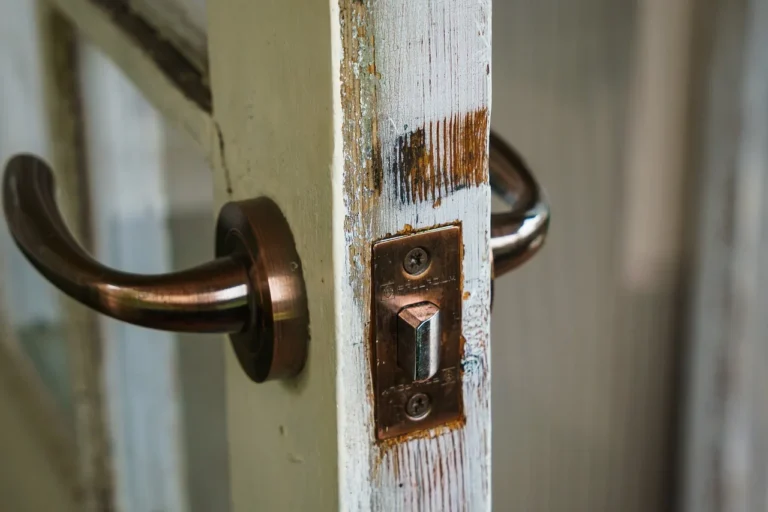
Set screw location matters. On many lever sets, the small hex screw sits on the underside or the neck, so you may not see it from the front. If the hardware uses hidden trim, look for a faceplate or rosette cover that lifts off before you can reach the screws.
Handle, spindle, latch, and strike plate
The spindle is often a square metal bar that connects both sides of the handle, though some hardware uses a round bar. It is usually square, though some hardware uses a round bar. If it bends, strips, or slips in the hub, the handle can turn with little effect at the latch.
The latch mechanism is the spring-loaded bolt on the door edge. It should retract when you turn the handle and spring back when you let go. If the bolt sticks, grinds, or fails to return, the handle may be fine while the latch is not.
The strike plate is the matching point in the jamb. If the latch hits the edge of the plate instead of entering cleanly, the door may feel broken even when the handle still works. That is an alignment fault, not a handle fault.
How do you tighten a loose interior handle?
Find the fastener before you turn anything. A loose interior handle is often fixed by tightening the set screw with an Allen wrench or by tightening the through-bolts that clamp the rosettes to the door. If the handle still wobbles after that, check for stripped threads or cracked trim.
- Hold the lever or knob steady and look for the small hex set screw under the neck or on the underside.
- Insert the correct Allen wrench and tighten the set screw until the handle no longer rocks.
- If the trim still moves, remove the rosette cover and tighten the through-bolts alternately so the two sides clamp evenly.
- Test the handle again. Uneven tightening can leave one side loose and the other side bound.
- If the screws spin without biting, inspect the door holes and the fasteners for stripped threads.
Through-bolts matter more than many homeowners expect. They clamp both rosettes to the door, so a loose pair can create wobble even when the set screw looks tight. Tighten them alternately so the trim seats flat instead of pulling crooked.
Picture a bedroom lever that shifts a few millimeters every time you press it. If the set screw is tight but the rosette still rocks, the door holes may be worn out. If the door holes are worn out, retightening alone usually will not hold.
Why does the handle spin without opening the door?

A spinning handle usually means the handle is no longer driving the spindle. The spindle may be stripped, bent, or not seated fully in the hub on one or both sides. A weak return spring can add slack, but a handle that spins freely without moving the latch usually points to a connection failure first.
Test the spindle connection
Remove the trim enough to expose the spindle connection. Turn the handle and watch whether the spindle moves with it. If one side turns while the bar does not, or if the bar turns but the latch does not react, the spindle or its grip points are suspect.
A square spindle can round off at the corners. A round spindle can slip if the set screw does not bite firmly. If the spindle is bent, it can create stiffness on one turn and free spin on the next, which makes the failure look random.
Check the return spring
A drooping lever means the internal spring is fatigued. The handle may still turn, but it will not return to level and may not drive the spindle with enough force to pull the latch back. When the spring fails inside the trim, replacement is usually the honest fix.
Say your bathroom lever turns halfway and then spins at the end of the stroke. If the spindle and set screw are intact, the return spring inside the handle may have lost tension. In that case, the trim assembly is the part to replace, not the latch.
How do you fix a handle that will not turn?
First separate stiffness in the handle from stiffness in the latch. If the handle will not turn because the mechanism feels gritty or bound, use dry silicone lubricant on the moving parts. If it remains stiff after cleaning and lubrication, the failure may be worn metal, a bent spindle, or a latch that needs replacement.
Use lubricant only for a stiff mechanism
Dry silicone lubricant is often the safer choice for interior door hardware when the problem is friction, not breakage. Competitor guidance commonly recommends dry PTFE or graphite near door hardware. That advice fits a stiff latch or dry spindle better than household oil or WD-40, which can leave residue or wash debris deeper into the mechanism.
Lubrication makes sense when the latch bolt moves slowly, squeaks, or grinds. It does not fix a cracked hub, stripped spindle, or broken spring. If the handle still binds after a small amount of dry lubricant, stop and inspect the hardware instead of flooding it.
When stiffness means replacement
If the handle must be forced, the spindle may be bent or the latch spring may be wearing out. A handle that needs repeated force can damage the set screw, strip the hub, or deform the strike plate opening. Replace worn parts before the hardware fails completely.
A common first-timer mistake is spraying lubricant into a handle that has a cracked lever hub. The spray may make the motion feel better for a day, but the crack keeps opening and the handle fails again. That is a replacement case, not a lubrication case.
Does the latch or strike plate need work?
If the handle turns but the door will not latch, inspect the latch bolt and the strike plate together. The latch bolt should retract fully and then spring back into the strike opening when the door closes. Many interior-handle failures are actually alignment problems with the strike plate. (Wikipedia)
Check whether the latch bolt retracts fully
Open the door and turn the handle while watching the latch bolt on the door edge. It should pull in smoothly. If it sticks halfway, the latch mechanism may be dirty, worn, or damaged. If it retracts normally by hand but still will not catch, the strike plate is likely out of line.
The latch bolt is the angled metal tongue on the door edge. That angle helps it ride over the strike plate as the door closes. If the angle is damaged, the latch body is worn, or the bolt does not spring back, the door will not stay closed.
Mark the strike contact point
Use lipstick or chalk to mark the strike opening, then close the door gently and turn the handle. The mark shows where the latch is hitting. That contact point tells you whether the plate needs a slight file, a small shift, or a full repositioning.
Filing works only when the latch is barely missing the opening. If the latch is striking high, low, or too far to one side, move the strike plate instead. If the screw holes are stripped, fill the old screw holes with a toothpick and wood glue before reinstalling the plate.
Interior handle repair decision guide
Replace only the failed part when the diagnosis is clear. A loose set screw can be tightened. A weak rosette can be retightened. A stiff latch may respond to dry lubricant. But broken springs, stripped spindles, damaged latch bodies, and cracked handle hardware usually justify replacement because the repair will not hold.
| Part | Repair usually makes sense when | Replace when | Time reality check |
|---|---|---|---|
| Set screw | The screw is present and only loose | The hex head is stripped or will not tighten | Often a quick fix once access is clear |
| Through-bolts | The rosettes are loose but intact | The bolts spin, the holes are stripped, or the trim cracks | Usually part of a short repair if the trim is sound |
| Spindle | The bar is slightly misseated or lightly worn | It is bent, rounded, or stripped at the drive point | Replacement is common once the bar will not grip |
| Latch assembly | The bolt is sticky but the body is intact | The spring fails, the bolt jams, or the housing is damaged | A full latch swap is often cleaner than piecemeal repair |
| Strike plate | The latch almost lines up and only needs minor adjustment | The plate is bent, loose, or the screw holes are wrecked | Minor filing is quick; bad alignment can take longer |
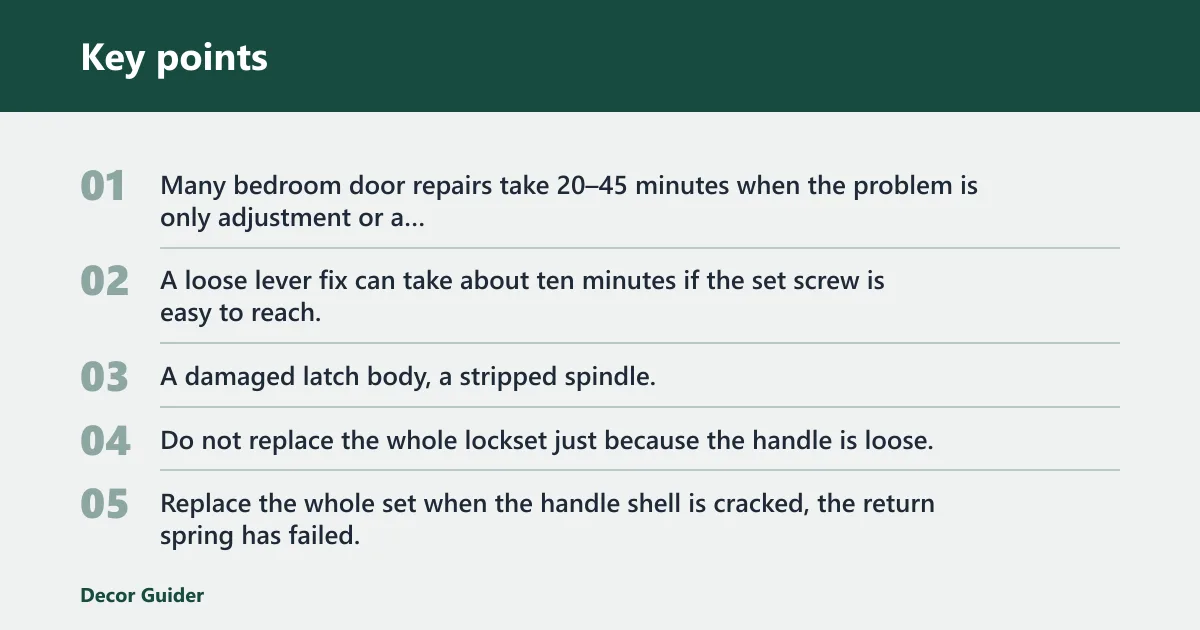
Many bedroom door repairs take 20–45 minutes when the problem is only adjustment or a loose fastener. A loose lever fix can take about ten minutes if the set screw is easy to reach. A damaged latch body, a stripped spindle, or a privacy release problem can take longer because the failed part has to come out.
Do not replace the whole lockset just because the handle is loose. Replace the whole set when the handle shell is cracked, the return spring has failed, the spindle no longer bites, or the latch assembly and trim both show wear. That keeps the repair honest and avoids swapping parts that still work.
Frequently asked questions
How do I fix a broken door handle on the inside of a room?
Start by deciding whether the handle, spindle, latch, or strike plate failed. Tighten the set screw with an Allen wrench, then check the through-bolts and the spindle connection. If the handle moves but the latch does not retract, the latch or strike plate needs attention instead of the trim.
Why is my interior door handle loose but still attached?
A handle can feel loose when the set screw backs out, the through-bolts loosen, or the rosette mounting shifts. The handle may still be attached because the hardware has not separated, but the grip between the trim and spindle has weakened. Tighten the correct fastener, not every screw you see.
What causes a bedroom door handle to spin without opening the door?
That symptom usually means the spindle is stripped, bent, or not engaged fully in the handle hub. A fatigued return spring can add slack, but a free-spinning handle more often means the drive connection failed. Remove the trim before replacing the latch.
What lubricant should I use on an interior door handle?
Use a dry silicone lubricant, or a dry PTFE or graphite product if that is what the hardware guidance calls for. These are better choices for stiff interior hardware than household oil or WD-40 when the problem is friction. Lubricant will not fix broken springs or stripped parts.
How do I know if the spindle is broken on a door handle?
If one side turns and the other does not, or if the handle spins while the latch stays still, the spindle is a strong suspect. Look for rounding, bending, or slipping at the drive point. A square spindle should fit tightly; a worn one will no longer transmit force cleanly.
When should I replace an interior door handle instead of repairing it?
Replace it when the return spring is tired, the spindle is stripped, the lever shell is cracked, or the trim will not stay tight after retightening. Replace the latch assembly when the bolt sticks, jams, or will not retract. Repair is only worth it when the failed part still has solid material left.
Products related to this article
Sponsored / affiliate links. As an Amazon Associate I earn from qualifying purchases. I may earn additional commission from eligible campaigns.